
API Integration Services in Kenya: Transforming Businesses Through Connected Systems
The modern business environment depends on speed, efficiency, and automation. Companies no longer operate using a single software solution. Instead, they rely on accounting software, CRMs, ERPs, payment gateways, HR systems, eCommerce platforms, mobile apps, and cloud services. For these systems to work together efficiently, businesses require professional API Integration Services in Kenya.
API integration has become one of the most important technologies driving digital transformation across Kenya. Whether you’re a startup, SME, NGO, school, SACCO, hospital, manufacturing company, or government institution, integrating your systems allows data to move automatically between applications without manual intervention.
Businesses that invest in API Integration Services in Kenya enjoy increased productivity, better customer experiences, improved accuracy, and significant operational cost savings.
In this comprehensive guide, we’ll explore everything you need to know about API integration, its benefits, industries using it, common integrations, implementation process, challenges, future trends, and why choosing the right software development partner matters.
What is API Integration?
API stands for Application Programming Interface.
An API is a set of rules that allows two or more software applications to communicate with each other.
Think of an API as a messenger.
When one application requests information, the API delivers the request to another application and returns the response instantly.
For example:
- A customer places an order on your website.
- The website automatically sends payment details to your payment gateway.
- The payment gateway confirms payment.
- Your accounting software records the transaction.
- Your inventory system updates stock.
- The customer receives an SMS and email confirmation.
All these processes happen through APIs.
Without API integration, employees would have to manually perform each step.
This explains why businesses increasingly invest in professional API Integration Services in Kenya.
Why API Integration Matters More Than Ever
Businesses generate enormous amounts of data every day.
Without connected systems, organizations face:
- Duplicate data
- Human errors
- Slow workflows
- Poor customer experiences
- High operational costs
- Delayed reporting
- Inefficient communication
API integration eliminates these problems by ensuring all systems communicate automatically.
Instead of employees spending hours copying information between systems, APIs handle the work in seconds.
How API Integration Works
The process is surprisingly simple.
Imagine a customer purchasing products from your online store.
The API performs several actions simultaneously:
- Captures customer information.
- Sends payment request.
- Confirms successful payment.
- Updates inventory.
- Creates invoice.
- Updates CRM.
- Sends SMS.
- Sends email receipt.
- Updates analytics dashboard.
All these operations occur within seconds.
That’s the power of API Integration Services in Kenya.
Types of API Integrations
Businesses use different API integration methods depending on their requirements.
REST APIs
REST APIs are the most widely used today.
Benefits include:
- Fast performance
- Easy implementation
- Secure communication
- Scalable architecture
- Compatible with modern applications
Most cloud software supports REST APIs.
SOAP APIs
SOAP APIs are commonly used in:
- Banks
- Government agencies
- Insurance companies
- Enterprise software
They provide high security and standardized communication.
GraphQL APIs
GraphQL allows applications to request only the data they need.
Advantages include:
- Faster applications
- Reduced bandwidth
- Better mobile performance
- Flexible data retrieval
Webhooks
Unlike regular APIs that continuously request information, webhooks send information automatically whenever an event occurs.
Example:
A customer completes payment.
Immediately:
- SMS is sent
- Invoice generated
- Stock reduced
- Sales report updated
No manual action required.
Common API Integration Services in Kenya
Businesses integrate many different systems.
Payment Gateway Integration
Online businesses require seamless payment processing.
Popular integrations include:
- M-Pesa
- Airtel Money
- Visa
- Mastercard
- Banks
- Online wallets
Benefits include:
- Instant payment confirmation
- Automatic reconciliation
- Reduced fraud
- Faster transactions
CRM Integration
Sales teams use CRMs to manage customer relationships.
API integration connects CRM systems with:
- Websites
- Email marketing
- Accounting software
- Customer support
- SMS gateways
This creates a complete customer profile.
ERP Integration
ERP software manages:
- Procurement
- Finance
- Manufacturing
- Inventory
- HR
- Payroll
API integration ensures all departments work using synchronized information.
Accounting Software Integration
Finance departments save countless hours through API automation.
Common integrations include:
- Online stores
- Payment gateways
- Banking systems
- Payroll
- Expense management
Transactions are recorded automatically.
Inventory Management Integration
Retailers use APIs to synchronize stock between:
- Physical shops
- Online stores
- Warehouses
- POS systems
- Suppliers
Customers always see accurate inventory levels.
HR and Payroll Integration
Human Resource systems connect with:
- Attendance systems
- Biometric devices
- Payroll
- Tax software
- Leave management
Everything becomes automated.
eCommerce API Integration
Online stores connect with:
- Payment gateways
- Courier companies
- Accounting systems
- Inventory
- Customer support
- Marketing tools
Orders flow seamlessly through every stage.
Industries Using API Integration Services in Kenya
Virtually every industry benefits from API integration.
Banking
Banks integrate:
- Mobile banking
- ATMs
- Core banking
- Credit scoring
- Fraud detection
- Payment systems
This improves customer experience.
Healthcare
Hospitals integrate:
- Patient management
- Pharmacy
- Laboratory
- Billing
- Insurance
- Appointment booking
Healthcare providers access complete patient records instantly.
Education
Schools integrate:
- Student portals
- Finance
- Learning Management Systems
- Attendance
- Parent communication
- Examination systems
Administration becomes more efficient.
Real Estate
Property companies integrate:
- Property management
- Accounting
- Rent collection
- Tenant portals
- Maintenance requests
- Mobile payments
This improves landlord and tenant experiences.
Retail
Retail businesses integrate:
- POS
- Inventory
- Accounting
- CRM
- Online shops
- Delivery services
Everything updates automatically.
Manufacturing
Manufacturers connect:
- Procurement
- Warehouses
- Production
- Quality control
- Finance
- Sales
This increases productivity.
NGOs
Non-governmental organizations integrate:
- Donor management
- Accounting
- Monitoring systems
- Procurement
- HR
- Reporting dashboards
Transparency improves significantly.
Benefits of API Integration Services in Kenya
Businesses investing in API Integration Services in Kenya enjoy numerous advantages.
Improved Efficiency
Automation eliminates repetitive tasks.
Employees focus on strategic work instead of manual data entry.
Reduced Human Errors
Manual processes inevitably create mistakes.
API integration transfers data accurately every time.
Faster Decision Making
Management receives real-time reports instead of waiting days for manual compilation.
Better Customer Experience
Customers receive:
- Instant notifications
- Faster service
- Accurate information
- Real-time updates
- Seamless digital experiences
Satisfied customers become loyal customers.
Cost Reduction
Although API integration requires initial investment, businesses save money by reducing:
- Administrative work
- Manual errors
- Duplicate processes
- Operational delays
- Paperwork
The return on investment is often realized within months.
Enhanced Data Accuracy
Since information is synchronized automatically across systems, every department works with the same up-to-date data. This reduces inconsistencies, improves reporting, and enables confident decision-making.
Scalability for Business Growth
As your business expands, new applications can be connected without rebuilding existing systems. Professional API Integration Services in Kenya allow organizations to scale efficiently while maintaining seamless communication between platforms.
API Integration Services in Kenya for Different Industries
Businesses across Kenya operate in diverse industries, each with unique operational requirements. Modern organizations are increasingly adopting API Integration Services in Kenya to streamline workflows, eliminate repetitive tasks, and improve customer experiences.
Below are the industries benefiting the most.
Banking and Financial Services
Banks, SACCOs, fintech startups, and microfinance institutions rely heavily on APIs to connect multiple financial platforms.
Examples include:
- Mobile banking integrations
- Loan management systems
- Fraud detection services
- KYC verification platforms
- Credit scoring services
- Core banking software
- Digital wallets
API integrations enable secure financial transactions while ensuring compliance with industry regulations.
API Integration Services in Kenya for E-Commerce
Kenya’s e-commerce market continues to grow rapidly. Online stores need multiple systems working together.
Typical integrations include:
- Payment gateways
- Inventory systems
- Courier companies
- CRM software
- Accounting software
- Customer support platforms
- SMS notification systems
- Email marketing tools
Instead of manually updating inventory after every purchase, APIs synchronize stock levels instantly across all channels.
This reduces overselling and improves customer satisfaction.
Healthcare API Integrations
Hospitals and clinics are digitizing their operations faster than ever.
Healthcare organizations use API Integration Services in Kenya to connect:
- Hospital Management Systems
- Laboratory Information Systems
- Pharmacy software
- Insurance verification
- Appointment booking platforms
- Electronic Medical Records (EMR)
- Telemedicine solutions
Doctors can instantly access patient histories without switching between multiple applications.
Patients enjoy faster service and improved healthcare experiences.
Education Sector API Integrations
Schools, colleges, and universities are embracing digital learning.
Common education integrations include:
- Student Information Systems
- Learning Management Systems
- Payment portals
- Attendance systems
- Parent communication platforms
- Library management software
- Examination portals
Educational institutions eliminate duplicate data entry while improving communication among teachers, students, and parents.
Real Estate API Integration
Property developers and real estate agencies increasingly rely on automation.
Examples include integrating:
- Property management software
- Accounting systems
- Tenant portals
- Rent collection platforms
- SMS notifications
- Digital lease signing
- CRM software
With API Integration Services in Kenya, landlords receive automatic payment confirmations while tenants receive instant receipts.
Manufacturing Industry
Manufacturers manage numerous systems simultaneously.
These include:
- Enterprise Resource Planning (ERP)
- Inventory management
- Production planning
- Procurement software
- Accounting systems
- Warehouse management
- Logistics tracking
API integrations ensure every department accesses the same real-time information.
Production managers make better decisions because data is always accurate.
Logistics and Transport
Transport companies depend on accurate, real-time information.
API integrations connect:
- GPS tracking
- Fleet management
- Customer portals
- Delivery tracking
- Fuel management
- Accounting software
- Mobile payment systems
Customers can monitor deliveries in real time, reducing customer service inquiries.
Hospitality Industry
Hotels and restaurants increasingly automate operations.
Typical integrations include:
- Hotel booking engines
- Point of Sale (POS)
- Accounting software
- Online travel agencies
- Restaurant management systems
- Customer loyalty platforms
These integrations improve guest experiences while reducing operational costs.
Government Digital Services
Government institutions increasingly embrace digital transformation.
APIs facilitate connections between:
- Citizen service portals
- Identity verification systems
- Tax platforms
- Licensing services
- Payment gateways
- County government systems
Citizens enjoy faster service delivery through connected digital platforms.
Common APIs Businesses Integrate
Organizations rarely operate using a single application.
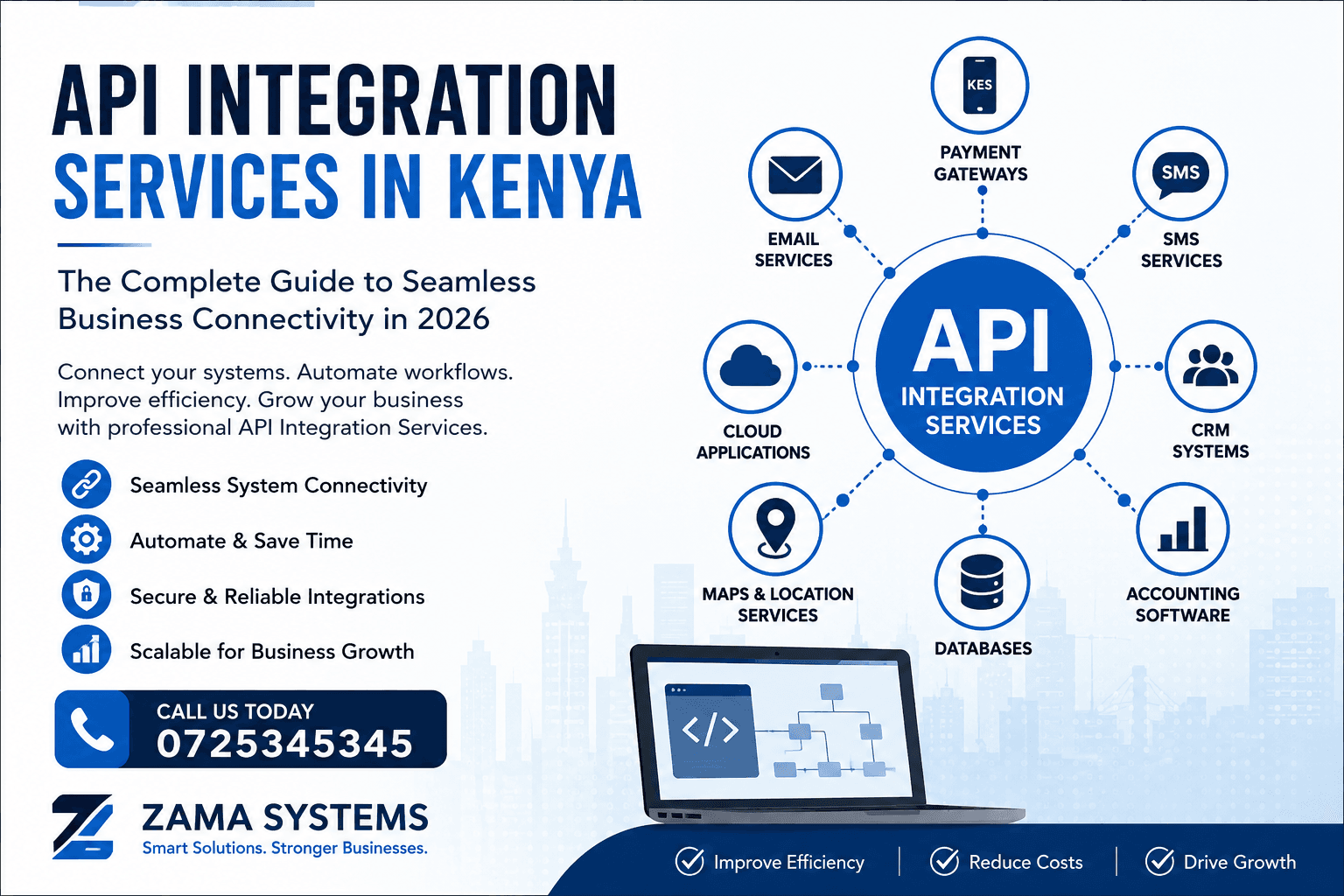
Some of the most requested API Integration Services in Kenya involve connecting:
Payment APIs
These include:
- M-Pesa
- Airtel Money
- Visa
- Mastercard
- Bank transfers
Payment APIs enable secure online transactions.
SMS APIs
Businesses automate:
- OTP verification
- Appointment reminders
- Marketing campaigns
- Delivery notifications
- Payment confirmations
SMS APIs improve customer communication.
Email APIs
Companies integrate email services for:
- Welcome emails
- Password resets
- Promotional campaigns
- Order confirmations
- Receipts
Everything becomes automated.
Maps APIs
Businesses integrate location services for:
- Delivery tracking
- Route optimization
- Store locators
- Customer addresses
- Distance calculations
Logistics companies benefit significantly.
CRM APIs
Customer Relationship Management systems integrate with:
- Websites
- ERP software
- Accounting systems
- Marketing platforms
- Customer support tools
This creates a unified customer profile.
Accounting APIs
Finance teams connect accounting software with:
- Payroll systems
- Inventory
- Banking
- Sales systems
- Procurement platforms
Financial reports become more accurate.
API Security Best Practices
Integration should never compromise security.
Professional API Integration Services in Kenya implement several security measures.
Authentication
Only authorized users and systems should access APIs.
Methods include:
- API Keys
- OAuth 2.0
- JWT Tokens
- Multi-factor Authentication
Data Encryption
Sensitive information should always be encrypted during transmission.
This prevents cybercriminals from intercepting valuable business data.
Rate Limiting
Rate limiting protects systems against abuse.
It prevents malicious users from overwhelming servers with excessive requests.
Access Control
Different employees should have different access permissions.
Not everyone requires administrative privileges.
Activity Logging
Every API request should be logged.
This assists in:
- Auditing
- Security monitoring
- Error tracking
- Compliance reporting
API Integration Challenges
Although integrations offer significant benefits, businesses may encounter several challenges.
Legacy Systems
Older software often lacks modern API support.
Custom middleware may be required.
Data Inconsistency
Different systems may use different formats.
Data mapping becomes essential.
Security Risks
Poorly designed APIs expose businesses to cyber threats.
Security testing is therefore critical.
Downtime
External API providers occasionally experience outages.
Businesses should implement backup processes.
Documentation Issues
Poor API documentation slows development.
Experienced developers overcome these challenges more efficiently.
The Future of API Integration Services in Kenya
The future is becoming increasingly connected.
Emerging trends include:
- AI-powered integrations
- Low-code integration platforms
- Event-driven architectures
- API marketplaces
- Internet of Things (IoT)
- Blockchain integrations
- Open Banking
- Smart city connectivity
- Predictive automation
- Machine Learning APIs
Organizations investing in API Integration Services in Kenya today position themselves for long-term digital success.
As businesses continue embracing automation, APIs will become the invisible backbone connecting applications, devices, customers, and partners across every industry. Companies that adopt robust integration strategies now will enjoy greater operational efficiency, improved customer experiences, stronger data accuracy, and the flexibility to scale with future technological innovations.
How to Choose the Right API Integration Partner in Kenya
Selecting the right technology partner is just as important as choosing the software itself. A well-executed integration project can transform business operations, while a poorly planned one can lead to delays, security issues, and increased costs.
When evaluating providers of API Integration Services in Kenya, consider the following factors.
Industry Experience
Different industries have unique integration requirements. A provider that has worked with businesses in your sector will better understand your workflows, compliance needs, and operational challenges.
For example:
- Healthcare providers require secure patient data integrations.
- Financial institutions require highly secure payment and banking APIs.
- Retail businesses focus on inventory, CRM, and e-commerce integrations.
- Educational institutions require student management and learning platform integrations.
An experienced partner can recommend best practices and avoid common implementation mistakes.
Technical Expertise
API integration involves more than connecting two systems. Developers should have expertise in:
- REST APIs
- SOAP APIs
- GraphQL
- JSON and XML
- Webhooks
- Cloud computing
- Database management
- Middleware development
- Authentication protocols
- Cybersecurity
Businesses investing in API Integration Services in Kenya should ensure their technology partner has a proven technical track record.
Custom Integration Capabilities
Every organization has different business processes. Off-the-shelf integrations may not address every requirement.
Choose a provider that can build custom API solutions tailored to your workflows, allowing your systems to communicate efficiently without forcing you to change how your business operates.
Scalability
Your business will grow, and your systems should grow with it.
A scalable integration solution should support:
- Additional users
- New software platforms
- More transactions
- Increased data volumes
- Expansion into multiple locations
- New business units
Scalability ensures you do not need to rebuild your integrations every time your business expands.
Security Standards
Security should never be an afterthought.
Ask potential providers about:
- Data encryption
- Secure authentication methods
- Access controls
- Penetration testing
- Security monitoring
- Compliance with data protection regulations
Reliable API Integration Services in Kenya prioritize protecting sensitive business and customer information.
Documentation and Knowledge Transfer
Well-documented integrations make future maintenance easier.
Quality documentation should include:
- API endpoints
- Authentication methods
- Error codes
- Data structures
- Integration workflows
- Maintenance procedures
Good documentation reduces dependency on a single developer and simplifies future upgrades.
Ongoing Technical Support
Business systems require continuous monitoring.
Choose a provider that offers:
- System monitoring
- Performance optimization
- Bug fixes
- Version upgrades
- Security updates
- Technical support
Continuous support ensures integrations remain reliable as technologies evolve.
API Integration Implementation Process
Professional API Integration Services in Kenya typically follow a structured implementation methodology.
Step 1: Business Requirements Analysis
Developers begin by understanding:
- Existing software
- Current workflows
- Business objectives
- User requirements
- Integration priorities
This phase ensures the project aligns with business goals.
Step 2: API Assessment
The development team evaluates available APIs to determine:
- Compatibility
- Authentication methods
- Performance limits
- Documentation quality
- Available endpoints
This helps identify potential challenges before development begins.
Step 3: Solution Design
Developers create a detailed integration architecture that defines:
- Data flow
- Security mechanisms
- Error handling
- Synchronization frequency
- Backup strategies
A well-designed architecture improves system reliability.
Step 4: Development
Developers build the integrations using modern programming frameworks and best practices.
Tasks include:
- Writing API connectors
- Configuring authentication
- Mapping data fields
- Implementing business logic
- Creating automated workflows
Each component is developed with scalability and maintainability in mind.
Step 5: Testing
Before deployment, the integration undergoes comprehensive testing, including:
- Functional testing
- Security testing
- Performance testing
- User acceptance testing
- Error handling validation
Testing minimizes the risk of disruptions after launch.
Step 6: Deployment
After successful testing, the integration is deployed into the live environment.
Deployment includes:
- Configuration
- Monitoring
- Performance verification
- User onboarding
A phased rollout may be used to minimize business disruption.
Step 7: Continuous Improvement
API integration is an ongoing process.
Businesses should regularly review:
- Performance metrics
- User feedback
- API updates
- Security patches
- Opportunities for further automation
Continuous optimization helps maximize the return on investment.
Measuring the Success of API Integrations
To evaluate the effectiveness of API Integration Services in Kenya, businesses should track key performance indicators (KPIs), such as:
- Reduction in manual data entry
- Faster transaction processing
- Improved customer satisfaction
- Reduced operational costs
- Lower error rates
- Increased employee productivity
- Faster response times
- Higher system uptime
- Growth in online sales
- Improved reporting accuracy
Regular monitoring helps identify areas for improvement and demonstrates the value of digital transformation initiatives.
Frequently Asked Questions (FAQs)
What are API Integration Services?
API Integration Services connect different software applications so they can exchange data automatically and work together efficiently.
Are API integrations secure?
Yes. When implemented using secure authentication, encryption, and access controls, API integrations provide a safe and reliable way to share data.
Can existing software be integrated?
In many cases, yes. Even legacy systems can often be connected using middleware, custom APIs, or specialized integration platforms.
How long does an integration project take?
The timeline depends on the number of systems involved, the complexity of the workflows, and the availability of well-documented APIs. Simple integrations may take a few days, while enterprise projects can take several weeks or months.
Is API integration suitable for small businesses?
Absolutely. Small businesses can automate repetitive tasks, improve customer service, and reduce operational costs through affordable API integrations that scale as the business grows.
Which businesses benefit the most?
Almost every industry can benefit, including finance, healthcare, education, logistics, manufacturing, hospitality, real estate, retail, e-commerce, government, and professional services.
Conclusion
In today’s fast-paced digital economy, businesses need technology that works together seamlessly rather than operating in isolated systems. Investing in API Integration Services in Kenya enables organizations to connect applications, automate workflows, eliminate manual processes, and improve the overall customer experience. Whether you are a startup, SME, or large enterprise, the right integration strategy can help your business become more efficient, scalable, and competitive.
As businesses continue to embrace digital transformation, API Integration Services in Kenya have become an essential component of modern operations. From integrating payment gateways and accounting software to customer relationship management systems, e-commerce platforms, inventory management, and cloud applications, these integrations ensure that critical business information flows securely and accurately across all departments.
Choosing a reliable technology partner is equally important. Professional providers of API Integration Services in Kenya understand how to design secure, scalable, and future-ready integrations that align with your business objectives. They also provide ongoing support, monitoring, and optimization to ensure your systems continue performing at their best as your business grows.
Organizations that adopt API Integration Services in Kenya today are preparing for tomorrow’s opportunities. Connected systems improve decision-making by providing real-time data, reducing operational costs, increasing employee productivity, and enabling faster responses to customer needs. Instead of spending valuable time on repetitive manual tasks, businesses can focus on innovation, customer satisfaction, and sustainable growth.
The future belongs to businesses that embrace connectivity, automation, and intelligent data exchange. With advancements in artificial intelligence, cloud computing, the Internet of Things (IoT), and machine learning, API Integration Services in Kenya will continue to play a vital role in helping organizations adapt to changing market demands. Companies that invest in modern integration solutions today will be better positioned to scale efficiently and remain competitive in the years ahead.
If you are planning to modernize your business, streamline operations, or improve collaboration between your software applications, now is the ideal time to invest in API Integration Services in Kenya. The benefits extend beyond automation—they create a connected digital ecosystem that supports innovation, business intelligence, and long-term success.
At Zama Systems, we specialize in delivering reliable, secure, and customized API Integration Services in Kenya tailored to businesses across various industries. Our experienced development team helps organizations integrate payment systems, CRMs, ERPs, accounting software, mobile applications, cloud platforms, and third-party services to create efficient and scalable business ecosystems.
Whether your goal is to automate workflows, improve customer experiences, enhance reporting, or accelerate digital transformation, our API Integration Services in Kenya are designed to meet your unique business requirements. Partner with Zama Systems today and discover how professionally implemented API Integration Services in Kenya can transform your business, improve operational efficiency, and drive sustainable growth in 2026 and beyond.