
A purchase request reaches its final approver just as that manager starts leave. Staff forward screenshots to a colleague, somebody replies “approved” in a chat, and the system still shows the original request as pending. The immediate delay may be solved, but the record no longer explains who had authority to decide.
Approval delegation is a specific business process automation problem: keep work moving during an absence while preserving the scope, duration and history of each decision. This guide helps Kenyan businesses specify that workflow for an internal portal or custom enterprise system.
Define delegation as a temporary assignment
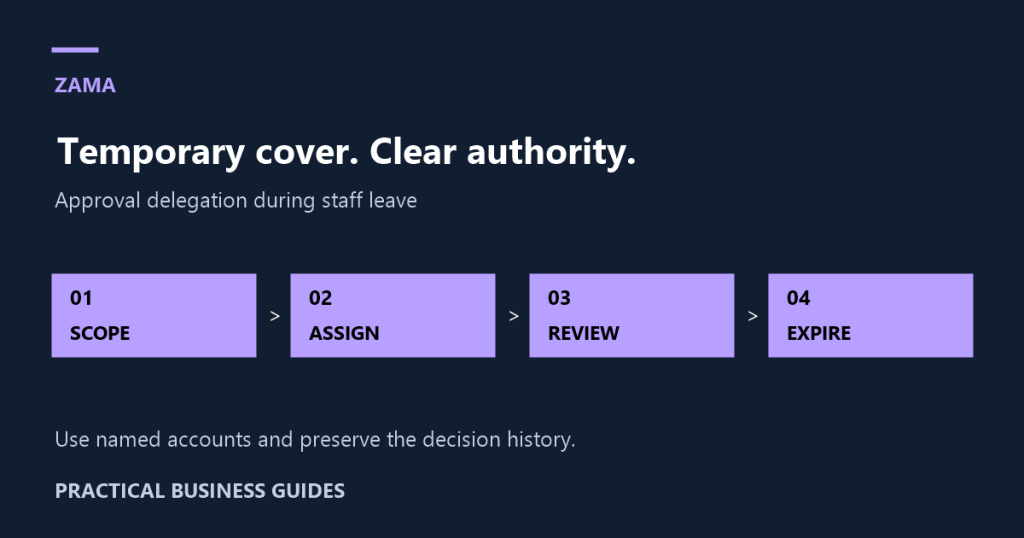
A substitute approver should use their own account. Sharing the absent manager’s login makes the decision history unreliable and makes it harder to remove access later. A delegation record should name the original approver, the substitute, the covered workflow, its start and end, and the person authorised to establish it.
Keep the scope narrow enough to explain. Covering routine purchase requests for one branch is different from gaining every permission held by a director. The substitute may need enough information to review a request without receiving unrelated access to payroll, contracts or other departments.
Write the decision rules before drawing the screens
| Design question | Decision to document |
|---|---|
| When does cover begin? | Exact start time and time zone |
| Which requests are included? | Workflow, department and applicable limits |
| What happens to pending work? | Existing requests, new requests or both |
| Can cover be passed on again? | Whether further delegation is permitted |
| Who handles a conflict? | Independent fallback approver |
| When does access end? | Automatic expiry and early cancellation rules |
Use examples from actual operating procedures. If a request exceeds the substitute’s authority, it should follow the agreed escalation path. Do not make that exception disappear by assigning the substitute a broader role simply to clear the queue.
Prevent self-approval and overlapping decisions
Consider a substitute who is also the person requesting the purchase. The workflow needs a defined conflict route, such as another independent approver. Check conflicts against the underlying request, not just the name of the approval step. A renamed role does not remove the conflict.
Also decide what happens if the original manager returns early and both people open the same request. The system should accept only a valid decision against the current state, then show the other reviewer that the request has changed. This prevents a stale screen from overriding a completed review.
Keep a readable decision history
A useful history says who acted, under which delegation, on what version of the request, and when. Record the reason for rejection or return for correction. If the applicant changes the amount or a supporting document, define whether earlier approvals remain valid or a fresh review is required.
Do not rely on notification emails as the only audit trail. Messages may be deleted or forwarded without their context. The authoritative request record should carry its own history, including delegation creation, changes, cancellation and expiry. Notifications should direct authorised people to that record.
Handle absence without creating permanent access
Automatic expiry matters because temporary arrangements are easy to forget. Decide whether a substitute loses only the ability to decide or also the ability to view historical requests when the cover period ends. The answer may differ by role, but it should be explicit.
When an employee leaves, cancel active delegations involving that account and reassign open work through the approved process. Keep completed decision history intact. Removing a person’s ability to sign in should not erase the explanation for decisions they validly made while employed.
Test the difficult cases in a demonstration
- Create a request shortly before the delegation starts.
- Create another during the cover period and confirm the assigned reviewer.
- Submit a request raised by the substitute and observe the conflict route.
- Try a request outside the delegated scope.
- Change a material detail after an approval and inspect the next step.
- End the delegation early and check pending requests.
- Open an old notification after expiry and confirm that it grants no new authority.
Use fictional employees and test requests. Ask the supplier to show the resulting records rather than describe what ought to happen. Keep a short acceptance sheet with the expected behaviour, observed result and any configuration still needed.
Measure whether the workflow helps
Compare requests waiting for an unavailable approver, time to the next valid decision, and cases needing manual reassignment. Review whether delegation caused extra returns or incorrect approvals. Faster processing alone is not sufficient if the business loses control over who may authorise work.
Start with one well-understood process and a limited pilot. Ask the people submitting and reviewing requests where the instructions remain confusing. Use those findings to adjust the rules before extending the workflow to other teams.
Prepare a business automation brief for Zama
Bring your approval matrix, common absence scenarios, current request forms and reporting expectations to the scope discussion. List the systems that must receive an approved outcome and the owner of each integration. Separate the initial workflow from later enhancements so the first release has clear acceptance criteria.
Zama develops business systems and secure portals. Use this checklist to discuss a scoped approval-delegation workflow, including access rules, exceptions, decision history and support after launch. Confirm the proposed functionality in the project specification; this guide describes requirements to evaluate rather than a standard feature package.
A well-designed cover arrangement should be easy to explain after the manager returns: which requests were handled, who decided them, why that person was authorised, and when the temporary assignment ended.