
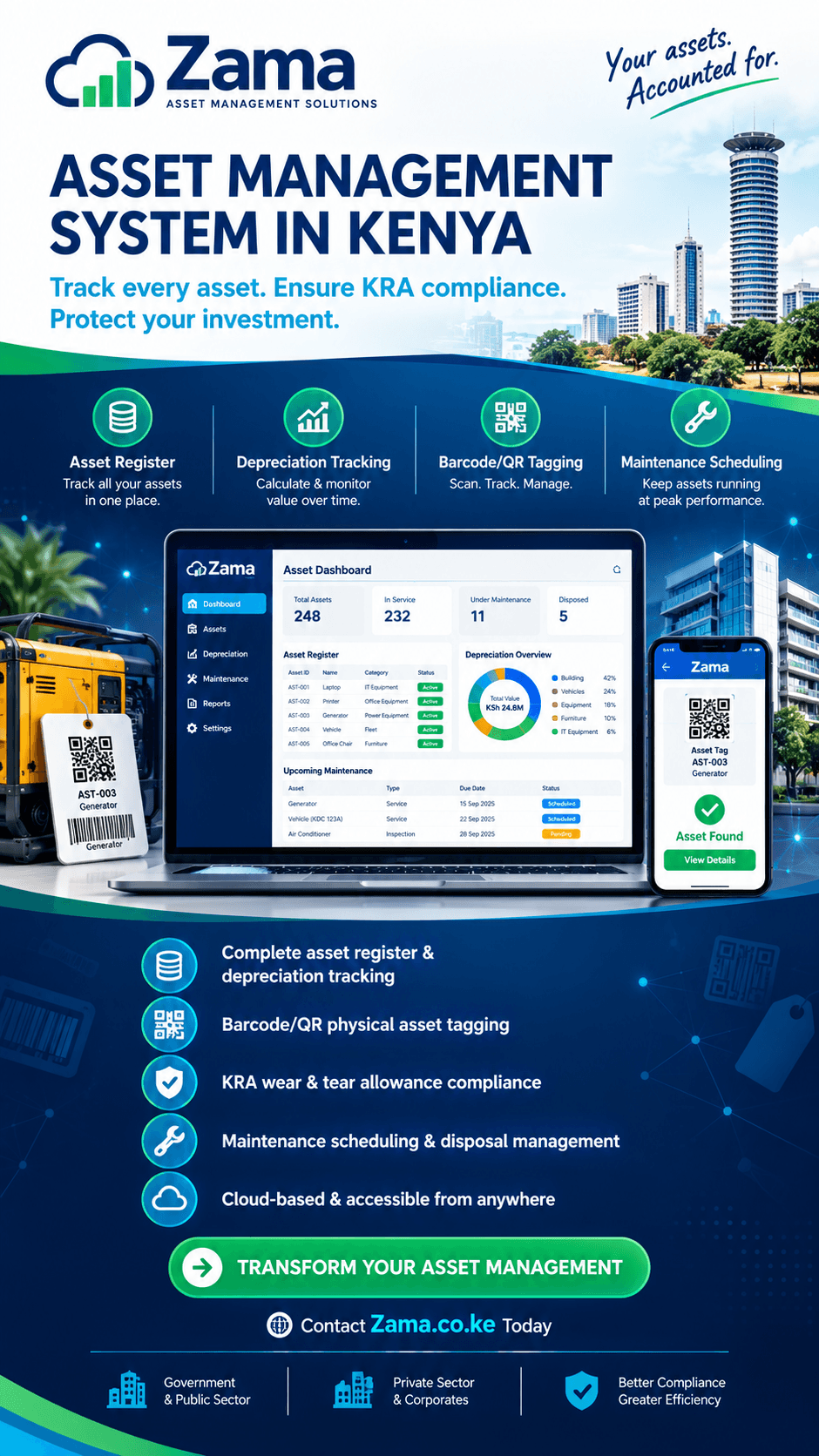
Asset management system in Kenya is a question that every finance director, operations manager, and business owner must answer in 2026. With the Kenya Fixed Asset Management Software Market estimated at USD 168 Million in 2025 and projected to reach USD 231 Million by 2032, growing at a CAGR of 5.5%, the pressure to digitize asset tracking has never been greater. At zama.co.ke, we’ve helped numerous organizations across Kenya implement asset management systems that track depreciation accurately, ensure KRA compliance, and protect valuable business assets. This comprehensive guide explores asset management system in Kenya, from understanding core features to selecting the right solution for your organization.
What an Asset Management System Actually Does
Before diving into asset management system in Kenya, it’s essential to understand what this technology actually does. An asset management system is a digital platform that tracks, manages, and monitors an organization’s physical and financial assets throughout their lifecycle—from acquisition to disposal. It replaces fragmented spreadsheets, manual registers, and disconnected tracking methods with a centralized, real-time system.
A proper asset management system in Kenya maintains a complete asset register with unique identification numbers, tracks depreciation and net book value, manages maintenance schedules, monitors asset locations and assignments, generates valuation reports, and handles disposal and write-off processes. It connects physical assets to accounting records, purchase documentation, tax schedules, and financial statements.
For a Kenyan business or public institution, the practical definition of asset management system in Kenya is this: the system that tells you exactly what assets you own, exactly where they are located, exactly how much they are worth, exactly who is responsible for them, and exactly how they are depreciated—all from a single dashboard accessible on any device.
Why Kenyan Organizations Need Asset Management Systems
When evaluating asset management system in Kenya, consider the compelling reasons for adoption:
KRA Compliance and Wear & Tear Allowances
The most urgent driver for asset management system in Kenya is tax compliance. KRA publishes different investment allowance rates depending on the category of asset, including machinery, motor vehicles, heavy earth-moving equipment, computers, furniture, and telecommunications equipment. When capital allowances are claimed, organizations need reliable records that support the underlying assets and expenditure.
A tax audit can require an organization to demonstrate that its records accurately represent its business activities and assets. Without a proper asset register, businesses struggle to support depreciation calculations, defend capital allowance claims, and reconcile physical assets against accounting records. From 2026, KRA uses digital verification comparing declared asset values against import, insurance, and bank financing records, so mismatches and unsupported rates are flagged. This makes a robust asset management system in Kenya essential for any business claiming wear and tear allowances.
Government Digitization Push
The Government has rolled out the Integrated Financial Management Information System (IFMIS) asset and inventory module to counties as part of a nationwide push to digitize public assets and strengthen accountability. The IFMIS fixed asset module was implemented in 2023/24, with all state departments uploading their asset data, and 52 state departments have gone live on the module.
The Public Investments and Assets Management Principal Secretary emphasized that this is “not just a technical upgrade” but “a fundamental shift towards greater accuracy, enhanced safeguarding of public resources, and uniform reporting standards across the public sector”. All public entities are required to transition from cash to accrual-based accounting by 2027, a shift that makes accurate digital asset registers more urgent. This government-led digitization is driving demand for asset management system in Kenya across both public and private sectors.
Operational Efficiency and Asset Visibility
Many Kenyan organizations operate with fragmented asset records. A company may have machinery recorded in its fixed asset register, but the physical asset still needs to be identifiable. If the company has hundreds of machines, computers, and pieces of equipment, relying only on descriptions and serial numbers makes reconciliation difficult.
A proper asset management system in Kenya solves this by linking unique asset tags—barcodes or QR codes—to physical assets and their corresponding register entries. This creates traceability from purchase to disposal, enabling physical verification, audit readiness, and accountability.
Audit Readiness
Statutory audits require evidence that assets exist, that the business owns or controls them, that values are correctly recorded, that depreciation has been calculated appropriately, and that disposals and transfers have been properly accounted for. A weak or outdated asset register creates problems during statutory audits, affects depreciation calculations, delays financial reporting, and makes it difficult to support tax claims. A comprehensive asset management system in Kenya ensures your organization is always audit-ready.
Essential Features of an Asset Management System in Kenya
When evaluating asset management system in Kenya, focus on these core features:
1. Complete Asset Register
The foundation of any asset management system is a comprehensive register that captures every significant asset. A professional register should include asset identification number, description, purchase date, supplier details, invoice number, purchase cost, asset category, location, responsible department, depreciation method, useful life, accumulated depreciation, and net book value. A proper asset management system in Kenya maintains this register digitally, ensuring accuracy and accessibility.
2. Depreciation Tracking and Calculation
Depreciation is a critical financial function. A comprehensive asset management system in Kenya automatically calculates depreciation based on KRA-approved rates and methods, tracks accumulated depreciation over time, and generates reports for financial statements and tax returns. This eliminates manual calculation errors and ensures consistent treatment across all asset categories.
3. Physical Asset Tagging with Barcodes and QR Codes
Physical tagging bridges the gap between the fixed asset register and reality. A unique asset number, barcode, or QR code connects an item on the factory floor, in a Nairobi office, or at a regional project site to its corresponding register entry. A quality asset management system in Kenya supports barcode and QR code generation, printing, and scanning, making physical verification and reconciliation significantly easier.
4. Maintenance Schedule Management
Assets require maintenance to function optimally. An asset management system in Kenya should track maintenance schedules, log service history, generate alerts for upcoming maintenance, and record repair costs. Lake Turkana Wind Power, which operates one of Africa’s largest wind farms with 365 turbines spread across 40,000 acres, implemented an enterprise asset management system to automate work order generation, track maintenance tasks, and manage inventory of more than 3,000 items.
5. Asset Location and Assignment Tracking
Knowing where assets are located and who is responsible for them is essential for accountability. A robust asset management system in Kenya tracks asset locations across multiple sites, records assignment to departments or individuals, and supports asset transfers with proper documentation.
6. Disposal and Write-Off Management
Assets eventually reach end of life. A proper asset management system in Kenya should manage disposal workflows, track write-offs, record disposal proceeds or losses, and ensure proper documentation for audit and tax purposes.
7. Reporting and Analytics
A comprehensive asset management system in Kenya generates statutory, business, and control-related reports. These include asset registers, depreciation schedules, asset valuation reports, disposal reports, and asset movement histories. Real-time dashboards give management visibility into asset utilization, condition, and value.
8. Integration with Financial Systems
For maximum efficiency, an asset management system in Kenya should integrate with accounting software and ERP systems. This ensures that asset transactions flow seamlessly into financial statements, that depreciation postings are automated, and that asset records reconcile with general ledger balances.
Types of Asset Management Systems Available in Kenya
When researching asset management system in Kenya, several options are available:
Fixed Asset Management Software
Dedicated fixed asset management software focuses on tracking and depreciating long-term assets. Solutions like dPOS offer complete asset registers, depreciation tracking, maintenance schedule management, asset location and assignment tracking, asset valuation reports, and disposal management. These systems are ideal for businesses that need robust financial asset tracking without broader ERP functionality.
Enterprise Asset Management (EAM) Systems
Enterprise Asset Management systems are designed for organizations with complex, high-value assets. eFACiLiTY Enterprise Asset Management Software was selected by Lake Turkana Wind Power for its robust capabilities in managing a wide range of facility and operational assets. The software helps optimize asset performance, streamline maintenance, and enhance overall operational efficiency. EAM systems are suitable for manufacturing plants, energy companies, large facilities, and infrastructure operators.
Cloud-Based vs On-Premise
Cloud-based asset management systems offer flexibility, scalability, and remote access. The Kenya Fixed Asset Management Software Market is witnessing a shift towards cloud solutions, providing businesses with the flexibility and scalability they require to manage assets throughout their lifecycle. On-premise systems remain an option for organizations with strict data sovereignty requirements.
IFMIS Asset Module for Public Entities
For government entities, the IFMIS asset and inventory module provides a standardized platform for asset registration and reporting. The module has been cascaded to county governments, and all public entities are required to transition from cash to accrual-based accounting by 2027.
Real-World Examples of Asset Management in Kenya
Lake Turkana Wind Power
Lake Turkana Wind Power (LTWP) operates one of Africa’s largest wind farms, supplying about 11% of Kenya’s electricity demand. Managing such a large-scale operation came with complexities: over 1,500 critical assets to manage, operational inefficiencies due to lack of automation, manual inventory management affecting maintenance readiness, and audit and compliance challenges.
LTWP selected eFACiLiTY Enterprise Asset Management Software to optimize asset performance, streamline maintenance, and enhance operational efficiency. The implementation delivered automated work order management, real-time inventory tracking of spare parts, centralized asset tracking, and improved audit and compliance readiness.
Public Sector Digitization
The National Treasury has digitized assets in the Assets and Inventory Management modules in the IFMIS for use by both National and County Governments. Fifty-two state departments have gone live on the IFMIS Asset module and are at various stages of uploading their registers for six asset categories. The Principal Secretary emphasized that public assets should not lie dormant and must be leveraged to generate revenue for service delivery.
Implementation Considerations for Kenyan Organizations
When implementing an asset management system in Kenya, consider these factors:
Assess Your Asset Base
Before selecting a system, conduct a comprehensive inventory of your assets. Identify asset categories, quantities, locations, values, and current condition. This assessment forms the foundation for system configuration and data migration.
Choose the Right Solution
The best asset management system in Kenya for your organization depends on your asset complexity, compliance requirements, budget, and integration needs. Fixed asset management software suits financial asset tracking, while EAM systems handle complex operational assets.
Plan for Physical Tagging
Physical asset tagging is not optional—it is essential for KRA compliance and audit readiness. Plan for barcode or QR code generation, tag printing, and asset tagging across all locations. The workflow should be: purchase, asset registration, asset tagging, asset assignment, physical verification, accounting records, and tax records.
Migrate Data Carefully
Data migration from existing registers—whether spreadsheets or legacy systems—requires careful validation. Ensure asset descriptions, acquisition dates, costs, locations, and depreciation data are accurate before migration.
Train Your Team
Finance teams, asset managers, and department heads need training on the new system. Role-specific training using real asset scenarios produces higher adoption and better data quality.
Ensure KRA Compliance
Configure the system to calculate depreciation according to KRA rates, generate reports that support capital allowance claims, and maintain audit trails for tax verification. From 2026, KRA’s digital verification means mismatches will be flagged, making accuracy non-negotiable.
The ROI of an Asset Management System in Kenya
When evaluating an asset management system in Kenya, the ROI is compelling:
KRA Compliance: Accurate asset registers support wear and tear allowance claims, reducing tax risks and penalties.
Audit Readiness: Complete asset documentation ensures smooth statutory audits and reduces audit queries.
Asset Protection: Physical tagging and tracking prevent loss, misuse, or unauthorized disposal.
Depreciation Accuracy: Automated calculations eliminate errors and ensure consistent treatment.
Maintenance Optimization: Scheduled maintenance extends asset life and reduces downtime.
Insurance Management: Accurate asset values help determine adequate insurance coverage.
Business Planning: Understanding asset condition and replacement needs supports informed capital expenditure decisions.
The Zama.co.ke Approach
When considering an asset management system in Kenya, zama.co.ke follows a structured approach:
Asset Assessment
We evaluate your organization’s asset base: categories, quantities, locations, values, and compliance requirements.
System Design
We design an asset management solution tailored to your specific needs—whether it’s fixed asset tracking for financial compliance or enterprise asset management for operational assets.
Implementation and Configuration
We handle system configuration, data migration, asset tagging, and integration with existing financial systems.
Training and Support
We provide role-specific training for finance teams, asset managers, and administrators, including report generation, depreciation calculation, and KRA compliance.
Post-Implementation Support
We remain available for maintenance, troubleshooting, and system upgrades as your asset base evolves.
Asset management system in Kenya is essential for any organization seeking to track assets accurately, ensure KRA compliance, and protect valuable resources. From Lake Turkana Wind Power’s enterprise asset management to the government’s IFMIS digitization push, the benefits are proven and substantial.
At zama.co.ke, we’ve helped organizations across Kenya implement asset management systems that deliver measurable results. Our approach ensures you get exactly what your organization needs—nothing more, nothing less.
Don’t let the complexity of asset management system in Kenya hold you back. Whether you’re a small business or a large public entity, we have the expertise to guide you through every step.
Contact zama.co.ke today and let us help you build an asset management system that transforms your asset tracking and compliance.