
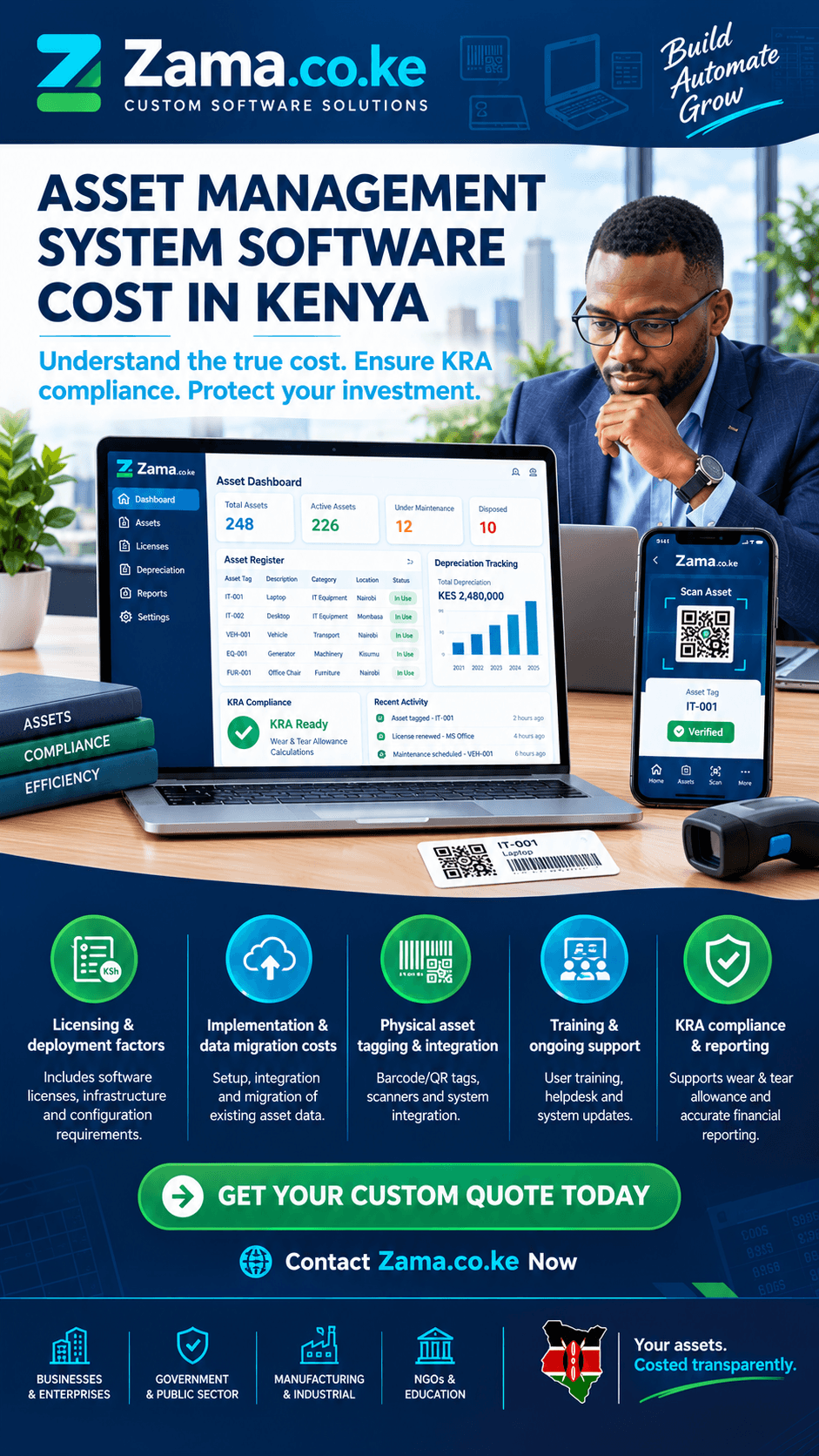
Asset management system software cost in Kenya is a question that every finance director, operations manager, and business owner must answer in 2026. With the Kenya Fixed Asset Management Software Market estimated at USD 168 Million in 2025 and projected to reach USD 231 Million by 2032, growing at a CAGR of 5.5%, and KRA now requiring every capital asset to be supported by a compliant eTIMS invoice from January 2026, the pressure to digitize asset tracking has never been greater. At zama.co.ke, we’ve helped numerous organizations across Kenya understand the true asset management system software cost in Kenya and select solutions that deliver real value. This comprehensive guide explores asset management system software cost in Kenya, from understanding pricing models to calculating total cost of ownership.
What Asset Management System Software Actually Does
Before diving into asset management system software cost in Kenya, it’s essential to understand what this technology actually does. An asset management system is a digital platform that tracks, manages, and monitors an organization’s physical and financial assets throughout their lifecycle—from acquisition to disposal. It maintains a complete asset register with unique identification numbers, tracks depreciation and net book value, manages maintenance schedules, monitors asset locations and assignments, generates valuation reports, and handles disposal and write-off processes.
A proper asset management system software cost in Kenya analysis must account for more than just the software licence. The total investment includes implementation costs, data migration, asset tagging, training, integration with existing systems, and ongoing support. Each component contributes to the overall cost, and understanding these components is essential for accurate budgeting.
For a Kenyan organization, the practical definition of asset management system software cost in Kenya is this: the total investment required to acquire, deploy, and operate an asset management platform—including software licensing, hardware, implementation, training, integration, and ongoing support—spread over the expected lifetime of the system.
Why Kenyan Organizations Need Asset Management Software
When evaluating asset management system software cost in Kenya, it’s important to understand the regulatory and operational pressures driving adoption. From 2026, KRA uses digital verification comparing declared asset values against import, insurance, and bank financing records, so mismatches and unsupported rates are flagged. Every capital asset must be supported by a compliant eTIMS invoice. Capital assets not supported by compliant eTIMS invoices may be disallowed as deductible expenses or capital claims during KRA review. This makes a robust asset management system essential for any business claiming wear and tear allowances.
A modern asset management system software cost in Kenya analysis must also consider operational efficiency. Most Kenyan organizations manage assets through spreadsheets, manual registers, and institutional memory. This approach works when the organization has 50 assets. It fails catastrophically when the organization has 5,000 assets across multiple locations. Without a proper system, organizations face lost assets, inaccurate depreciation calculations, audit failures, and missed maintenance schedules.
Key Factors That Determine Asset Management System Software Cost in Kenya
When analysing asset management system software cost in Kenya, several factors directly influence pricing:
1. Number of Assets and Users
The number of assets and users is a primary driver of asset management system software cost in Kenya. Entry-level solutions typically cover a limited number of assets and users, with pricing scaling as both increase. A small business tracking 200 assets with five users will pay significantly less than a large manufacturer tracking 10,000 assets with fifty users.
For a Kenyan organization, accurately estimating the number of assets and users is essential. Underestimating leads to unexpected upgrade costs; overestimating leads to paying for capacity that is never used.
2. Software Licensing Model
Software licensing is a critical factor in asset management system software cost in Kenya. Several licensing models are available:
Perpetual Licence: A one-time payment for the software, with optional annual maintenance fees. This model has higher upfront costs but lower ongoing costs.
Subscription (SaaS): A recurring monthly or annual fee based on the number of assets, users, or sites. Cloud-based asset management platforms offer recurring revenue opportunities, with monthly SaaS fees depending on the modules selected and the number of users. This model has lower upfront costs but higher cumulative costs over time.
Per-User Licensing: Some vendors charge per user, making the asset management system software cost in Kenya scale directly with the number of staff who need access.
Enterprise Licensing: For large organizations with multiple branches, enterprise licensing agreements provide unlimited assets across all sites for a single annual fee.
When analysing asset management system software cost in Kenya, organizations must consider not just the initial licence cost but the total cost of ownership over the system’s lifetime.
3. Deployment Model
The deployment model significantly affects asset management system software cost in Kenya:
On-Premise Deployment: The software and hardware are installed at the organization’s premises. This requires server hardware, network infrastructure, and IT staff for maintenance. The upfront cost is higher, but ongoing costs are lower.
Cloud-Based Deployment: The software is hosted by the vendor and accessed via the internet. This reduces upfront infrastructure costs and shifts maintenance responsibility to the vendor. However, it requires reliable internet connectivity and incurs recurring subscription fees. The Kenya Fixed Asset Management Software Market is witnessing a shift towards cloud solutions, providing businesses with the flexibility and scalability they require to manage assets throughout their lifecycle.
Hybrid Deployment: A combination of on-premise and cloud components. For example, asset data is stored locally for reliability, while reporting and analytics are cloud-based.
The choice of deployment model affects both upfront and ongoing costs, making it a critical consideration when evaluating asset management system software cost in Kenya.
4. Implementation and Data Migration
Implementation and data migration are significant components of asset management system software cost in Kenya. Migrating existing asset data from spreadsheets, legacy systems, or manual registers requires careful validation. Asset descriptions, acquisition dates, costs, locations, and depreciation data must be accurate before migration. Poor data quality leads to system distrust and adoption problems.
For organizations with thousands of assets, data migration can be complex and time-consuming. The cost of data cleansing, validation, and migration must be factored into the overall budget.
5. Physical Asset Tagging
Physical asset tagging is essential for KRA compliance and audit readiness. A proper asset management system software cost in Kenya calculation must include the cost of barcode or QR code generation, label printing, and asset tagging across all locations. For organizations with assets spread across multiple counties, the logistics of physical tagging add to the overall cost.
6. Integration Requirements
Asset management systems rarely operate in isolation. Integration with existing systems adds to asset management system software cost in Kenya:
Accounting Systems: Integration allows asset transactions to flow seamlessly into financial statements, with depreciation postings automated.
ERP Systems: Integration with ERP platforms ensures that asset records reconcile with general ledger balances.
Procurement Systems: Integration ensures that asset registration begins from the purchase order, not after the invoice.
IFMIS: For public entities, integration with the Integrated Financial Management Information System is essential.
Each integration adds complexity and cost. Custom integrations typically cost more than pre-built connectors. When evaluating asset management system software cost in Kenya, organizations must budget for integration requirements.
7. Customisation and Branding
Off-the-shelf asset management systems come with standard interfaces and workflows. Customisation—custom fields, custom workflows, custom reports, custom integrations—adds to asset management system software cost in Kenya. A system that matches the organization’s specific asset categories, depreciation methods, and approval hierarchies costs more than a generic system.
For Kenyan organizations with unique operational requirements, customisation is often essential. The cost of customisation must be factored into the overall budget.
8. Training and Change Management
Training finance teams, asset managers, and department heads is essential for successful adoption. Training costs—whether included in the software licence or charged separately—add to asset management system software cost in Kenya. Role-specific training, on-site training, and ongoing training as staff turnover occurs all contribute to the total cost.
9. Ongoing Support and Maintenance
Asset management systems require ongoing support and maintenance. This includes software updates, bug fixes, KRA rate updates, and technical support. Support costs vary based on the level of service—business hours support, 24/7 support, dedicated account management—and whether support is included in the licence or charged separately.
KRA investment allowance rates may change, requiring updates to depreciation calculations. The vendor must provide these updates as part of ongoing support. This ongoing support should be factored into asset management system software cost in Kenya.
Pricing Models for Asset Management System Software in Kenya
Several pricing models are available for asset management systems in Kenya:
Monthly Subscription
A monthly subscription includes the software licence, hosting, support, and updates. The organization pays a recurring fee based on the number of assets, users, or sites. Entry-level solutions start at affordable monthly rates for small numbers of users and assets, with pricing scaling as requirements grow.
Annual Subscription
Annual subscriptions offer cost savings compared to monthly billing, with organizations committing to a full year of service. This model provides cost predictability and simplifies budgeting.
One-Time Purchase
A one-time purchase includes the software licence, with the organization responsible for hosting and maintenance. This model has higher upfront costs but lower ongoing costs. Annual maintenance fees typically apply.
Per-Asset Pricing
Some vendors charge per asset tracked—for example, a fixed fee per asset per year. This model is suitable for organizations with stable asset bases but can become expensive for rapidly growing organizations.
Enterprise Agreement
For large organizations with multiple branches, enterprise agreements provide unlimited assets across all sites for a single annual fee. This model simplifies budgeting and provides cost predictability.
Hidden Costs to Budget For
Beyond the visible costs, several hidden expenses affect asset management system software cost in Kenya:
Hardware for Asset Tagging
Barcode scanners, label printers, and mobile devices for field asset verification add to the overall cost. For organizations with assets spread across multiple locations, multiple scanners and printers may be required.
Network Infrastructure
Asset management systems require network connectivity between users, servers, and databases. Organizations may need to upgrade network infrastructure, install additional access points, or improve internet connectivity.
Power Backup
Kenyan organizations face power fluctuations and outages. Asset management systems require UPS backup for servers and workstations.
Data Cleansing
Before migrating data, existing records must be cleansed and validated. This can be a significant effort, particularly for organizations with years of inconsistent record-keeping.
KRA Compliance Updates
As KRA updates investment allowance rates and eTIMS requirements, the asset management system must be updated accordingly. Vendors may charge for these updates.
Audit Support
During statutory audits, the vendor may need to provide compliance documentation, support audit queries, or assist with asset verification. Some vendors include these services; others charge for audit support.
The ROI of Asset Management System Software in Kenya
When evaluating asset management system software cost in Kenya, the ROI must be considered alongside the investment. The costs are offset by:
KRA Compliance: Accurate asset registers support wear and tear allowance claims, reducing tax risks and penalties.
Audit Readiness: Complete asset documentation ensures smooth statutory audits and reduces audit queries.
Asset Protection: Physical tagging and tracking prevent loss, misuse, or unauthorized disposal.
Depreciation Accuracy: Automated calculations eliminate errors and ensure consistent treatment.
Maintenance Optimization: Scheduled maintenance extends asset life and reduces downtime.
Insurance Management: Accurate asset values help determine adequate insurance coverage.
Business Planning: Understanding asset condition and replacement needs supports informed capital expenditure decisions.
The Zama.co.ke Approach to Asset Management System Software Cost in Kenya
When considering asset management system software cost in Kenya, zama.co.ke follows a structured approach:
Asset Assessment
We evaluate your organization’s asset base: categories, quantities, locations, values, and compliance requirements. This includes understanding your current asset management challenges and defining success metrics.
Cost Modelling
We build a detailed cost model that includes software licensing, hardware, implementation, training, integration, and ongoing support. We help you understand the total cost of ownership, not just the monthly subscription.
Solution Design
We design an asset management solution tailored to your specific needs—whether it’s fixed asset tracking for financial compliance or enterprise asset management for operational assets.
Implementation and Configuration
We handle system configuration, data migration, asset tagging, and integration with existing financial systems. We ensure the system supports KRA-compliant depreciation calculations from day one.
Training and Support
We provide role-specific training for finance teams, asset managers, and administrators, including report generation, depreciation calculation, and KRA compliance.
Post-Implementation Support
We remain available for maintenance, troubleshooting, and system upgrades as your asset base evolves.
Implementation Considerations for Kenyan Organizations
When implementing an asset management system, consider these factors:
Assess Your Asset Base
Before selecting a system, conduct a comprehensive inventory of your assets. Identify asset categories, quantities, locations, values, and current condition. This assessment forms the foundation for system configuration and data migration.
Choose the Right Solution
The best asset management system for your organization depends on your asset complexity, compliance requirements, budget, and integration needs. A small business may need basic fixed asset tracking; a large manufacturer or utility may need full enterprise asset management with predictive maintenance and IoT integration.
Plan for Physical Tagging
Physical asset tagging is not optional—it is essential for KRA compliance and audit readiness. Plan for barcode or QR code generation, tag printing, and asset tagging across all locations.
Migrate Data Carefully
Data migration from existing registers requires careful validation. Ensure asset descriptions, acquisition dates, costs, locations, and depreciation data are accurate before migration.
Train Your Team
Finance teams, asset managers, and department heads need training on the new system. Role-specific training using real asset scenarios produces higher adoption and better data quality.
Ensure KRA Compliance
Configure the system to calculate depreciation according to KRA rates, generate reports that support capital allowance claims, and maintain audit trails for tax verification.
Consider a Phased Rollout
For large organizations, consider a phased rollout. Start with one department or asset category, prove the system works, refine based on feedback, then expand.
Why Contact Zama.co.ke for Asset Management System Software Cost in Kenya
When researching asset management system software cost in Kenya, organizations should contact zama.co.ke because:
Transparent Pricing: No hidden fees, clear milestone timelines, and full source-code ownership.
Local Expertise: We understand Kenyan regulatory requirements, including KRA investment allowance rates and eTIMS compliance.
Custom Development: We build systems tailored to your specific asset categories, depreciation methods, and operational workflows.
Integration Capabilities: We connect asset management to accounting, ERP, procurement, and government systems.
Hardware and Software: We supply, install, and configure barcode scanners, label printers, and network equipment alongside the software.
Ongoing Support: We remain available for maintenance, troubleshooting, and system upgrades as your asset base evolves.
For a custom quote based on your organization’s specific requirements, contact zama.co.ke today.
The Cost of Delaying Asset Management Implementation
While organizations evaluate asset management system software cost in Kenya, the cost of inaction compounds daily. Every month of manual asset tracking represents compliance risk—KRA’s digital verification is flagging mismatches, and penalties for incorrect capital allowance claims can be substantial. Every month of fragmented records represents audit risk—missing documentation leads to audit queries and delays. Every month of unmonitored assets represents financial loss—assets that cannot be located, assets that are not maintained, assets that are not insured for their true value.
Meanwhile, organizations that have implemented asset management systems are achieving KRA compliance, passing audits without queries, and optimizing asset utilization. The competitive gap widens with every passing month.
Asset management system software cost in Kenya depends on several factors—the number of assets and users, software licensing model, deployment model, implementation complexity, integration requirements, and ongoing support. The total cost of ownership includes software, hardware, implementation, training, integration, and support. But the ROI—KRA compliance, audit readiness, asset protection, and depreciation accuracy—far exceeds the investment.
At zama.co.ke, we’ve helped organizations across Kenya evaluate, implement, and optimize asset management systems that deliver measurable results. Our approach ensures you get exactly what your organization needs—nothing more, nothing less.
Don’t let the complexity of asset management system software cost in Kenya hold you back. Whether you’re a small business or a large public entity, we have the expertise to guide you through every step.
Contact zama.co.ke today for a custom quote based on your organization’s specific requirements.