
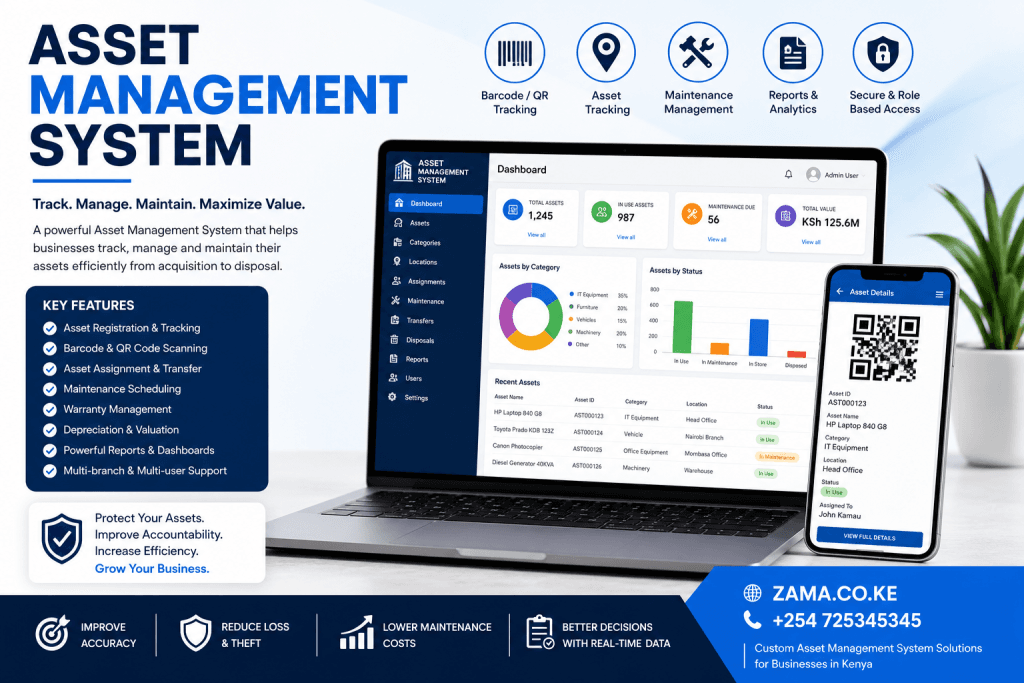
Asset Management System: The Ultimate Solution for Tracking and Managing Business Assets in Kenya
Every growing business owns valuable assets. Whether it is computers, laptops, printers, office furniture, company vehicles, machinery, tools, or specialized equipment, keeping track of these resources is essential. Unfortunately, many organizations still rely on spreadsheets, notebooks, or manual records that easily become outdated.
An Asset Management System eliminates these challenges by providing a centralized digital platform where every company asset can be tracked, monitored, maintained, and managed throughout its entire lifecycle.
At Zama.co.ke, we develop a modern, secure, and scalable Asset Management System that helps businesses improve accountability, reduce losses, increase operational efficiency, and make informed decisions based on real-time asset data.
Whether you operate a small business, a corporate organization, a government institution, a school, a hospital, or a manufacturing company, implementing an Asset Management System is one of the smartest investments you can make.
Call us today: +254 725345345
What is an Asset Management System?
An Asset Management System is software designed to record, organize, monitor, and manage all physical and digital assets owned by an organization.
Instead of maintaining multiple spreadsheets or handwritten registers, the system stores everything in one secure database where authorized users can quickly access accurate asset information.
The software enables organizations to:
- Track every asset
- Monitor asset location
- Record asset ownership
- Schedule maintenance
- Calculate depreciation
- Manage repairs
- Generate reports
- Track asset history
- Reduce asset losses
- Improve accountability
A professionally designed Asset Management System gives businesses complete visibility over their investments while improving operational efficiency.
Why Businesses Need an Asset Management System
As organizations grow, managing assets manually becomes increasingly difficult.
Employees move between departments.
Equipment gets transferred.
Assets require maintenance.
Some items become obsolete.
Others are stolen or misplaced.
Without an Asset Management, organizations experience:
- Missing assets
- Duplicate purchases
- Poor accountability
- Unplanned maintenance
- High replacement costs
- Inaccurate inventory
- Financial reporting errors
- Increased operational costs
An automated Asset Management System solves these problems by maintaining accurate records from asset acquisition to disposal.
Common Assets Managed by an Asset Management System
Every organization owns different categories of assets.
A modern Asset Management System can manage:
IT Assets
- Desktop computers
- Laptops
- Tablets
- Smartphones
- Monitors
- Servers
- Routers
- Switches
- UPS devices
- Network equipment
Office Assets
- Chairs
- Tables
- Cabinets
- Shelves
- Air conditioners
- Projectors
- Televisions
- Meeting room equipment
Vehicle Assets
- Company cars
- Delivery vehicles
- Trucks
- Motorcycles
- Forklifts
Industrial Equipment
- Manufacturing machines
- Construction equipment
- Farm machinery
- Heavy equipment
- Power generators
Medical Equipment
Hospitals use an Asset Management to monitor:
- X-ray machines
- Ultrasound machines
- Patient monitors
- ICU equipment
- Laboratory machines
- Surgical equipment
School Assets
Schools manage:
- Classroom furniture
- Laboratory equipment
- Library books
- School buses
- Computers
- Printers
Features of a Modern Asset Management System
An advanced Asset Management System developed by Zama.co.ke comes with powerful features that simplify asset management.
1. Asset Registration
Register every company asset with detailed information including:
- Asset name
- Category
- Purchase date
- Supplier
- Purchase cost
- Warranty period
- Asset condition
- Department
- Assigned employee
- Current location
This creates a comprehensive asset database.
2. Barcode and QR Code Tracking
Every asset can receive a unique barcode or QR code.
Employees simply scan the code using a mobile device to instantly access:
- Asset details
- Maintenance history
- Current location
- Assigned employee
- Warranty information
Barcode tracking significantly improves efficiency.
3. Asset Assignment
Know exactly who is responsible for each asset.
The Asset Management System records:
- Employee name
- Department
- Assignment date
- Return date
- Transfer history
This improves accountability across the organization.
4. Asset Location Tracking
Organizations with multiple branches often struggle to locate assets.
The Asset Management records:
- Office
- Building
- Floor
- Room
- Department
Managers can instantly identify where each asset is located.
5. Maintenance Management
Equipment requires regular servicing.
Our Asset Management System allows organizations to:
- Schedule maintenance
- Receive reminders
- Record repair history
- Track maintenance costs
- Assign technicians
Preventive maintenance reduces downtime and extends equipment lifespan.
6. Warranty Tracking
Many organizations lose money because they forget warranty periods.
The system automatically tracks:
- Warranty start date
- Warranty expiry
- Supplier information
- Service provider contacts
Alerts are sent before warranties expire.
7. Depreciation Management
Finance departments need accurate depreciation reports.
The Asset Management System automatically calculates depreciation using different accounting methods.
This simplifies financial reporting and auditing.
8. Asset Transfers
When employees change departments, assets move with them.
The software records:
- Previous department
- New department
- Transfer approval
- Transfer date
Complete transfer history is maintained.
9. Asset Disposal
Assets eventually reach end-of-life.
The system records:
- Disposal reason
- Disposal date
- Sale value
- Scrap value
- Approval workflow
Nothing is removed without proper authorization.
10. Reporting Dashboard
Managers receive real-time insights through interactive dashboards.
Reports include:
- Total assets
- Assets by department
- Assets by category
- Assets under maintenance
- Expired warranties
- Asset depreciation
- Asset valuation
- Lost assets
- Asset movement
Reports support better business decisions.
Benefits of an Asset Management System
Improved Asset Visibility
Managers know exactly:
- What assets exist
- Where assets are located
- Who is using them
- Their condition
Nothing gets lost.
Reduced Asset Loss
Asset theft and misplacement become easier to detect.
Organizations significantly reduce unnecessary replacement costs.
Better Accountability
Employees become responsible for assigned equipment because every transfer is recorded.
Faster Audits
Auditors no longer search through filing cabinets.
Everything is available within seconds.
Lower Maintenance Costs
Preventive maintenance reduces expensive emergency repairs.
Organizations save substantial operational costs.
Improved Compliance
Many industries require proper asset documentation.
An Asset Management System simplifies regulatory compliance.
Better Financial Planning
Management understands:
- Current asset value
- Future replacement costs
- Depreciation trends
- Maintenance expenses
This supports strategic planning.
Industries That Benefit from an Asset Management System
Almost every industry benefits from implementing an Asset Management System.
These include:
Manufacturing Companies
Manufacturers manage expensive production equipment and machinery.
The system reduces equipment downtime.
Government Institutions
Government agencies manage thousands of public assets.
Digital asset management improves transparency and accountability.
Schools and Universities
Educational institutions track:
- Computers
- Furniture
- Laboratory equipment
- Projectors
- Vehicles
Hospitals
Hospitals rely on expensive medical equipment.
The Asset Management System ensures equipment remains operational and properly maintained.
Construction Companies
Construction firms monitor:
- Heavy machinery
- Excavators
- Trucks
- Generators
- Power tools
NGOs
Non-profit organizations improve donor accountability by maintaining accurate asset records.
Financial Institutions
Banks manage:
- ATMs
- Servers
- Computers
- Branch equipment
- Security systems
Retail Businesses
Retail stores track:
- POS machines
- Shelves
- Refrigeration equipment
- Delivery vehicles
- Warehouse equipment
Why Choose Zama.co.ke for Your Asset Management System?
At Zama.co.ke, we don’t just build software—we create business solutions tailored to your organization’s unique needs.
Our Asset Management System is designed with Kenyan businesses in mind, offering flexibility, security, and ease of use for organizations of all sizes. Whether you need a cloud-based platform or an on-premise installation, we can customize the solution to match your workflow, reporting requirements, and approval processes.
When you choose Zama.co.ke, you benefit from:
- Custom-built Asset Management System solutions
- User-friendly interface
- Secure cloud and on-premise deployment options
- Barcode and QR code integration
- Multi-user access with role-based permissions
- Detailed reporting and analytics
- Ongoing technical support and system maintenance
- Integration with other business systems where required
- Affordable pricing for SMEs and large enterprises
- Scalable architecture that grows with your business
Our goal is to help your organization eliminate manual asset tracking, improve accountability, and maximize the return on every asset investment.
Ready to Digitize Your Asset Management?
If your organization is still relying on spreadsheets or paper records, now is the time to upgrade to a modern Asset Management System.
Contact Zama.co.ke today to discuss your requirements and get a customized solution that fits your business.
📞 Call/WhatsApp: +254 725345345
Understanding the Asset Lifecycle in an Asset Management System
One of the greatest advantages of implementing an Asset Management System is the ability to manage every asset from the moment it is purchased until it is disposed of. This complete process is known as the asset lifecycle.
A professional Asset Management System ensures that every stage is documented, monitored, and reported accurately.
Asset Planning
Before purchasing any equipment, organizations should identify their needs.
The Asset Management System allows management to:
- Forecast future asset requirements
- Estimate budgets
- Compare previous purchases
- Plan replacements
- Identify underutilized assets
Proper planning prevents unnecessary purchases and improves budgeting.
Asset Procurement
After planning, assets are purchased.
The Asset Management System records:
- Purchase request
- Purchase approval
- Supplier information
- Purchase order number
- Invoice details
- Purchase cost
- Delivery date
- Warranty information
Everything is stored digitally for future reference.
Asset Registration
Immediately after procurement, every asset should be registered.
Each asset receives:
- Unique Asset ID
- Barcode
- QR Code
- Serial Number
- Asset Category
- Asset Description
- Department
- Location
- Custodian
- Purchase Value
A centralized Asset Management System ensures no asset is forgotten.
Asset Deployment
After registration, assets are assigned.
Examples include:
- Laptop assigned to Finance Manager
- Company vehicle assigned to Sales Team
- Generator assigned to Branch Office
- Printer assigned to Human Resource Department
Every movement is recorded.
Asset Maintenance
Maintenance is critical.
An Asset Management System automatically reminds maintenance teams when equipment requires servicing.
Maintenance records include:
- Technician
- Service Date
- Service Cost
- Parts Replaced
- Downtime
- Next Service Date
This extends asset lifespan.
Asset Inspection
Routine inspections identify:
- Damaged equipment
- Missing assets
- Safety concerns
- Performance issues
Managers can schedule inspections directly within the Asset Management.
Asset Disposal
Eventually every asset reaches end-of-life.
The Asset Management System records:
- Disposal approval
- Disposal reason
- Scrap value
- Sale value
- Buyer details
- Disposal certificate
Complete historical records remain available even after disposal.
Fixed Asset Management System
A Fixed Asset Management System specifically manages long-term physical assets.
Examples include:
- Buildings
- Company vehicles
- Office furniture
- Manufacturing equipment
- Computers
- Servers
- Air conditioners
- Heavy machinery
Businesses rely on a Fixed Asset Management System for financial reporting, depreciation, audits, and insurance documentation.
Enterprise Asset Management System
Large organizations require more than basic tracking.
An Enterprise Asset Management System (EAM) provides advanced capabilities such as:
- Multi-branch asset management
- Workflow automation
- Asset maintenance scheduling
- Inventory integration
- Procurement integration
- Vendor management
- Work order management
- Mobile asset tracking
- Compliance management
- Performance analytics
Large enterprises benefit significantly from implementing an Enterprise Asset Management System.
Asset Tracking System Using QR Codes
Traditional spreadsheets cannot instantly identify assets.
Modern Asset Tracking Systems use QR codes.
Every asset receives a unique QR code.
Employees simply scan the code to access:
- Asset information
- Warranty
- Purchase details
- Assigned employee
- Current department
- Service history
- Asset image
QR code technology improves speed and accuracy.
Barcode Asset Tracking System
Barcode technology remains one of the most reliable asset tracking methods.
Benefits include:
- Fast scanning
- Reduced human error
- Accurate inventory
- Faster audits
- Lower operational costs
- Better accountability
An Asset Management System can generate thousands of unique barcodes automatically.
Cloud-Based Asset Management System
Many businesses now prefer cloud solutions.
A cloud Asset Management System allows users to access information from anywhere.
Advantages include:
- No expensive servers
- Automatic backups
- Secure cloud storage
- Remote access
- Easy software updates
- High availability
- Lower IT costs
- Business continuity
Organizations with multiple branches benefit greatly from cloud deployment.
On-Premise Asset Management System
Some organizations prefer keeping their systems inside their own infrastructure.
Advantages include:
- Complete data ownership
- Internal network security
- Greater customization
- Compliance with internal IT policies
- Offline accessibility
Zama.co.ke develops both cloud and on-premise Asset Management Systems.
Mobile Asset Management System
Modern organizations require mobility.
Managers should not wait until they return to the office.
Our Asset Management System supports mobile devices, enabling users to:
- Scan QR codes
- Register assets
- Approve transfers
- Record maintenance
- Conduct inspections
- Upload asset photos
- Generate reports
Mobile functionality improves productivity.
Asset Maintenance Management
Maintenance is one of the largest operational expenses.
A professional Asset Management System helps organizations reduce maintenance costs through preventive maintenance.
Instead of repairing broken equipment, businesses schedule maintenance before breakdowns occur.
Benefits include:
- Reduced downtime
- Lower repair costs
- Longer equipment lifespan
- Increased productivity
- Better planning
Preventive Maintenance vs Corrective Maintenance
Preventive maintenance involves scheduled servicing before equipment fails.
Corrective maintenance occurs after a breakdown.
An Asset Management System encourages preventive maintenance because it:
- Generates reminders
- Creates maintenance schedules
- Records maintenance history
- Tracks service costs
- Assigns technicians
Preventive maintenance saves organizations significant amounts of money.
Role-Based User Permissions
Not every employee should access every function.
A secure Asset Management System provides role-based access.
Examples include:
System Administrator
- Manage users
- Configure settings
- View all reports
Finance Department
- View depreciation
- View asset valuation
- Generate financial reports
Department Managers
- View departmental assets
- Approve transfers
- Approve disposals
Employees
- View assigned assets
- Submit maintenance requests
This improves security.
Asset Management Reports
Reports provide valuable business intelligence.
Popular reports include:
Asset Register Report
Displays every registered asset.
Department Asset Report
Shows assets owned by each department.
Asset Valuation Report
Displays current asset value.
Depreciation Report
Calculates accumulated depreciation.
Maintenance Report
Shows maintenance frequency and costs.
Asset Transfer Report
Displays asset movement.
Disposal Report
Lists disposed assets.
Warranty Expiry Report
Highlights warranties nearing expiration.
Lost Asset Report
Helps management investigate missing assets.
Integration with Other Business Systems
A professional Asset Management System can integrate with other enterprise software.
Examples include:
ERP Systems
Synchronize financial and procurement information.
HR Systems
Automatically assign assets to employees.
Accounting Software
Synchronize depreciation and financial records.
Inventory Management Systems
Track consumables alongside fixed assets.
Procurement Systems
Automatically register newly purchased assets.
Maintenance Systems
Manage repair requests and work orders.
Why Small Businesses Need an Asset Management System
Many small businesses believe asset management software is only for large corporations.
This is not true.
Even businesses with 20 assets benefit from an Asset Management.
Advantages include:
- Better organization
- Reduced losses
- Improved budgeting
- Faster audits
- Better accountability
- Accurate records
- Increased productivity
As businesses grow, the software grows with them.
Common Mistakes Businesses Make Without an Asset Management System
Organizations relying on manual processes often experience:
- Duplicate purchases
- Lost equipment
- Poor maintenance records
- Missing warranties
- Incorrect depreciation
- Untracked transfers
- Audit delays
- Poor accountability
- Missing purchase documents
- Inaccurate inventory
An Asset Management System eliminates these challenges.
Future Trends in Asset Management Systems
Technology continues to transform how organizations manage assets.
Some of the latest trends include:
Artificial Intelligence (AI)
AI can predict maintenance needs based on historical data, reducing unexpected equipment failures.
Internet of Things (IoT)
Connected devices automatically send performance data to the Asset Management, enabling real-time monitoring.
Predictive Maintenance
Machine learning algorithms analyze asset conditions and recommend maintenance before breakdowns occur.
GPS Tracking
Organizations can monitor the real-time location of vehicles and mobile equipment.
Mobile-First Solutions
Employees increasingly use smartphones and tablets to manage assets from any location.
Advanced Analytics
Interactive dashboards and data visualization tools help managers make informed decisions based on asset utilization, maintenance costs, and lifecycle performance.
Frequently Asked Questions (FAQs)
What is an Asset Management System?
An Asset Management System is software used to track, monitor, maintain, and manage an organization’s physical and digital assets throughout their lifecycle.
Who needs an Asset Management System?
Any organization that owns valuable assets, including businesses, schools, hospitals, NGOs, government institutions, factories, warehouses, and financial organizations.
Can the system manage multiple branches?
Yes. Our Asset Management System supports multiple branches, departments, and locations from a single centralized platform.
Is the system secure?
Absolutely. The system includes user authentication, role-based permissions, activity logs, encrypted data transmission, and secure backups to protect your business information.
Can I customize the system?
Yes. At Zama.co.ke, we develop customized Asset Management Systems that align with your organization’s workflow, approval hierarchy, branding, and reporting needs.
Can existing asset data be imported?
Yes. We can import your existing asset records from Excel spreadsheets or other databases, making migration quick and seamless.
Does the system support barcode and QR code scanning?
Yes. Our solution supports both barcode and QR code technology for fast and accurate asset identification and tracking.
Why Choose Zama.co.ke for Your Asset Management System?
Choosing the right software development partner is just as important as choosing the right software. At Zama.co.ke, we specialize in building reliable, scalable, and user-friendly business management systems tailored to Kenyan organizations.
When you work with us, you get:
- Custom Asset Management System development
- Responsive web-based applications
- Cloud and on-premise deployment
- QR code and barcode integration
- Role-based security controls
- Multi-branch and multi-user support
- Automated reporting and dashboards
- Seamless integration with existing business software
- Ongoing maintenance, upgrades, and technical support
- Affordable pricing with scalable solutions
Whether you are a startup, SME, NGO, school, hospital, manufacturing company, or large enterprise, we have the expertise to deliver an Asset Management System that improves efficiency and protects your valuable investments.
Conclusion
In today’s competitive business environment, relying on spreadsheets or manual registers to manage valuable assets is no longer sustainable. A modern Asset Management System provides complete visibility into your organization’s resources, improves accountability, reduces losses, simplifies audits, and supports informed decision-making.
From procurement and asset registration to maintenance, transfers, depreciation, and disposal, a comprehensive Asset Management System ensures every stage of the asset lifecycle is efficiently managed. By embracing digital asset management, organizations can reduce operational costs, extend asset lifespan, strengthen compliance, and maximize returns on every investment.
If your business is ready to modernize its asset management processes, Zama.co.ke is ready to help. Our experienced development team builds customized, secure, and scalable Asset Management System solutions designed to meet the unique needs of organizations across Kenya.
Whether you require a Fixed Asset Management System, Enterprise Asset Management System, Asset Tracking Software, or a fully customized Asset Management Solution, we can deliver a platform that grows with your business.
Contact Zama.co.ke Today
Transform the way your organization manages assets with a powerful and intelligent Asset Management System.
Website: Zama.co.ke
Phone / WhatsApp: +254 725345345
Invest in a smarter future with a customized Asset Management System from Zama.co.ke and gain complete control over your business assets, improve operational efficiency, and drive sustainable growth.