
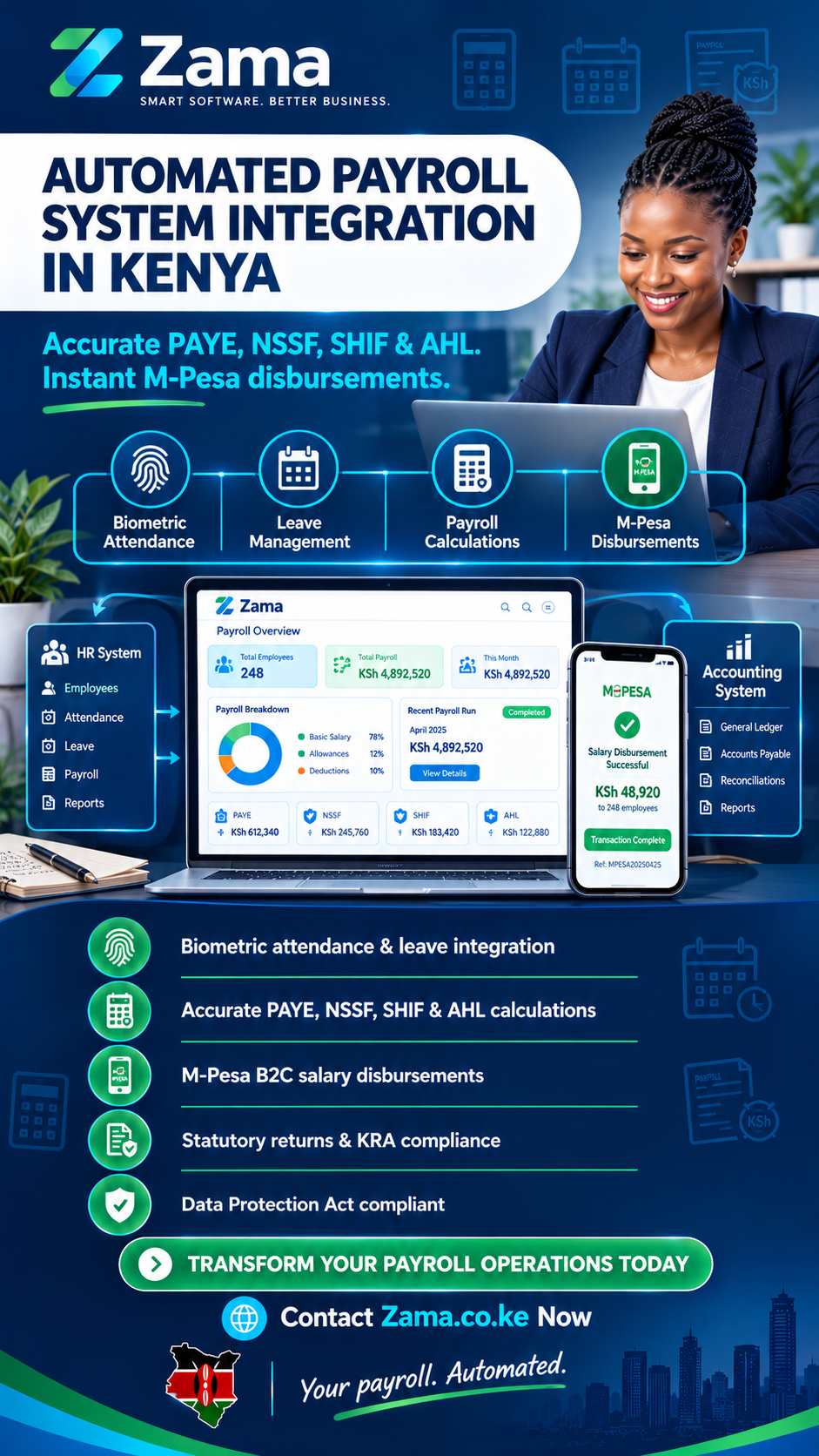
Automated payroll system integration in Kenya is a question that every HR director, finance manager, and business owner must answer in 2026. With Kenyan employers facing complex statutory deductions including PAYE, NSSF, SHIF, and AHL, the Data Protection Act governing employee data, and workforces increasingly distributed across multiple locations, the need for seamless payroll integration has never been greater. At zama.co.ke, we’ve helped numerous organizations across Kenya implement automated payroll system integration that eliminates manual calculations, ensures statutory compliance, and provides real-time visibility into payroll operations. This comprehensive guide explores automated payroll system integration in Kenya, from understanding what integration delivers to selecting the right approach for your organization.
What Automated Payroll System Integration Actually Delivers
Before diving into automated payroll system integration in Kenya, it’s essential to understand what this technology actually does. Automated payroll system integration is the process of connecting your payroll software with other business systems—attendance tracking, leave management, HR records, accounting, and payment platforms—so that data flows automatically and payroll runs accurately without manual intervention. It replaces spreadsheets, manual calculations, and error-prone data entry with automated workflows that ensure every employee is paid correctly and on time.
A proper automated payroll system integration in Kenya does far more than calculate net pay. It pulls attendance data from biometric systems, calculates overtime based on actual hours worked, applies leave deductions automatically, calculates PAYE according to graduated tax bands, deducts NSSF, SHIF, and AHL at current statutory rates, generates payslips, initiates M-Pesa or bank payments, and produces statutory returns for KRA, NSSF, SHIF, and AHL remittance.
For a Kenyan organization, the practical definition of automated payroll system integration in Kenya is this: the connected ecosystem that tells you exactly what every employee is owed, exactly how much tax and statutory deductions apply, exactly when payments are made, and exactly how your organization complies with Kenyan payroll regulations—all in real time, with data flowing automatically between systems.
Why Kenyan Organizations Need Automated Payroll System Integration
When evaluating automated payroll system integration in Kenya, consider the compelling reasons for adoption:
The Complexity of Kenyan Payroll
Kenyan payroll is complex. Employers must calculate PAYE according to graduated tax bands that change with annual Finance Acts. NSSF contributions follow tiered rates. SHIF deductions are calculated as a percentage of gross salary. AHL applies at specified rates. Overtime must be calculated according to Employment Act provisions—weekday overtime, weekend overtime, and public holiday rates. Leave deductions must comply with statutory minimums. Housing levy, pension contributions, and other deductions all affect net pay.
Manual payroll processes are error-prone and time-consuming. A single miscalculation can result in penalties, employee disputes, and compliance issues. The Kenya Revenue Authority has been increasing scrutiny of payroll compliance, making accuracy essential.
A modern automated payroll system integration in Kenya automates all these calculations. It applies current statutory rates automatically. It calculates overtime based on attendance data. It generates payslips, produces bank payment files, and creates reports for statutory remittances. It updates when rates change.
Data Protection Act Compliance
Kenya’s Data Protection Act imposes strict requirements on how organizations handle personal data. Payroll data includes some of the most sensitive personal information—salaries, bank accounts, tax details, and statutory deductions. A compliant automated payroll system integration in Kenya ensures that employee data is processed lawfully, stored securely, retained only as long as necessary, and disposed of appropriately. It supports data subject access requests by enabling efficient identification of records held about any employee.
Integration with Attendance and Leave Systems
Payroll is not an isolated function. It depends on attendance data—hours worked, overtime, and absences. It depends on leave data—days taken, balances remaining, and types of leave. Without integration, these dependencies are managed manually. Attendance data is re-entered into payroll. Leave balances are checked manually. Overtime is calculated from memory or notes.
A proper automated payroll system integration in Kenya connects payroll to attendance and leave systems. Attendance data flows automatically into payroll calculations. Leave deductions are applied automatically. Overtime is calculated from actual clock-in and clock-out times. The result is accurate payroll without manual effort.
M-Pesa and Bank Payment Integration
Paying employees efficiently requires integration with payment systems. M-Pesa B2C payments enable instant salary disbursement to employee mobile money accounts. Bank payment files enable bulk transfers to employee bank accounts. Without integration, payments are made manually—a slow and error-prone process.
A comprehensive automated payroll system integration in Kenya integrates with M-Pesa and bank payment systems. Salaries are disbursed instantly upon payroll approval. Payment confirmations are received automatically. Reconciliation is automated.
Statutory Returns and Compliance
Employers must file statutory returns with KRA (PAYE), NSSF, SHIF, and AHL. These returns must be accurate, timely, and supported by complete records. Manual preparation of statutory returns is time-consuming and error-prone.
A quality automated payroll system integration in Kenya generates statutory returns automatically. PAYE returns for KRA. NSSF returns. SHIF returns. AHL returns. All produced from the same data that generated payslips, ensuring consistency and accuracy.
The Cost of Manual Payroll
Manual payroll is expensive. HR and finance teams spend days every month on payroll calculations, data entry, payslip generation, and statutory returns. Errors result in penalties, disputes, and rework. The cost of manual payroll—in staff time, penalties, and risk—far exceeds the cost of automated integration.
A proper automated payroll system integration in Kenya eliminates these costs. Payroll runs in hours rather than days. Errors are eliminated. Penalties are avoided. Staff focus on strategic work rather than manual calculations.
Key Features of Automated Payroll System Integration in Kenya
When evaluating automated payroll system integration in Kenya, focus on these core features:
1. Biometric Attendance Integration
The foundation of accurate payroll is accurate attendance data. A proper automated payroll system integration in Kenya connects to biometric attendance systems—fingerprint readers, facial recognition terminals, and card readers—so that clock-in and clock-out times flow automatically into payroll calculations.
Attendance data should include regular hours, overtime hours, late arrivals, early departures, and absences. The integration should handle multiple attendance devices across multiple locations, consolidating data into a single payroll run.
2. Leave Management Integration
Leave management is a critical component of payroll. A comprehensive automated payroll system integration in Kenya connects payroll to leave management systems so that leave balances, leave types, and leave deductions are applied automatically. When an employee takes unpaid leave, the deduction is applied. When an employee takes paid leave, the balance is reduced.
Leave types—annual leave, sick leave, maternity leave, paternity leave, compassionate leave—should be configurable according to Employment Act requirements and organizational policy. Leave balances should update automatically as leave is taken and accrued.
3. PAYE Calculation and KRA Integration
PAYE calculation is mandatory for all Kenyan employers. A proper automated payroll system integration in Kenya calculates PAYE according to current graduated tax bands. It applies personal relief, insurance relief, and other allowable deductions. It generates PAYE returns for KRA and supports electronic filing.
The integration should stay current with Finance Act changes. When tax bands or reliefs change, the system should update automatically or through a simple configuration change.
4. NSSF, SHIF, and AHL Deductions
NSSF, SHIF, and AHL deductions are mandatory. A comprehensive automated payroll system integration in Kenya calculates these deductions at current statutory rates. It generates returns for NSSF, SHIF, and AHL. It maintains records for audit purposes.
The integration should handle tiered NSSF contributions, SHIF percentage calculations, and AHL rates accurately. It should update when rates change.
5. Overtime Calculation
Overtime calculation is complex. Weekday overtime is paid at different rates than weekend overtime. Public holiday overtime is paid at yet another rate. A proper automated payroll system integration in Kenya calculates overtime automatically based on attendance data and Employment Act provisions.
The system should distinguish between authorized and unauthorized overtime, apply the correct rates, and generate overtime reports for management review.
6. M-Pesa and Bank Payment Integration
Paying employees efficiently requires integration with payment systems. A quality automated payroll system integration in Kenya integrates with M-Pesa B2C for mobile money payments and with bank systems for bulk transfers. Salaries are disbursed instantly upon payroll approval.
The integration should support payment reconciliation—matching payments to employee accounts, confirming successful disbursements, and handling failed payments.
7. Payslip Generation and Distribution
Payslips are a statutory requirement. A comprehensive automated payroll system integration in Kenya generates payslips automatically, showing gross pay, deductions, and net pay with breakdowns for PAYE, NSSF, SHIF, AHL, and other deductions. Payslips should be distributed via employee self-service portals, email, or mobile apps.
8. Statutory Returns and Reporting
Statutory returns are mandatory. A proper automated payroll system integration in Kenya generates PAYE returns for KRA, NSSF returns, SHIF returns, and AHL returns. It supports electronic filing and maintains records for audit purposes.
9. Employee Self-Service
Modern employees expect self-service. A comprehensive automated payroll system integration in Kenya connects to employee self-service portals where employees can view payslips, download tax documents, and update personal details. Self-service reduces administrative burden on HR teams.
10. Accounting Integration
Payroll data must flow into accounting systems. A quality automated payroll system integration in Kenya integrates with accounting software to post payroll expenses, statutory liabilities, and net pay. This ensures that financial statements reflect accurate payroll costs.
What Makes Automated Payroll System Integration in Kenya Different
automated payroll system integration in Kenya has unique characteristics that global solutions often lack:
Kenyan Statutory Expertise
Kenyan payroll is different from payroll in other countries. PAYE tax bands are specific. NSSF, SHIF, and AHL rates are specific. Overtime rules are specific. A proper automated payroll system integration in Kenya builds these requirements in from day one. Global payroll systems may support Kenya as an option, but they rarely handle the nuances as well as locally-built integration.
M-Pesa Integration
M-Pesa is the primary payment method for millions of Kenyan employees. A proper integration supports M-Pesa B2C payments for salary disbursements, with automated reconciliation. Employees receive salaries instantly to their mobile money accounts.
Data Protection Act Compliance
Kenya’s Data Protection Act requires organizations to protect employee data. A compliant integration implements encryption, access controls, retention schedules, and data subject rights. The Office of the Data Protection Commissioner has been actively enforcing compliance, making this a regulatory necessity.
Offline and Low-Bandwidth Capability
Internet in Kenya is not always reliable, especially outside major urban centres. Good payroll integrations should queue transactions during connectivity issues and sync when connection returns.
Local Support and Training
The best automated payroll system integration in Kenya providers offer local support, training, and implementation services. Organizations need a partner who can respond quickly when issues arise and who understands the Kenyan regulatory environment.
Key Factors That Determine Automated Payroll System Integration Cost in Kenya
When analysing automated payroll system integration costs in Kenya, several factors directly influence pricing:
1. Number of Employees
The number of employees on payroll is a primary cost driver. A small organization with 50 employees has simpler requirements than a large enterprise with 5,000 employees.
2. Integration Complexity
The number of systems to integrate—attendance, leave, accounting, M-Pesa, banks—affects development complexity and cost. Each integration requires development effort and ongoing maintenance.
3. Payroll Complexity
Payroll complexity affects cost. Organizations with multiple pay grades, complex overtime rules, and diverse benefits require more configuration than organizations with simple payroll structures.
4. Statutory Compliance Requirements
Compliance requirements affect cost. Accurate PAYE, NSSF, SHIF, and AHL calculations require careful implementation. Penalties for non-compliance make accuracy essential.
5. Payment Integration Requirements
Payment integration—M-Pesa B2C, bank transfers, or both—affects cost. M-Pesa integration requires Daraja API implementation. Bank integration requires file generation and secure transmission.
6. Deployment Model
The deployment model affects cost. On-premise deployment requires server hardware and IT infrastructure. Cloud-based deployment shifts infrastructure responsibility to the development partner. Hybrid deployment combines both approaches.
7. Customization Requirements
Customization—custom reports, custom workflows, custom integrations—adds to development cost.
8. Training and Change Management
Training HR and finance staff on the new system adds to the overall investment.
9. Ongoing Support and Maintenance
Ongoing support, statutory updates, and system upgrades contribute to the total cost of ownership. Payroll systems require updates when statutory rates change, making ongoing support essential.
For a transparent quote based on your organization’s specific requirements, contact zama.co.ke today.
Automated Payroll System Integration Use Cases in Kenya
Corporate Enterprises
Corporate organizations use automated payroll system integration to manage payroll for thousands of employees across multiple locations. Integration with attendance, leave, and accounting systems ensures accuracy and efficiency.
Manufacturing and Industrial
Manufacturers use automated payroll system integration to manage shift workers, calculate overtime, and process payroll accurately. Integration with biometric attendance systems ensures accurate time tracking.
Retail Chains
Retail chains use automated payroll system integration to manage staff across multiple branches, track attendance and shift schedules, and process payroll efficiently.
Hospitals and Healthcare
Healthcare facilities use automated payroll system integration to manage clinical and non-clinical staff, track shift rotations, and process payroll. Integration with attendance systems ensures accurate payment for shift work.
Educational Institutions
Schools and universities use automated payroll system integration to manage teaching and non-teaching staff, track attendance, and process payroll.
NGOs and Development Organizations
NGOs use automated payroll system integration to manage staff across programs and locations, track donor-funded positions, and ensure compliance with donor requirements.
Government and Public Sector
Government ministries, departments, and agencies use automated payroll system integration to manage large workforces and process payroll at scale.
The Zama.co.ke Approach to Automated Payroll System Integration in Kenya
When considering automated payroll system integration in Kenya, zama.co.ke follows a structured approach:
Payroll Assessment
We evaluate your organization’s payroll operations: workforce size, pay structures, statutory requirements, attendance systems, leave policies, and payment methods. This includes understanding your current challenges and defining success metrics.
Integration Design
We design the integration architecture—attendance integration, leave integration, payment integration, accounting integration—and configure payroll rules, statutory calculations, and reporting. The design supports your specific payroll workflows and compliance requirements.
Development and Configuration
We develop the integrations, configure payroll rules, and set up reporting. We ensure the system calculates PAYE, NSSF, SHIF, and AHL accurately according to current statutory rates.
Data Migration
We migrate existing employee records, payroll histories, and leave balances into the new system. We validate data accuracy before migration and ensure that historical records are preserved.
Training and Support
We provide role-specific training for HR teams, finance teams, and administrators. We remain available for ongoing support, statutory updates, and system upgrades.
Post-Launch Optimization
After go-live, we monitor performance, gather user feedback, and refine the integration to improve payroll accuracy and efficiency.
The ROI of Automated Payroll System Integration in Kenya
When evaluating automated payroll system integration in Kenya, the ROI is compelling:
Reduced Payroll Processing Time: Payroll runs in hours rather than days. HR and finance teams focus on strategic work.
Eliminated Calculation Errors: Automated calculations eliminate the errors that plague manual payroll, reducing penalties and employee disputes.
Compliance Protection: Automated statutory calculations and returns ensure compliance with KRA, NSSF, SHIF, and AHL requirements.
Faster Payments: M-Pesa and bank integration enables instant salary disbursement, improving employee satisfaction.
Reduced Administrative Costs: Less manual work means lower administrative costs. Staff focus on higher-value activities.
Data Protection: Compliance with the Data Protection Act reduces legal and regulatory risk.
Real-Time Visibility: Dashboards provide management with real-time visibility into payroll costs and compliance.
Scalability: Automated payroll integration scales with your organization, adding employees and features without rebuilding.
Implementation Considerations for Kenyan Organizations
When implementing automated payroll system integration in Kenya, consider these factors:
Assess Your Current Payroll Processes
Before selecting a solution, map your current payroll processes. How is attendance captured? How is leave managed? How are salaries calculated? How are payments made? What are the pain points? This assessment forms the foundation for integration design.
Choose the Right Solution
The best automated payroll system integration for your organization depends on your size, industry, and requirements. A small organization may need basic payroll and M-Pesa integration. A large enterprise may need comprehensive integration across multiple systems.
Plan for Data Migration
Migrating employee records and payroll histories requires careful validation. Ensure employee details, salary information, and leave balances are accurate before migration.
Train Your Team
HR staff, finance teams, and administrators need training on the new system. Role-specific training produces higher adoption and better outcomes.
Ensure Compliance
Configure the system for Kenyan statutory compliance from day one. Ensure PAYE, NSSF, SHIF, and AHL calculations are correct. Ensure Data Protection Act compliance.
Test Thoroughly
Test all scenarios: payroll calculations, overtime, leave deductions, statutory returns, and payment disbursements. Ensure the system works correctly when connectivity is lost.
Consider a Phased Rollout
For large organizations, consider a phased rollout. Start with core payroll, prove the system works, refine based on feedback, then expand to other integrations.
The Cost of Delaying Payroll Integration
While organizations evaluate automated payroll system integration in Kenya, the cost of inaction compounds daily. Every month of manual payroll represents error risk and wasted staff time. Every month of non-compliance represents regulatory risk. Every month of delayed payments represents employee dissatisfaction.
Meanwhile, organizations with automated payroll system integration are achieving payroll accuracy, compliance, and improved employee satisfaction. The competitive gap widens with every passing month.
Why Contact Zama.co.ke for Automated Payroll System Integration in Kenya
When researching automated payroll system integration in Kenya, organizations should contact zama.co.ke because:
Local Expertise: We understand Kenyan payroll requirements, including PAYE, NSSF, SHIF, and AHL calculations.
M-Pesa Expertise: We integrate M-Pesa B2C for salary disbursements, with automated reconciliation.
eTIMS Expertise: We build KRA eTIMS integration where required, ensuring tax compliance.
Data Protection Expertise: We build systems with Data Protection Act compliance built in from day one.
Custom Development: We build integrations tailored to your specific payroll workflows, attendance systems, and payment methods, not generic solutions.
Transparent Pricing: No hidden fees, clear milestone timelines, and full source-code ownership.
Ongoing Support: We remain available for maintenance, statutory updates, and system upgrades as your organization evolves.
For a custom quote based on your organization’s specific requirements, contact zama.co.ke today.
Automated payroll system integration in Kenya is essential for any organization seeking to eliminate manual calculations, ensure statutory compliance, and pay employees accurately and on time. From biometric attendance integration and leave management to PAYE calculations, M-Pesa disbursements, and statutory returns, the right integration transforms how organizations manage payroll.
At zama.co.ke, we’ve helped organizations across Kenya implement automated payroll system integration that delivers measurable results. Our approach ensures you get exactly what your organization needs—nothing more, nothing less.
Don’t let the complexity of automated payroll system integration in Kenya hold you back. Whether you’re a small business or a large enterprise, we have the expertise to guide you through every step.
Contact zama.co.ke today for a custom quote based on your organization’s specific requirements.