
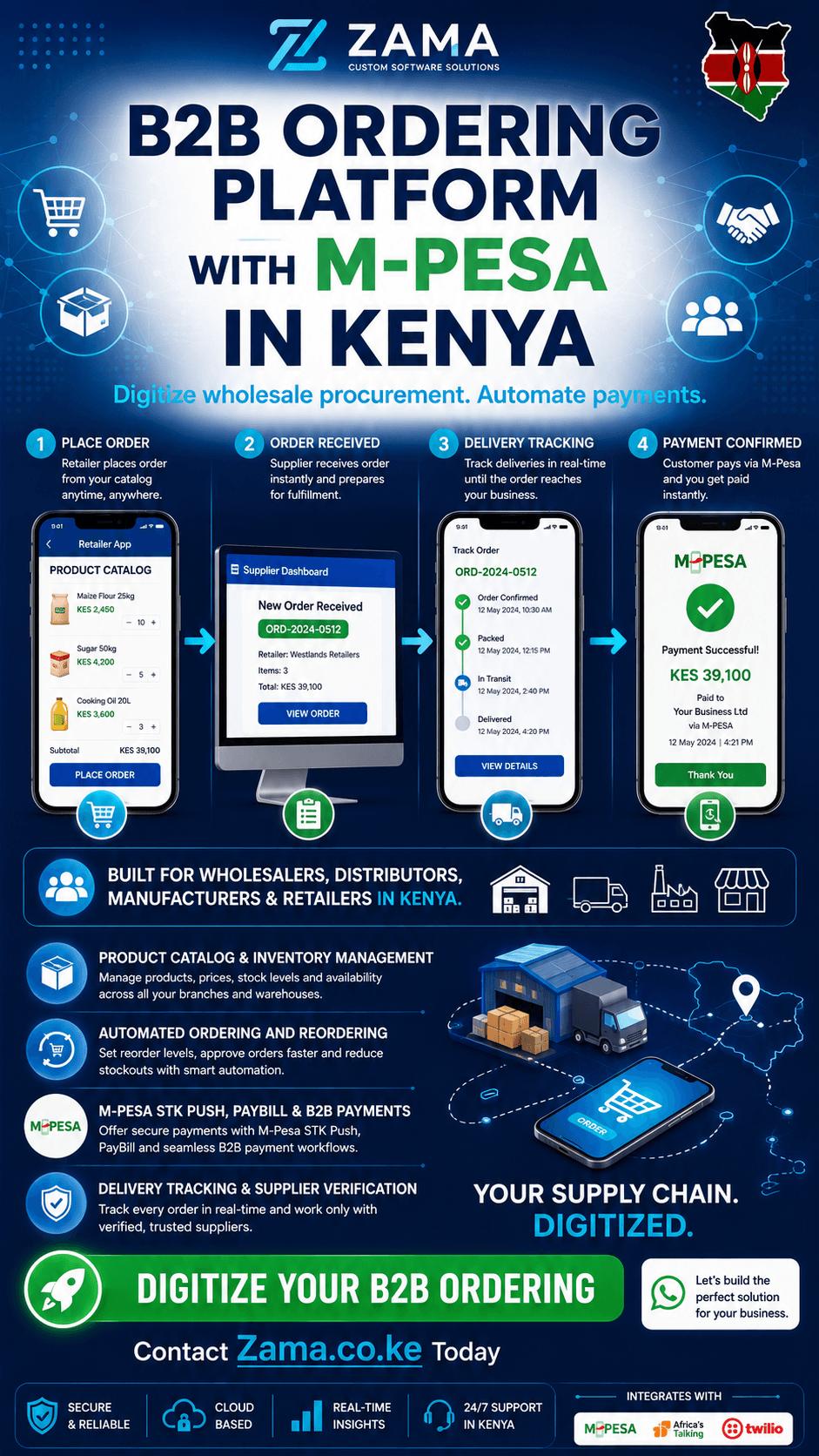
B2B ordering platform with M-Pesa in Kenya is a question that every wholesaler, distributor, manufacturer, and retailer must answer in 2026. With Kenya’s B2B e-commerce sector experiencing rapid growth and mobile money transactions surpassing 2 trillion shillings annually, the ability to digitize wholesale ordering and payment processes has become essential for businesses seeking to compete in the modern marketplace. At zama.co.ke, we’ve helped numerous businesses across Kenya build B2B ordering platforms with M-Pesa integration that streamline procurement, automate payment reconciliation, and strengthen supply chain relationships. This comprehensive guide explores B2B ordering platform with M-Pesa in Kenya, from understanding the core components to implementing solutions that transform how businesses buy and sell wholesale.
Understanding the B2B Ordering Landscape in Kenya
Before diving into B2B ordering platform with M-Pesa in Kenya, it’s essential to understand the current landscape. The Kenyan B2B market is undergoing significant digital transformation, with new platforms emerging to connect manufacturers, wholesalers, and retailers. DukaLink, for example, recently launched as a powerful B2B marketplace designed to connect duka owners directly with manufacturers, wholesalers, and producers across Kenya . The platform enables shopkeepers to place bulk orders via mobile app or USSD, track deliveries, and access verified suppliers—all integrated with M-Pesa payments .
Similarly, Jumba is a construction technology company simplifying construction in Africa through its B2B Marketplace, integrating the construction materials supply chain and providing a single reliable source of materials for hardware stores and construction companies . These platforms demonstrate the growing demand for B2B ordering platform with M-Pesa in Kenya across diverse industries.
When evaluating B2B ordering platform with M-Pesa in Kenya, consider the unique challenges that drive businesses to seek digital solutions:
Manual Ordering Is Inefficient: Many businesses still rely on phone calls, WhatsApp messages, and spreadsheets for ordering. This creates bottlenecks, errors, and delays that cost time and money.
Payment Reconciliation Is a Nightmare: Without integrated payment systems, businesses face constant reconciliation challenges. Payments arrive without proper references, and finance teams spend hours matching payments to orders.
Supplier Visibility Is Limited: Retailers often lack visibility into product availability, pricing, and delivery status. This uncertainty leads to missed sales and frustrated customers.
Scaling Is Impossible Manually: Manual ordering processes do not scale. As customer volumes grow, the ordering workload increases proportionally, making growth difficult.
Trust and Verification Are Critical: In wholesale trade, verifying supplier authenticity and product quality is essential . Digital platforms with verification systems help build this trust.
Key Components of a B2B Ordering Platform with M-Pesa Integration
When evaluating B2B ordering platform with M-Pesa in Kenya, several components work together to create a seamless experience:
1. Product Catalog and Inventory Management
A robust product catalog is the foundation of any B2B ordering platform. Key features include:
Product Listings: Comprehensive product information including descriptions, pricing, images, and specifications.
Stock Visibility: Real-time inventory availability showing what’s in stock and expected restock dates.
Bulk Pricing: Support for tiered pricing based on order volume, with automatic price calculations.
Category Management: Organized product categories for easy browsing and search.
Supplier Verification: A verification system to ensure supplier legitimacy and product authenticity .
2. Order Management System
The ordering workflow is critical for B2B ordering platform with M-Pesa in Kenya. Essential features include:
Order Creation: Simple order creation with the ability to add products, specify quantities, and review before submission.
Order History: Complete visibility into past orders, with the ability to reorder quickly.
Order Tracking: Real-time order status updates from placement to delivery.
Delivery Scheduling: Ability to specify delivery dates and times based on availability.
Bulk Ordering: Support for bulk ordering with pre-set order templates for regular purchases.
3. M-Pesa Payment Integration
M-Pesa integration is the heart of any B2B ordering platform with M-Pesa in Kenya. The integration should support:
STK Push Payments: Customers receive payment prompts on their phones and authorize with their PIN, eliminating manual payment entry .
PayBill and Till Integration: Support for customers paying via PayBill or Till numbers .
Automated Reconciliation: Incoming payments are automatically matched to orders, updating statuses instantly .
B2B Payments: Support for business-to-business payments between companies .
Real-Time Payment Confirmation: Instant confirmation when payments are received, triggering order fulfillment .
4. Customer and User Management
For a comprehensive B2B ordering platform with M-Pesa in Kenya, user management is essential:
Customer Accounts: Retailers can create accounts, manage their profiles, and view order history.
Role-Based Access: Different permissions for buyers, managers, and administrators.
Route Management: For manufacturers and distributors, the ability to group customers according to routes and assign them to sales representatives .
Customer Segmentation: Group customers by location, order volume, or other criteria for targeted offerings.
5. Delivery and Logistics Management
Delivery visibility is critical for B2B ordering platform with M-Pesa in Kenya. Features include:
Delivery Tracking: Real-time tracking of deliveries from warehouse to customer.
Delivery Notifications: Automated SMS or email notifications at key delivery milestones.
Proof of Delivery: Digital proof of delivery with signatures or photos.
Route Optimization: Smart routing to ensure efficient deliveries .
Smart Matching: Connecting retailers with the right suppliers based on their needs .
6. Reporting and Analytics
Data-driven decisions require comprehensive reporting:
Sales Reports: Visibility into sales by product, customer, region, and period.
Customer Insights: Understanding customer behavior, order patterns, and preferences.
Financial Reconciliation: Complete records of payments, refunds, and outstanding balances.
Supplier Performance: Tracking supplier reliability, delivery times, and product quality.
Implementation Approaches
Option 1: Using Existing Platforms
Several platforms already support B2B ordering platform with M-Pesa in Kenya. Businesses can leverage these solutions rather than building from scratch:
DukaLink: A B2B marketplace connecting duka owners directly with manufacturers, wholesalers, and producers. Features include verified sellers, flash sales, bulk discounts, integrated M-Pesa payments, smart matching, and mobile-first design .
Jumba: A B2B Marketplace for construction materials, integrating the supply chain and providing a single reliable source for hardware stores and construction companies. Features include M-Pesa payment integration and order tracking .
Dukasasa: A Kenya-based digital platform that helps entrepreneurs create and manage no-code online stores with M-Pesa payments. The platform provides design tools, M-Pesa payments, and a SaaS platform for seamless online store management .
Sukhiba: A B2B conversational commerce tool enabling businesses to reach and sell to customers through WhatsApp. Features include order management, M-Pesa acceptance, order notifications, and customer grouping. Manufacturers use Sukhiba to help their sales teams widen their coverage and gain new customers .
tappi: A full digital commerce SaaS solution for small and medium-sized businesses. Through its partnership with M-Pesa, tappi helps SMEs build online presence, capture verified reviews, and strengthen customer engagement. The agreement aims to digitise 650,000 business users in Kenya .
Option 2: Custom Development
For businesses with unique requirements, custom development offers the most flexibility for B2B ordering platform with M-Pesa in Kenya:
Custom Ordering Workflows: Build workflows that match your specific business processes.
Unique Pricing Models: Support for specialized pricing, discounts, and promotions.
Specific Integrations: Connect with existing ERP, accounting, or inventory systems.
Personalized User Experience: Tailored interfaces for different user types.
Modular Architecture: A micro-service-based approach where each capability lives in its own container, enabling easy scaling and adding new features without rewriting the entire system .
Option 3: Hybrid Approach
Many businesses benefit from a hybrid approach:
Start with a Platform: Begin with an existing platform to get started quickly.
Customize as Needed: Add custom features and integrations as the business grows.
Gradually Move to Custom: Transition to a fully custom solution when the business outgrows the platform.
M-Pesa Integration Patterns for B2B Platforms
B2B Payment APIs
Safaricom’s Daraja API supports B2B payments, allowing funds to move between two business shortcodes . Key endpoints include:
B2B Payment Request: Move funds between two business shortcodes .
B2B Express Checkout: Trigger a B2B Express Checkout USSD push to a till operator .
Result URL: The real transaction result is posted to a Result URL .
C2B and B2C Integration
For complete payment lifecycle management:
C2B (Customer to Business): Customers pay businesses via PayBill or Till numbers. The POS registers callback URLs and listens for payment confirmations .
B2C (Business to Customer): Businesses send money to customers for refunds or payouts .
STK Push (M-Pesa Express): Merchant-initiated payment method where the merchant asks for payment through the API with a USSD prompt on the customer’s phone. The customer enters their PIN, and the API calls the callback to reconcile the transaction with the order .
Unified Payment Gateway
A comprehensive B2B ordering platform with M-Pesa in Kenya can implement a unified payment gateway that handles all transaction types:
Revenue: Secure customer checkout via STK Push with retries and smart phone validation .
Reconciliation: Use the “M-Pesa” payment method when registering payments on vendor bills, automatically sending payments via B2B (Paybill or Till) or B2C (Pochi or Phone) .
Operations: Close the financial loop by issuing payouts directly from the invoice or payment record using the M-Pesa B2C API .
Secure Payment Flow
When implementing B2B ordering platform with M-Pesa in Kenya, payment security is critical. Key considerations include:
Token Management: Store API keys and credentials securely in environment variables.
Callback Handling: Validate incoming callbacks to ensure they are genuine M-Pesa notifications.
Retry Logic: Implement intelligent retry logic for failed STK requests .
C2B Fallback: Provide manual payment instructions for Paybill Short Codes if the STK Push is ignored or fails .
Key Use Cases for B2B Ordering Platforms in Kenya
Wholesale Distribution
Wholesalers distributing products to retailers across Kenya need B2B ordering platform with M-Pesa in Kenya to:
Automate Ordering: Retailers place orders online instead of via phone or WhatsApp.
Collect Payments: Integrated M-Pesa payments with automated reconciliation.
Manage Delivery: Track deliveries and provide visibility to customers.
Gain Insights: Understand sales patterns and customer behavior.
Manufacturing
Manufacturers selling directly to retailers or distributors benefit from B2B ordering platform with M-Pesa in Kenya to:
Enable Self-Service: Retailers place orders independently.
Streamline Sales: Sales teams use the platform to serve more customers .
Route Management: Group customers by routes and assign them to sales representatives .
CRM Integration: Power an entire CRM function through the platform with route mapping, sales staff coordination, and monitoring .
Construction Materials
Construction material suppliers serving hardware stores and construction companies need:
Bulk Ordering: Support for large construction orders.
Delivery Tracking: Real-time visibility into material deliveries.
M-Pesa Integration: Secure payments for construction materials .
The Zama.co.ke Approach
When considering B2B ordering platform with M-Pesa in Kenya, zama.co.ke follows a structured approach:
Workflow Discovery
We define your B2B workflows: catalog management, ordering processes, payment flows, delivery logistics, and the reports leadership needs.
System Design
We design the platform architecture, including product catalog, order management, payment integration, delivery tracking, and reporting dashboards.
M-Pesa Integration Build
We implement M-Pesa integration using the appropriate SDKs, implement payment flows, and build the reconciliation engine.
Testing and Validation
We test all ordering scenarios, payment flows, delivery tracking, and exception handling before launch.
Post-Launch Support
We remain available to maintain, refine, and extend the platform as your business evolves.
B2B ordering platform with M-Pesa in Kenya is essential for wholesalers, distributors, manufacturers, and retailers seeking to digitize procurement and payment processes. From product catalog management and automated ordering to M-Pesa payment integration and delivery tracking, the right platform transforms how businesses buy and sell wholesale.
At zama.co.ke, we’ve helped businesses across Kenya build B2B ordering platforms with M-Pesa integration that streamline operations and strengthen supply chain relationships. Our approach ensures you get exactly what your business needs—nothing more, nothing less.
Contact zama.co.ke today and let us help you build a B2B ordering platform with M-Pesa integration that transforms your business operations.