
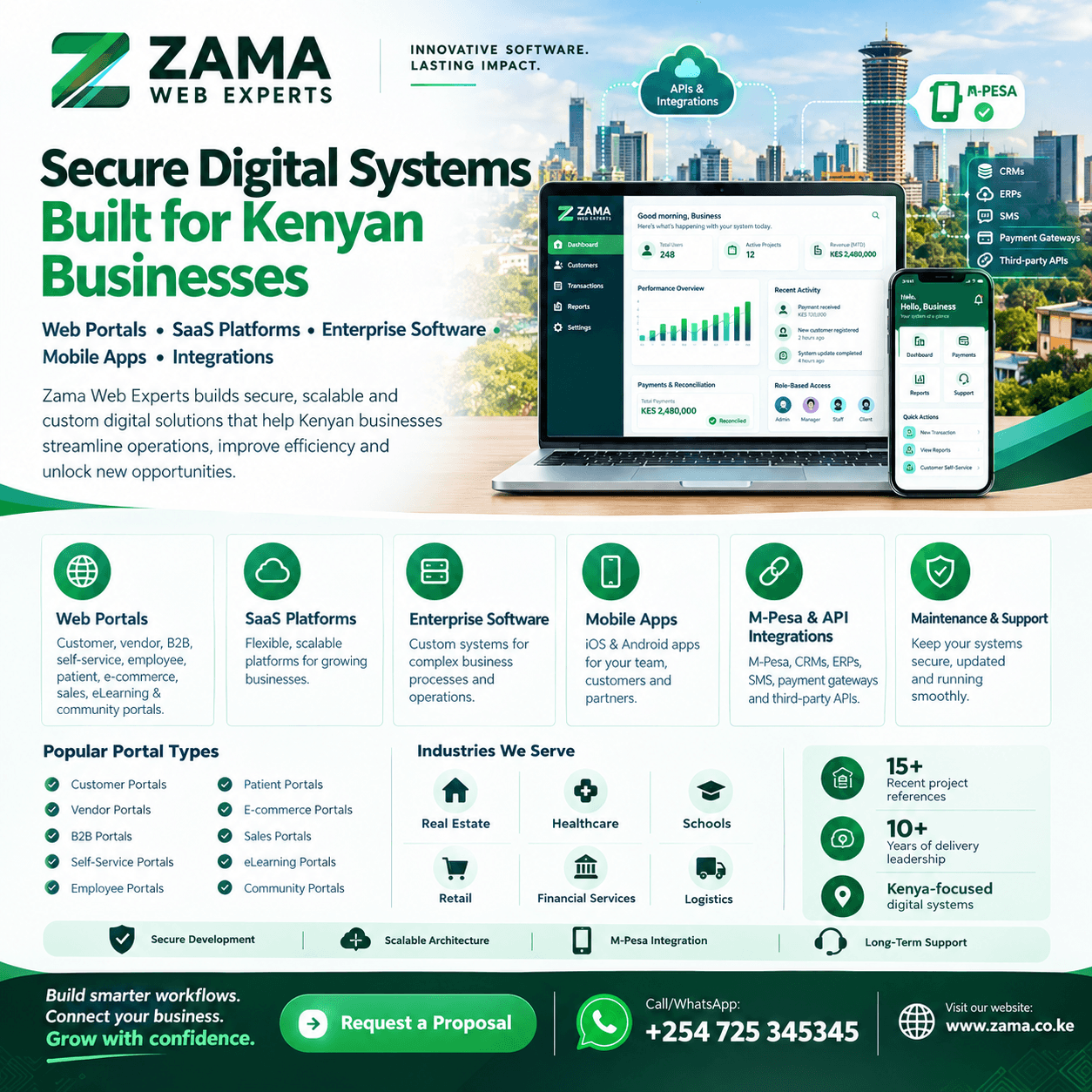
B2B payment reconciliation dashboard is a question that every finance director, accounts receivable manager, and operations leader in Kenya must answer in 2026. With B2B transactions arriving through M-Pesa, bank transfers, cheques, and cash, each with different references and inconsistent timing, finance teams spend hours matching payments to invoices manually. The gap between what has been paid and what is recorded as paid becomes a source of disputes, delayed cash flow visibility, and audit risk. At zama.co.ke, we’ve helped numerous B2B organizations across Kenya implement custom payment reconciliation dashboards that match payments to invoices automatically, surface exceptions clearly, and give finance leadership real-time visibility into receivables. This comprehensive guide explores the B2B payment reconciliation dashboard, from understanding what these dashboards deliver to selecting the right approach for your business.
What a B2B Payment Reconciliation Dashboard Actually Delivers
Before diving into the B2B payment reconciliation dashboard, it’s essential to understand what this technology actually does. A B2B payment reconciliation dashboard is a digital platform that consolidates payment data from multiple sources—M-Pesa statements, bank feeds, cheque registers, and cash receipts—and matches each payment against outstanding invoices, customer accounts, and credit notes. It displays the results in real time, highlighting what has matched, what remains unmatched, and what requires human attention.
A proper B2B payment reconciliation dashboard does far more than display a list of transactions. It receives M-Pesa payment notifications through Daraja API, imports bank statements, and captures manual payment entries. It applies matching rules—by invoice reference, customer account, phone number, amount, and date—to pair payments with invoices automatically. It handles partial payments, overpayments, and payments covering multiple invoices. It flags genuinely ambiguous cases for review. It updates customer balances and aging automatically.
For a Kenyan B2B business, the practical definition of a B2B payment reconciliation dashboard is this: the single screen that tells you exactly how much has been received today, exactly which invoices have been settled, exactly which payments remain unmatched and why, and exactly what your true receivables position is—without anyone manually reconciling statements.
Why Kenyan B2B Businesses Need a Payment Reconciliation Dashboard
When evaluating the B2B payment reconciliation dashboard, consider the compelling reasons for adoption:
The Manual Reconciliation Burden
Kenyan B2B finance teams spend an extraordinary amount of time reconciling payments. Payments arrive with transaction codes rather than invoice numbers. Customers pay multiple invoices with a single transfer. Partial payments arrive without explanation. Some customers pay for a different account than the one they reference. Reconciling these payments against ledgers requires judgement and investigation.
A modern B2B payment reconciliation dashboard automates the majority of this work. Matching rules handle the predictable cases—exact invoice references, exact amounts, known customer phone numbers. Only the genuinely ambiguous cases reach a human reviewer, and those arrive with context already attached.
Cash Flow Visibility Depends on Reconciliation Speed
A business cannot manage cash flow it cannot see. If reconciliation lags by a week, management is making decisions on data that is a week old. Credit decisions, supplier payments, and investment choices all depend on knowing the true cash position.
A proper B2B payment reconciliation dashboard updates the cash position in real time. When M-Pesa confirms a payment, the dashboard reflects it immediately. Management sees today’s position, not last week’s.
The Cost of Unapplied Cash
Unapplied cash is the most expensive form of working capital inefficiency. Payments received but not matched to invoices sit in suspense accounts. The customer’s balance still shows as overdue. Collection efforts continue against a customer who has already paid—damaging the relationship. Meanwhile, the business may be borrowing to cover a cash gap that does not actually exist.
A comprehensive B2B payment reconciliation dashboard eliminates unapplied cash by matching payments promptly and completely. Every payment finds its invoice. The true receivables position is visible immediately.
Dispute Resolution Requires Evidence
When a B2B customer disputes a balance, the finance team must reconstruct the payment history. With manual records, this takes hours or days. With a dashboard, the evidence is immediate—every payment, its timestamp, its source, and the invoices it settled.
A quality B2B payment reconciliation dashboard maintains a complete, timestamped reconciliation trail. Disputes are resolved quickly and with confidence.
Multi-Channel Complexity
Kenyan B2B payments arrive through many channels. M-Pesa STK Push, M-Pesa PayBill, M-Pesa Till Number, bank RTGS, bank EFT, cheques, and cash all appear in different formats. Consolidating these into a single view of receivables is impossible without a system.
A proper B2B payment reconciliation dashboard consolidates every payment channel into a single view. Whether the buyer paid via M-Pesa or bank transfer, the payment appears in the same dashboard and is matched against the same invoices.
Credit Control Depends on Accurate Balances
Credit limits are only meaningful if balances are accurate. A customer with an overdue balance should be blocked from new orders. A customer who has paid but whose payment is unapplied should not be blocked. Manual reconciliation produces both types of error—approving risky orders and blocking good customers.
A comprehensive B2B payment reconciliation dashboard keeps customer balances accurate in real time, enabling credit control decisions that are both safe and fair.
Audit and Compliance Requirements
Tax authorities and auditors require evidence that payments received correspond to invoices issued, and that revenue is recognized correctly. Without systematic reconciliation, demonstrating this becomes a manual reconstruction exercise.
A quality B2B payment reconciliation dashboard maintains complete audit trails for every payment—source, timestamp, matched invoices, and the user who reviewed any exceptions. Audit preparation becomes straightforward.
Key Features of a B2B Payment Reconciliation Dashboard
When evaluating the B2B payment reconciliation dashboard, focus on these core features:
1. Multi-Channel Payment Ingestion
The foundation is receiving payments from every channel. A proper system ingests M-Pesa payments through Daraja API callbacks, imports bank statements through file upload or bank API integration, records cheque payments, and captures cash receipts. Every payment enters the dashboard with its source, reference, amount, and timestamp intact.
2. Automated Matching Rules
Matching is the core function. A comprehensive B2B payment reconciliation dashboard applies configurable rules to match payments against invoices—exact invoice reference, customer account number, payer phone number against customer records, and amount against outstanding invoices. Rules can be prioritized and combined to handle complex scenarios.
3. Partial Payment Handling
B2B customers frequently pay partially. A quality B2B payment reconciliation dashboard allocates partial payments correctly, tracking the remaining balance on the invoice, and applying subsequent payments to clear the remainder. It distinguishes between partial payments against a single invoice and lump-sum payments covering multiple invoices.
4. Overpayment and Credit Management
Customers sometimes overpay or prepay. A proper B2B payment reconciliation dashboard tracks overpayments as customer credits, applies those credits to future invoices automatically or on instruction, and refunds them where requested—with a complete audit trail.
5. Exception Queues with Context
Not every payment matches automatically. A comprehensive B2B payment reconciliation dashboard routes unmatched payments into a review queue where each item arrives with context—the payment source, amount, payer details, and suggested matches based on partial data. Reviewers resolve exceptions quickly rather than investigating from scratch.
6. Real-Time Cash Position
Finance leadership needs a live cash position. A quality B2B payment reconciliation dashboard shows today’s receipts by channel, total cash received this week and month, the outstanding receivables position, and the aging profile—all updated as payments arrive.
7. Customer Account Statements
Customers need accurate statements. A proper B2B payment reconciliation dashboard generates statements showing opening balance, invoices issued, payments received, credit notes, and closing balance, with reconciled payments clearly identified.
8. Aging and DSO Analytics
Days Sales Outstanding (DSO) is a key measure of working capital efficiency. A comprehensive B2B payment reconciliation dashboard calculates DSO, ages receivables into buckets, tracks collection performance over time, and identifies customers whose payment behaviour is deteriorating.
9. Reconciliation Reports for Audit
Auditors need evidence of reconciliation. A quality B2B payment reconciliation dashboard generates reconciliation reports showing each payment, its source, the invoices it settled, the date of reconciliation, and any exceptions and their resolutions—providing complete audit evidence.
10. Role-Based Access and Audit Trails
Reconciliation involves sensitive financial data. A proper B2B payment reconciliation dashboard implements role-based access—reviewers can see and resolve exceptions, supervisors can override matches, and management can view dashboards without editing. Every action is logged with user, timestamp, and details.
What Makes a B2B Payment Reconciliation Dashboard Different in Kenya
The B2B payment reconciliation dashboard has unique characteristics that global solutions often lack:
M-Pesa as the Primary Source
In most markets, reconciliation focuses on bank feeds and card processors. In Kenya, M-Pesa dominates. A dashboard built for Kenya integrates Daraja API natively, ingesting STK Push confirmations, PayBill payments, Till Number receipts, and B2C disbursement records as first-class payment sources.
Reference Chaos
Kenyan B2B payments often carry inconsistent references. A customer may reference an invoice number, an account number, a phone number, a business name, or nothing at all. A dashboard built for Kenya employs intelligent matching—using payer phone numbers to identify customers, amounts to suggest invoices, and historical patterns to predict likely matches.
Multi-Channel Consolidation
Kenyan B2B businesses receive payments across M-Pesa, bank transfers, cheques, and cash. A dashboard built for Kenya consolidates all channels into one reconciliation view, rather than treating each channel separately.
Credit Trade Reality
Kenyan wholesale and distribution run heavily on credit. A dashboard built for Kenya connects reconciliation to credit control—when payment is reconciled, the customer’s credit headroom is restored automatically.
eTIMS-Linked Invoices
Every invoice a VAT-registered business issues is eTIMS compliant. A dashboard built for Kenya reconciles payments against eTIMS-validated invoices, ensuring alignment between tax records and financial records.
Intermittent Connectivity
Connectivity outside Nairobi can be unreliable. A dashboard built for Kenya queues payment data during outages and reconciles when connectivity returns, rather than losing data or requiring manual re-entry.
Data Protection Act Compliance
Payments carry personal data—payer names, phone numbers, and account details. A compliant dashboard implements access controls, encryption, and retention policies aligned with the Data Protection Act.
Local Support
Kenyan finance teams need support in their timezone and language. Local support is a practical requirement.
Key Factors That Determine Cost
When analysing cost, several factors directly influence pricing:
1. Transaction Volume
Higher payment volumes mean more matching operations, more exceptions, and more infrastructure load.
2. Number of Payment Channels
Each additional payment channel adds ingestion integration and matching logic.
3. Integration Scope
Integration with accounting, ERP, M-Pesa, banks, and eTIMS determines effort.
4. Matching Complexity
Simple exact matching is easier to build than intelligent multi-criteria matching with fuzzy logic.
5. Customer Base Size
More customers mean more reference patterns and more matching rules.
6. Reporting Requirements
Custom reconciliation reports and audit evidence add complexity.
7. Deployment Model
Cloud, on-premise, or hybrid deployment affects cost and ongoing support.
8. Customization
Custom dashboards, reports, and workflows add to the build.
9. Training and Ongoing Support
Training finance teams and ongoing support contribute to total cost.
For a transparent quote based on your business’s specific requirements, contact zama.co.ke today.
Use Cases
FMCG Distributors
FMCG distributors reconcile thousands of M-Pesa payments weekly against invoices for hundreds of retail customers, many paying partially and with inconsistent references.
Wholesalers
Wholesalers reconcile bank transfers and M-Pesa payments against credit invoices, tracking which customers have restored their credit headroom.
Manufacturing Companies
Manufacturers reconcile payments against distributor orders and credit notes, with complex multi-invoice settlements.
Building Materials Suppliers
Suppliers reconcile payments against project-based invoices and retention balances.
Pharmaceutical Distributors
Distributors reconcile payments against batch-specific invoices while maintaining regulatory documentation.
Services and Consultancies
Service businesses reconcile retainer payments and project billing against milestones and timesheets.
The Zama.co.ke Approach to B2B Payment Reconciliation Dashboard Development
When considering the B2B payment reconciliation dashboard, zama.co.ke follows a structured approach:
Requirements Discovery
We map your payment channels, customer reference patterns, invoicing structure, and reconciliation workflows.
Dashboard Design
We design ingestion pipelines, matching rules, exception queues, and reporting views.
Development and Integration
We build the dashboard, integrate M-Pesa Daraja API, bank feeds, accounting systems, and eTIMS, and configure matching logic.
Testing and Data Migration
We test matching accuracy across real payment patterns, handle edge cases, and migrate historical payment data.
Training and Support
We train finance and credit control teams, and document reconciliation workflows.
Post-Launch Optimization
We monitor match rates, exception volumes, and aging metrics, then refine matching rules.
The ROI
When evaluating the B2B payment reconciliation dashboard, the ROI is compelling:
Eliminated Manual Matching: Finance teams stop matching statements by hand, reclaiming hours daily.
Reduced Unapplied Cash: Payments are applied promptly, so receivables reflect reality.
Faster Credit Decisions: Accurate balances enable safe, fair credit control.
Faster Dispute Resolution: Timestamped reconciliation records resolve disputes in minutes.
Improved Cash Visibility: Management sees the true cash position in real time.
Lower DSO: Prompt application of payments and accurate reminders accelerate collections.
Audit Readiness: Complete reconciliation trails satisfy auditors without reconstruction.
Implementation Considerations
Assess Your Current Reconciliation Process
Document how payments arrive, how they are matched today, where the delays and errors occur, and what the current aging profile looks like.
Choose the Right Solution
Match complexity to your volumes and channels. A cash-only wholesaler needs less than a credit distributor with five channels.
Plan for Data Migration
Migrate customer records, open invoices, and historical payments carefully.
Train Your Team
Finance and credit control staff must understand matching rules and exception handling.
Ensure Compliance
Build Data Protection Act and eTIMS alignment in from day one.
Test Thoroughly
Test every channel, every reference pattern, and every exception scenario.
Consider a Phased Rollout
Start with M-Pesa reconciliation, then add bank and other channels.
The Cost of Delaying
While finance teams evaluate the B2B payment reconciliation dashboard, the cost of inaction compounds daily. Every day of manual reconciliation is unapplied cash. Every day of inaccurate balances is credit risk and customer friction. Every day of delayed visibility is a decision made on stale data.
Why Contact Zama.co.ke
When researching the B2B payment reconciliation dashboard, businesses should contact zama.co.ke because:
M-Pesa Expertise: We integrate Daraja API for real-time payment ingestion and reconciliation.
B2B Expertise: We understand credit trade, partial payments, and reference chaos.
eTIMS Expertise: We reconcile payments against eTIMS-validated invoices.
Custom Development: We build matching logic matched to your actual payment patterns.
Transparent Pricing: No hidden fees and full source-code ownership.
Ongoing Support: We stay available as your channels and volumes grow.
For a custom quote based on your business’s specific requirements, contact zama.co.ke today.
The B2B payment reconciliation dashboard is essential for any B2B business seeking to eliminate manual matching, reduce unapplied cash, and see its true cash position. From multi-channel ingestion and automated matching to exception queues and audit-ready reporting, the right dashboard changes how your finance function operates.
At zama.co.ke, we’ve helped B2B businesses across Kenya implement reconciliation dashboards that deliver measurable results. Our approach ensures you get exactly what your business needs—nothing more, nothing less.
Don’t let the complexity of a B2B payment reconciliation dashboard hold you back. Whether you process a hundred payments a month or fifty thousand, we have the expertise to guide you through every step.
Contact zama.co.ke today for a custom quote based on your business’s specific requirements.