
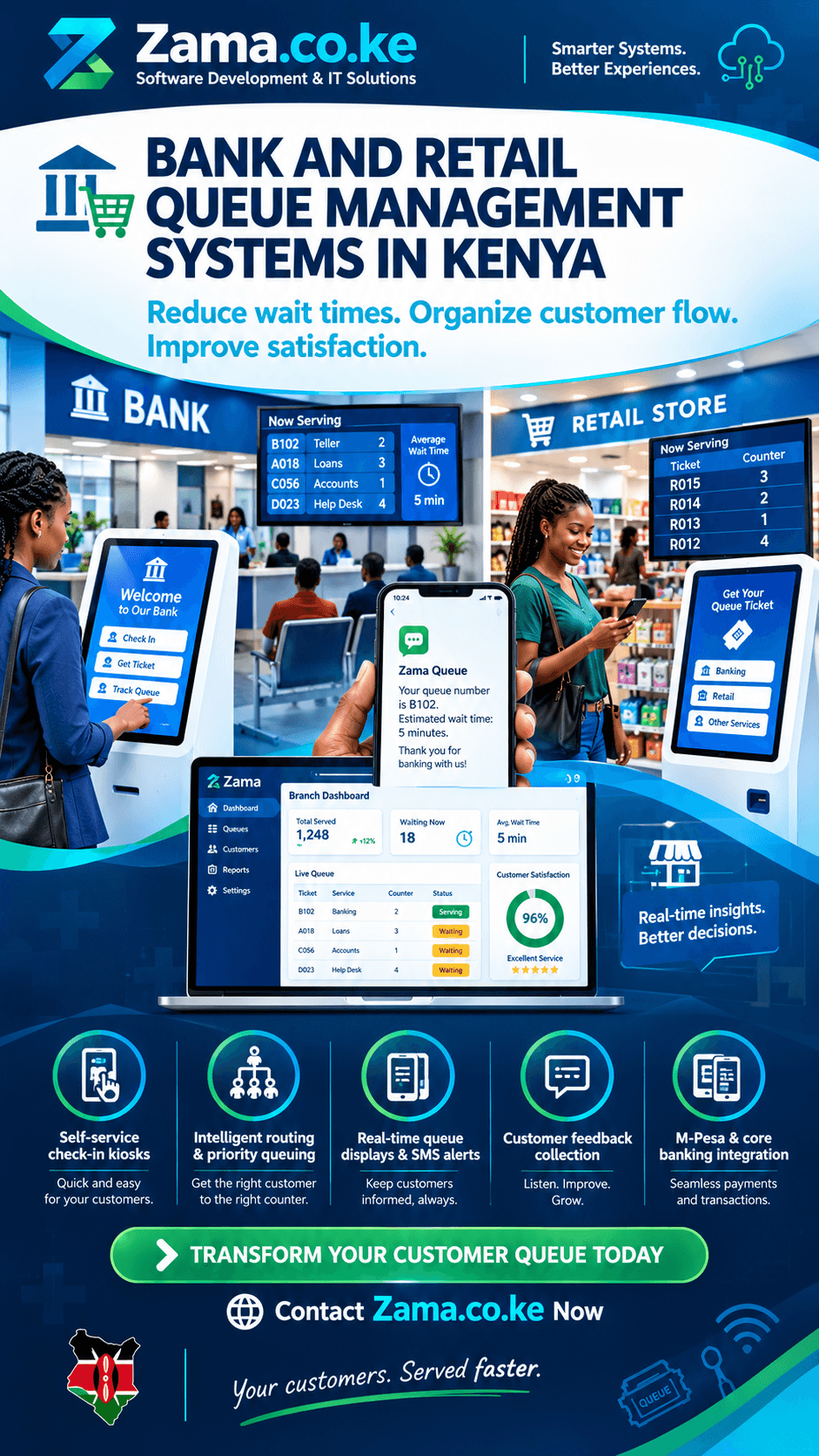
Bank and retail queue management systems in Kenya is a question that every bank branch manager, retail operations director, and customer experience leader must answer in 2026. With Kenyan banks serving millions of customers through branch networks, retail chains expanding across Nairobi, Mombasa, Kisumu, and beyond, and customers increasingly unwilling to tolerate long waits, the pressure to modernize queue management has never been greater. At zama.co.ke, we’ve helped numerous organizations across Kenya implement queue management systems that transform how customers are served in banking halls and retail stores. This comprehensive guide explores bank and retail queue management systems in Kenya, from understanding what these systems do to selecting the right solution for your organization.
What Bank and Retail Queue Management Systems Actually Do
Before diving into bank and retail queue management systems in Kenya, it’s essential to understand what these systems actually do. Bank and retail queue management systems are digital platforms that organize, monitor, and optimize customer flow in service environments. They replace chaotic physical queues, manual paper registers, and disorderly waiting areas with intelligent digital systems that assign tickets, route customers, track wait times, and provide real-time visibility into branch and store activity.
A proper bank and retail queue management systems in Kenya does far more than display a token number on a screen. It integrates with core banking systems, customer relationship management platforms, and retail point-of-sale systems. It routes customers to the correct service counters based on transaction type—cash deposit, withdrawal, account opening, loan consultation, customer service, or returns processing. It prioritizes premium customers, elderly customers, and persons with disabilities. It provides real-time dashboards showing counter activity, staff productivity, and customer wait times.
For a Kenyan bank or retailer, the practical definition of bank and retail queue management systems in Kenya is this: the platform that tells you exactly how many customers are waiting, exactly which counters are overloaded, exactly how long each customer has been waiting, and exactly how to route customers to reduce wait times—all in real time, from a single dashboard accessible on any device, with workflows tailored to your specific branches, staff, and customer categories.
Why Kenyan Banks and Retailers Need Queue Management Systems
When evaluating bank and retail queue management systems in Kenya, it’s important to understand the challenges driving adoption. Kenyan banks face intense competition from mobile banking, fintech, and digital wallets. Customers visit branches less frequently than in the past, but when they do visit—for account opening, loan applications, or complex transactions—they expect efficient service. Long waits drive customers away, and banks that cannot serve them quickly lose business to competitors.
Retailers face similar pressures. With the rise of e-commerce and changing shopping habits, brick-and-mortar stores must deliver exceptional in-person experiences to compete. Customers who wait too long at checkout or customer service desks may abandon purchases or take their business elsewhere.
A custom bank and retail queue management systems in Kenya addresses these challenges systematically. It eliminates congested waiting areas by allowing customers to wait elsewhere—in their cars, at nearby shops, or at home—until their turn approaches. It provides accurate wait time information so customers can plan their visit. It routes customers to the correct counters automatically. It alerts supervisors when queues exceed thresholds, enabling rapid intervention.
The Kenyan market has already demonstrated the value of these systems. Newforties SACCO deployed a comprehensive Bank Queue Management System and Customer Experience platform, transforming from manual queuing to intelligent, data-driven member flow management. Self-service QMS kiosks enable members to select services and receive queue tickets, dramatically reducing waiting time within banking halls. Stima DT SACCO deployed a data-driven queue management system with synchronized lobby and counter displays, and a lightweight feedback portal designed specifically with Kenya’s data-protection requirements in mind. The Business Registration Service operationalized a queue management system serving more than 5,000 customers monthly, with digital tickets and automatic routing. Kenya Power installed queue management and customer experience feedback systems at eight key regional service centres, with customers picking digital tickets and tracking their queue positions on wall-mounted screens.
Essential Features of Bank and Retail Queue Management Systems in Kenya
When evaluating bank and retail queue management systems in Kenya, focus on these core features:
1. Self-Service Customer Check-In
The foundation of any queue management system is customer check-in. A proper system should offer self-service kiosks, mobile check-in, and reception-assisted check-in options. Customers arriving at a bank branch or retail store can identify themselves using their national ID, phone number, account number, or QR code. The system verifies their identity, identifies the services they need, and issues a digital queue ticket.
Self-service check-in reduces the burden on reception staff, shortens the check-in process, and ensures customer information is captured accurately. For Kenyan banks and retailers where branches are often congested, kiosk-based or mobile-based check-in significantly improves the arrival experience.
2. Intelligent Customer Routing
Once checked in, customers must be routed to the correct service counter. A comprehensive bank and retail queue management systems in Kenya automatically routes customers based on the service they need—cash deposit, withdrawal, account opening, loan consultation, customer service, or returns processing. The system considers counter availability, queue lengths, and customer priority.
Premium customers, elderly customers, and persons with disabilities should be flagged and prioritized automatically. Customers with appointments should be placed in the appropriate queue without waiting behind walk-in customers. Customers requiring multiple services—deposit, then consultation—should be tracked through their entire visit.
3. Priority-Based Queuing
Not all customers are equal in queue management terms. A proper bank and retail queue management systems in Kenya should support priority-based queuing:
Premium Customer Priority: High-value customers, private banking clients, and premium account holders receive priority service.
Elderly and Vulnerable Customer Priority: Elderly customers, pregnant women, and persons with disabilities receive priority based on organizational policy.
Appointment Priority: Customers with scheduled appointments receive priority over walk-ins.
Staff Priority: Where applicable, staff members receive priority handling for internal transactions.
The system should apply these priorities automatically based on customer attributes, without requiring staff to manually intervene at each queue position.
4. Real-Time Display Screens
Customers need to know where they stand in the queue. A comprehensive bank and retail queue management systems in Kenya should support large-screen displays in waiting areas showing current queue numbers, the counters serving them, and estimated wait times. When customers are called, their numbers appear on the screen along with the counter number.
Digital displays reduce the stress of queuing because customers know approximately how long they will wait. They also reduce the need for customers to crowd around counters, freeing up space in waiting areas and improving the overall customer experience.
5. SMS and Mobile Notifications
Customers should not have to sit in a waiting area for hours when they could be elsewhere. A modern bank and retail queue management systems in Kenya should support SMS and mobile app notifications. When a customer’s turn is approaching, they receive an SMS alert. When their turn arrives, they receive a second alert. This enables customers to wait in a nearby area, at the bank cafeteria, or outside in the shade, returning when their turn is called.
For Kenyan banks and retailers serving customers who may not have smartphones, SMS notifications are essential. The system should support basic feature phones, not just smartphone apps.
6. Counter and Staff Management
Banks and retail stores have multiple counters, each with its own staff and service requirements. A proper bank and retail queue management systems in Kenya should support counter-level queue management. Each counter has its own queue, its own staff assignments, and its own service capabilities. Supervisors can see counter-level performance in real time—how many customers are waiting, average wait times, and staff productivity.
The system should support staff reassignment—moving staff from a low-demand counter to a high-demand counter in real time—and counter reassignment—opening additional counters when queues grow.
7. Integration with Core Banking and Retail Systems
Queue management systems rarely operate in isolation. A comprehensive bank and retail queue management systems in Kenya should integrate with core banking systems, customer relationship management platforms, and retail point-of-sale systems. When a customer is called to a counter, the teller should already have access to the customer’s account information. When a transaction is completed, the core banking system should be updated automatically. When a retail customer is called to the returns desk, the POS system should have the purchase history ready.
8. Customer Feedback Collection
Customer satisfaction is a critical measure of service quality. A quality bank and retail queue management systems in Kenya should include customer feedback capabilities. After service is completed, customers receive SMS or in-app requests to rate their experience—wait times, staff courtesy, branch cleanliness, clarity of communication. Feedback is collected and analyzed, providing management with actionable insights.
Newforties SACCO’s feedback portal and Kenya Power’s customer experience portal allow customers to share satisfaction ratings and comments through in-branch kiosks or mobile device links. BRS managers can track satisfaction levels over time to identify areas for improvement.
9. Analytics and Reporting
Data from customer flow should inform management decisions. A proper bank and retail queue management systems in Kenya should generate comprehensive reports:
Customer Volume Reports: Daily, weekly, and monthly customer volumes by branch and service type.
Wait Time Reports: Average wait times by branch, by service type, by time of day.
Service Time Reports: Average transaction durations by teller, by counter, by service type.
Peak Hour Analysis: Identification of peak periods for staffing optimization.
Customer Feedback Reports: Satisfaction scores and comments by branch and service type.
Staff Performance Reports: Productivity metrics by staff member and counter.
These reports support operational decisions—staff scheduling, branch capacity planning, process improvement—and provide evidence for quality improvement initiatives.
10. Offline Capability and Resilience
Kenyan banks and retail stores face power fluctuations and internet outages. A proper bank and retail queue management systems in Kenya should continue functioning during connectivity issues. Customer check-in, queue tracking, and display screens should continue operating locally, syncing data with the central system when connectivity returns.
What Makes Bank and Retail Queue Management Systems in Kenya Different
Bank and retail queue management systems in Kenya have unique characteristics that generic solutions often lack:
M-Pesa Payment Integration
For banks and retailers that collect payments at service points, M-Pesa integration is essential. The queue management system should support M-Pesa STK Push for service payments, automatically confirming payment and releasing the customer to the next stage of their visit. Bill payments, account deposits, and retail purchases can all be processed via M-Pesa within the queue management workflow.
Integration with Core Banking Systems
Kenyan banks use core banking systems to manage accounts, transactions, and customer data. A queue management system for banks must integrate with these systems, automatically verifying customer identity, retrieving account information, and updating transaction records. Integration with systems from vendors like Finacle, T24, and Flexcube is essential.
Multi-Branch Support
Kenyan banks and retail chains operate across multiple branches. A proper queue management system should centralize management while respecting local branch autonomy. Head office can monitor queue performance across all branches. Branch managers can manage their own queues. Regional managers can compare performance across branches.
SMS-First Design
Unlike markets where smartphone penetration is near-universal, Kenya has significant feature phone usage. A queue management system designed for Kenya must support SMS as a primary channel, not an afterthought. Customers should be able to join queues, receive updates, and check their position via SMS without needing a smartphone.
Multi-Language Support
Kenyan banks and retailers serve customers in English and Swahili, and often in local languages. A proper queue management system should support multiple languages for customer-facing interfaces and notifications.
KRA eTIMS Compliance
For transactions that require tax invoices, the queue management system should support KRA eTIMS compliance, generating tax invoices and transmitting them to KRA automatically.
Data Protection Act Compliance
Kenyan banks and retailers handle sensitive customer data. A queue management system must comply with the Data Protection Act, ensuring customer data is encrypted, access is controlled, and audit trails are maintained. The system should support customer consent management and data subject access requests.
Bank and Retail Queue Management Systems in Kenya: Use Cases
Bank Branches
Bank branches use queue management systems to manage customer flow across teller counters, customer service desks, account opening, and loan consultation. Customers check in via kiosk or mobile, receive estimated wait times, and are notified when their turn approaches. The system routes customers to the correct counters and collects feedback on their experience.
SACCOs and Microfinance Institutions
SACCOs and microfinance institutions use queue management systems to manage member flow. Newforties SACCO deployed a comprehensive system with self-service kiosks, and Stima DT SACCO deployed a data-driven system with synchronized lobby and counter displays. Members select services and receive queue tickets, reducing waiting time dramatically.
Retail Stores
Retail stores use queue management systems to manage customer service desks, returns processing, and checkout queues. Customers check in, receive queue numbers, and are notified when staff are available to assist them.
Supermarkets and Hypermarkets
Supermarkets use queue management systems to manage checkout queues. While traditional checkout lines are still common, some supermarkets use virtual queuing for customer service, returns, and specialized services.
Telecoms Retail Outlets
Telecoms operators use queue management systems to manage customer service requests. Customers check in, receive queue numbers, and are notified when staff are available to assist them.
Government Service Centres
Government offices use queue management systems to manage citizens seeking services. The Business Registration Service operationalized a queue management system serving more than 5,000 customers monthly, with digital tickets and automatic routing to the next available service counter.
Utility Companies
Utility companies use queue management systems to manage customer service centres. Kenya Power installed queue management and customer experience feedback systems at eight key regional service centres, with customers picking digital tickets and tracking their queue positions on wall-mounted screens.
The Zama.co.ke Approach to Bank and Retail Queue Management Systems
When considering bank and retail queue management systems in Kenya, zama.co.ke follows a structured approach:
Workflow Discovery
We define your customer journeys, service types, staff roles, and reporting needs. This includes understanding your current queuing challenges, customer expectations, and operational workflows.
System Design
We design the queue management architecture—customer interfaces, staff dashboards, routing rules, notification workflows, and integration points. The design supports your specific service types and customer categories.
Development and Integration
We develop the platform, integrate with existing systems (core banking, CRM, POS, payment systems), and configure queue rules, notification templates, and reporting dashboards.
Hardware Selection and Installation
We recommend and supply kiosks, displays, printers, and network equipment suitable for your branch or store environment.
Training and Support
We provide role-specific training for tellers, customer service representatives, branch managers, and administrators. We remain available for ongoing support, maintenance, and system upgrades.
Post-Launch Optimization
After go-live, we monitor performance, gather user feedback, and refine the system to improve wait times and customer satisfaction.
The ROI of Bank and Retail Queue Management Systems in Kenya
When evaluating bank and retail queue management systems in Kenya, the ROI is compelling:
Reduced Wait Times: Digital queue management significantly reduces customer wait times by optimizing routing, automating priority, and enabling real-time intervention when queues exceed thresholds.
Improved Customer Satisfaction: Customers know where they stand in the queue, receive SMS notifications, and experience shorter waits. Satisfaction scores improve, and complaints decline.
Increased Throughput: Faster customer processing means branches and stores can serve more customers per day without adding staff or facilities.
Enhanced Staff Productivity: Staff no longer spend time managing physical queues, answering repetitive questions, or searching for customers. They focus on serving customers.
Data-Driven Decisions: Real-time dashboards and comprehensive reports provide management with actionable insights for staffing, capacity planning, and process improvement.
Compliance Support: Data Protection Act compliance is built into the system, reducing legal and regulatory risk.
Scalability: The system can grow with your organization, adding branches, counters, and services without rebuilding.
Implementation Considerations for Kenyan Banks and Retailers
When implementing bank and retail queue management systems in Kenya, consider these factors:
Assess Your Current Customer Flow
Before selecting a system, document your current customer journey. Where do customers arrive? How do they check in? How are they routed? Where do they wait? How long do they wait? Where are the bottlenecks? This assessment forms the foundation for system design.
Choose the Right Solution
The best queue management system for your organization depends on your branch or store size, service types, customer volume, and integration requirements. A small retail store may need basic check-in and queue tracking; a large bank branch may need multi-counter routing, priority rules, and extensive integration.
Plan for Data Protection Compliance
Configure the system for Data Protection Act compliance from day one. Implement customer consent management, access controls, audit logging, and data retention policies.
Train Tellers and Customer Service Staff
Tellers, customer service representatives, and branch managers need training on the new system. Role-specific training using real scenarios produces higher adoption and better customer outcomes.
Test Thoroughly
Test all scenarios: appointments, walk-ins, priority customers, multi-service journeys, exception handling, offline mode, and report generation.
Integrate with Existing Systems
Where possible, integrate the queue management system with existing core banking, CRM, POS, and payment systems. This creates a unified customer service ecosystem.
Consider a Phased Rollout
For large organizations, consider a phased rollout. Start with one branch or store, prove the system works, refine based on feedback, then expand. This approach catches issues early and builds confidence among staff.
The Cost of Delaying Queue Management Implementation
While bank and retail executives evaluate bank and retail queue management systems in Kenya, the cost of inaction compounds daily. Every day of physical queue management represents longer wait times, frustrated customers, and strained staff. Every day of paper-based processes represents data protection risks and missed opportunities for operational improvement. Every day of customer dissatisfaction represents reputational damage and potential loss of customers to competitors.
Meanwhile, organizations that have implemented queue management systems are achieving shorter wait times, higher customer satisfaction, and improved operational efficiency. The competitive gap widens with every passing month.
The Zama.co.ke Difference
When you choose zama.co.ke for your bank and retail queue management system, you gain:
Local Expertise: We understand Kenyan banking and retail operations, customer expectations, and regulatory requirements.
Custom Development: We build systems tailored to your specific service types, customer categories, and operational workflows, not generic solutions.
Integration Capabilities: We connect queue management to core banking, CRM, POS, and payment systems.
Hardware and Software: We supply, install, and configure kiosks, displays, and network equipment alongside the software.
Ongoing Support: We remain available for maintenance, troubleshooting, and system upgrades.
Transparent Pricing: No hidden fees, clear milestone timelines, and full source-code ownership.
Bank and retail queue management systems in Kenya are essential for any organization seeking to reduce wait times, organize customer flow, improve satisfaction, and ensure data protection compliance. From multi-channel check-in and real-time queue position updates to intelligent routing and priority-based queuing, the right queue management system transforms how banks and retailers serve their customers.
At zama.co.ke, we’ve helped organizations across Kenya implement queue management systems that deliver measurable results. Our approach ensures you get exactly what your organization needs—nothing more, nothing less.
Don’t let the complexity of bank and retail queue management systems in Kenya hold you back. Whether you’re managing a single bank branch, a SACCO, a retail chain, or a supermarket, we have the expertise to guide you through every step.
Contact zama.co.ke today and let us help you build a queue management system that transforms your customer experience.