
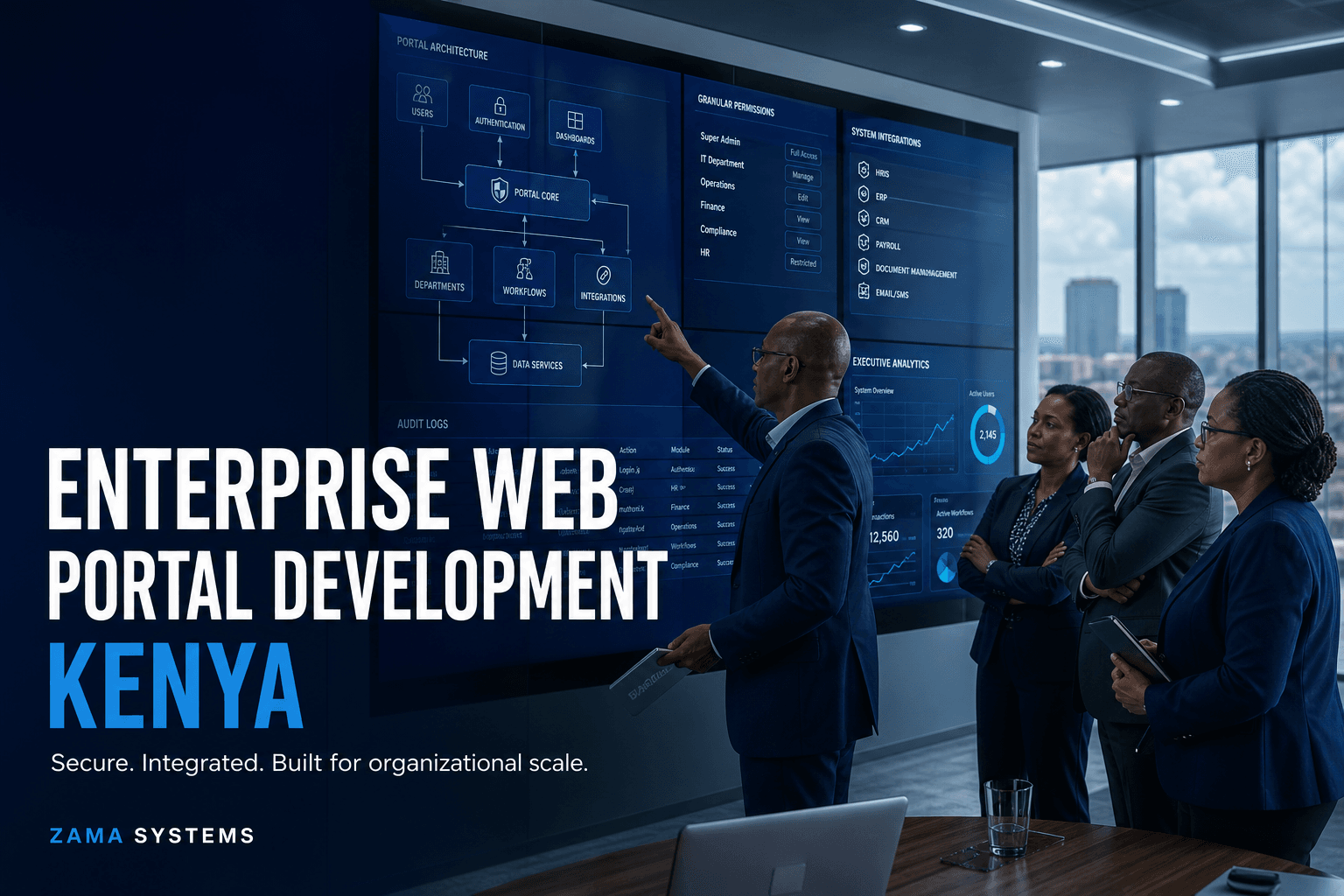
Best API integration for Kenyan enterprise software is a question that every IT director, operations manager, and enterprise architect must answer in 2026. With Kenya’s enterprise software ecosystem expanding rapidly, M-Pesa processing over 2 trillion shillings in annual transactions, KRA eTIMS compliance mandatory for all VAT-registered businesses, and enterprises across banking, manufacturing, retail, and logistics recognizing that disconnected systems erode profitability, the ability to connect enterprise software with critical APIs has become essential for operational efficiency. At zama.co.ke, we’ve helped numerous organizations across Kenya implement API integrations that connect their enterprise software to M-Pesa, eTIMS, SMS gateways, and other critical systems. This comprehensive guide explores the best API integration for Kenyan enterprise software, from understanding what API integration delivers to selecting the right approach for your organization.
What API Integration for Kenyan Enterprise Software Actually Delivers
Before diving into the best API integration for Kenyan enterprise software, it’s essential to understand what this technology actually does. API integration connects your enterprise software—whether it’s an ERP, CRM, POS, facility management platform, or custom business system—to external services through Application Programming Interfaces. It enables real-time data flow between systems, automates transactions, and eliminates manual data entry.
A proper best API integration for Kenyan enterprise software does far more than connect systems. It enables M-Pesa payments to reconcile automatically against invoices. It transmits tax invoices to KRA eTIMS in real time. It sends SMS notifications when payments are received. It updates inventory when sales are made. It synchronizes customer data across CRM and accounting platforms.
For a Kenyan enterprise, the practical definition of best API integration for Kenyan enterprise software is this: the connected ecosystem that tells you exactly what has been paid, exactly what has been invoiced, exactly what has been shipped, and exactly how every system in your business is performing—all in real time, with data flowing automatically between platforms.
Why Kenyan Enterprises Need API Integration
When evaluating the best API integration for Kenyan enterprise software, consider the compelling reasons for adoption:
The Cost of Disconnected Systems
Most Kenyan enterprises operate with fragmented software ecosystems. The accounting system is separate from the POS. The CRM is separate from the ERP. The payment system is separate from the billing system. The SMS gateway is separate from the customer database. This fragmentation creates significant problems:
Manual Data Entry: Staff spend hours re-entering data between systems, introducing errors and wasting time.
Payment Mismatches: M-Pesa payments arrive without automatic reconciliation, requiring manual matching against invoices and customer accounts.
Compliance Gaps: Without eTIMS integration, tax invoices are not transmitted to KRA in real time, creating compliance risk.
Delayed Reporting: Financial reports are compiled manually from multiple systems, arriving too late to inform decisions.
Poor Customer Experience: Customers wait for payment confirmation, receive no automated notifications, and experience delays in service delivery.
A modern best API integration for Kenyan enterprise software addresses these challenges systematically. It connects systems, automates data flow, eliminates manual entry, and provides real-time visibility across the entire business.
M-Pesa Is the Default Payment Rail
M-Pesa is not just a payment option in Kenya—it is the default rail. If your enterprise software does not integrate with M-Pesa, you are turning away most of your customers. The M-Pesa Daraja API enables businesses to accept mobile money programmatically through STK Push, C2B, B2C, and B2B flows. A proper best API integration for Kenyan enterprise software includes native M-Pesa integration from day one.
KRA eTIMS Compliance Is Mandatory
Since January 2024, all VAT-registered businesses in Kenya must transmit invoices to KRA through eTIMS. Non-compliance carries penalties of up to KES 1 million or imprisonment. A proper best API integration for Kenyan enterprise software includes eTIMS integration that transmits invoices in real time, generates KRA-compliant tax invoices, and maintains audit trails.
The Growth of Enterprise API Platforms in Kenya
The Kenya Revenue Authority itself is rolling out an Enterprise API gateway platform to enable integration internally across systems and externally with taxpayers and partner Government agencies through Open APIs and self-service. This government-led push toward API-driven integration is driving demand for best API integration for Kenyan enterprise software across both public and private sectors.
Essential API Integrations for Kenyan Enterprise Software
When evaluating the best API integration for Kenyan enterprise software, focus on these core integrations:
1. M-Pesa Daraja API Integration
M-Pesa Daraja API integration is the foundation of any enterprise software API strategy in Kenya. A proper integration should support:
M-Pesa Express (STK Push): The customer enters a phone number at checkout. Your system calls Daraja, which pushes a payment prompt to the customer’s phone. They enter their M-PESA PIN to confirm. You receive a callback when payment completes—success or failure. This is ideal for online checkout, fee payment, deposit collection, and app top-ups.
C2B (Customer to Business): The customer pays your Paybill or Till number directly from their phone. You receive validation and confirmation webhooks. No prompt is pushed from your side. This is ideal for offline scenarios, fee payments with reference numbers, utility bills, and rent.
B2C (Business to Customer): You send money from your business shortcode to a customer’s M-PESA wallet—for refunds, marketplace seller payouts, supplier payments, or casual labour disbursement. B2C requires organisational shortcode with adequate float and tight operational controls.
Account Balance & Transaction Status: These utility APIs turn unreliable integrations into reliable ones. Account Balance tells you how much float is in your B2C shortcode. Transaction Status queries the state of a specific transaction by its M-PESA receipt number—essential when callbacks fail or arrive late.
B2B (Business to Business): For payments between business accounts, such as inter-company transactions or bulk supplier payments.
2. KRA eTIMS API Integration
KRA eTIMS integration is mandatory for VAT-registered enterprises. A proper integration should support:
Online Sales Control Unit (OSCU): Designed for businesses that operate online invoicing systems continuously and are always online. This configuration allows for real-time data exchange, ensuring that all transactions are immediately reported to eTIMS.
Virtual Sales Control Unit (VSCU): Tailored for businesses that may not always be online. It supports bulk invoicing and allows for periodic data uploads to eTIMS.
System-to-System Connection: The integration typically involves establishing a system-to-system connection, allowing your existing ERP or POS system to communicate directly with the eTIMS platform through API connections or middleware solutions.
Item Master Data Management: Perform CRUD operations for product/service item master data, keeping KRA informed of product catalogues.
Purchase Data Management: Send and retrieve purchase data to ensure compliance with eTIMS requirements.
3. SMS and Communication API Integration
SMS remains one of the most effective communication channels in Kenya, with open rates exceeding 90%. A proper enterprise API integration should support:
Bulk SMS: Send notifications to customers, staff, and partners. Africa’s Talking offers SMS with 98% open rates, USSD, and voice built for Africa.
WhatsApp Business API: Kenya’s most-used messaging app. Twilio provides WhatsApp Business API integration for Kenya with international reach.
USSD: For customers without smartphones, USSD provides a channel for service access.
Delivery Tracking: SMS and email notifications when payments are received, orders are shipped, or services are completed.
4. ERP and Accounting API Integration
Enterprise software rarely operates in isolation. A proper best API integration for Kenyan enterprise software should connect:
Accounting Software: Sync sales data, inventory updates, financial reports, and customer records with accounting platforms.
ERP Platforms: Connect enterprise resource planning systems with POS, CRM, and payment platforms.
Custom Business Systems: Integrate proprietary or custom-built systems with standard enterprise software.
This removes duplicate data entry and ensures financial accuracy across the organization.
5. CRM and Marketing Automation Integration
Customer relationship management and marketing automation depend on accurate, real-time data. A comprehensive best API integration for Kenyan enterprise software should connect:
Email Marketing Platforms: Sync customer data and automate campaigns.
SMS Gateways: Trigger SMS notifications based on customer actions.
WhatsApp APIs: Send WhatsApp messages for customer onboarding, payment reminders, and subscription renewals.
Lead Management Systems: Capture leads from multiple sources and route them to the right teams.
6. Payment Gateway Integration
Beyond M-Pesa, enterprises need to accept cards, bank transfers, and international payments. A proper integration should support:
Card Payment Processors: Accept Visa, Mastercard, and other card payments.
International Payment APIs: Support PayPal, Stripe, and Flutterwave for international customers.
Wallet Systems: Integrate with digital wallets and mobile money platforms.
Subscription Billing Engines: Automate recurring billing and subscription management.
7. Direct Bank API Integration
For enterprises that need direct bank integration, modern platforms connect directly with local banking APIs, enabling secure, automated, and real-time transaction tracking. A proper integration should support:
Real-Time Transaction Tracking: Monitor bank transactions as they happen.
Automated Reconciliation: Match bank transactions against invoices and payments.
Multi-Bank Support: Connect with multiple banks for comprehensive financial visibility.
8. Government API Connectivity
For enterprises that work with government agencies, API connectivity is increasingly important. A proper integration should support:
eTIMS Compliance: Automated eTIMS compliance so tax invoicing satisfies KRA requirements.
PIN Verification: Verify supplier and customer PINs against KRA records.
TCC Checks: Verify Tax Compliance Certificates.
Declaration Lookups: Retrieve declaration data for customs and tax purposes.
Key Factors That Determine API Integration Cost in Kenya
When analysing the best API integration for Kenyan enterprise software, several factors directly influence pricing:
1. Number of API Integrations
The number of external services your enterprise software needs to connect with is a primary cost driver. A single M-Pesa integration has simpler requirements than an integration connecting M-Pesa, eTIMS, SMS, accounting, CRM, and banking systems.
2. API Complexity
Some APIs are straightforward—well-documented REST APIs with standard authentication. Others are complex—legacy systems with proprietary protocols, or APIs that require custom middleware for data transformation. M-Pesa Daraja API, for example, requires OAuth token management, callback handling, and idempotency for reliable operation.
3. Integration Volume
The volume of transactions processed through the integrations affects infrastructure requirements and API call volumes. A business processing thousands of M-Pesa transactions daily requires more robust infrastructure than one processing hundreds.
4. Data Transformation Requirements
If your enterprise software and external APIs use different data formats, an API middleware layer is required to transform data between formats. This adds development complexity and cost.
5. Authentication and Security
API integrations require authentication—OAuth, API keys, or mutual TLS—and security measures that add to development and operational costs. For enterprises handling sensitive data, security is non-negotiable.
6. Deployment Model
The deployment model affects development and hosting costs. On-premise deployment requires server hardware and IT infrastructure. Cloud-based deployment shifts infrastructure responsibility to the development partner. Hybrid deployment combines both approaches.
7. Training and Change Management
Training staff on the new integrated systems is essential for successful adoption. Training costs add to the overall investment.
8. Ongoing Support and Maintenance
API integrations require ongoing support and maintenance. APIs change, tokens expire, callbacks fail, and new requirements emerge. Ongoing support ensures that integrations continue to function reliably.
What Makes API Integration for Kenyan Enterprise Software Different
Best API integration for Kenyan enterprise software has unique characteristics that global solutions often lack:
M-Pesa First Design
Kenyan enterprise software must be designed around M-Pesa as the primary payment channel. Unlike global systems designed for credit cards and bank transfers, Kenyan solutions must integrate directly with Safaricom’s Daraja API for STK Push, C2B, B2C, and B2B transactions.
KRA eTIMS Compliance
Kenyan enterprise software must integrate with KRA eTIMS for electronic tax invoice transmission. This is not optional—it is a regulatory requirement with significant penalties for non-compliance.
Local Payment Realities
Beyond M-Pesa, Kenyan enterprises must handle Airtel Money, Pesalink, and other local payment methods. The best API integration for Kenyan enterprise software supports multiple local payment channels.
Offline and Low-Bandwidth Capability
Internet in Kenya is not always reliable, especially outside major urban centres. Good API integrations should queue transactions during connectivity issues and sync when connection returns.
Multi-Currency Support
Kenyan enterprises that import goods or serve international customers require multi-currency support for API transactions.
Local Support and Training
The best API integration providers in Kenya offer local support, training, and implementation services. Enterprises need a partner who can respond quickly when issues arise and who understands the Kenyan regulatory environment.
Common API Integration Challenges in Kenya
When evaluating the best API integration for Kenyan enterprise software, understanding the challenges is essential:
Integration Complexity
The more challenging technical aspect of mobile money, for corporate users, is the issue of integration into the M-Pesa platform. When Safaricom developed the platform, it was a proprietary system with no future plans for integration into other systems outside of the MNO and therefore no APIs for easy integration. While Daraja API has addressed this, integration still requires careful attention to authentication, callbacks, and error handling.
Documentation Quality
Unclear API documentation can make testing arduous and expensive. Belated compliance demands can wreak havoc on product development. The best API integration providers understand these challenges and build robust, well-documented integrations.
Callback Reliability
M-Pesa callbacks may fail or arrive late. A proper integration must handle callback failures gracefully, using Transaction Status queries to verify payment status when callbacks are not received.
Reconciliation Complexity
Matching M-Pesa payments to invoices and customer accounts is complex, especially when customers provide inconsistent references or make partial payments. A proper integration includes intelligent matching logic and exception handling.
Compliance Requirements
KRA eTIMS requirements are detailed and evolving. A proper integration must stay current with regulatory changes and ensure ongoing compliance.
The Zama.co.ke Approach to API Integration for Kenyan Enterprise Software
When considering the best API integration for Kenyan enterprise software, zama.co.ke follows a structured approach:
Requirements Analysis
We understand your business workflows, data structure, and integration goals. This includes mapping your current systems, identifying integration requirements, and defining success metrics.
API Architecture Planning
We design secure endpoints, authentication layers, and data flow logic. We ensure the architecture supports real-time data flow, error handling, and offline capability.
Development and Testing
We implement the integrations and test thoroughly using sandbox and live environments. We test all scenarios: success paths, failure modes, callback handling, and exception processing.
Deployment and Monitoring
We deploy securely and monitor performance, logs, and transaction flows. We ensure that integrations function reliably under production loads.
Ongoing Support
We provide maintenance and scaling support as your business grows. We stay current with API changes, regulatory updates, and new integration requirements.
The ROI of API Integration for Kenyan Enterprise Software
When evaluating the best API integration for Kenyan enterprise software, the ROI is compelling:
Eliminated Manual Data Entry: API integrations eliminate the manual data entry that consumes staff time and introduces errors.
Accelerated Payments: M-Pesa integration enables instant payment collection and reconciliation, accelerating cash flow.
Compliance Protection: eTIMS integration ensures KRA compliance, eliminating penalties and audit risks.
Improved Customer Experience: Automated notifications, instant payment confirmation, and faster service delivery improve customer satisfaction.
Real-Time Visibility: Connected systems provide real-time visibility into payments, inventory, and operations.
Scalability: API integrations enable enterprises to handle more transactions without proportional increases in staff.
Competitive Advantage: Enterprises with integrated systems can respond faster to market changes and customer needs.
Implementation Considerations for Kenyan Enterprises
When implementing the best API integration for Kenyan enterprise software, consider these factors:
Assess Your Current Systems
Before selecting an integration solution, document your existing software systems and the data that needs to flow between them. Identify which systems have open APIs and which require custom development.
Choose the Right Solution
The best API integration for your enterprise depends on your industry, system complexity, transaction volume, and compliance requirements. A small business may need basic M-Pesa and eTIMS integration; a large enterprise may need comprehensive integration across multiple systems.
Plan for Data Migration
Migrating existing data into integrated systems requires careful validation. Ensure customer records, product catalogues, and financial data are accurate before migration.
Train Your Team
IT staff need training on managing API integrations. Business users need training on the new integrated workflows. Role-specific training produces higher adoption.
Test Thoroughly
Test all integration scenarios: normal operation, error handling, system downtime, data format mismatches, and authentication failures. Ensure the integrations handle failures gracefully.
Ensure Security
Implement encryption, access controls, audit logging, and rate limiting. Ensure compliance with the Data Protection Act and industry-specific regulations.
Consider a Phased Rollout
For large enterprises, consider a phased rollout. Start with core integrations, prove they work, refine based on feedback, then expand.
The Cost of Delaying API Integration
While enterprises evaluate the best API integration for Kenyan enterprise software, the cost of inaction compounds daily. Every month of manual data entry represents wasted staff time and errors. Every month of disconnected systems represents missed opportunities for automation and efficiency. Every month without eTIMS integration represents compliance risk.
Meanwhile, enterprises with integrated systems are achieving faster payments, lower costs, and better customer experiences. The competitive gap widens with every passing month.
Why Contact Zama.co.ke for API Integration for Kenyan Enterprise Software
When researching the best API integration for Kenyan enterprise software, organizations should contact zama.co.ke because:
Local Expertise: We understand Kenyan regulatory requirements, including KRA eTIMS compliance and M-Pesa integration.
M-Pesa Expertise: We integrate directly with Safaricom’s Daraja API for STK Push, C2B, B2C, and B2B transactions.
eTIMS Expertise: We build eTIMS integrations that transmit invoices in real time and maintain compliance.
Integration Capabilities: We connect enterprise software to M-Pesa, eTIMS, SMS, accounting, CRM, banking, and government systems.
Transparent Pricing: No hidden fees, clear milestone timelines, and full source-code ownership.
Ongoing Support: We remain available for maintenance, troubleshooting, and integration updates as your business evolves.
For a custom quote based on your organization’s specific requirements, contact zama.co.ke today.
Best API integration for Kenyan enterprise software is essential for any organization seeking to eliminate manual data entry, accelerate payments, ensure compliance, and provide real-time visibility across operations. From M-Pesa Daraja API and KRA eTIMS to SMS gateways and accounting systems, the right integrations transform how enterprises operate.
At zama.co.ke, we’ve helped organizations across Kenya implement API integrations that deliver measurable results. Our approach ensures you get exactly what your enterprise needs—nothing more, nothing less.
Don’t let the complexity of best API integration for Kenyan enterprise software hold you back. Whether you’re a small business or a large enterprise, we have the expertise to guide you through every step.
Contact zama.co.ke today for a custom quote based on your organization’s specific requirements.