
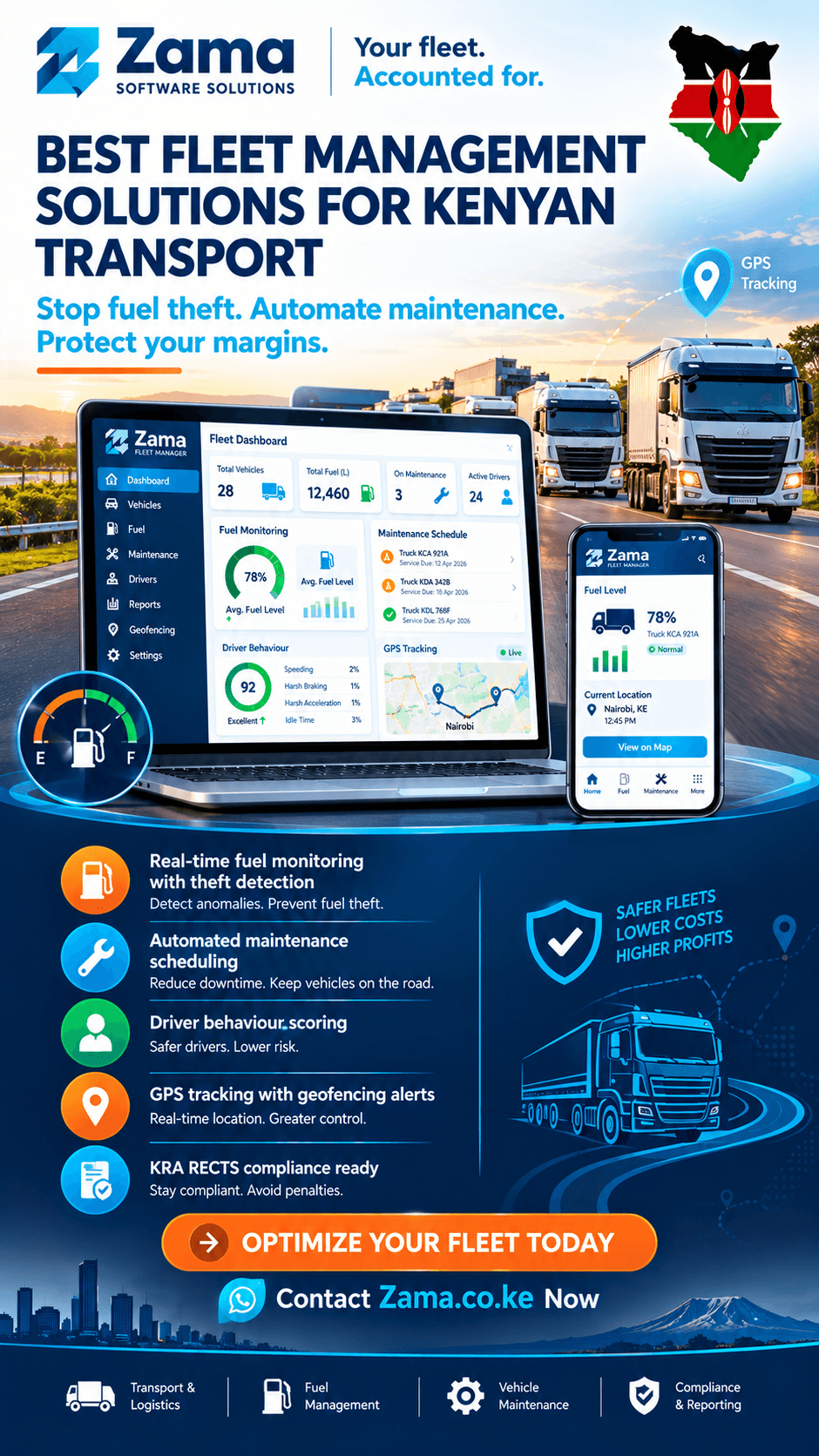
Best fleet management solutions for Kenyan transport is a question that every transport manager, logistics director, and fleet owner must answer in 2026. With fuel representing 30 to 40 percent of total fleet running costs and industry estimates suggesting that transport companies across East Africa lose between 15% and 30% of their total fuel budget to theft every single year, the pressure to digitize fleet operations has never been greater. At zama.co.ke, we’ve helped numerous fleet operators across Kenya implement management solutions that eliminate fuel theft, automate service scheduling, and provide real-time visibility into every vehicle, every litre, and every repair. This comprehensive guide explores the best fleet management solutions for Kenyan transport, from understanding core features to selecting the right platform for your fleet operations.
The Cost of Poor Fleet Management in Kenyan Transport
Before diving into the best fleet management solutions for Kenyan transport, it’s essential to understand the scale of the problem. Fleet operators across Kenya face a silent crisis that erodes profitability trip by trip.
Fuel Theft and Fraud: Fuel theft is the most consistent profit leak for Kenyan fleet operators, and it is rarely dramatic enough to be caught without monitoring. On a 300 km round trip from Nakuru to Kisumu, a driver siphoning 10 litres costs the business approximately KES 1,300 per trip. Across a 5-truck fleet running 5 days a week, that compounds to over KES 1.6 million lost annually to fuel alone. The methods are sophisticated: drivers siphon diesel into jerry cans during overnight stops, fuel attendants at depots dispense less than what is recorded, and collusion between drivers and roadside fuel vendors creates ghost transactions that look legitimate on paper.
When fleet operators install fuel monitoring systems, the results are immediate. Trucks that previously claimed 420 litres for a Nairobi trip when the vehicle only required 360 litres suddenly report accurate consumption. Each truck can save between Sh5,000 and Sh7,000 per trip once monitoring is in place. That is the difference between a fleet that survives and one that thrives.
Maintenance Neglect and Breakdowns: Without proper maintenance scheduling, vehicles deteriorate. Breakdowns on the Mombasa-Nairobi highway or the Northern Corridor cost far more than preventive servicing. A single unplanned breakdown can cost hundreds of thousands in lost cargo, emergency repairs, and customer penalties. When the best fleet management solutions for Kenyan transport are properly implemented, maintenance becomes proactive rather than reactive.
Compliance Risks: The Kenya Revenue Authority mandates that all commercial transporters use a fully automated digital system to clear and license customs vehicles. Starting July 1, 2026, KRA requires all transit goods vehicles to use the Regional Electronic Cargo Tracking System (RECTS) and Integrated Customs Management System (ICMS). Failure to possess precise, digitized credentials triggers algorithmic rejection of applications, stalling fleet operations indefinitely. Non-compliant fleets face fines and operational disruptions that far exceed the cost of proper software.
Understanding these realities is the first step in identifying the best fleet management solutions for Kenyan transport that actually work.
What Fleet Management Solutions Actually Do
A fleet management solution is a digital platform that monitors vehicle location, fuel consumption, driver behaviour, and maintenance schedules in real time, providing comprehensive reporting for fleet operations. It replaces manual dipsticks, paper fuel logs, and spreadsheet-based maintenance schedules with a centralized system that captures every litre, every service, and every repair.
A proper fleet management solution for Kenyan transport answers the operational questions that manual systems cannot: exactly how much fuel is in each tank right now, exactly when a vehicle was last serviced, exactly which driver is wasting fuel, exactly when the next service is due, and exactly what each vehicle costs per kilometre. The software needs to push alerts to fleet managers through SMS, email, or app notifications, without requiring someone to stare at a dashboard all day.
For a Kenyan fleet operator, the practical definition of the best fleet management solutions for Kenyan transport is this: the system that tells you exactly where every vehicle is, exactly how much fuel it is consuming, exactly when it needs maintenance, and exactly what it costs to run—all in real time, from a single dashboard accessible on any device.
Essential Features of the Best Fleet Management Solutions for Kenyan Transport
When evaluating the best fleet management solutions for Kenyan transport, focus on these core features:
1. Real-Time Visibility With Contextual Alerts
Live tracking is the baseline. Real-time visibility means instant alerts when a vehicle enters or exits a geofence, when a driver exceeds a set speed on a highway stretch, when a truck idles for too long at a fuel stop on the Nairobi-Mombasa road, or when an asset moves outside approved hours. The software needs to push these alerts to fleet managers through SMS, email, or app notifications, without requiring someone to stare at a dashboard all day. Passive systems that only show historical data after incidents have already happened are not fleet management tools. They are expensive logbooks.
2. Integrated Fuel Monitoring
Fuel is typically the single largest cost in any Kenyan fleet operation, often representing 30 to 40 percent of total running costs. Software that relies only on odometer readings or fuel card records leaves enormous room for manipulation. A robust platform must integrate directly with fuel-level sensors mounted inside the tank, giving managers precise data on every litre consumed, every refill recorded, and every unexplained drop flagged automatically. This is the only way to catch fuel siphoning, ghost refuelling, and excessive idling that burns diesel without covering any kilometres. Any fleet management software that does not offer direct sensor integration is leaving money on the table for operators across Nairobi, Mombasa, Kisumu, and beyond.
3. Driver Behaviour Monitoring and Scoring
Driver behaviour has a direct impact on fuel consumption, tyre wear, accident risk, and cargo safety. Fleet software needs to track harsh braking, rapid acceleration, sharp cornering, speeding, and excessive idling, then translate those events into actionable driver scores. Managers should be able to see which drivers are consistently performing well and which ones need coaching or intervention. The best systems go further and integrate with dashcams so that behaviour data is supported by video evidence, removing disputes when incidents occur on busy routes like Thika Road or the Likoni corridor.
4. Maintenance Scheduling and Reminders
Preventive maintenance reduces breakdowns and extends vehicle life. A comprehensive fleet management solution should schedule daily, weekly, or monthly reports for trips, mileage, idling, and more, with proactive service scheduling based on mileage or engine hours. The system should generate reminders before scheduled maintenance dates and maintain a complete service history for every vehicle. Fleet systems can include automated document management that tracks vehicle and driver licences, sending alerts before expiration.
5. Real-Time GPS Tracking with Mobile Access
Live tracking is the baseline. Real-time visibility means instant alerts when a vehicle enters or exits a geofence, when a driver exceeds a set speed, when a truck idles too long at a fuel stop, or when an asset moves outside approved hours. In East Africa, vehicles move through areas with inconsistent network coverage. A good platform handles this with intelligent buffering—storing location data locally when connectivity drops, then syncing the moment signal returns. The best fleet management solutions for Kenyan transport support multiple network operators simultaneously, because single-carrier dependency is a risk your fleet cannot afford.
6. Reporting That Supports Business Decisions
Data is only valuable when it leads to decisions. Fleet management software should generate scheduled and on-demand reports covering trip summaries, fuel usage, driver scores, maintenance alerts, mileage by vehicle, and cost-per-kilometre analysis. These reports need to be exportable in formats that finance teams, operations managers, and transport coordinators can actually use. If a fleet manager cannot walk into a weekly review meeting with a clear picture of what the fleet cost to run that week and which vehicles or drivers are underperforming, the software is not doing its job.
7. Trip and Route Management
For fleets operating across multiple routes, the system should map the most efficient route for each trip, flag deviations the moment a driver takes an unapproved turn, and provide live ETA updates dispatchers can share with clients proactively. Route optimisation across Kenya’s multi-directional fleet corridors—Nairobi to Mombasa, Nakuru to Kisumu, Eldoret to Malaba—requires software built for local road conditions, not European highways.
8. Compliance and Audit Readiness
KRA requires all commercial transporters to use a fully automated digital system for customs clearance and licensing. A compliant fleet management solution should integrate with RECTS and ICMS, maintain audit-ready GPS logs, and generate the reports required by regulators. The system should also support electronic pre-trip inspections to enhance vehicle safety and reduce maintenance costs.
What Makes Fleet Management Solutions for Kenyan Transport Different
Fleet management solutions for Kenyan transport have unique characteristics that global solutions often lack:
Built for East African Operating Realities
Global platforms were built for markets with reliable fuel cards, standardised vehicle data, and road infrastructure that does not punish a fleet every second week. The best fleet platforms for Kenya are designed for East Africa, not adapted for it. They handle the Mombasa Road, the Rift Valley, and cross-border routes into Uganda and Tanzania. They account for the realities of operating in a market where fuel theft is a structural leak, not an edge case.
Wireless Sensor Technology
Wireless BLE fuel sensors now deliver the same sub-1-percent measurement accuracy as hardwired systems, without the cabling, labour costs, or installation downtime. The fuel level sensor communicates with the tracking unit via Bluetooth and runs on an independent battery, making tampering difficult. This technology is essential for the best fleet management solutions for Kenyan transport.
Mobile-First and Offline-Capable
Kenyan fleet managers are rarely desk-bound. They need mobile access to fuel data, maintenance schedules, and alerts. The platform should work on any device, with offline capability when connectivity is unreliable. When the best fleet management solutions for Kenyan transport are mobile-first, managers can monitor fuel levels and approve maintenance from their phones, wherever they are.
Local Support and Installation
The best providers offer local support, installation, and training. Installation costs vary depending on the tracker model, the number of vehicles, and whether fuel sensors or dashcams are included. Fleet operators need a partner who can respond quickly when a sensor needs calibration or a platform issue arises—not a helpdesk that closes when Nairobi wakes up.
Fleet Management Solution Use Cases in Kenyan Transport
Long-Distance Haulage
Kenyan haulage companies operating on the Northern Corridor and the Mombasa-Nairobi route are the primary adopters of fleet management solutions. The haulage sector is increasingly adopting digital fuel monitoring systems to reduce fuel theft, improve accountability, and lower operational costs amid high fuel prices. Fleet owners across the country have reported millions of shillings in savings after deploying fuel monitoring, with the best fleet management solutions for Kenyan transport delivering measurable returns within the first quarter of operation.
Agricultural Logistics
Nakuru’s fleet economy serves agricultural logistics—pyrethrum, maize, wheat, and horticultural exports from the Rift Valley moving to Nairobi markets and Mombasa Port. Fuel theft on these routes is the most consistent profit leak. Fuel sensors paired with GPS tracking eliminate this problem at the source, installing directly in the fuel tank and transmitting real-time fuel level readings to the fleet software dashboard.
Telecom Infrastructure
Kenyan telecom infrastructure fleets have won IoT project awards for fuel theft prevention and maintenance efficiency. These companies implemented pre-trip inspections using electronic checklists to improve vehicle safety and reduce maintenance costs, with a proactive approach that also reduces repair costs over time. When the best fleet management solutions for Kenyan transport are deployed across technical fleets, vehicle availability improves and operational costs fall.
Government and Public Sector Fleets
The Treasury has been pushing for automation and fleet tracking to reduce fuel costs, with a proposal requiring government vehicles to refuel exclusively through automated card systems and be monitored using digital trackers to curb operational expenses. Public universities and government agencies have deployed comprehensive Fleet Management Systems to streamline management of their fleets, including automated document management and maintenance scheduling.
Implementation Considerations for Kenyan Fleets
When implementing the best fleet management solutions for Kenyan transport, consider these factors:
Start with a Pilot
Implement the system on a small fleet first, gather feedback, and refine before rolling out to the entire fleet. This approach catches issues early and builds confidence.
Choose the Right Hardware
Fuel sensors should be durable and suitable for Kenyan road conditions. Wireless BLE sensors reduce installation downtime. GPS trackers should support multiple network operators to maintain connectivity across different regions.
Train Drivers and Managers
Fleet managers and drivers need proper training. Role-specific training delivered using real scenarios consistently produces higher adoption rates. When drivers understand that fuel monitoring is in place and every litre is accounted for, behaviour improves.
Integrate with Existing Systems
The fleet management software should integrate with accounting systems, procurement platforms, and KRA compliance systems. This creates a unified operational platform and eliminates manual data entry.
Ensure KRA RECTS Compliance
For commercial transporters, integration with RECTS and ICMS is mandatory. The system should maintain audit-ready logs and generate the reports required by regulators.
The ROI of the Best Fleet Management Solutions for Kenyan Transport
When evaluating the best fleet management solutions for Kenyan transport, the ROI is compelling:
Fuel Savings: Each truck can save between Sh5,000 and Sh7,000 per trip after installing fuel monitoring systems. For a fleet of 20 trucks running regular routes, this translates to millions of shillings annually.
Reduced Fuel Theft: Digital fuel monitoring systems significantly reduce fuel theft, with industry estimates suggesting 15-30% of fuel budgets are lost to theft without monitoring.
Lower Maintenance Costs: Proactive maintenance reduces breakdowns and repair costs. Technology application results in improved vehicle maintenance efficiency and reduced operational costs.
Improved Fleet Utilisation: Technology application enhances fleet utilisation, with the majority of respondents reporting improved maintenance efficiency and reduced operational costs.
Compliance Protection: Audit-ready GPS logs and RECTS compliance prevent KRA fines and operational disruptions.
Driver Accountability: Driver behaviour monitoring reduces traffic offences, speeding, and unauthorised vehicle use.
Scalability: Automation enables fleets to handle more vehicles without proportional increases in management staff.
The Zama.co.ke Approach
When considering the best fleet management solutions for Kenyan transport, zama.co.ke follows a structured approach:
Fleet Assessment
We evaluate your fleet operations: vehicle types, routes, fuel consumption patterns, maintenance history, driver management, and compliance requirements.
System Design
We design a fleet management solution tailored to your specific fleet—whether it’s a small delivery operation or a large haulage company.
Implementation and Integration
We handle system configuration, fuel sensor installation, GPS tracker setup, maintenance schedule creation, and integration with existing systems.
Training and Support
We provide role-specific training for fleet managers, dispatchers, and drivers, including fuel monitoring, maintenance scheduling, and reporting.
Post-Implementation Support
We remain available for maintenance, troubleshooting, and system upgrades as your fleet evolves.
Best fleet management solutions for Kenyan transport are essential for any fleet operator seeking to eliminate fuel theft, automate service scheduling, ensure KRA compliance, and protect profit margins. From Sh5,000-7,000 savings per trip to award-winning fuel theft prevention and the government’s push for fleet automation, the benefits are proven and substantial.
At zama.co.ke, we’ve helped fleet operators across Kenya implement fleet management solutions that deliver measurable results. Our approach ensures you get exactly what your fleet needs—nothing more, nothing less.
Don’t let the complexity of the best fleet management solutions for Kenyan transport hold you back. Whether you’re running a small delivery fleet or a large haulage company, we have the expertise to guide you through every step.
Contact zama.co.ke today and let us help you build a fleet management system that transforms your operations.