
Cloud Application Development West Africa: The Complete Guide to Scalable Business Solutions
Digital transformation is reshaping businesses across West Africa. Organizations are moving away from traditional desktop software and expensive on-premise servers in favor of cloud-based applications that offer flexibility, scalability, and cost efficiency. Whether operating in Nigeria, Ghana, Côte d’Ivoire, Senegal, Sierra Leone, Liberia, or other West African markets, businesses require software that supports remote work, real-time collaboration, and seamless access from anywhere. This growing demand has made Cloud Application Development West Africa a critical investment for organizations seeking sustainable growth.
Cloud applications enable businesses to streamline operations, automate workflows, improve customer experiences, and make informed decisions using real-time data. Unlike conventional software, cloud applications are hosted on secure cloud infrastructure and accessed through the internet, eliminating the need for costly local servers while ensuring continuous availability and simplified maintenance.
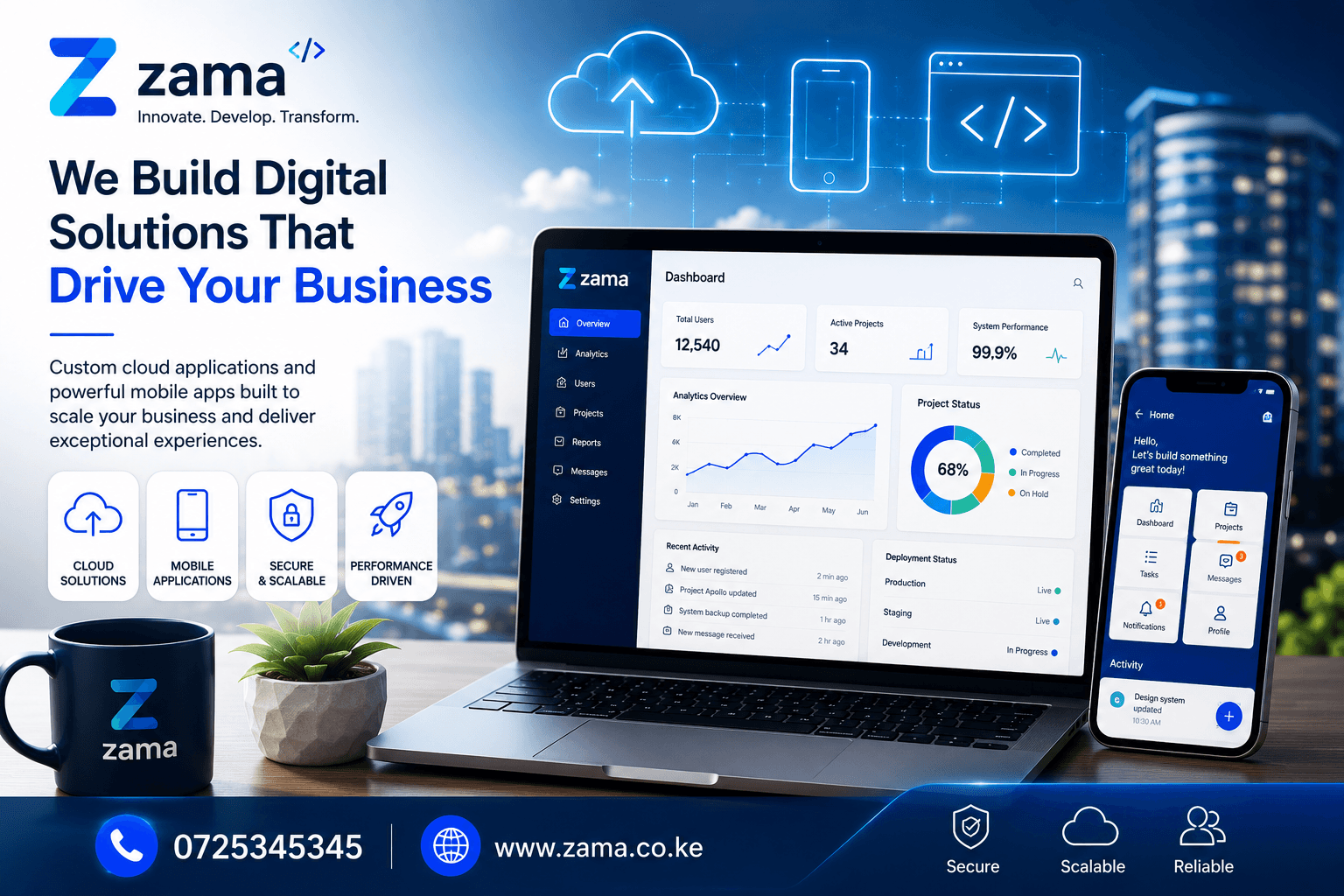
At Zama.co.ke, we provide professional Cloud Application Development West Africa services that help startups, SMEs, NGOs, governments, and enterprises build secure, high-performance cloud solutions. Our experienced development team designs applications that are scalable, reliable, and customized to meet the unique business requirements of organizations throughout the West African region.
What is Cloud Application Development?
Cloud Application Development West Africa refers to the process of designing, developing, deploying, and maintaining software applications that operate on cloud infrastructure instead of traditional local servers.
Cloud applications allow authorized users to securely access business systems using desktops, laptops, tablets, or smartphones from virtually any location. They support real-time collaboration, automatic updates, centralized data storage, and seamless integration with other digital platforms.
Unlike desktop software that requires installation and manual updates on every device, cloud applications are centrally managed, making them easier to maintain, secure, and scale as business needs evolve.
Why Businesses Across West Africa Are Investing in Cloud Applications
Organizations throughout West Africa are embracing cloud technologies to improve operational efficiency and remain competitive in an increasingly digital economy.
Benefits of Cloud Application Development West Africa include:
- Secure access from any location
- Reduced IT infrastructure costs
- Automatic software updates
- Improved collaboration across multiple offices
- Faster deployment of business systems
- Enhanced cybersecurity
- Automatic data backups
- Business continuity and disaster recovery
- Easy scalability as businesses grow
- Real-time reporting and analytics
These advantages help businesses modernize operations while reducing maintenance costs and improving service delivery.
Cloud Application Development Services Offered by Zama.co.ke
We deliver comprehensive cloud solutions designed to meet the needs of businesses operating across West Africa.
Our services include:
- Custom Cloud Application Development
- Software as a Service (SaaS) Development
- Enterprise Cloud Solutions
- Cloud CRM Development
- Cloud ERP Systems
- Workflow Automation Platforms
- Cloud-Based Inventory Systems
- Financial Management Applications
- Cloud API Development
- Legacy System Modernization
- Cloud Database Design
- Cloud Migration Services
- Business Intelligence Dashboards
- Mobile Cloud Integration
- Application Maintenance and Support
Every solution is tailored to your operational requirements while ensuring long-term scalability and reliability.
Industries We Serve
Our cloud application development expertise supports organizations across numerous industries, including:
- Banking and Financial Services
- Healthcare
- Education
- Government Institutions
- NGOs
- Telecommunications
- Agriculture
- Manufacturing
- Logistics
- Retail
- Hospitality
- Real Estate
- Property Management
- Construction
- Insurance
- Professional Services
- E-commerce
Each solution is customized to address industry-specific challenges and workflows.
Features of High-Performance Cloud Applications
Successful cloud applications combine advanced functionality with exceptional reliability.
Key features include:
- Secure user authentication
- Role-based access control
- Real-time dashboards
- Cloud backups
- Multi-user collaboration
- Automatic software updates
- Responsive web interfaces
- Mobile accessibility
- API integrations
- Data encryption
- Audit trails
- Notification systems
- Workflow automation
- High availability
- Scalable cloud infrastructure
These features help organizations improve productivity while maintaining strong security and performance.
Technologies We Use
At Zama.co.ke, we build cloud applications using modern technologies trusted by businesses worldwide.
Our technology stack includes:
- Microsoft Azure
- Amazon Web Services (AWS)
- Google Cloud Platform (GCP)
- Microsoft .NET
- Laravel
- Node.js
- Python
- Java
- React
- Angular
- Vue.js
- Flutter
- PostgreSQL
- MySQL
- MongoDB
- Docker
- Kubernetes
- REST APIs
- GraphQL
By combining these technologies with industry best practices, we deliver cloud applications that are secure, scalable, and built for long-term success.
Why Choose Zama.co.ke for Cloud Application Development West Africa?
Organizations across West Africa trust Zama.co.ke because we deliver innovative cloud solutions that solve real business challenges.
Our approach includes:
- Thorough business analysis
- Custom software development
- Modern UI/UX design
- Agile project delivery
- Enterprise-grade security
- Seamless third-party integrations
- Scalable cloud architecture
- Transparent communication
- Ongoing technical support
- Cost-effective development services
We focus on building cloud applications that enhance efficiency, improve customer experiences, and support business growth across the West African market.
Cloud Application Development Lifecycle
Building a successful cloud application requires more than writing code. It involves a carefully planned development lifecycle that ensures the final solution is secure, scalable, reliable, and aligned with business objectives. At Zama.co.ke, every Cloud Application Development West Africa project follows a proven methodology that minimizes risk while delivering maximum value.
Discovery and Business Analysis
Every project begins by understanding the client’s organization, operational challenges, existing systems, and long-term goals. During this stage, our team identifies business processes that can be automated, gathers technical requirements, and recommends the most suitable cloud technologies.
This approach ensures the application is built around real business needs rather than assumptions, resulting in software that delivers measurable improvements in efficiency and productivity.
Solution Architecture
Once requirements are gathered, our architects design a secure and scalable cloud infrastructure. The architecture determines how databases, application servers, APIs, user authentication, storage, and integrations will interact to provide a seamless user experience.
A well-designed architecture allows applications to support increasing numbers of users without sacrificing performance or reliability.
UI/UX Design
An intuitive user interface is critical to application success. Our designers focus on creating responsive layouts that provide a consistent experience across desktops, tablets, and smartphones. Simple navigation, fast-loading pages, and accessible interfaces encourage user adoption while reducing training requirements.
Development and Testing
Developers build the application using modern frameworks and industry best practices while quality assurance teams continuously test each module for functionality, security, performance, and compatibility. Continuous testing throughout development significantly reduces errors before deployment.
Deployment and Continuous Improvement
After successful testing, the application is deployed to secure cloud infrastructure. However, development does not end there. Continuous monitoring, feature enhancements, security updates, and performance optimization ensure the application continues to meet evolving business requirements.
Cloud Deployment Models
Organizations have different operational needs, making cloud deployment models an important consideration during Cloud Application Development West Africa projects.
Public Cloud
Public cloud platforms such as Microsoft Azure, Amazon Web Services, and Google Cloud Platform provide cost-effective infrastructure with virtually unlimited scalability. They are ideal for startups, SMEs, and rapidly growing businesses.
Private Cloud
Private cloud infrastructure offers dedicated resources exclusively for one organization. This model is preferred by businesses with strict compliance, security, or regulatory requirements.
Hybrid Cloud
Many organizations combine public and private cloud environments to achieve flexibility while maintaining sensitive data within private infrastructure. Hybrid cloud models are increasingly popular among financial institutions, healthcare providers, and government agencies across West Africa.
Understanding SaaS, PaaS, and IaaS
Cloud computing offers different service models depending on business requirements.
Software as a Service (SaaS)
SaaS delivers complete software solutions through the internet. Users simply log in through a browser without installing software locally.
Examples include:
- Customer Relationship Management systems
- Accounting software
- School management systems
- Human Resource Management software
Platform as a Service (PaaS)
PaaS provides developers with the infrastructure required to build, test, and deploy applications without managing hardware.
Benefits include:
- Faster development
- Simplified deployment
- Automatic scaling
- Reduced maintenance
Infrastructure as a Service (IaaS)
IaaS provides virtual servers, storage, networking, and computing resources that organizations manage according to their needs.
This model offers maximum flexibility for enterprises requiring customized cloud environments.
Security in Cloud Application Development
Security remains one of the highest priorities when delivering Cloud Application Development West Africa solutions. Businesses handle sensitive customer information, financial records, employee data, and operational documents that require comprehensive protection.
Our cloud applications implement multiple security layers, including:
- Multi-factor authentication
- Secure API management
- Role-based user permissions
- End-to-end encryption
- Secure password hashing
- SSL certificates
- Automated backups
- Activity logging
- Data encryption at rest
- Disaster recovery planning
- Continuous vulnerability monitoring
These measures help organizations protect valuable information while maintaining customer trust and regulatory compliance.
Cloud Application Integrations
Modern businesses rely on multiple digital systems working together. Cloud applications become even more powerful when integrated with existing software.
Common integrations include:
- ERP systems
- CRM platforms
- Accounting software
- Inventory management systems
- Payment gateways
- SMS gateways
- Email services
- WhatsApp Business API
- Microsoft 365
- Google Workspace
- Business Intelligence platforms
- HR Management Systems
- Document Management Systems
These integrations eliminate duplicate data entry, improve operational efficiency, and provide a unified business ecosystem.
Artificial Intelligence in Cloud Applications
Artificial Intelligence is transforming how businesses operate across West Africa. AI-powered cloud applications enable organizations to automate routine tasks, gain valuable insights, and deliver personalized customer experiences.
AI capabilities include:
- Intelligent chatbots
- Predictive analytics
- Customer behavior analysis
- Automated document processing
- Recommendation engines
- Image recognition
- Fraud detection
- Voice assistants
- Workflow automation
Incorporating AI into Cloud Application Development West Africa enables businesses to make faster, data-driven decisions while improving productivity and customer satisfaction.
Migrating Legacy Systems to the Cloud
Many organizations still rely on outdated desktop applications or manual processes that limit productivity and increase maintenance costs. Migrating these systems to the cloud offers significant operational advantages.
Benefits include:
- Reduced infrastructure costs
- Improved accessibility
- Better collaboration
- Enhanced security
- Automatic backups
- Simplified maintenance
- Increased scalability
- Faster software updates
A carefully planned migration minimizes disruption while ensuring business continuity throughout the transition.
Benefits of Cloud Application Development for West African Businesses
Businesses throughout West Africa are increasingly investing in cloud technologies because they provide long-term value beyond simple software deployment.
Key benefits include:
- Lower operational costs
- Greater flexibility
- Improved employee productivity
- Better customer experiences
- Faster decision-making
- Centralized data management
- Business continuity
- Real-time reporting
- Simplified collaboration across multiple branches
- Enhanced cybersecurity
- Rapid deployment of new features
- Easy expansion into new markets
These advantages enable organizations to remain competitive in rapidly evolving industries.
Industries Benefiting from Cloud Application Development West Africa
Cloud technology supports virtually every sector of the economy.
Organizations successfully implementing cloud applications include:
- Financial institutions
- Educational institutions
- Healthcare providers
- Logistics companies
- Retail businesses
- Manufacturing firms
- Government agencies
- NGOs
- Hospitality businesses
- Real estate companies
- Construction firms
- Agriculture enterprises
- Telecommunications providers
- Professional service firms
Each industry benefits from customized cloud solutions that automate workflows, improve communication, and increase operational visibility.
Best Practices for Successful Cloud Application Development
Organizations planning cloud initiatives should follow proven best practices to maximize return on investment.
These include:
- Clearly defining business objectives before development.
- Choosing scalable cloud architecture.
- Prioritizing cybersecurity from the beginning.
- Designing user-friendly interfaces.
- Integrating existing business systems.
- Conducting comprehensive testing before deployment.
- Monitoring application performance continuously.
- Training users to encourage adoption.
- Planning for future growth and feature expansion.
- Partnering with experienced cloud developers.
Following these practices helps ensure cloud applications remain valuable as business requirements evolve.
Frequently Asked Questions
What is Cloud Application Development West Africa?
It is the design, development, deployment, and maintenance of cloud-based software solutions tailored to organizations operating across West African markets.
Which businesses need cloud applications?
Startups, SMEs, enterprises, NGOs, educational institutions, healthcare providers, financial organizations, logistics companies, retailers, and government agencies can all benefit from cloud applications.
Are cloud applications secure?
Yes. Modern cloud applications implement encryption, authentication, backups, monitoring, and access controls to protect sensitive information.
Can existing software be integrated?
Absolutely. Cloud applications can integrate with accounting software, ERPs, CRMs, payment gateways, inventory systems, HR platforms, and many other business solutions.
Can cloud applications grow with my business?
Yes. One of the greatest advantages of Cloud Application Development West Africa is scalability. Resources can be expanded as user demand increases without replacing the entire system.
How long does development take?
Project timelines depend on complexity, features, integrations, and testing requirements. Smaller applications may take several weeks, while enterprise systems require several months.
Conclusion
The future of business in West Africa is increasingly cloud-driven. Organizations require flexible, secure, and scalable digital solutions that enable them to serve customers efficiently, collaborate across multiple locations, and adapt quickly to changing market conditions. Investing in Cloud Application Development West Africa provides businesses with the technological foundation needed to improve productivity, reduce operational costs, strengthen security, and accelerate digital transformation.
At Zama.co.ke, we combine technical expertise, modern cloud technologies, and deep business understanding to develop customized cloud applications that deliver measurable results. Whether you need a Software as a Service (SaaS) platform, enterprise management system, customer portal, workflow automation solution, or cloud-native business application, our experienced team is ready to help you build a secure and future-ready solution.
Partner with Zama.co.ke to leverage professional Cloud Application Development West Africa services and transform the way your organization operates. Together, we can build innovative cloud applications that drive efficiency, enhance customer experiences, and position your business for sustainable growth in today’s competitive digital economy.