
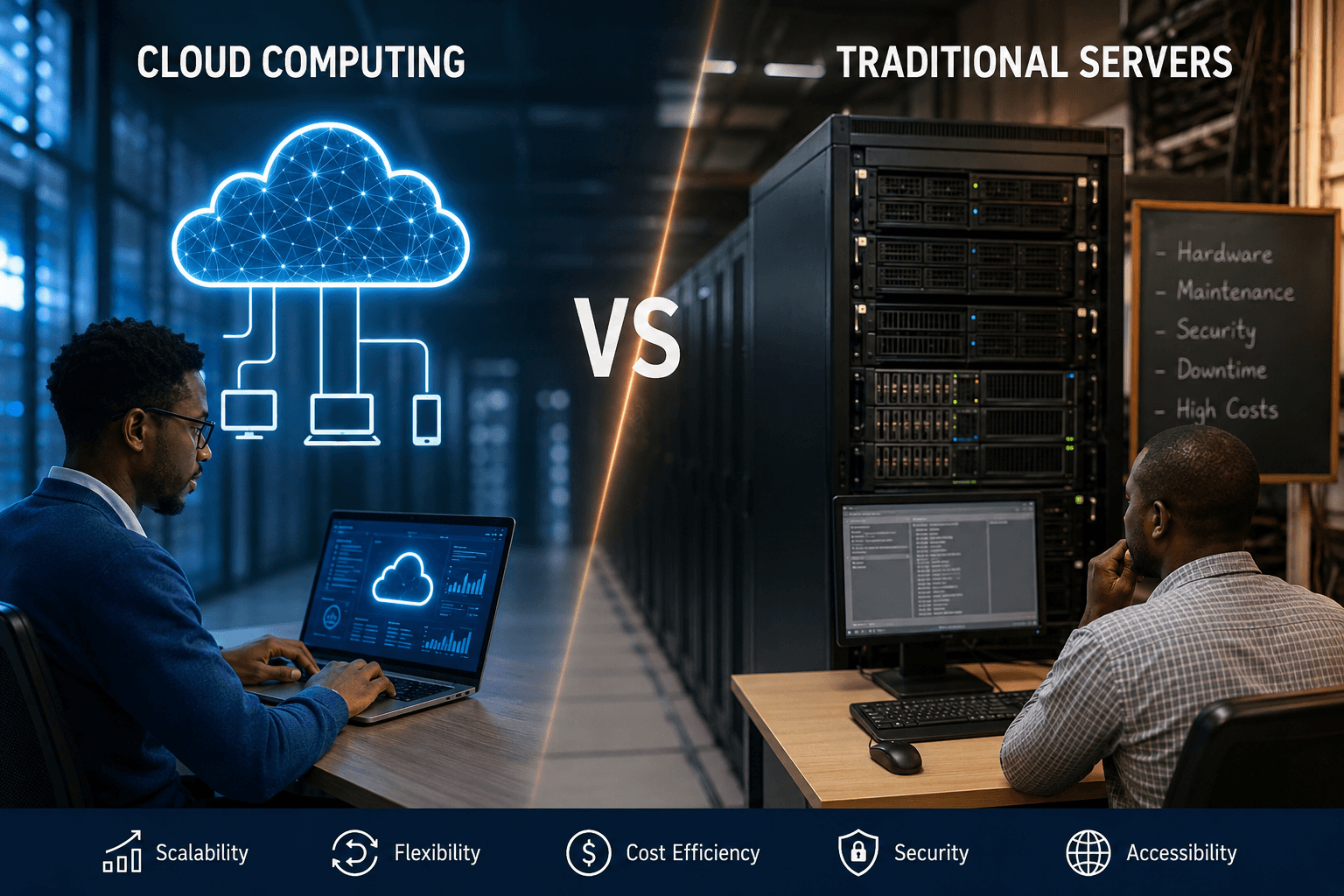
In today’s fast-changing digital world, businesses in Kenya are rapidly adopting modern technologies to stay competitive, secure, and efficient. One of the biggest decisions companies face is whether to use cloud computing or continue relying on traditional servers. From small startups to large enterprises, choosing the right IT infrastructure can affect productivity, security, scalability, and overall business growth.
At Zama Systems Limited, we help businesses across Kenya implement reliable IT solutions, cloud services, server infrastructure, website development, software development, and digital transformation strategies that improve operations and reduce costs.
If your business is struggling with slow systems, high server maintenance costs, downtime, or data security concerns, understanding the difference between cloud computing and traditional servers is essential.
In this comprehensive guide, we compare cloud computing vs traditional servers, explain the advantages and disadvantages of each, and help Kenyan businesses decide which solution is best for their needs.
What is Cloud Computing?
Cloud computing refers to the delivery of computing services such as storage, servers, databases, networking, and software over the internet instead of relying on physical on-site hardware.
Rather than purchasing and maintaining expensive servers in your office, cloud computing allows businesses to access IT resources online whenever needed.
Popular cloud platforms include:
- Google Cloud
- Microsoft Azure
- Amazon Web Services (AWS)
- Dropbox
- OneDrive
With cloud computing, businesses can:
- Store files online
- Run applications remotely
- Access systems from anywhere
- Backup data automatically
- Scale resources on demand
Cloud computing has become increasingly popular in Kenya because it offers flexibility, lower upfront costs, and easier management.
What are Traditional Servers?
Traditional servers are physical computers located within a company’s premises or data center. These servers store files, run applications, manage databases, and support company operations internally.
Businesses using traditional servers usually need:
- Dedicated server rooms
- IT maintenance teams
- Cooling systems
- Hardware upgrades
- Security monitoring
- Backup systems
Traditional servers have been used for decades and are still common in banks, hospitals, schools, government institutions, and companies with strict data control requirements.
Difference Between Cloud Computing and Traditional Servers
Although both cloud computing and traditional servers perform similar functions, they differ in several important areas.
1. Infrastructure Location
Cloud Computing
Data and applications are hosted online in remote data centers managed by cloud providers.
Traditional Servers
Servers are physically located inside the business premises or local data centers.
2. Initial Costs
Cloud Computing
Cloud solutions require minimal upfront investment because businesses pay monthly or yearly subscriptions.
Traditional Servers
Traditional infrastructure requires purchasing expensive hardware, networking equipment, power backup systems, and software licenses.
3. Scalability
Cloud Computing
Businesses can easily increase or reduce storage and computing power whenever needed.
Traditional Servers
Scaling requires purchasing additional hardware, which can be expensive and time-consuming.
4. Maintenance
Cloud Computing
The cloud provider handles maintenance, updates, security patches, and infrastructure management.
Traditional Servers
The company’s internal IT team is responsible for maintaining the hardware and software.
5. Accessibility
Cloud Computing
Employees can access systems from anywhere using the internet.
Traditional Servers
Access is usually limited to office networks unless remote access systems are configured.
Advantages of Cloud Computing for Businesses in Kenya
Cloud computing offers numerous benefits for modern businesses.
Reduced IT Costs
One of the biggest advantages of cloud computing is lower operational costs.
Businesses do not need to:
- Buy expensive servers
- Maintain hardware
- Hire large IT teams
- Upgrade infrastructure frequently
This makes cloud computing ideal for startups and SMEs in Kenya.
Remote Work Flexibility
Cloud systems allow employees to work from anywhere.
This is especially useful for:
- Hybrid work environments
- Remote teams
- Sales teams
- Field staff
- Multi-branch businesses
Employees can securely access files and systems using laptops, tablets, or smartphones.
Automatic Data Backup
Cloud platforms automatically backup data, reducing the risk of losing important business information due to:
- Hardware failure
- Theft
- Fire
- Accidental deletion
- Viruses
Businesses can quickly recover lost data when needed.
Better Scalability
As your business grows, cloud services can easily expand with you.
You can increase:
- Storage space
- Processing power
- User accounts
- Applications
Without buying additional hardware.
Improved Collaboration
Cloud computing enables teams to collaborate in real time.
Employees can:
- Share files instantly
- Edit documents together
- Access centralized systems
- Communicate efficiently
This improves productivity and workflow management.
Enhanced Security
Modern cloud providers invest heavily in cybersecurity.
Cloud systems often include:
- Encryption
- Multi-factor authentication
- Firewall protection
- Security monitoring
- Threat detection
Many cloud providers offer better security than what small businesses can implement internally.
Advantages of Traditional Servers
Although cloud computing is becoming more popular, traditional servers still offer several benefits.
Full Control Over Infrastructure
Businesses have complete control over:
- Hardware
- Security policies
- Data storage
- System configurations
This is important for organizations with strict compliance requirements.
No Dependence on Internet Connectivity
Traditional servers can continue functioning locally even during internet outages.
This is beneficial in areas with unstable internet connections.
Customization Flexibility
Traditional infrastructure allows businesses to create highly customized systems for specific operations.
This is useful for:
- Manufacturing companies
- Financial institutions
- Research facilities
- Specialized enterprise systems
Long-Term Cost Savings for Large Organizations
For very large companies with stable infrastructure needs, traditional servers may become cheaper over time after the initial investment is recovered.
Disadvantages of Cloud Computing
Despite its many advantages, cloud computing also has limitations.
Internet Dependency
Cloud systems require reliable internet connectivity.
Poor internet can affect:
- Access speed
- Productivity
- Communication
- File uploads and downloads
Recurring Costs
Monthly subscriptions may become expensive over many years depending on usage levels.
Limited Direct Control
Businesses rely on third-party providers for infrastructure management.
This means less direct control over servers and configurations.
Disadvantages of Traditional Servers
Traditional servers also come with several challenges.
High Initial Investment
Businesses must spend heavily on:
- Hardware
- Installation
- Networking
- Backup systems
- Cooling equipment
Expensive Maintenance
Ongoing maintenance costs include:
- Repairs
- Electricity
- Software updates
- IT staff salaries
Difficult Scalability
Expanding server infrastructure can take weeks or months.
Risk of Physical Damage
On-site servers are vulnerable to:
- Fire
- Flooding
- Theft
- Hardware failure
Without proper backups, data loss can be devastating.
Cloud Computing vs Traditional Servers: Cost Comparison
Cost is often the biggest factor when businesses choose IT infrastructure.
Cloud Computing Costs
Cloud solutions typically use pay-as-you-go pricing.
Businesses only pay for:
- Storage used
- Computing resources consumed
- Active users
- Services required
This reduces upfront financial pressure.
Traditional Server Costs
Traditional servers require:
- Hardware purchase
- Server installation
- Licensing fees
- Maintenance contracts
- Backup systems
- Cooling systems
The initial setup cost can be very high.
Which Solution is Better for Small Businesses in Kenya?
For most SMEs in Kenya, cloud computing is usually the better option because:
- It is affordable
- Easy to manage
- Scalable
- Flexible
- Secure
Cloud systems help small businesses compete with larger companies without huge IT investments.
Examples include:
- Cloud accounting systems
- Cloud-based ERP systems
- Online backup services
- Remote collaboration tools
- Web hosting platforms
Which Businesses Should Use Traditional Servers?
Traditional servers may still be ideal for:
- Banks
- Government institutions
- Large corporations
- Companies with strict compliance requirements
- Businesses requiring full infrastructure control
Some organizations also prefer hybrid systems that combine both cloud and on-premise servers.
Hybrid Cloud Solutions
Many businesses today use hybrid cloud environments.
A hybrid setup combines:
- Traditional local servers
- Cloud-based infrastructure
This provides flexibility while maintaining some level of local control.
For example:
- Sensitive data may remain on local servers
- Backup and collaboration systems may operate in the cloud
Hybrid systems are becoming increasingly popular among medium and large businesses in Kenya.
Security Comparison: Cloud vs Traditional Servers
Security is a major concern for all businesses.
Cloud Security
Cloud providers offer:
- Data encryption
- Security monitoring
- Disaster recovery
- Compliance certifications
- Advanced threat protection
However, businesses must still implement:
- Strong passwords
- Employee training
- Access control policies
Traditional Server Security
Traditional servers provide direct security control but require businesses to manage:
- Firewall configuration
- Antivirus systems
- Physical security
- Data backups
- Monitoring systems
Without experienced IT teams, security risks can increase.
Performance Comparison
Performance depends on proper implementation.
Cloud Performance
Cloud platforms offer:
- Fast deployment
- High uptime
- Flexible resource allocation
- Global accessibility
However, internet speed can affect performance.
Traditional Server Performance
Local servers may provide faster access within office networks.
But performance depends heavily on:
- Hardware quality
- Maintenance
- Upgrades
- Network infrastructure
Why Kenyan Businesses are Moving to the Cloud
Digital transformation in Kenya is accelerating rapidly.
Businesses are embracing cloud solutions because they support:
- Mobile workforces
- Online services
- E-commerce
- Automation
- Data analytics
- Business continuity
Cloud computing also helps companies reduce operational costs while improving efficiency.
Industries adopting cloud computing include:
- Healthcare
- Education
- Retail
- Logistics
- Finance
- Real estate
- Manufacturing
How Zama Systems Limited Helps Businesses in Kenya
At Zama Systems Limited, we provide reliable IT solutions tailored to modern businesses.
Our services include:
- Cloud computing solutions
- Server installation and maintenance
- Website development
- Software development
- ERP systems
- Data backup solutions
- IT consultancy
- Cybersecurity solutions
- Network setup and management
We help businesses choose the best infrastructure based on their:
- Budget
- Security needs
- Growth plans
- Industry requirements
Whether you need cloud migration, server setup, or complete digital transformation, our experienced team is ready to help.
Choosing the Right Solution for Your Business
Before deciding between cloud computing and traditional servers, consider:
Your Budget
Can your business afford high upfront infrastructure costs?
Business Size
Small businesses often benefit more from cloud systems.
Internet Reliability
Reliable internet is important for cloud-based operations.
Security Requirements
Some industries require tighter control over sensitive data.
Growth Plans
Cloud computing supports rapid business expansion.
Future of Cloud Computing in Kenya
The future of cloud computing in Kenya looks very promising.
As internet connectivity improves and businesses embrace digital transformation, cloud adoption will continue growing rapidly.
Emerging technologies driving cloud adoption include:
- Artificial intelligence
- Machine learning
- Big data analytics
- Internet of Things (IoT)
- Automation systems
Businesses that modernize early gain competitive advantages through efficiency, scalability, and innovation.
Final Thoughts
Both cloud computing and traditional servers have advantages and disadvantages. The right choice depends on your business goals, budget, security requirements, and operational needs.
For most modern businesses in Kenya, cloud computing offers greater flexibility, lower costs, easier scalability, and improved collaboration. However, traditional servers may still be suitable for organizations requiring full control and strict data management.
A professional IT assessment can help determine the best infrastructure for your company.
At Zama Systems Limited, we help businesses implement reliable, secure, and scalable IT solutions that support growth and digital transformation.
Whether you want cloud migration, server installation, software development, or complete IT support, we are here to help.
Contact us today:
Phone: +254 725345345
Website: https://zama.co.ke
Frequently Asked Questions (FAQs)
Is cloud computing cheaper than traditional servers?
Yes, cloud computing is usually cheaper for small and medium businesses because it reduces hardware and maintenance costs.
Can cloud computing work for Kenyan businesses?
Yes. Many businesses in Kenya already use cloud-based systems for accounting, communication, data storage, and collaboration.
Are cloud systems secure?
Modern cloud providers use advanced security technologies including encryption and multi-factor authentication.
What is the biggest disadvantage of cloud computing?
Dependence on reliable internet connectivity is one of the biggest challenges.
Can businesses combine cloud and traditional servers?
Yes. Hybrid cloud systems combine local servers with cloud infrastructure for flexibility and control.
Does Zama Systems Limited provide cloud services in Kenya?
Yes. Zama Systems Limited offers cloud computing solutions, server installation, software development, website development, and IT consultancy services across Kenya.