Talk to a Kenyan software expert 0725 345 345

Digital Transformation

CMMS Software Cost in Kenya

September 30, 2026 · Terah

CMMS software cost in Kenya is a question that every facility manager, operations director, and maintenance supervisor must answer in 2026. With the Kenya Computerized Maintenance Management System market expanding across manufacturing, facility management, healthcare, education, and government sectors, and organizations recognizing that reactive maintenance erodes profitability, understanding what drives the CMMS software cost in Kenya has become essential for accurate budgeting and vendor comparison. At zama.co.ke, we've helped numerous organizations across Kenya understand the true CMMS software cost in Kenya and select solutions that deliver real value. This comprehensive guide explores CMMS software cost in Kenya, from understanding pricing models to calculating total cost of ownership.What CMMS Software Actually DoesBefore diving into CMMS software cost in Kenya, it's essential to understand what this technology actually does. A Computerized Maintenance Management System (CMMS) is a software platform that helps organizations plan, track, and execute maintenance activities across their assets and facilities. It replaces spreadsheets, paper logbooks, and phone calls with a centralized system that captures every maintenance request, work order, and repair history.A proper CMMS software cost in Kenya analysis must account for more than just the software licence. The total investment includes implementation costs, data migration, asset tagging, training, integration with existing systems, and ongoing support. Each component contributes to the overall cost, and understanding these components is essential for accurate budgeting.For a Kenyan organization, the practical definition of CMMS software cost in Kenya is this: the total investment required to acquire, deploy, and operate a maintenance management platform—including software licensing, hardware, implementation, training, integration, and ongoing support—spread over the expected lifetime of the system.Why Kenyan Organizations Need CMMS SoftwareWhen evaluating CMMS software cost in Kenya, it's important to understand the operational pressures driving adoption. Kenyan facilities management firms are adopting CMMS and CAFM systems to replace manual workflows, gaining granular data on asset history and maintenance costs to improve operational efficiency.A modern CMMS software cost in Kenya analysis must also consider the cost of inaction. Manual and reactive maintenance is expensive. Without a proper system, maintenance requests get lost, repairs are delayed, contractors overcharge, and equipment fails unexpectedly. Property managers spend thousands of shillings every month on repairs without knowing which building costs the most, which equipment fails repeatedly, which contractors overcharge, or where preventive maintenance could reduce expenses.Key Factors That Determine CMMS Software Cost in KenyaWhen analysing CMMS software cost in Kenya, several factors directly influence pricing:1. Number of Assets and UsersThe number of assets under management and the number of users who need access to the system are primary drivers of CMMS software cost in Kenya. A small facility with 100 assets and five users has simpler requirements than a large manufacturer with 10,000 assets and fifty users. Pricing typically scales with both asset count and user count.2. Software Licensing ModelSoftware licensing is a critical factor in CMMS software cost in Kenya. Several licensing models are available. Perpetual licences involve a one-time payment with optional annual maintenance fees. Subscription-based models charge recurring monthly or annual fees based on the number of users, assets, or sites. Per-user licensing scales costs directly with the number of staff who need access. Enterprise licensing agreements provide unlimited users across all sites for a single annual fee.3. Deployment ModelThe deployment model significantly affects CMMS software cost in Kenya. On-premise deployment requires server hardware, network infrastructure, and IT staff for maintenance, resulting in higher upfront costs but lower ongoing costs. Cloud-based deployment reduces upfront infrastructure costs and shifts maintenance responsibility to the vendor, but requires reliable internet connectivity and incurs recurring subscription fees.4. Implementation and Data MigrationImplementation and data migration are significant components of CMMS software cost in Kenya. Migrating existing asset registers, maintenance histories, and vendor records requires careful validation. Asset descriptions, locations, and maintenance histories must be accurate before migration. Poor data quality leads to system distrust and adoption problems.5. Integration RequirementsCMMS software rarely operates in isolation. Integration with existing systems adds to CMMS software cost in Kenya. Accounting systems integration ensures that maintenance costs flow into financial statements. Procurement systems integration ensures that spare parts procurement is linked to work orders. Access control integration ensures that maintenance staff access is controlled and logged. Payment systems integration with M-Pesa enables efficient contractor payment and automated reconciliation.6. Mobile Access RequirementsField technicians need mobile access to work orders, asset histories, and digital checklists. A comprehensive CMMS software cost in Kenya must account for mobile functionality. Organizations report that mobile functionality often requires additional licensing, so this must be factored into the budget.7. Spare Parts and Inventory ManagementMaintenance requires parts. The complexity of spare parts inventory management affects cost. For large operations, managing thousands of inventory items requires real-time visibility and automated reordering, which adds to the overall investment.8. Reporting and Analytics RequirementsReporting requirements affect CMMS software cost in Kenya. The system must generate maintenance performance reports, cost analysis reports, asset history reports, compliance reports, and management dashboards. Complex reporting requirements require more configuration effort.9. Training and Change ManagementTraining maintenance technicians, supervisors, and managers is essential for successful adoption. Training costs—whether included in the software licence or charged separately—add to CMMS software cost in Kenya. Role-specific training, on-site training, and ongoing training as staff turnover occurs all contribute to the total cost.10. Ongoing Support and MaintenanceCMMS software requires ongoing support and maintenance. This includes software updates, bug fixes, feature enhancements, and technical support. Support costs vary based on the level of service and whether support is included in the licence or charged separately.Pricing Models Available for CMMS Software in KenyaSeveral pricing models are available for CMMS software in Kenya:Monthly SubscriptionA monthly subscription includes the software licence, hosting, support, and updates. The organization pays a recurring fee based on the number of users, assets, or sites. This model has lower upfront costs but higher cumulative costs over time.Annual SubscriptionAnnual subscriptions offer cost savings compared to monthly billing, with organizations committing to a full year of service. This model provides cost predictability and simplifies budgeting.Perpetual LicenceA perpetual licence includes a one-time payment for the software, with the organization responsible for hosting and maintenance. Annual maintenance fees typically apply. This model has higher upfront costs but lower ongoing costs.Per-Asset PricingSome vendors charge per asset tracked—for example, a fixed fee per asset per year. This model is suitable for organizations with stable asset bases but can become expensive for rapidly growing organizations.Enterprise AgreementFor large organizations with multiple sites, enterprise agreements provide unlimited assets across all locations for a single annual fee. This model simplifies budgeting and provides cost predictability.Hidden Costs to Budget ForBeyond the visible costs, several hidden expenses affect CMMS software cost in Kenya:Network InfrastructureCMMS software requires network connectivity between users, servers, and databases. Organizations may need to upgrade network infrastructure, install additional access points, or improve internet connectivity.Power BackupKenyan organizations face power fluctuations and outages. CMMS software requires UPS backup for servers and workstations.Data CleansingBefore migrating data, existing records must be cleansed and validated. This can be a significant effort, particularly for organizations with years of inconsistent record-keeping.Asset TaggingPhysical asset tagging is essential for effective maintenance management. Barcode or QR code generation, label printing, and asset tagging across all locations add to the overall investment.Mobile Device ProcurementIf technicians do not already have suitable mobile devices, organizations must budget for tablets or smartphones for field access.Compliance UpdatesAs regulations change, the CMMS software must be updated accordingly. Vendors may charge for these updates.The ROI of CMMS Software in KenyaWhen evaluating CMMS software cost in Kenya, the ROI must be considered alongside the investment. The costs are offset by:Reduced Downtime: Preventive maintenance and predictive analytics prevent equipment failures before they occur.Lower Maintenance Costs: Understanding where and how maintenance costs are incurred helps identify inefficiencies and optimize spending. A leading energy distributor operating 600+ sites across Kenya, Uganda, Rwanda, and Zambia reported a 25% reduction in maintenance costs after implementing a CMMS platform.Extended Asset Life: Regular preventive maintenance extends the life of appliances, equipment, and building systems.Improved Tenant Satisfaction: Faster response times and better communication improve tenant retention and satisfaction.Audit Readiness: Automated compliance tracking and instant report generation ensure audit readiness at all times.Staff Accountability: Every work order has an assigned owner, a due date, and a completion record.Data-Driven Decisions: Maintenance analytics reveal trends, recurring issues, and opportunities for improvement.The Zama.co.ke Approach to CMMS Software Cost in KenyaWhen considering CMMS software cost in Kenya, zama.co.ke follows a structured approach:Maintenance AssessmentWe evaluate your organization's maintenance operations: asset types, request volume, team structure, contractor management, compliance requirements, and reporting needs. This includes understanding your current challenges and defining success metrics.Cost ModellingWe build a detailed cost model that includes software licensing, hardware, implementation, training, integration, and ongoing support. We help you understand the total cost of ownership, not just the monthly subscription.Solution DesignWe design a CMMS solution tailored to your specific needs—whether it's property maintenance, manufacturing equipment, fleet maintenance, or facility operations.Implementation and ConfigurationWe handle system configuration, asset register setup, workflow automation, mobile app deployment, and integration with existing systems.Training and SupportWe provide role-specific training for technicians, supervisors, and managers, including work order management, preventive maintenance scheduling, and reporting.Post-Implementation SupportWe remain available for maintenance, troubleshooting, and system upgrades as your asset base evolves.Implementation Considerations for Kenyan OrganizationsWhen implementing CMMS software in Kenya, consider these factors:Assess Your Maintenance NeedsEvaluate your asset base, maintenance volume, team structure, and reporting requirements. A small property management company has different needs from a manufacturing plant with hundreds of machines.Choose the Right SolutionThe best CMMS for your organization depends on your industry, asset complexity, and budget. For property managers, systems with multi-tenant support and tenant portals are essential. For manufacturers, systems with preventive maintenance and spare parts management are critical.Plan for Data MigrationMigrating asset registers, maintenance histories, and vendor records requires careful validation. Ensure asset descriptions, locations, and maintenance histories are accurate before migration.Train Your TeamMaintenance technicians, supervisors, and managers need training on the new system. Role-specific training using real scenarios produces higher adoption and better data quality.Start with a PilotMany Kenyan organizations achieve better results by introducing the system in one building or with one maintenance team before expanding across the portfolio.Ensure IntegrationPlan for integration with existing systems including accounting software, procurement systems, and access control. This creates a unified operational platform.Plan for Mobile AccessMobile functionality is essential for field technicians. Ensure your CMMS includes mobile access for work orders, asset data, and digital checklists.The Cost of Delaying CMMS ImplementationWhile organizations evaluate CMMS software cost in Kenya, the cost of inaction compounds daily. Every month of manual maintenance represents unplanned downtime, emergency repairs, and lost productivity. Every month of paper-based records represents audit risk and compliance gaps. Every month of reactive maintenance represents shortened asset life and missed savings opportunities.Meanwhile, organizations that have implemented CMMS software are achieving preventive maintenance, reducing downtime, and extending asset life. The competitive gap widens with every passing month.Why Contact Zama.co.ke for CMMS Software Cost in KenyaWhen researching CMMS software cost in Kenya, organizations should contact zama.co.ke because:Local Expertise: We understand Kenyan operating realities, regulatory requirements, and infrastructure conditions.Transparent Pricing: No hidden fees, clear milestone timelines, and full source-code ownership.Custom Development: We build systems tailored to your specific maintenance workflows, asset categories, and reporting requirements.Integration Capabilities: We connect CMMS to accounting, procurement, access control, and ERP systems.Mobile-First Design: We build mobile access for field technicians from day one.Ongoing Support: We remain available for maintenance, troubleshooting, and system upgrades as your asset base evolves.For a custom quote based on your organization's specific requirements, contact zama.co.ke today.Final ThoughtsCMMS software cost in Kenya depends on several factors—the number of assets and users, software licensing model, deployment model, implementation complexity, integration requirements, mobile access needs, and ongoing support. The total cost of ownership includes software, hardware, implementation, training, integration, and support. But the ROI—reduced downtime, lower maintenance costs, extended asset life, and audit readiness—far exceeds the investment.At zama.co.ke, we've helped organizations across Kenya evaluate, implement, and optimize CMMS software that delivers measurable results. Our approach ensures you get exactly what your organization needs—nothing more, nothing less.Don't let the complexity of CMMS software cost in Kenya hold you back. Whether you're managing properties, manufacturing plants, healthcare facilities, or energy infrastructure, we have the expertise to guide you through every step.Contact zama.co.ke today for a custom quote based on your organization's specific requirements.

CMMS software cost in Kenya is a question that every facility manager, operations director, and maintenance supervisor must answer in 2026. With the Kenya Computerized Maintenance Management System market expanding across manufacturing, facility management, healthcare, education, and government sectors, and organizations recognizing that reactive maintenance erodes profitability, understanding what drives the CMMS software cost in Kenya has become essential for accurate budgeting and vendor comparison. At zama.co.ke, we’ve helped numerous organizations across Kenya understand the true CMMS software cost in Kenya and select solutions that deliver real value. This comprehensive guide explores CMMS software cost in Kenya, from understanding pricing models to calculating total cost of ownership.

What CMMS Software Actually Does

Before diving into CMMS software cost in Kenya, it’s essential to understand what this technology actually does. A Computerized Maintenance Management System (CMMS) is a software platform that helps organizations plan, track, and execute maintenance activities across their assets and facilities. It replaces spreadsheets, paper logbooks, and phone calls with a centralized system that captures every maintenance request, work order, and repair history.

A proper CMMS software cost in Kenya analysis must account for more than just the software licence. The total investment includes implementation costs, data migration, asset tagging, training, integration with existing systems, and ongoing support. Each component contributes to the overall cost, and understanding these components is essential for accurate budgeting.

For a Kenyan organization, the practical definition of CMMS software cost in Kenya is this: the total investment required to acquire, deploy, and operate a maintenance management platform—including software licensing, hardware, implementation, training, integration, and ongoing support—spread over the expected lifetime of the system.

Why Kenyan Organizations Need CMMS Software

When evaluating CMMS software cost in Kenya, it’s important to understand the operational pressures driving adoption. Kenyan facilities management firms are adopting CMMS and CAFM systems to replace manual workflows, gaining granular data on asset history and maintenance costs to improve operational efficiency.

A modern CMMS software cost in Kenya analysis must also consider the cost of inaction. Manual and reactive maintenance is expensive. Without a proper system, maintenance requests get lost, repairs are delayed, contractors overcharge, and equipment fails unexpectedly. Property managers spend thousands of shillings every month on repairs without knowing which building costs the most, which equipment fails repeatedly, which contractors overcharge, or where preventive maintenance could reduce expenses.

Key Factors That Determine CMMS Software Cost in Kenya

When analysing CMMS software cost in Kenya, several factors directly influence pricing:

1. Number of Assets and Users

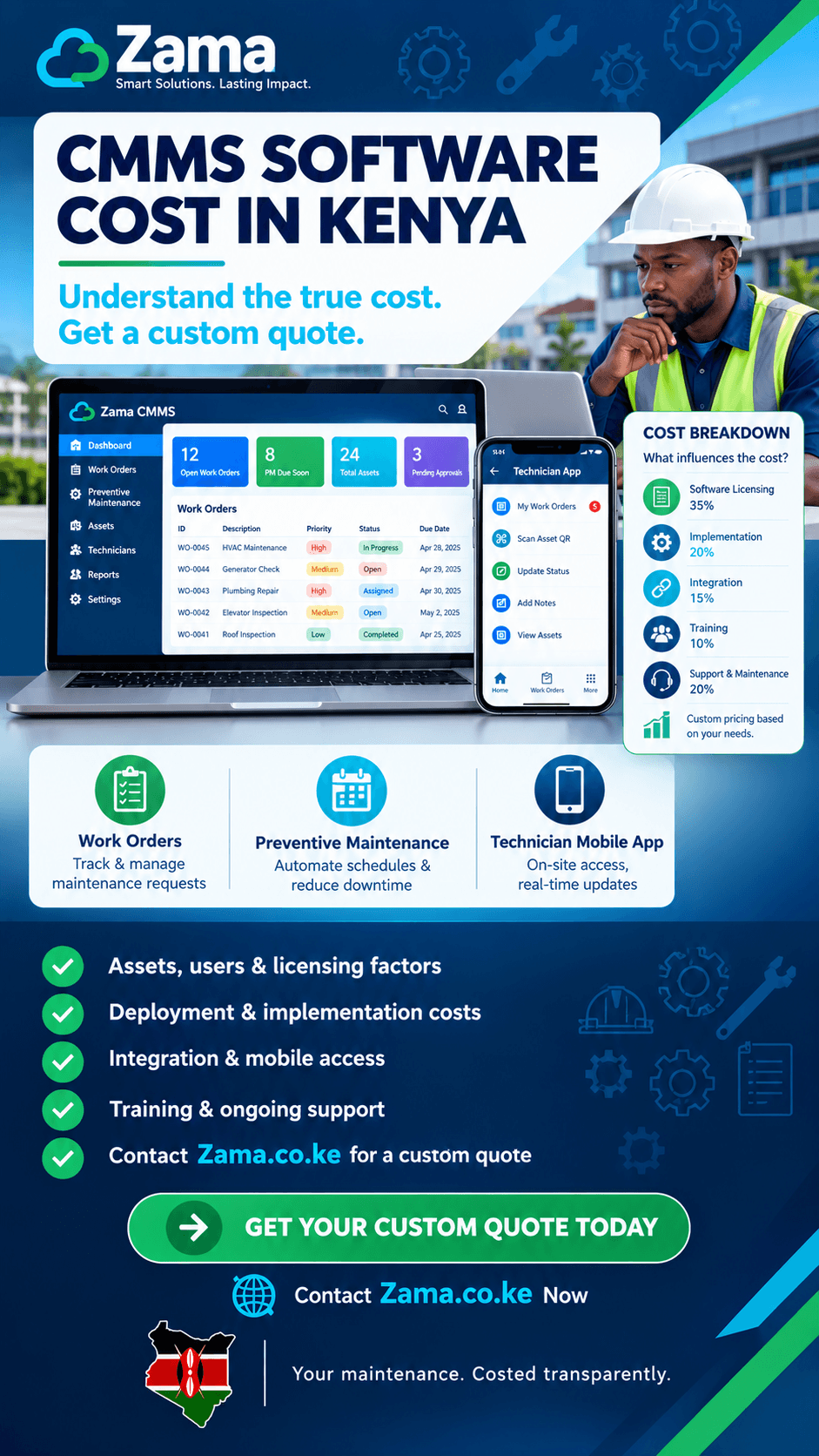
The number of assets under management and the number of users who need access to the system are primary drivers of CMMS software cost in Kenya. A small facility with 100 assets and five users has simpler requirements than a large manufacturer with 10,000 assets and fifty users. Pricing typically scales with both asset count and user count.

2. Software Licensing Model

Software licensing is a critical factor in CMMS software cost in Kenya. Several licensing models are available. Perpetual licences involve a one-time payment with optional annual maintenance fees. Subscription-based models charge recurring monthly or annual fees based on the number of users, assets, or sites. Per-user licensing scales costs directly with the number of staff who need access. Enterprise licensing agreements provide unlimited users across all sites for a single annual fee.

3. Deployment Model

The deployment model significantly affects CMMS software cost in Kenya. On-premise deployment requires server hardware, network infrastructure, and IT staff for maintenance, resulting in higher upfront costs but lower ongoing costs. Cloud-based deployment reduces upfront infrastructure costs and shifts maintenance responsibility to the vendor, but requires reliable internet connectivity and incurs recurring subscription fees.

4. Implementation and Data Migration

Implementation and data migration are significant components of CMMS software cost in Kenya. Migrating existing asset registers, maintenance histories, and vendor records requires careful validation. Asset descriptions, locations, and maintenance histories must be accurate before migration. Poor data quality leads to system distrust and adoption problems.

5. Integration Requirements

CMMS software rarely operates in isolation. Integration with existing systems adds to CMMS software cost in Kenya. Accounting systems integration ensures that maintenance costs flow into financial statements. Procurement systems integration ensures that spare parts procurement is linked to work orders. Access control integration ensures that maintenance staff access is controlled and logged. Payment systems integration with M-Pesa enables efficient contractor payment and automated reconciliation.

6. Mobile Access Requirements

Field technicians need mobile access to work orders, asset histories, and digital checklists. A comprehensive CMMS software cost in Kenya must account for mobile functionality. Organizations report that mobile functionality often requires additional licensing, so this must be factored into the budget.

7. Spare Parts and Inventory Management

Maintenance requires parts. The complexity of spare parts inventory management affects cost. For large operations, managing thousands of inventory items requires real-time visibility and automated reordering, which adds to the overall investment.

8. Reporting and Analytics Requirements

Reporting requirements affect CMMS software cost in Kenya. The system must generate maintenance performance reports, cost analysis reports, asset history reports, compliance reports, and management dashboards. Complex reporting requirements require more configuration effort.

9. Training and Change Management

Training maintenance technicians, supervisors, and managers is essential for successful adoption. Training costs—whether included in the software licence or charged separately—add to CMMS software cost in Kenya. Role-specific training, on-site training, and ongoing training as staff turnover occurs all contribute to the total cost.

10. Ongoing Support and Maintenance

CMMS software requires ongoing support and maintenance. This includes software updates, bug fixes, feature enhancements, and technical support. Support costs vary based on the level of service and whether support is included in the licence or charged separately.

Pricing Models Available for CMMS Software in Kenya

Several pricing models are available for CMMS software in Kenya:

Monthly Subscription

A monthly subscription includes the software licence, hosting, support, and updates. The organization pays a recurring fee based on the number of users, assets, or sites. This model has lower upfront costs but higher cumulative costs over time.

Annual Subscription

Annual subscriptions offer cost savings compared to monthly billing, with organizations committing to a full year of service. This model provides cost predictability and simplifies budgeting.

Perpetual Licence

A perpetual licence includes a one-time payment for the software, with the organization responsible for hosting and maintenance. Annual maintenance fees typically apply. This model has higher upfront costs but lower ongoing costs.

Per-Asset Pricing

Some vendors charge per asset tracked—for example, a fixed fee per asset per year. This model is suitable for organizations with stable asset bases but can become expensive for rapidly growing organizations.

Enterprise Agreement

For large organizations with multiple sites, enterprise agreements provide unlimited assets across all locations for a single annual fee. This model simplifies budgeting and provides cost predictability.

Hidden Costs to Budget For

Beyond the visible costs, several hidden expenses affect CMMS software cost in Kenya:

Network Infrastructure

CMMS software requires network connectivity between users, servers, and databases. Organizations may need to upgrade network infrastructure, install additional access points, or improve internet connectivity.

Power Backup

Kenyan organizations face power fluctuations and outages. CMMS software requires UPS backup for servers and workstations.

Data Cleansing

Before migrating data, existing records must be cleansed and validated. This can be a significant effort, particularly for organizations with years of inconsistent record-keeping.

Asset Tagging

Physical asset tagging is essential for effective maintenance management. Barcode or QR code generation, label printing, and asset tagging across all locations add to the overall investment.

Mobile Device Procurement

If technicians do not already have suitable mobile devices, organizations must budget for tablets or smartphones for field access.

Compliance Updates

As regulations change, the CMMS software must be updated accordingly. Vendors may charge for these updates.

The ROI of CMMS Software in Kenya

When evaluating CMMS software cost in Kenya, the ROI must be considered alongside the investment. The costs are offset by:

Reduced Downtime: Preventive maintenance and predictive analytics prevent equipment failures before they occur.

Lower Maintenance Costs: Understanding where and how maintenance costs are incurred helps identify inefficiencies and optimize spending. A leading energy distributor operating 600+ sites across Kenya, Uganda, Rwanda, and Zambia reported a 25% reduction in maintenance costs after implementing a CMMS platform.

Extended Asset Life: Regular preventive maintenance extends the life of appliances, equipment, and building systems.

Improved Tenant Satisfaction: Faster response times and better communication improve tenant retention and satisfaction.

Audit Readiness: Automated compliance tracking and instant report generation ensure audit readiness at all times.

Staff Accountability: Every work order has an assigned owner, a due date, and a completion record.

Data-Driven Decisions: Maintenance analytics reveal trends, recurring issues, and opportunities for improvement.

The Zama.co.ke Approach to CMMS Software Cost in Kenya

When considering CMMS software cost in Kenya, zama.co.ke follows a structured approach:

Maintenance Assessment

We evaluate your organization’s maintenance operations: asset types, request volume, team structure, contractor management, compliance requirements, and reporting needs. This includes understanding your current challenges and defining success metrics.

Cost Modelling

We build a detailed cost model that includes software licensing, hardware, implementation, training, integration, and ongoing support. We help you understand the total cost of ownership, not just the monthly subscription.

Solution Design

We design a CMMS solution tailored to your specific needs—whether it’s property maintenance, manufacturing equipment, fleet maintenance, or facility operations.

Implementation and Configuration

We handle system configuration, asset register setup, workflow automation, mobile app deployment, and integration with existing systems.

Training and Support

We provide role-specific training for technicians, supervisors, and managers, including work order management, preventive maintenance scheduling, and reporting.

Post-Implementation Support

We remain available for maintenance, troubleshooting, and system upgrades as your asset base evolves.

Implementation Considerations for Kenyan Organizations

When implementing CMMS software in Kenya, consider these factors:

Assess Your Maintenance Needs

Evaluate your asset base, maintenance volume, team structure, and reporting requirements. A small property management company has different needs from a manufacturing plant with hundreds of machines.

Choose the Right Solution

The best CMMS for your organization depends on your industry, asset complexity, and budget. For property managers, systems with multi-tenant support and tenant portals are essential. For manufacturers, systems with preventive maintenance and spare parts management are critical.

Plan for Data Migration

Migrating asset registers, maintenance histories, and vendor records requires careful validation. Ensure asset descriptions, locations, and maintenance histories are accurate before migration.

Train Your Team

Maintenance technicians, supervisors, and managers need training on the new system. Role-specific training using real scenarios produces higher adoption and better data quality.

Start with a Pilot

Many Kenyan organizations achieve better results by introducing the system in one building or with one maintenance team before expanding across the portfolio.

Ensure Integration

Plan for integration with existing systems including accounting software, procurement systems, and access control. This creates a unified operational platform.

Plan for Mobile Access

Mobile functionality is essential for field technicians. Ensure your CMMS includes mobile access for work orders, asset data, and digital checklists.

The Cost of Delaying CMMS Implementation

While organizations evaluate CMMS software cost in Kenya, the cost of inaction compounds daily. Every month of manual maintenance represents unplanned downtime, emergency repairs, and lost productivity. Every month of paper-based records represents audit risk and compliance gaps. Every month of reactive maintenance represents shortened asset life and missed savings opportunities.

Meanwhile, organizations that have implemented CMMS software are achieving preventive maintenance, reducing downtime, and extending asset life. The competitive gap widens with every passing month.

Why Contact Zama.co.ke for CMMS Software Cost in Kenya

When researching CMMS software cost in Kenya, organizations should contact zama.co.ke because:

  • Local Expertise: We understand Kenyan operating realities, regulatory requirements, and infrastructure conditions.

  • Transparent Pricing: No hidden fees, clear milestone timelines, and full source-code ownership.

  • Custom Development: We build systems tailored to your specific maintenance workflows, asset categories, and reporting requirements.

  • Integration Capabilities: We connect CMMS to accounting, procurement, access control, and ERP systems.

  • Mobile-First Design: We build mobile access for field technicians from day one.

  • Ongoing Support: We remain available for maintenance, troubleshooting, and system upgrades as your asset base evolves.

For a custom quote based on your organization’s specific requirements, contact zama.co.ke today.

CMMS software cost in Kenya depends on several factors—the number of assets and users, software licensing model, deployment model, implementation complexity, integration requirements, mobile access needs, and ongoing support. The total cost of ownership includes software, hardware, implementation, training, integration, and support. But the ROI—reduced downtime, lower maintenance costs, extended asset life, and audit readiness—far exceeds the investment.

At zama.co.ke, we’ve helped organizations across Kenya evaluate, implement, and optimize CMMS software that delivers measurable results. Our approach ensures you get exactly what your organization needs—nothing more, nothing less.

Don’t let the complexity of CMMS software cost in Kenya hold you back. Whether you’re managing properties, manufacturing plants, healthcare facilities, or energy infrastructure, we have the expertise to guide you through every step.

Contact zama.co.ke today for a custom quote based on your organization’s specific requirements.