Talk to a Kenyan software expert 0725 345 345

Zama Web Experts

Content Management System: The Complete Guide to Choosing, Using, and Growing Your Business with a CMS in Kenya

July 14, 2026 · Zama

Content Management System

Table of Contents

Content Management System: Everything You Need to Know in 2026

A Content Management System (CMS) has become one of the most important tools for businesses, organizations, schools, churches, government institutions, and entrepreneurs looking to establish a strong online presence. Whether you want to launch a corporate website, an eCommerce platform, a blog, a portfolio, or a customer portal, choosing the right Content Management System can determine how successful your website becomes.

Businesses in Kenya are rapidly adopting digital technologies, and one of the biggest investments they make is in a professional website powered by a reliable Content Management System. Unlike traditional websites that require coding every time you need to update content, a CMS allows anyone to add pages, upload images, publish blogs, manage products, and edit website content with ease.

At Zama Technologies (zama.co.ke), we specialize in designing modern websites powered by advanced Content Management Systems that are secure, scalable, mobile-friendly, and optimized for search engines.

Need a professional Content Management System for your business?

Call us today: +254 725345345


What is a Content Management System?

A Content Management System is software that enables users to create, organize, edit, publish, and manage digital content without requiring extensive programming knowledge.

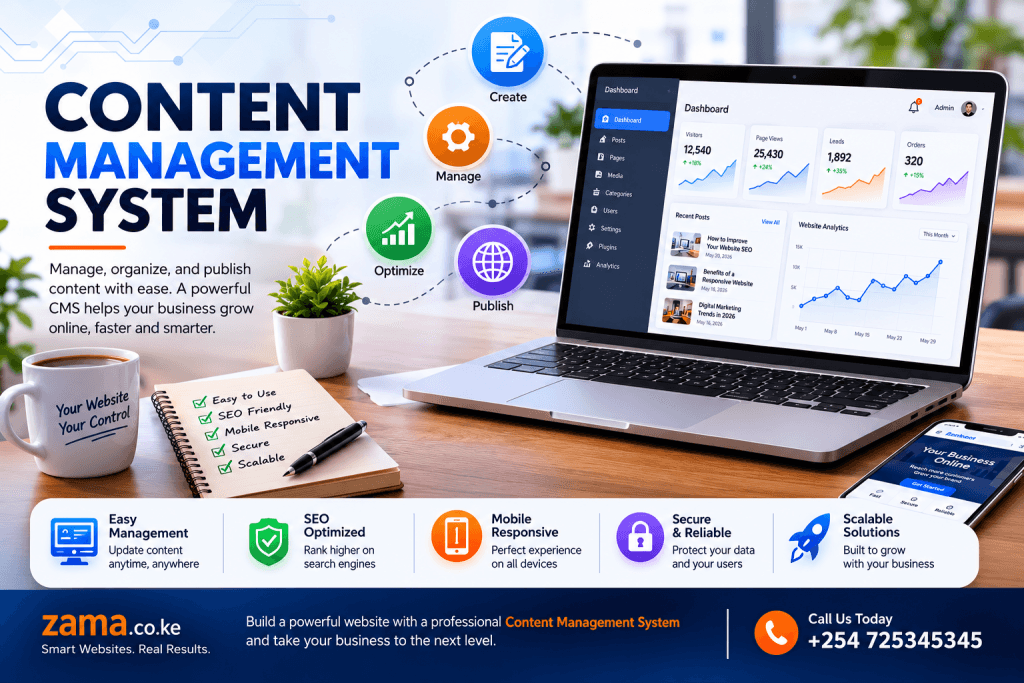
Instead of writing HTML, CSS, or JavaScript every time you need to update your website, a CMS provides an easy-to-use dashboard where you can:

  • Publish blog articles
  • Update company information
  • Upload images
  • Create service pages
  • Manage products
  • Edit menus
  • Change website banners
  • Optimize SEO
  • Control user permissions

This means business owners can manage their own websites without depending on developers for every small change.

A modern Content Management System saves time, reduces maintenance costs, and gives organizations full control over their online presence.


Why Every Business Needs a Content Management System

Today’s customers search online before purchasing products or services. Without an updated website, businesses lose credibility and opportunities.

A professional Content Management System allows businesses to:

  • Keep information updated
  • Publish regular blogs
  • Improve Google rankings
  • Generate leads
  • Increase sales
  • Build trust
  • Showcase products
  • Accept customer inquiries
  • Grow online visibility

Businesses that regularly update their websites often outperform competitors who maintain static websites.


How a Content Management System Works

A Content Management System has two major components.

1. Content Management Application (CMA)

This is the admin dashboard where users log in.

Here they can:

  • Create pages
  • Publish blogs
  • Upload media
  • Edit menus
  • Manage users
  • Install plugins
  • Change website settings

Everything happens through a simple interface.


2. Content Delivery Application (CDA)

The CDA displays the content to visitors.

Whenever someone visits your website, the CMS automatically retrieves information from the database and displays it in a professional format.

Visitors never see the backend.


Benefits of Using a Content Management System

There are numerous advantages to using a Content Management System.

Easy Website Management

One of the biggest advantages is simplicity.

Anyone can:

  • Edit text
  • Upload images
  • Add new pages
  • Publish blogs

No coding skills required.


Better SEO

Modern Content Management Systems include built-in SEO tools that help improve search engine rankings.

These include:

  • Meta titles
  • Meta descriptions
  • SEO URLs
  • XML sitemaps
  • Internal linking
  • Schema support

All these features improve visibility on Google.


Faster Content Publishing

Businesses can publish:

  • News
  • Promotions
  • Events
  • Offers
  • Company updates

within minutes.


Lower Website Maintenance Costs

Without a CMS, every update requires hiring a developer.

With a Content Management System, your staff can make updates internally.

This saves significant money over time.


Mobile-Friendly Websites

Modern CMS platforms create responsive websites that automatically adapt to:

  • Smartphones
  • Tablets
  • Laptops
  • Desktop computers

Google prioritizes mobile-friendly websites.


Better Security

Professional CMS platforms provide:

  • Regular updates
  • Security patches
  • User access control
  • Password protection
  • Two-factor authentication
  • Backup tools

These protect your business from cyber threats.


Features of a Good Content Management System

Not every CMS is created equal.

A quality Content Management System should include:

User-Friendly Dashboard

Users should easily navigate the administration area.

A clean interface increases productivity.


Media Library

A CMS should allow easy uploading and organization of:

  • Images
  • Videos
  • PDFs
  • Documents
  • Audio files

SEO Management

A modern CMS should support:

  • Custom URLs
  • Meta tags
  • Image optimization
  • Redirect management
  • XML sitemaps

User Roles

Businesses often have multiple users.

A CMS should support different permissions.

Examples include:

  • Administrator
  • Editor
  • Author
  • Contributor
  • Subscriber

This improves security.


Plugin Support

Plugins extend functionality.

Examples include:

  • Contact forms
  • Payment gateways
  • Analytics
  • Security tools
  • Backup systems
  • Marketing integrations

Analytics Integration

Businesses should monitor website performance using:

  • Google Analytics
  • Google Search Console
  • Heatmaps
  • Visitor reports

A good CMS makes integration easy.


Types of Content Management Systems

There are different CMS platforms depending on business needs.


Open Source CMS

These are free to use.

Examples include:

  • WordPress
  • Joomla
  • Drupal

Advantages:

  • Flexible
  • Large community
  • Thousands of plugins
  • Affordable

Proprietary CMS

These are developed by software companies.

Advantages include:

  • Dedicated support
  • Custom features
  • Enterprise security
  • Professional maintenance

Headless CMS

A Headless Content Management System separates the backend from the frontend.

This provides:

  • Better performance
  • API integrations
  • Multi-platform publishing
  • Mobile application support

Enterprise CMS

Large organizations often require enterprise solutions capable of handling:

  • Multiple users
  • Large traffic
  • Advanced security
  • Workflow management
  • Digital asset management

Industries That Benefit from a Content Management System

Almost every industry can benefit from a professional CMS.

These include:

Corporate Companies

Corporate websites require:

  • Company profiles
  • Team pages
  • Investor information
  • News updates

Schools

Schools use CMS platforms for:

  • Admissions
  • News
  • Academic calendars
  • Downloads
  • Student resources

Churches

Churches manage:

  • Sermons
  • Events
  • Donations
  • Ministries
  • Prayer requests

Hospitals

Hospitals publish:

  • Services
  • Doctors
  • Appointments
  • Health articles

NGOs

NGOs manage:

  • Projects
  • Reports
  • Publications
  • Donations
  • Volunteers

Hotels

Hotels use CMS websites to manage:

  • Rooms
  • Bookings
  • Promotions
  • Customer inquiries

Real Estate Companies

Real estate firms showcase:

  • Property listings
  • Images
  • Virtual tours
  • Agent profiles

Online Stores

E-commerce businesses require CMS platforms for:

  • Product management
  • Orders
  • Inventory
  • Payments
  • Shipping

Why WordPress is the Most Popular Content Management System

WordPress powers millions of websites globally because it offers flexibility and ease of use.

Benefits include:

  • Beginner-friendly
  • Thousands of themes
  • Powerful plugins
  • Excellent SEO
  • Large developer community
  • Affordable maintenance
  • Fast deployment

For many Kenyan businesses, WordPress remains the preferred Content Management System due to its reliability and cost-effectiveness.


How a Content Management System Improves SEO

Search engines love websites that publish fresh, relevant content consistently.

A CMS helps by making it easy to:

  • Publish blog posts
  • Optimize page titles
  • Add keywords naturally
  • Improve page speed
  • Compress images
  • Build internal links
  • Generate XML sitemaps

These practices help improve search rankings and increase organic traffic.


Common Mistakes Businesses Make When Choosing a Content Management System

Many organizations rush into selecting a CMS without evaluating their long-term needs. Common mistakes include:

  • Choosing a platform that cannot scale with business growth.
  • Ignoring security features.
  • Selecting a CMS without SEO capabilities.
  • Overlooking mobile responsiveness.
  • Using too many unnecessary plugins that slow down the website.
  • Failing to plan for future integrations such as CRM, ERP, or payment gateways.
  • Not investing in regular updates and maintenance.

Avoiding these mistakes ensures that your Content Management System continues to support your business as it grows.


Why Choose Zama Technologies for Your Content Management System?

At Zama Technologies, we build custom and WordPress-based Content Management Systems tailored to the unique needs of Kenyan businesses. Our websites are designed to be:

  • Fast and responsive
  • SEO-optimized
  • Secure and regularly maintained
  • Easy to manage
  • Scalable for future growth
  • Integrated with modern business tools

Whether you need a corporate website, school portal, eCommerce platform, or custom CMS solution, our experienced team is ready to help.

Contact Zama Technologies today:

📞 +254 725345345

🌐 Website: zama.co.ke

Advanced Guide to Content Management System (CMS) for Businesses in Kenya

How to Choose the Best Content Management System

Choosing the right Content Management System is one of the most important decisions a business can make. Your website will become the digital face of your company, and the Content Management System you choose will determine how easy it is to manage content, improve SEO, expand functionality, and support future growth.

When evaluating a Content Management System, consider the following factors:

Ease of Use

A good Content Management System should be easy enough for non-technical users. Your employees should be able to publish blogs, update services, upload images, and modify content without hiring a web developer every time.

Scalability

As your business grows, your Content Management System should also grow with you. You may begin with a five-page website but later require:

  • Customer portals
  • Online payment integration
  • Appointment booking
  • Live chat
  • CRM integration
  • Inventory management
  • Membership systems

A scalable Content Management System makes future expansion much easier.

Security Features

Website security is no longer optional. A reliable Content Management System should include:

  • User authentication
  • SSL compatibility
  • Firewall integration
  • Security updates
  • Malware protection
  • Automatic backups
  • Role-based permissions

Protecting customer information should always be a priority.


Popular Content Management System Platforms

There are several excellent Content Management System platforms available today. Each serves different business needs.

WordPress CMS

WordPress remains the world’s most popular Content Management System because of its flexibility and ease of use.

Advantages include:

  • Thousands of professional themes
  • Over 60,000 plugins
  • Excellent SEO support
  • Easy customization
  • Affordable development costs
  • Massive global community
  • Mobile responsiveness

Most SMEs in Kenya choose WordPress because it offers enterprise-level features without enterprise-level costs.


Joomla Content Management System

Joomla offers greater flexibility than many platforms while remaining relatively user-friendly.

Best suited for:

  • Educational institutions
  • Membership websites
  • Government portals
  • Community websites

Drupal Content Management System

Drupal is known for its security and scalability.

Large organizations prefer Drupal because it handles:

  • High traffic
  • Large databases
  • Complex user permissions
  • Enterprise workflows

Custom Content Management System

Sometimes businesses require features that existing platforms cannot provide.

A custom-built Content Management System offers:

  • Tailored workflows
  • Better performance
  • Industry-specific modules
  • Improved security
  • Unlimited customization

At Zama Technologies, we also develop custom CMS platforms designed specifically around your business operations.


Essential Features Every Modern Content Management System Should Have

Today’s businesses require much more than simply publishing pages.

A modern Content Management System should support:

Blog Management

Publishing regular blogs helps improve SEO.

An advanced Content Management System allows users to:

  • Schedule articles
  • Categorize posts
  • Add tags
  • Manage comments
  • Optimize SEO
  • Track engagement

Consistent blogging helps businesses rank higher on Google.


Media Management

A good Content Management System should organize:

  • Photos
  • Videos
  • PDFs
  • Documents
  • Audio files
  • Infographics

Proper media organization saves time and improves website management.


Search Functionality

Large websites require intelligent search.

Visitors should quickly find:

  • Products
  • Services
  • Blog posts
  • Downloads
  • News
  • FAQs

An efficient search function enhances the user experience.


User Management

Businesses often have multiple people managing content.

Your Content Management System should allow administrators to assign roles such as:

  • Super Admin
  • Administrator
  • Editor
  • Author
  • Marketing Manager
  • Content Creator

Each role should have controlled permissions.


Why Businesses in Kenya Are Investing in Content Management Systems

Kenyan businesses have realized that customers now search online before making purchasing decisions.

A professional Content Management System helps businesses:

  • Build credibility
  • Reach new customers
  • Improve customer service
  • Increase online sales
  • Generate leads
  • Publish educational content
  • Strengthen branding

Whether you’re a startup or a large enterprise, investing in a robust Content Management System creates long-term value.


SEO Advantages of a Content Management System

One of the biggest reasons businesses invest in a Content Management System is search engine optimization.

An SEO-friendly Content Management System provides:

Clean URLs

Instead of:

website.com/page?id=12345

You get:

website.com/content-management-system

Search engines prefer descriptive URLs.


Meta Titles

Every page should have a customized title.

A professional Content Management System makes editing titles easy.


Meta Descriptions

Optimized descriptions improve click-through rates from Google search results.


Internal Linking

A Content Management System makes it easy to connect related pages.

Internal links improve:

  • User navigation
  • SEO rankings
  • Crawlability

Image Optimization

Modern CMS platforms allow:

  • Alt text
  • Image compression
  • Responsive images
  • Lazy loading

These features improve page speed and accessibility.


Content Management System and Mobile Optimization

More than half of internet traffic now comes from smartphones.

A professional Content Management System ensures your website:

  • Loads quickly on mobile devices
  • Adapts to different screen sizes
  • Offers touch-friendly navigation
  • Maintains excellent readability
  • Supports mobile SEO

Google prioritizes mobile-first websites, making responsive design essential.


Integrating Your Content Management System with Business Tools

A modern Content Management System should seamlessly integrate with essential business applications, including:

  • Customer Relationship Management (CRM) software
  • Email marketing platforms
  • Payment gateways
  • Inventory systems
  • Accounting software
  • Social media platforms
  • Live chat applications
  • Google Analytics
  • Google Search Console

These integrations streamline operations and improve efficiency.


Common Challenges When Managing a Content Management System

Even the best Content Management System requires proper management. Some common challenges include:

Outdated Software

Failing to update your CMS can expose your website to security vulnerabilities.

Weak Passwords

Always use strong, unique passwords and enable two-factor authentication where possible.

Poor Content Organization

As your website grows, organizing pages, categories, and media becomes increasingly important.

Slow Website Performance

Installing too many plugins or uploading unoptimized images can slow down your site. Regular maintenance helps keep your Content Management System running efficiently.


Future Trends in Content Management Systems

The future of the Content Management System industry is exciting, with innovations that make websites smarter, faster, and easier to manage.

Artificial Intelligence (AI)

AI-powered CMS features include:

  • Automatic content suggestions
  • SEO recommendations
  • Grammar correction
  • Image generation
  • Personalized user experiences
  • Automated customer support

Headless CMS

Businesses are increasingly adopting Headless Content Management Systems to deliver content across websites, mobile apps, kiosks, and smart devices through APIs.

Voice Search Optimization

Modern CMS platforms are evolving to support voice-search-friendly content structures as voice assistants become more common.

Enhanced Cybersecurity

Security features such as behavioral analytics, AI-powered threat detection, and automated patch management are becoming standard in advanced Content Management Systems.


Why Professional CMS Development Matters

While free website builders exist, professional CMS development provides significant advantages:

  • Better performance
  • Improved security
  • Custom branding
  • Advanced functionality
  • Faster loading speeds
  • Better SEO optimization
  • Scalability
  • Ongoing support

Partnering with experienced developers ensures your Content Management System aligns with your business goals.


Frequently Asked Questions About Content Management Systems

Is a Content Management System suitable for small businesses?

Yes. A Content Management System is ideal for businesses of all sizes, from startups to multinational corporations.


Can I update my website without coding?

Absolutely. One of the biggest benefits of a Content Management System is that it allows users to update content through an easy-to-use dashboard.


Which is the best Content Management System?

The best Content Management System depends on your requirements. WordPress is excellent for most businesses, while custom CMS solutions are ideal for organizations with specialized needs.


Is a Content Management System secure?

Yes, when properly maintained. Regular updates, secure hosting, backups, and strong authentication practices help keep your CMS secure.


How often should I update my Content Management System?

Security updates should be applied as soon as they become available. Regular maintenance ensures optimal performance and protection.


Why Choose Zama Technologies for Content Management System Development?

If you’re looking for a reliable partner to build or upgrade your Content Management System, Zama Technologies is ready to help.

We specialize in developing CMS-powered websites that are:

  • SEO optimized
  • Fast-loading
  • Mobile responsive
  • Secure
  • Easy to manage
  • Scalable
  • Customizable
  • Integrated with business tools

Whether you need a corporate website, eCommerce platform, educational portal, church website, NGO portal, real estate platform, or a fully customized Content Management System, our experienced developers will deliver a solution tailored to your business.

Our services include:

  • Custom CMS Development
  • WordPress Website Development
  • CMS Migration
  • Website Redesign
  • SEO Optimization
  • Website Maintenance
  • Security Hardening
  • Performance Optimization
  • Plugin Development
  • CMS Training and Support

With years of experience serving businesses in Kenya, we understand what it takes to build websites that not only look professional but also generate measurable business results.


Building a Strong Digital Presence Through Consistent Website Management

Creating a professional website is a significant milestone for any organization, but its true value is realized through continuous improvement and active management. A website should never remain static after launch. Instead, it should evolve alongside your business, reflecting new services, customer needs, market trends, and technological advancements. Companies that regularly invest in their online presence often enjoy stronger customer relationships, higher search visibility, and increased business opportunities.

One of the most effective ways to maintain a vibrant website is by publishing fresh and valuable content. Customers appreciate businesses that share useful information, answer common questions, and provide industry insights. Regular updates demonstrate professionalism and reassure visitors that the business is active and committed to serving its customers. Fresh content also encourages repeat visits, giving potential clients more reasons to engage with your brand over time.

Beyond publishing articles, businesses should periodically review existing pages to ensure all information remains accurate. Phone numbers, email addresses, operating hours, pricing, and service descriptions may change over time. Outdated information can frustrate visitors and reduce trust, while current and accurate details create confidence in your organization.

Visual presentation also plays an important role in user experience. High-quality photographs, professional graphics, and consistent branding contribute significantly to how visitors perceive your company. Investing in professional imagery can make products and services more attractive while reinforcing your brand identity. Images should be optimized to maintain fast loading speeds without sacrificing quality.

Customer testimonials are another valuable asset that should be updated regularly. Positive reviews from satisfied clients build credibility and help potential customers feel confident in choosing your services. Featuring detailed success stories, case studies, or project highlights can further demonstrate your expertise and showcase the results you’ve achieved for previous clients.

Another area that deserves continuous attention is website navigation. As more pages and resources are added, menus should remain organized and intuitive. Visitors should always be able to locate information within a few clicks. Simple navigation reduces frustration and encourages users to explore additional pages, increasing the likelihood of inquiries or purchases.

Website accessibility is equally important. Businesses should ensure that their websites are usable by individuals with varying abilities. Clear typography, sufficient color contrast, descriptive image text, keyboard navigation support, and properly structured headings contribute to an inclusive online experience. Accessibility improvements not only benefit users but also enhance overall website quality.

Performance optimization should become part of every organization’s routine maintenance plan. Visitors expect websites to load almost instantly, and even minor delays can result in lost customers. Compressing images, minimizing unnecessary scripts, optimizing databases, and using reliable hosting services all contribute to improved speed and responsiveness. Fast websites create a better user experience and encourage visitors to spend more time exploring available information.

Security should remain a constant priority regardless of company size. Cyber threats continue to evolve, making proactive protection essential. Organizations should regularly update software, monitor unusual activity, use strong authentication methods, and perform scheduled backups. Preparing for potential security incidents reduces downtime and helps protect valuable business data.

Businesses should also establish a clear content strategy rather than publishing information randomly. Planning content several months in advance ensures consistency and allows teams to align website updates with marketing campaigns, seasonal promotions, product launches, and company events. Editorial calendars help maintain publishing schedules while reducing last-minute pressure on content creators.

Collaboration between departments often improves website quality. Marketing teams, sales representatives, customer support staff, and technical experts each possess unique knowledge that can contribute valuable information. By working together, organizations can create content that addresses real customer questions while accurately representing products and services.

Monitoring visitor behavior provides valuable insights into how people interact with your website. Understanding which pages receive the most traffic, where visitors spend the most time, and where they leave the website can help identify opportunities for improvement. Small adjustments based on user behavior often lead to meaningful increases in engagement and conversions.

Search trends also change over time. Businesses should periodically review the language customers use when searching online. Adapting website content to reflect evolving terminology helps maintain relevance and ensures information continues reaching the intended audience. This ongoing refinement supports long-term visibility and competitiveness.

Organizations should not overlook the importance of internal communication regarding website management. Employees responsible for updating content should receive proper training and understand established publishing standards. Maintaining consistent formatting, writing style, image quality, and branding strengthens the professional appearance of the entire website.

As businesses expand, additional features may become valuable. Appointment booking, customer portals, online payments, live chat, downloadable resources, event registration, and customer support centers can significantly improve convenience while reducing administrative workload. Introducing new functionality gradually allows organizations to adapt efficiently without overwhelming users.

International expansion presents another opportunity for growth. Businesses targeting customers across multiple regions may consider multilingual websites to improve accessibility and communication. Providing content in multiple languages demonstrates commitment to serving diverse audiences and opens opportunities in new markets.

Video content has become increasingly influential in online communication. Educational tutorials, product demonstrations, customer interviews, company introductions, and behind-the-scenes videos help visitors connect with businesses more personally. Video often increases engagement and makes complex topics easier to understand than text alone.

Organizations should also recognize the value of downloadable resources such as guides, brochures, checklists, white papers, templates, and frequently asked questions. These resources provide additional value to visitors while positioning the business as a knowledgeable industry leader. Educational materials encourage longer website visits and often generate valuable customer inquiries.

Consistency across all digital channels strengthens brand recognition. Information presented on the website should align with social media profiles, business directories, email signatures, advertising campaigns, and printed marketing materials. Uniform branding creates a seamless customer experience and reinforces professionalism.

Periodic redesigns may also become necessary as design trends and user expectations evolve. While complete redesigns are not required frequently, refreshing layouts, updating graphics, improving navigation, and modernizing interfaces every few years helps maintain a contemporary appearance. A visually outdated website may unintentionally create the impression that a business itself is outdated.

Perhaps most importantly, businesses should view their website as a long-term investment rather than a one-time project. Continuous improvement, thoughtful planning, regular maintenance, and attention to user needs contribute to sustained online success. Organizations that treat their digital presence as an evolving business asset are better positioned to attract customers, build trust, and remain competitive in an increasingly digital marketplace.

Ultimately, lasting online success comes from consistently delivering value to visitors. When businesses focus on providing accurate information, exceptional user experiences, helpful resources, and reliable service, their websites naturally become stronger marketing tools. Over time, these ongoing improvements contribute to increased customer confidence, stronger brand reputation, and measurable business growth, making the website one of the organization’s most valuable long-term assets.

Final Thoughts

A Content Management System is far more than just software for publishing web pages—it is the foundation of a successful digital presence. The right Content Management System empowers businesses to manage content efficiently, improve search engine visibility, enhance customer engagement, and adapt to changing business needs.

As technology evolves, investing in a scalable and SEO-friendly Content Management System will continue to be one of the smartest decisions for organizations seeking sustainable online growth. Whether you’re launching your first website or replacing an outdated platform, choosing the right CMS and working with experienced developers can make all the difference.

At Zama Technologies, we are committed to building high-performance Content Management System solutions that help businesses across Kenya thrive online. From planning and design to development, optimization, and ongoing support, we provide end-to-end CMS services tailored to your goals.

Ready to build a professional Content Management System for your business?

Contact Zama Technologies today

📞 Phone: +254 725345345

🌐 Website: zama.co.ke

Let us help you build a secure, modern, and SEO-optimized Content Management System that drives traffic, generates leads, and grows your business for years to come.