
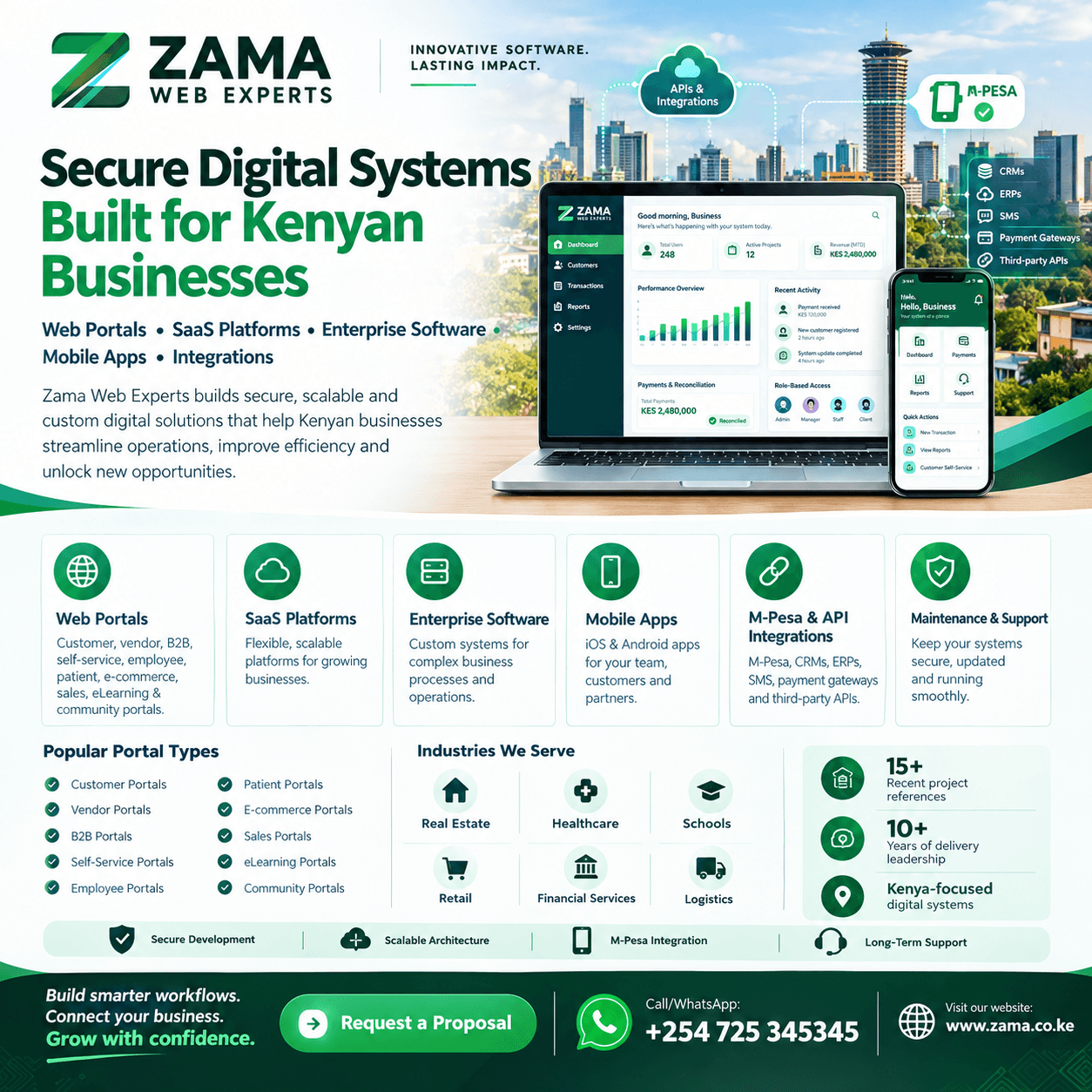
Cost of building custom business software in Kenya 2026 is a question that every business owner, operations director, and finance leader must answer before committing to a digital transformation project. With Kenyan organisations increasingly recognising that off-the-shelf tools cannot support unique workflows, and with KRA eTIMS compliance, M-Pesa integration, and Data Protection Act obligations shaping every software decision, understanding what drives the cost of building custom business software in Kenya 2026 has become essential for accurate budgeting and vendor comparison. At zama.co.ke, we’ve helped numerous organisations across Kenya navigate this complex landscape and build systems that deliver measurable returns. This comprehensive guide explores the cost of building custom business software in Kenya 2026, from understanding what determines pricing to calculating total cost of ownership.
What Custom Business Software Actually Delivers
Before diving into the cost of building custom business software in Kenya 2026, it’s essential to understand what you are investing in. Custom business software is a tailored digital platform built specifically for your organisation. It is designed around your exact workflows, approval hierarchies, reporting requirements, and integration needs. Unlike off-the-shelf solutions that force you to adapt your processes to generic software, custom software adapts to how your business actually operates.
A proper cost of building custom business software in Kenya 2026 analysis must account for more than just the development fee. The total investment includes discovery and requirements gathering, UX and interface design, development, integration with existing systems, data migration, testing, deployment, training, and ongoing support. Each component contributes to the overall cost, and understanding these components is essential for accurate budgeting.
For a Kenyan organisation, the practical definition of cost of building custom business software in Kenya 2026 is this: the total investment required to design, build, integrate, deploy, and maintain a tailored software platform—including discovery, development, integration, training, and ongoing support—spread over the expected lifetime of the system.
Why Kenyan Organisations Invest in Custom Business Software
When evaluating the cost of building custom business software in Kenya 2026, it’s important to understand the operational pressures driving adoption. Kenyan businesses face unique challenges that off-the-shelf software rarely addresses effectively.
The Limitations of Off-the-Shelf Software
Generic software is designed for broad markets, not specific organisations. It comes with standard workflows, fixed reporting structures, and limited customisation options. For Kenyan businesses with unique operational requirements—multi-tenant billing, complex approval hierarchies, local regulatory obligations, M-Pesa dependence—generic software creates more problems than it solves. Staff create manual workarounds. Data ends up in spreadsheets. Management cannot get consistent reports. The software becomes a liability rather than an asset.
A modern cost of building custom business software in Kenya 2026 analysis must also consider the cost of inaction. Research indicates that 73% of Kenyan SMEs who chose cheap ready-made software spent more on fixes than they would have on custom development. The savings from choosing the cheapest option upfront often disappear in workarounds, lost productivity, and missed opportunities.
M-Pesa Is the Default Payment Rail
Kenyan businesses need software that integrates with M-Pesa. Customers pay via M-Pesa, suppliers expect M-Pesa disbursements, and staff receive M-Pesa advances. Off-the-shelf software designed for credit card and bank transfer markets often lacks native M-Pesa integration. Custom software can be built with M-Pesa integration from day one, supporting STK Push, C2B, B2C, and B2B transactions.
KRA eTIMS Compliance Is Mandatory
Since January 2024, all VAT-registered businesses in Kenya must transmit invoices to KRA through eTIMS. Non-compliance carries penalties that can reach millions of shillings. Custom software can be built with eTIMS integration that transmits invoices in real time, generates KRA-compliant tax invoices, and maintains audit trails. Off-the-shelf software may have eTIMS integration, but the quality and completeness vary significantly.
Data Protection Act Compliance
Kenya’s Data Protection Act imposes strict requirements on how organisations handle personal data. Custom software can be designed with compliance built in—consent management, access controls, audit trails, and data subject rights. Off-the-shelf software may have compliance features, but they may not meet all requirements, particularly for organisations handling sensitive data.
Key Factors That Determine Cost of Building Custom Business Software in Kenya 2026
When analysing cost of building custom business software in Kenya 2026, several factors directly influence pricing:
1. Project Scope and Number of Workflows
Scope is the biggest cost driver. A system that records customers and produces a simple report is smaller than one that manages quotations, approvals, inventory, procurement, payments, projects, payroll, and audit trails. Every workflow requires analysis, interface design, business rules, development, testing, and documentation.
Before asking for a price, list the problems the software must solve. Separate essential workflows required for launch from features that can wait for a later phase. This makes quotations easier to compare and protects the project from uncontrolled expansion.
2. User Roles and Permissions
Role-based systems take more work than single-user applications. Administrators, managers, accountants, customers, suppliers, field officers, and executives may each need different screens and permissions. Sensitive actions may require approvals, maker-checker controls, or complete audit histories.
A proper cost of building custom business software in Kenya 2026 analysis must account for the number of user roles and the complexity of permissions. Each role adds design, development, and testing effort.
3. M-Pesa, eTIMS and Other Integrations
Kenyan software frequently connects to M-Pesa, banks, SMS providers, accounting platforms, identity services, maps, and KRA eTIMS. Integrations affect price because developers must build secure connections, handle callbacks, prevent duplicates, manage failed transactions, and reconcile data.
Safaricom provides M-Pesa APIs through the Daraja developer platform. KRA also provides several eTIMS options and system-to-system integration guidance. Integration should be priced as an operational workflow, not as a simple add-on. When evaluating cost of building custom business software in Kenya 2026, organisations must budget for integration complexity.
4. Data Migration Requirements
Data migration is often the longest single thread in a custom software project. Existing records must be cleansed, validated, mapped, and migrated into the new system. Customer records with incorrect tax IDs, product catalogues with inconsistent naming, and historical transactions with incomplete costing data all require attention before migration.
A quality cost of building custom business software in Kenya 2026 estimate must account for data migration effort. Beginning data cleansing during the project’s planning phase—not at migration—is essential. By the time cutover is approaching, the window for remediation is too small.
5. Security and Compliance Requirements
Security requirements affect development cost. Role-based access controls, encryption at rest and in transit, multi-factor authentication, audit trails, and data residency options all require development effort. For organisations handling sensitive data—financial records, medical records, legal documents, personal data—security features are non-negotiable.
Data Protection Act compliance adds to the cost of building custom business software in Kenya 2026. Consent management, data subject access requests, retention and deletion controls, and audit trails must be built into the software from day one.
6. Deployment Model
The deployment model affects cost. On-premise deployment requires server hardware, network infrastructure, and IT staff for maintenance. Cloud-based deployment shifts infrastructure responsibility to the vendor. Hybrid deployment combines both approaches. The choice affects both upfront and ongoing costs.
7. Mobile Access Requirements
Mobile access is essential for modern software. Field staff need mobile access to work orders, asset data, and digital checklists. Customers expect mobile-responsive portals. A comprehensive cost of building custom business software in Kenya 2026 analysis must account for responsive design or native mobile application development.
8. Reporting and Analytics Requirements
Reporting requirements affect development cost. The software must generate operational reports, financial reports, compliance reports, and management dashboards. Complex reporting requirements require more development effort and may require data warehouse or analytics infrastructure.
9. Training and Change Management
Training staff on the new software is essential for successful adoption. Training costs—whether included in the development fee or charged separately—add to the overall investment. Role-specific training, on-site training, and ongoing training as staff turnover occurs all contribute to the total cost of building custom business software in Kenya 2026.
10. Ongoing Support and Maintenance
Custom software requires ongoing support and maintenance. This includes software updates, security patches, bug fixes, integration maintenance, and feature enhancements. Support costs vary based on the level of service and whether support is included in the development agreement.
Pricing Models for Custom Business Software in Kenya 2026
Several pricing models are available for custom business software in Kenya 2026:
Fixed-Price Project
A fixed-price contract defines the scope, deliverables, timeline, and total cost upfront. This model provides budget certainty but requires a well-defined scope. Changes to scope typically trigger change requests with additional costs.
Time and Materials
A time and materials contract charges based on actual hours worked and materials used. This model provides flexibility for evolving requirements but offers less budget certainty. It requires careful monitoring and regular invoicing.
Phased Delivery
A phased delivery approach breaks the project into phases, each with its own scope, timeline, and cost. This model delivers value incrementally and allows for course correction between phases. It is well-suited to complex projects where requirements may evolve.
Retainer-Based Maintenance
After launch, many organisations move to a retainer-based maintenance agreement that covers ongoing support, updates, and enhancements. This provides predictable monthly costs and ensures continuity of support.
For a custom quote based on your specific requirements, contact zama.co.ke today. We provide transparent pricing based on your scope, integrations, and compliance needs.
Hidden Costs to Budget For
Beyond the visible costs, several hidden expenses affect cost of building custom business software in Kenya 2026:
Network Infrastructure
Custom software requires network connectivity between users, servers, and databases. Organisations may need to upgrade network infrastructure, install additional access points, or improve internet connectivity.
Power Backup
Kenyan organisations face power fluctuations and outages. Custom software requires UPS backup for servers and workstations.
Data Cleansing
Before migrating data, existing records must be cleansed and validated. This can be a significant effort, particularly for organisations with years of inconsistent record-keeping.
Compliance Updates
As KRA updates eTIMS requirements and ODPC issues new guidance, the software must be updated accordingly. Vendors may charge for these updates.
Audit Support
During statutory audits, the vendor may need to provide compliance documentation, support audit queries, or assist with verification. Some vendors include these services; others charge for audit support.
The ROI of Custom Business Software in Kenya 2026
When evaluating cost of building custom business software in Kenya 2026, the ROI must be considered alongside the investment. The costs are offset by significant savings and efficiency gains.
Eliminated Manual Workarounds: Custom software eliminates the manual workarounds that consume staff time and introduce errors. Staff focus on productive work rather than copying data between systems.
Accelerated Processes: Automated workflows reduce process cycle times from days to hours. Approvals move faster. Payments are processed sooner. Customers receive better service.
Compliance Protection: Automated KRA eTIMS compliance and Data Protection Act controls reduce legal and regulatory risk. Penalties are avoided.
Improved Decision-Making: Real-time dashboards and reports provide management with actionable insights for operational and strategic decisions.
Scalability: Custom software scales with your business, adding users, workflows, and integrations without rebuilding the system.
Competitive Advantage: Custom software enables capabilities that competitors using generic software cannot match.
What Makes Cost of Building Custom Business Software in Kenya 2026 Different
Cost of building custom business software in Kenya 2026 has unique characteristics that global estimates often lack:
M-Pesa Integration Complexity
M-Pesa integration is not a simple payment gateway integration. It requires OAuth token management, callback handling, idempotency for reliable operation, and reconciliation against invoices and customer accounts. The Daraja API has specific requirements that must be carefully implemented.
KRA eTIMS Compliance
eTIMS compliance adds complexity to custom software development. The software must generate KRA-compliant tax invoices, transmit them in real time, and maintain audit trails. The integration must stay current with KRA requirements, which evolve over time.
Data Protection Act Compliance
Kenya’s Data Protection Act imposes requirements that global software estimates may not account for. Consent management, data subject access requests, retention and deletion controls, and audit trails must be built into the software.
Offline and Low-Bandwidth Capability
Internet in Kenya is not always reliable. Custom software must often support offline capability, storing data locally and syncing when connection returns. This adds development complexity.
Local Support and Training
The best custom software development partners in Kenya offer local support, training, and implementation services. Organisations need a partner who can respond quickly when issues arise and who understands the Kenyan regulatory environment.
Implementation Considerations for Kenyan Organisations
When implementing custom business software in Kenya 2026, consider these factors:
Define Scope Clearly
Before selecting a development partner, define the scope clearly. What problems must the software solve? What workflows are essential for launch? What can wait for a later phase? A clear scope enables accurate estimates and protects against scope creep.
Choose the Right Development Partner
Select a development partner with experience in your industry, expertise in the required integrations, and a proven track record. The best cost of building custom business software in Kenya 2026 partners understand both technology and business processes.
Plan for Data Migration
Migrating existing data requires careful planning. Cleanse and validate data before migration. Ensure that customer records, product catalogues, and historical transactions are accurate.
Train Your Team
Staff at all levels need training on the new software. Role-specific training using real scenarios produces higher adoption and better data quality.
Test Thoroughly
Test all scenarios: normal operation, error handling, integrations, security controls, and performance under load. Ensure the software works correctly when connectivity is lost or systems fail.
Consider a Phased Approach
For complex projects, consider a phased approach. Start with core workflows, prove the software works, refine based on feedback, then expand to additional modules.
Common Mistakes to Avoid
When analysing cost of building custom business software in Kenya 2026, avoid these common mistakes:
Mistake One: Choosing on Price Alone
The cheapest development partner is rarely the best. Quality software requires investment. Choosing on price alone often leads to poor quality, missed deadlines, and higher long-term costs.
Mistake Two: Underestimating Data Migration
Data migration is almost always the longest single thread in a custom software project. Beginning data cleansing during the project’s planning phase—not at migration—is essential.
Mistake Three: Skipping Discovery
Discovery is where requirements are gathered, workflows are mapped, and scope is defined. Skipping discovery leads to misunderstandings, scope creep, and budget overruns.
Mistake Four: Ignoring Integration Complexity
Integrations with M-Pesa, eTIMS, banks, and other systems are more complex than they appear. Budget for integration effort and ongoing maintenance.
Mistake Five: Neglecting Security
Security is not optional. Build encryption, access controls, audit trails, and monitoring into the software from day one.
Mistake Six: No Post-Launch Support Plan
Software requires ongoing support and maintenance. Plan for post-launch support before launch, not after issues arise.
The Cost of Delaying Custom Software Development
While organisations evaluate cost of building custom business software in Kenya 2026, the cost of inaction compounds daily. Every month of manual workarounds represents wasted staff time and missed opportunities. Every month of non-compliance represents regulatory risk. Every month of relying on generic software represents competitive disadvantage.
Meanwhile, organisations that have invested in custom software are achieving operational efficiency, compliance, and competitive advantage. The gap widens with every passing month.
Why Contact Zama.co.ke for Custom Business Software in Kenya 2026
When researching cost of building custom business software in Kenya 2026, organisations should contact zama.co.ke because:
Local Expertise: We understand Kenyan regulatory requirements, including KRA eTIMS compliance and M-Pesa integration.
Transparent Pricing: No hidden fees, clear milestone timelines, and full source-code ownership.
Custom Development: We build software tailored to your specific workflows, integrations, and compliance requirements, not generic solutions.
Integration Capabilities: We connect software to M-Pesa, eTIMS, banks, SMS gateways, and other systems.
Proven Track Record: We’ve helped organisations across Kenya implement custom software that delivers measurable results.
Ongoing Support: We remain available for maintenance, troubleshooting, and software upgrades as your business evolves.
For a custom quote based on your organisation’s specific requirements, contact zama.co.ke today.
Cost of building custom business software in Kenya 2026 depends on several factors—project scope, user roles, integrations, data migration, security requirements, deployment model, mobile access, reporting needs, training, and ongoing support. The total investment includes discovery, design, development, integration, testing, deployment, training, and support. But the ROI—eliminated manual workarounds, accelerated processes, compliance protection, improved decision-making, and competitive advantage—far exceeds the investment.
At zama.co.ke, we’ve helped organisations across Kenya evaluate, build, and maintain custom business software that delivers measurable results. Our approach ensures you get exactly what your organisation needs—nothing more, nothing less.
Don’t let the complexity of cost of building custom business software in Kenya 2026 hold you back. Whether you’re a small business or a large enterprise, we have the expertise to guide you through every step.
Contact zama.co.ke today for a custom quote based on your organisation’s specific requirements.