
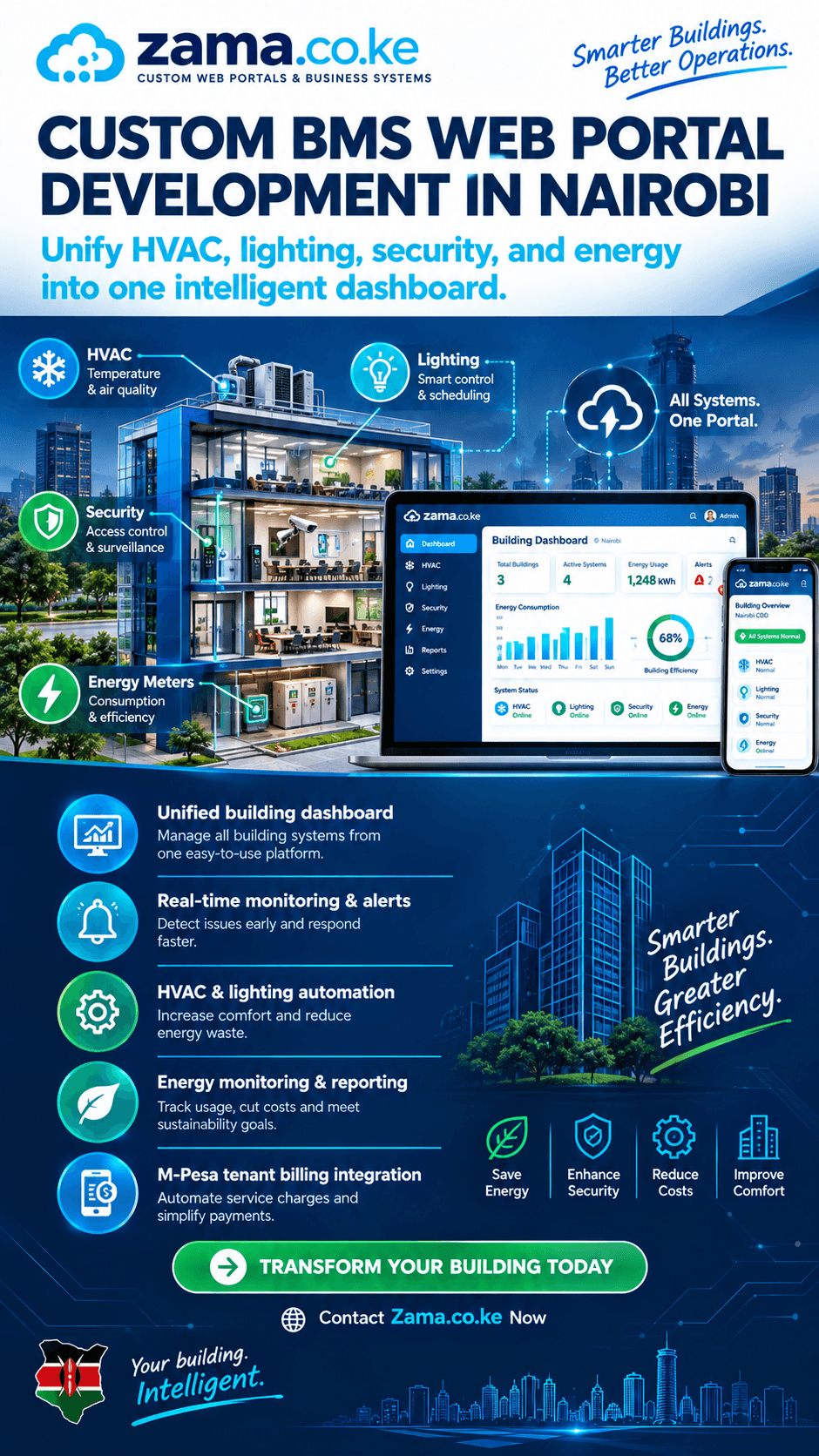
Custom BMS web portal development in Nairobi is a question that every property manager, facility director, and building owner must answer in 2026. With Nairobi’s commercial skyline expanding rapidly—Britam Tower, GTC, Two Rivers, and dozens of new office and residential developments—the complexity of managing building systems has outgrown the manual, fragmented approaches of the past. At zama.co.ke, we’ve helped numerous organizations across Nairobi develop custom BMS web portals that unify HVAC, lighting, security, energy monitoring, and access control into a single intelligent dashboard. This comprehensive guide explores custom BMS web portal development in Nairobi, from understanding what a BMS web portal does to selecting the right development approach for your facility.
What a Custom BMS Web Portal Actually Does
Before diving into custom BMS web portal development in Nairobi, it’s essential to understand what this technology actually does. A Building Management System (BMS) web portal is a browser-based interface that connects to your building’s control systems—HVAC, lighting, power, fire safety, access control, CCTV, elevators, and environmental sensors—and presents them through a unified, real-time dashboard. It replaces proprietary vendor software, on-premise terminals, and manual reporting with a secure, accessible, and customizable web platform.
A proper custom BMS web portal development in Nairobi does far more than display data. It aggregates information from multiple building systems, normalizes data formats, applies business rules, triggers automated actions, generates reports, and provides role-based access for facility managers, engineers, tenants, and executives. It connects to existing hardware through protocols like BACnet, Modbus, and KNX, extracting data from controllers and sensors that may have been installed years ago by different vendors.
For a Nairobi property owner, the practical definition of custom BMS web portal development in Nairobi is this: the web-based platform that tells you exactly how much energy your building is consuming, exactly which systems are running inefficiently, exactly when equipment needs maintenance, and exactly how to optimize operations—all in real time, from any device, with workflows tailored to your specific building and team.
Why Nairobi Buildings Need Custom BMS Web Portals
When evaluating custom BMS web portal development in Nairobi, consider the compelling reasons for adoption:
The Problem with Proprietary BMS Software
Most building management systems come with proprietary software from the vendor who installed the equipment. This creates several problems for Nairobi property owners:
Vendor Lock-In: Proprietary software ties you to a single vendor for upgrades, support, and modifications. If the vendor raises prices, reduces service quality, or exits the Kenyan market, you are stranded with a system you cannot maintain.
Limited Customization: Vendor software is designed for generic use cases. It may not support your specific reporting needs, your organizational structure, your tenant billing requirements, or your integration with other business systems.
Poor User Experience: Many BMS interfaces were designed by engineers for engineers. They are complex, unintuitive, and difficult for facility managers to use effectively.
Accessibility Limitations: On-premise BMS terminals restrict access to specific locations within the building. Managers who are traveling, working from home, or based at another site cannot access the system.
Integration Challenges: Vendor software rarely integrates easily with ERP systems, accounting platforms, tenant portals, or energy reporting tools. Data remains trapped in the BMS, preventing a unified view of building operations.
A proper custom BMS web portal development in Nairobi addresses all these challenges by building a web-based interface that is tailored to your building, owned by you, and designed for integration.
The Growth of Smart Buildings in Nairobi
Nairobi’s commercial real estate sector is rapidly adopting smart building technologies. Modern office developments in Westlands, Upper Hill, Kilimani, Gigiri, and Two Rivers are being built with integrated building management systems that control HVAC, lighting, security, and access from a single platform. For these buildings, custom BMS web portal development in Nairobi is not an add-on—it’s a core requirement.
Tenants increasingly expect smart building features. They want to control office temperatures from their phones, receive alerts about building events, access energy consumption data for their premises, and integrate building access with their own security systems. Buildings that cannot provide these capabilities are losing premium tenants to competitors with modern infrastructure.
Energy Cost Pressures
Energy costs in Kenya continue to rise. For commercial buildings, HVAC and lighting represent the largest energy consumers—often accounting for 60 to 70 percent of total electricity consumption. Without real-time visibility into energy usage, building owners cannot identify inefficiencies, optimize consumption, or implement effective energy-saving strategies.
A custom custom BMS web portal development in Nairobi provides the visibility and control needed to reduce energy consumption. By monitoring HVAC performance, lighting usage, and equipment efficiency in real time, facility managers can identify waste, adjust setpoints, schedule equipment operation, and reduce consumption by 20 to 40 percent.
Multi-Site Portfolio Management
Many Nairobi property owners manage multiple buildings—office parks, residential estates, retail centres. Managing these properties with separate, disconnected BMS systems creates inefficiency. A custom BMS web portal can connect multiple buildings into a unified dashboard, allowing central oversight while respecting site-specific configurations and local user roles.
Data Protection Act Compliance
Kenya’s Data Protection Act imposes strict requirements on how businesses handle personal data. BMS systems often process personal data—access control logs, tenant information, visitor records. A custom custom BMS web portal development in Nairobi can be designed with Data Protection Act compliance built in: consent management, access controls, audit trails, and data subject rights.
Essential Features of a Custom BMS Web Portal in Nairobi
When evaluating custom BMS web portal development in Nairobi, focus on these core features:
1. Unified Dashboard with Role-Based Views
The portal should present all building systems through a unified dashboard, with different views for different roles. A facility manager sees equipment status, alarms, and energy consumption. A security manager sees access control and CCTV. An executive sees portfolio-wide performance and costs. A tenant sees their own premises data.
Role-based access ensures that each user sees exactly what they need, without being overwhelmed by data that is not relevant to their role. Views should be customizable, allowing users to configure their own dashboards.
2. Real-Time Monitoring and Alerts
The portal should provide real-time monitoring of all connected systems. Temperature, humidity, energy consumption, equipment status, and system performance should update continuously. Alerts should trigger when readings exceed thresholds—temperature too high, energy consumption spiking, equipment offline—and notifications should reach the right people through SMS, email, or mobile app.
A proper custom BMS web portal development in Nairobi should support intelligent alerting: combining multiple conditions into a single alert, suppressing alerts during maintenance windows, and escalating unacknowledged alerts to senior staff.
3. HVAC Control and Optimization
HVAC is the largest energy consumer in most Nairobi buildings. The portal should provide comprehensive HVAC control: temperature setpoints, scheduling, occupancy-based optimization, and integration with weather forecasts. Facility managers should be able to adjust settings from the portal, schedule equipment operation, and monitor performance over time.
Advanced features should include automated optimization—adjusting setpoints based on occupancy, time of day, and weather—and predictive maintenance—identifying HVAC equipment that is degrading before it fails.
4. Lighting Automation
Modern BMS portals integrate with lighting control systems. The portal should support scheduling, occupancy-based lighting, daylight harvesting, and scene control. Facility managers should be able to adjust lighting schedules, monitor energy consumption, and configure automated behaviors.
KNX and DALI integrations allow the portal to control individual light fixtures, zones, or entire floors. Automated schedules reduce energy waste in unoccupied areas while maintaining adequate lighting for occupants.
5. Energy Monitoring and Reporting
Energy management is a primary driver for custom BMS web portal development in Nairobi. The portal should track energy consumption across all systems—HVAC, lighting, power, plug loads—and present it through intuitive dashboards. Detailed reports should show consumption by system, by floor, by tenant, and by time period.
Energy reporting supports sustainability goals, tenant billing, and cost allocation. The portal should be able to generate reports for Kenya’s energy regulatory requirements and support ISO 50001 energy management standards.
6. Access Control and Security Integration
The portal should integrate with access control systems, providing visibility into who is in the building, which doors are locked or unlocked, and what access events have occurred. Security teams should be able to lock down specific areas, grant temporary access, and review access logs.
Integration with CCTV allows video verification of access events. When an alarm triggers or an unauthorized access attempt occurs, the portal can display the relevant camera feed alongside the alert.
7. Tenant Management and Billing
For multi-tenant buildings, the portal should support tenant management. Each tenant should have access to their own dashboard, showing their energy consumption, their access events, their service requests. The portal should support tenant billing—allocating energy costs, generating invoices, and tracking payments.
Integration with M-Pesa enables automated payment collection for tenant service charges and energy bills. The portal can generate invoices, initiate M-Pesa STK Push prompts, and reconcile payments automatically.
8. Maintenance Management Integration
The BMS portal should integrate with maintenance management systems. When equipment requires service, the portal can automatically generate a work order, assign it to the right technician, and track progress. Historical data from the BMS—equipment runtime, energy consumption, alarm history—informs maintenance scheduling.
9. Reporting and Analytics
The portal should generate comprehensive reports: energy consumption, equipment performance, alarm history, access logs, maintenance activity. Reports should be customizable, exportable, and schedulable. Analytics should reveal trends, identify inefficiencies, and support decision-making.
Technology Stack for Custom BMS Web Portal Development in Nairobi
When planning custom BMS web portal development in Nairobi, the technology stack matters:
Frontend Technologies
The portal’s frontend should use modern JavaScript frameworks—React, Vue.js, or Angular—to deliver responsive, interactive dashboards. The interface should work seamlessly on desktop, tablet, and mobile devices. Charts, maps, and real-time displays should update smoothly without page reloads.
Backend Technologies
The backend should use robust server-side frameworks—Node.js, Python (Django or FastAPI), or Laravel—to handle API requests, process data, and manage integrations. The backend should be designed for scalability, supporting multiple buildings, thousands of sensors, and high-frequency data updates.
Database Technologies
Time-series databases—InfluxDB, TimescaleDB, or PostgreSQL with TimescaleDB extension—are ideal for storing sensor data. Relational databases handle configuration, user management, and business logic. The combination provides the performance and flexibility needed for BMS applications.
BMS Protocol Integration
The portal must integrate with building systems through standard protocols: BACnet for HVAC, Modbus for power and industrial equipment, KNX for lighting, and OPC UA for industrial systems. Integration libraries and gateways translate these protocols into data that the web portal can consume.
Cloud and On-Premise Deployment
The portal can be deployed on-premise for organizations requiring data sovereignty, in the cloud for accessibility and scalability, or in a hybrid configuration. For Kenyan organizations, data residency requirements may dictate deployment location.
What Makes Custom BMS Web Portal Development in Nairobi Different
Custom BMS web portal development in Nairobi has unique characteristics that global solutions often lack:
M-Pesa Integration
Kenyan buildings require M-Pesa integration for tenant billing, visitor parking, and service payments. A proper BMS web portal should support M-Pesa STK Push, PayBill, and automated reconciliation.
Local Support and Maintenance
The development partner must provide local support—available during Nairobi business hours, capable of visiting sites, understanding local infrastructure conditions.
Power Stability
Nairobi buildings face power fluctuations and outages. The BMS web portal should handle these gracefully: continuing to monitor during outages, resuming automatically when power returns, and alerting when backup systems activate.
Multi-Vendor Equipment
Nairobi buildings often have equipment from multiple vendors, installed at different times. The BMS web portal must integrate with diverse systems—older controllers, newer devices, different protocols—without requiring wholesale equipment replacement.
KRA eTIMS Compliance
For tenant billing and service charges, the portal should support KRA eTIMS compliance—generating tax invoices and transmitting them to KRA automatically.
The Zama.co.ke Approach to Custom BMS Web Portal Development in Nairobi
When considering custom BMS web portal development in Nairobi, zama.co.ke follows a structured approach:
Building Assessment
We evaluate your building’s systems, equipment, and integration requirements. This includes identifying protocols, mapping data points, and understanding your operational workflows.
Portal Design
We design the portal architecture, user interface, and integration approach. This includes defining data models, API structures, and user roles.
Development and Integration
We develop the portal, integrate with building systems, and configure dashboards, alerts, and reports. We test all scenarios before deployment.
Deployment and Training
We deploy the portal, configure user accounts, and provide role-specific training for facility managers, engineers, and administrators.
Post-Launch Support
We remain available for maintenance, troubleshooting, and system upgrades as your building evolves.
The ROI of Custom BMS Web Portal Development in Nairobi
When evaluating custom BMS web portal development in Nairobi, the ROI is compelling:
Energy Savings: Real-time monitoring and automated optimization reduce energy consumption by 20 to 40 percent, delivering significant annual savings.
Operational Efficiency: Facility managers can monitor and control all systems from a single dashboard, reducing time spent on manual checks and reporting.
Extended Equipment Life: Proactive maintenance based on real-time data extends equipment life and reduces emergency repair costs.
Tenant Satisfaction: Real-time visibility, responsive controls, and integrated billing improve tenant satisfaction and retention.
Compliance Protection: Data Protection Act and KRA eTIMS compliance built into the portal reduces legal and financial risk.
Scalability: The portal can grow with your portfolio, adding buildings, systems, and users without rebuilding.
Implementation Considerations for Nairobi Buildings
When implementing custom BMS web portal development in Nairobi, consider these factors:
Assess Your Building Systems
Before development begins, document your building systems: equipment types, protocols, data points, and integration requirements. This assessment forms the foundation for portal design.
Choose the Right Development Partner
Select a development partner with BMS integration experience, local support capabilities, and a proven track record. The best custom BMS web portal development in Nairobi providers understand building systems as well as web development.
Plan for Phased Deployment
Consider a phased approach: start with core systems (HVAC, energy), then expand to lighting, access control, and tenant management. This approach delivers early wins and manages complexity.
Train Your Team
Facility managers, engineers, and administrators need training on the new portal. Role-specific training ensures everyone understands their responsibilities and capabilities.
Ensure Data Security
BMS portals process sensitive data. Implement encryption, access controls, audit trails, and regular security assessments.
Custom BMS web portal development in Nairobi is essential for any modern building seeking to optimize energy consumption, improve operational efficiency, enhance tenant satisfaction, and ensure compliance. From unified dashboards and real-time monitoring to M-Pesa integration and predictive maintenance, the right portal transforms how buildings operate.
At zama.co.ke, we’ve helped property owners and facility managers across Nairobi develop custom BMS web portals that deliver measurable results. Our approach ensures you get exactly what your building needs—nothing more, nothing less.
Don’t let the complexity of custom BMS web portal development in Nairobi hold you back. Whether you’re managing a single building or a multi-site portfolio, we have the expertise to guide you through every step.
Contact zama.co.ke today and let us help you build a custom BMS web portal that transforms your building operations.