
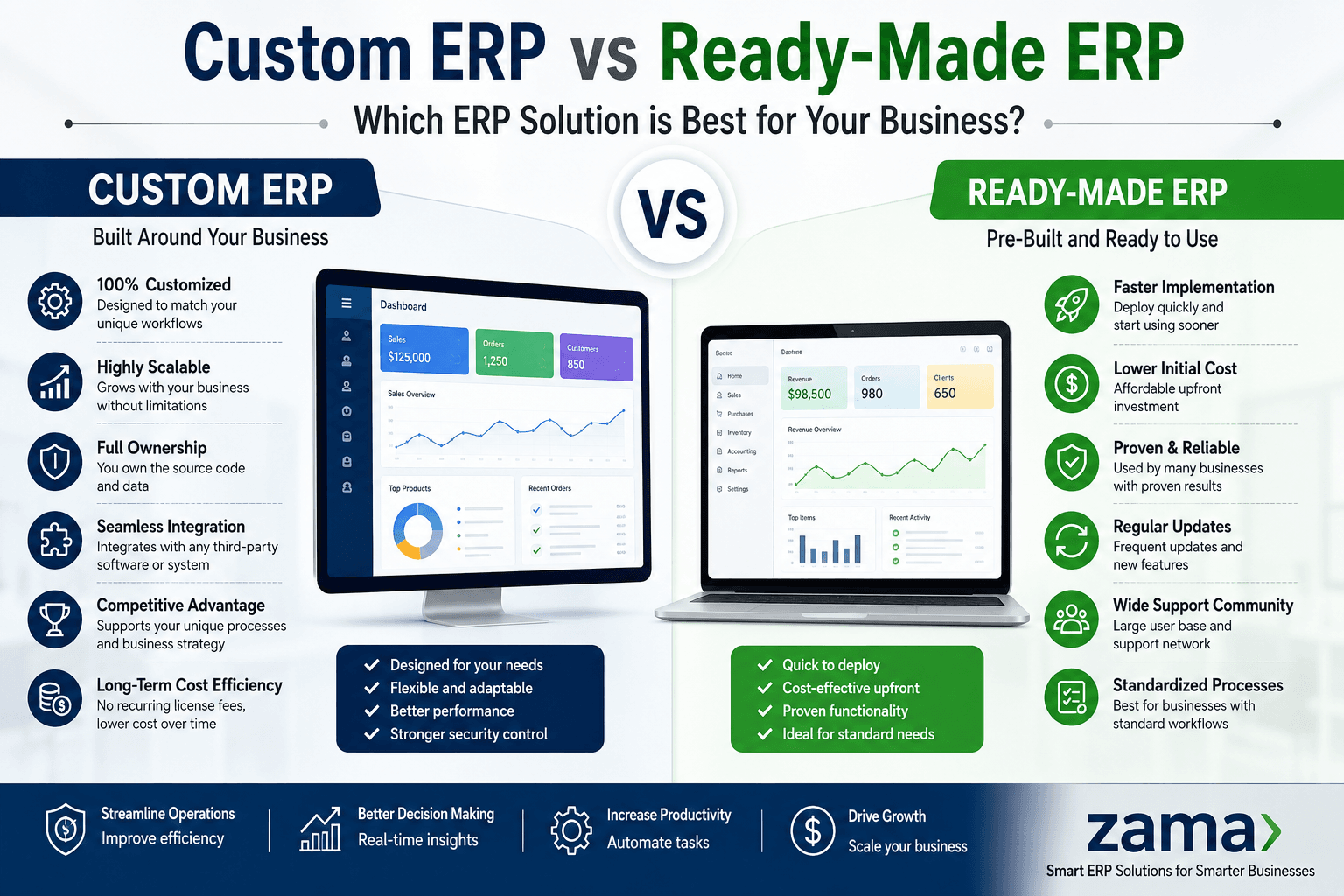
Custom enterprise software vs off-the-shelf ERP Kenya is a question that every business owner, operations director, and finance manager must answer in 2026. With the Kenya ERP software market experiencing steady growth, the Middle East and Africa ERP market projected to reach USD 10.20 billion by 2032, and over 56 ERP services startups operating in Kenya, the choice between building tailored software and buying a packaged solution has significant long-term implications. At zama.co.ke, we’ve helped numerous organizations across Kenya navigate this decision and select the approach that delivers real value. This comprehensive guide explores custom enterprise software vs off-the-shelf ERP Kenya, providing a practical framework to help you make the right choice for your business.
Understanding the Core Difference
Before diving into custom enterprise software vs off-the-shelf ERP Kenya, it’s essential to understand what each option actually is. Custom enterprise software is built specifically for your organization. Developers design the system around your exact workflows, approval hierarchies, reporting requirements, and integration needs. You own the source code, you control the roadmap, and the software evolves as your business evolves. Off-the-shelf ERP is a pre-built product. A vendor has already developed it, tested it with other customers, and packaged it for sale. You license the software, configure it to match your processes as closely as possible, and accept that some of your requirements will not be met without customization.
The distinction is fundamental. Custom software is a tailored suit. Off-the-shelf ERP is a ready-made garment. Both can clothe you, but the fit and the cost of alterations differ significantly. When considering custom enterprise software vs off-the-shelf ERP Kenya, you’re really asking whether your business is unique enough to justify a tailored solution or standard enough to benefit from a proven product.
Why Kenyan Organizations Face This Decision
When evaluating custom enterprise software vs off-the-shelf ERP Kenya, it’s important to understand the forces driving this choice. Kenyan organizations face a unique set of pressures that make the decision more complex than in other markets.
Regulatory Complexity: Kenya’s regulatory environment is demanding and constantly evolving. KRA eTIMS compliance, the Data Protection Act, PPADA procurement regulations, and sector-specific requirements create a complex compliance landscape. Off-the-shelf ERP systems built for other markets often struggle to accommodate these local requirements without expensive customization.
M-Pesa Integration: M-Pesa is the backbone of Kenyan business payments. Customers pay via M-Pesa, suppliers expect M-Pesa disbursements, and staff receive M-Pesa advances. Off-the-shelf ERP systems designed for credit card and bank transfer markets often lack native M-Pesa integration. Custom software can be built with M-Pesa integration from day one.
Multi-Currency and Import Documentation: Kenyan organizations import goods and services, requiring multi-currency support and import documentation tracking. Off-the-shelf systems may support multi-currency, but the documentation requirements and customs processes are often poorly handled.
Local Operating Realities: Kenyan businesses operate in conditions that global software rarely anticipates—power fluctuations, internet outages, and the need for offline capability. Custom software can be designed for these realities. Off-the-shelf systems may require workarounds.
What Custom Enterprise Software Delivers
When evaluating custom enterprise software vs off-the-shelf ERP Kenya, understanding what custom software delivers is essential:
Exact Fit to Your Workflows
Custom software is designed around how your business actually operates. If your approval hierarchy has seven levels with different thresholds, the software models it precisely. If your inventory management requires batch tracking with expiry dates and multi-location transfers, the software handles it. If your customer billing requires complex pricing rules based on volume, contract terms, and payment history, the software implements it. There is no need to change your processes to fit the software—the software fits your processes.
Ownership and Control
With custom software, you own the source code. You control the roadmap. You decide what features are built, when they are built, and how they are prioritized. You are not dependent on a vendor’s release schedule or product direction. This ownership is particularly valuable for organizations whose competitive advantage depends on unique processes or capabilities.
Integration Flexibility
Custom software can be built to integrate with any system your business uses. Whether it’s a legacy accounting package, a specialized industry application, or a proprietary internal tool, the custom software can connect to it. Off-the-shelf systems often have limited integration capabilities or require expensive middleware.
Scalability Without Per-User Fees
Custom software scales with your business without per-user fees. Whether you have 10 users or 1,000, the cost does not increase linearly. This makes custom software increasingly cost-effective as your organization grows.
No Vendor Lock-In
With custom software, you are not locked into a vendor’s ecosystem. You can maintain the software yourself, hire a different development partner, or modify the code as your needs change. You are not dependent on a vendor’s continued existence, pricing decisions, or product strategy.
What Off-the-Shelf ERP Delivers
When evaluating custom enterprise software vs off-the-shelf ERP Kenya, understanding what off-the-shelf ERP delivers is equally important:
Faster Time to Value
Off-the-shelf ERP can be deployed more quickly than custom software. The product already exists, has been tested by other customers, and has documentation and training materials. Configuration can begin immediately. For organizations that need a solution urgently, off-the-shelf ERP delivers faster time to value.
Proven Functionality
Off-the-shelf ERP has been used by many organizations. Its functionality has been tested in real-world conditions. Bugs have been found and fixed. Best practices have been incorporated. For standard business processes—general ledger accounting, accounts payable, accounts receivable, payroll—off-the-shelf ERP provides proven functionality that custom software would take months to replicate.
Vendor Support and Updates
Off-the-shelf ERP vendors provide ongoing support, updates, and regulatory compliance updates. When tax rates change, the vendor updates the software. When regulations change, the vendor adjusts. This ongoing support reduces the burden on your internal IT team.
Lower Initial Cost
Off-the-shelf ERP typically has a lower initial cost than custom software. The vendor has already amortized development costs across many customers. You pay a license fee or subscription, not the full cost of development.
Access to Expertise
Off-the-shelf ERP vendors employ specialists—accountants, supply chain experts, HR professionals—who contribute to product development. You benefit from this expertise without hiring these specialists yourself.
Key Factors That Determine the Right Choice
When analysing custom enterprise software vs off-the-shelf ERP Kenya, several factors should guide your decision:
1. Uniqueness of Your Processes
If your business processes are unique—if your competitive advantage depends on doing things differently—custom software is likely the better choice. If your processes are standard—if you follow common industry practices—off-the-shelf ERP may be sufficient.
2. Complexity of Integration Requirements
If your business requires integration with many systems—M-Pesa, eTIMS, local banks, specialized industry applications—custom software provides the flexibility to connect everything. If your integration requirements are simple, off-the-shelf ERP may suffice.
3. Regulatory Compliance Requirements
If your business operates in a heavily regulated sector with requirements that off-the-shelf ERP cannot easily accommodate—PPADA procurement, healthcare regulations, financial services compliance—custom software may be necessary. If your compliance requirements are standard, off-the-shelf ERP may handle them.
4. Growth Trajectory
If your business is growing rapidly and expects to double or triple in size, custom software provides scalability without per-user fees. If your business is stable and expects modest growth, off-the-shelf ERP may be more cost-effective.
5. Budget and Timeline
If your budget allows for custom development and your timeline permits a longer implementation, custom software delivers superior long-term value. If your budget is tight and your timeline is short, off-the-shelf ERP delivers faster time to value.
6. Internal IT Capability
If your organization has strong internal IT capability, custom software can be maintained internally. If your IT team is small or focused on other priorities, off-the-shelf ERP with vendor support may be more practical.
Cost Considerations for Custom Enterprise Software vs Off-the-Shelf ERP Kenya
When evaluating custom enterprise software vs off-the-shelf ERP Kenya, cost is often the primary consideration. However, the analysis must go beyond initial cost to total cost of ownership.
Initial Cost
Off-the-shelf ERP typically has a lower initial cost. License fees or subscription fees are predictable and known upfront. Custom software requires investment in development, testing, and deployment. The initial cost of custom software is higher.
Ongoing Cost
Off-the-shelf ERP has ongoing costs—subscription fees, per-user fees, support fees, and customization fees. These costs continue for as long as you use the software. Custom software has ongoing costs—maintenance, hosting, and enhancements—but these are typically lower and more predictable. There are no per-user fees.
Total Cost of Ownership
Over time, the total cost of ownership of custom software often becomes lower than off-the-shelf ERP, particularly for organizations with many users. The break-even point depends on the number of users, the level of customization required, and the ongoing fees of the off-the-shelf solution. Research on document management systems in Kenya showed that while initial custom development may look significant, the annual licence for a generic SaaS can exceed it, plus hidden fees for extra users and storage. Over three years, custom software can save up to 40 percent in total cost of ownership.
Hidden Costs
Off-the-shelf ERP often has hidden costs—customization fees, integration fees, training fees, and premium support fees. Custom software may have hidden costs too—scope creep, change requests, and unexpected complexity. Understanding these costs is essential for accurate comparison.
For a transparent comparison of custom enterprise software vs off-the-shelf ERP Kenya for your specific requirements, contact zama.co.ke today.
Integration Considerations
When evaluating custom enterprise software vs off-the-shelf ERP Kenya, integration is a critical factor:
M-Pesa Integration
M-Pesa integration is non-negotiable for Kenyan businesses. Off-the-shelf ERP systems designed for other markets often lack native M-Pesa integration. Custom software can be built with M-Pesa integration from day one, supporting STK Push, C2B, B2C, and B2B transactions.
KRA eTIMS Integration
KRA eTIMS compliance is mandatory for VAT-registered businesses. Off-the-shelf ERP systems may have eTIMS integration, but the quality and completeness vary. Custom software can be built with eTIMS integration that meets your specific requirements.
Local Bank Integration
Kenyan businesses work with local banks—Equity, KCB, Co-op, Stanbic, and others. Custom software can integrate with these banks’ APIs for payment processing, reconciliation, and reporting. Off-the-shelf ERP may require middleware or manual workarounds.
Industry-Specific Systems
Many Kenyan businesses use industry-specific systems—hospital management systems for healthcare, point-of-sale systems for retail, fleet management systems for logistics. Custom software can integrate with these systems. Off-the-shelf ERP may struggle.
Legacy Systems
Many Kenyan organizations have legacy systems that contain critical data. Custom software can be built to integrate with these systems, extending their life and protecting existing investments. Off-the-shelf ERP may require replacing legacy systems entirely.
Scalability Considerations
When evaluating custom enterprise software vs off-the-shelf ERP Kenya, scalability is a key differentiator:
User Scalability
Custom software scales with your user base without per-user fees. Off-the-shelf ERP typically charges per user, making costs increase linearly with growth. For organizations planning significant growth, custom software is more cost-effective.
Transaction Scalability
Custom software can be designed to handle your specific transaction volumes. Off-the-shelf ERP may have limits or require expensive upgrades to handle higher volumes.
Location Scalability
Custom software can support multiple locations, currencies, and regulatory environments. Off-the-shelf ERP may require separate instances for different locations or may not support all requirements.
Functional Scalability
Custom software can be extended with new modules and features as your needs evolve. Off-the-shelf ERP may require upgrading to a higher tier or purchasing additional modules.
Compliance Considerations
When evaluating custom enterprise software vs off-the-shelf ERP Kenya, compliance is a critical factor:
KRA eTIMS Compliance
From January 2024, business expenses must be supported by an electronic tax invoice. Off-the-shelf ERP systems may have eTIMS integration, but the quality varies. Custom software can be built with eTIMS compliance from day one.
Data Protection Act Compliance
Kenya’s Data Protection Act imposes strict requirements on how organizations handle personal data. Custom software can be designed with compliance built in—consent management, access controls, audit trails, and data subject rights. Off-the-shelf ERP may have compliance features, but they may not meet all requirements.
PPADA Compliance
Public entities must comply with the Public Procurement and Asset Disposal Act. Custom software can be built with procurement workflows that match PPADA requirements, including special group reservations and e-GP integration. Off-the-shelf ERP may require extensive customization.
Sector-Specific Compliance
Healthcare facilities, financial institutions, and other regulated sectors have specific compliance requirements. Custom software can be built to meet these requirements precisely. Off-the-shelf ERP may not support them without customization.
Support Considerations
When evaluating custom enterprise software vs off-the-shelf ERP Kenya, support is a critical factor:
Vendor Support
Off-the-shelf ERP vendors provide support, but the quality and responsiveness vary. Support may be limited to business hours, may be offshore, or may be slow to respond. Custom software development partners can provide local support with faster response times.
Community Support
Off-the-shelf ERP often has a community of users who share knowledge and solutions. This community can be valuable for troubleshooting and learning. Custom software does not have this community.
Documentation
Off-the-shelf ERP typically has extensive documentation—user guides, administrator guides, API documentation. Custom software documentation depends on the development partner. A good partner provides comprehensive documentation.
Training
Off-the-shelf ERP vendors often provide training programs and certification. Custom software training depends on the development partner. A good partner provides role-specific training tailored to your organization.
Ongoing Development
Off-the-shelf ERP vendors continue to develop the product, adding features and fixing bugs. Custom software requires ongoing investment in maintenance and enhancement. A good development partner provides this ongoing support.
When Custom Enterprise Software Is the Right Choice
When considering custom enterprise software vs off-the-shelf ERP Kenya, custom software is the right choice when:
Your business processes are unique and provide competitive advantage
You need extensive integration with local systems like M-Pesa and eTIMS
You operate in a heavily regulated sector with specific compliance requirements
You have many users and per-user fees would be expensive
You plan significant growth and need scalability without per-user fees
You have strong internal IT capability or a reliable development partner
You want to own your software and control your roadmap
You need offline capability for unreliable internet
You want to avoid vendor lock-in
When Off-the-Shelf ERP Is the Right Choice
When considering custom enterprise software vs off-the-shelf ERP Kenya, off-the-shelf ERP is the right choice when:
Your business processes are standard and follow common industry practices
Your integration requirements are simple
Your compliance requirements are standard
You have relatively few users
You need a solution quickly
You have limited budget for initial investment
You have limited internal IT capability
You want vendor support for regulatory updates
You prefer a proven product over a custom build
The Zama.co.ke Approach to Custom Enterprise Software vs Off-the-Shelf ERP Kenya
When considering custom enterprise software vs off-the-shelf ERP Kenya, zama.co.ke follows a structured approach:
Requirements Assessment
We evaluate your business processes, integration requirements, compliance obligations, user base, growth trajectory, and budget. This includes understanding your current challenges and defining success metrics.
Cost Modelling
We build a detailed cost model comparing custom enterprise software vs off-the-shelf ERP Kenya for your specific situation. We include initial costs, ongoing costs, hidden costs, and total cost of ownership over five years.
Solution Design
We design a solution tailored to your specific needs—whether it’s a custom build or an off-the-shelf implementation. We’re not locked into one approach—we recommend what fits your business.
Implementation and Integration
We implement the solution, build integrations with existing systems (M-Pesa, eTIMS, local banks, industry-specific systems), and configure workflows, dashboards, and reports.
Training and Support
We provide role-specific training for your team. We remain available for ongoing support, maintenance, and system upgrades.
Post-Launch Optimization
After go-live, we monitor performance, gather user feedback, and refine the solution to improve business efficiency and compliance.
The Cost of Choosing Wrong
When evaluating custom enterprise software vs off-the-shelf ERP Kenya, consider the cost of choosing wrong. Kenyan SMEs lose an estimated KSh 4.7 billion annually to software failures, system crashes, and poorly integrated digital tools. 78% of Kenyan SMEs that adopted global software solutions abandoned them within 18 months. Millions of shillings spent on systems that were supposed to transform operations—only to gather dust because they were built for a business environment that doesn’t exist in Kenya.
A manufacturing company spent millions implementing a popular ERP system. Six months later, they were still manually reconciling M-Pesa payments because the software couldn’t handle local payment flows. This is the cost of choosing wrong.
Meanwhile, organizations that have chosen the right approach are achieving compliance, reducing costs, and accelerating operations. The competitive gap widens with every passing month.
Why Contact Zama.co.ke for Custom Enterprise Software vs Off-the-Shelf ERP Kenya
When researching custom enterprise software vs off-the-shelf ERP Kenya, organizations should contact zama.co.ke because:
Local Expertise: We understand Kenyan regulatory requirements, including KRA eTIMS compliance, Data Protection Act obligations, and M-Pesa integration.
Balanced Advice: We’re not locked into one approach. We recommend custom or off-the-shelf based on what fits your business.
Transparent Pricing: No hidden fees, clear milestone timelines, and full source-code ownership for custom builds.
Integration Capabilities: We connect systems to M-Pesa, eTIMS, local banks, and industry-specific applications.
Proven Track Record: We’ve helped organizations across Kenya implement systems that deliver measurable results.
Ongoing Support: We remain available for maintenance, troubleshooting, and system upgrades as your business evolves.
For a custom quote and balanced advice on custom enterprise software vs off-the-shelf ERP Kenya for your organization, contact zama.co.ke today.
Custom enterprise software vs off-the-shelf ERP Kenya is not a decision to be taken lightly. The wrong choice costs millions in wasted investment, lost productivity, and compliance penalties. The right choice transforms your operations, ensures compliance, and positions your business for growth.
At zama.co.ke, we’ve helped organizations across Kenya navigate this decision and select the approach that delivers real value. Our approach ensures you get exactly what your business needs—nothing more, nothing less.
Don’t let the complexity of custom enterprise software vs off-the-shelf ERP Kenya hold you back. Whether you’re a growing SME or a large enterprise, we have the expertise to guide you through every step.
Contact zama.co.ke today for a balanced assessment of custom enterprise software vs off-the-shelf ERP Kenya for your organization.