
Custom ERP vs Ready-Made ERP: Which Solution Is Best for Your Business?
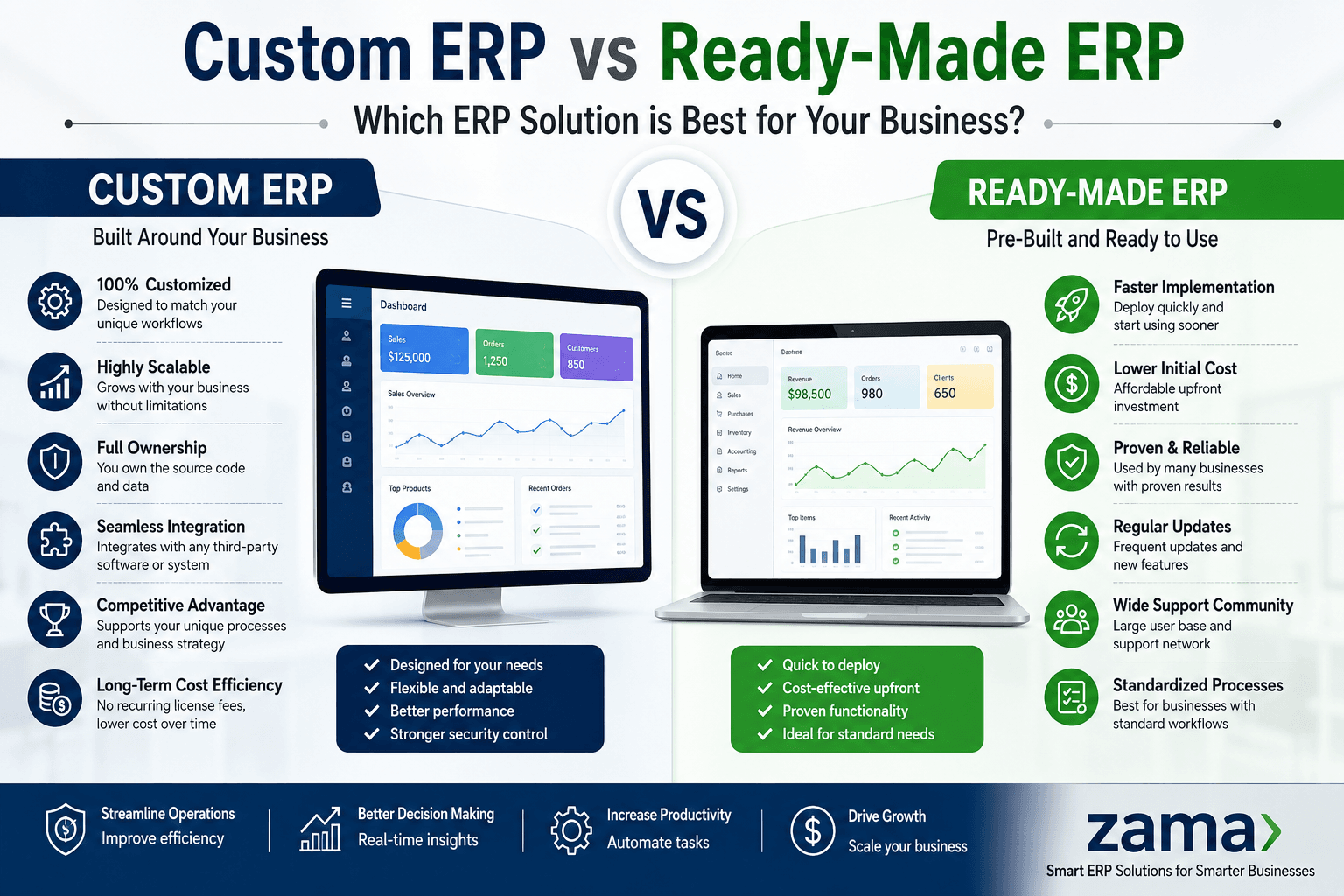
Choosing the right Enterprise Resource Planning (ERP) system is one of the most important technology decisions any business can make. The debate around Custom ERP vs Ready-Made ERP has become increasingly relevant as organizations seek software that improves efficiency, automates operations, and supports long-term growth.
Whether you operate a small business, a medium-sized enterprise, or a large corporation, understanding the differences between Custom ERP vs Ready-Made ERP will help you invest wisely. While ready-made ERP systems offer quick deployment and standardized features, custom ERP solutions provide flexibility, scalability, and business-specific functionality.
This comprehensive guide explores every aspect of Custom ERP vs Ready-Made ERP, including costs, implementation, advantages, disadvantages, industry use cases, and how to determine the best option for your organization.
What Is an ERP System?
Enterprise Resource Planning (ERP) software is an integrated business management system that connects different departments into one centralized platform.
An ERP system typically manages:
- Finance and Accounting
- Human Resources
- Sales and CRM
- Procurement
- Inventory
- Manufacturing
- Projects
- Customer Service
- Payroll
- Asset Management
- Reporting and Analytics
Instead of using multiple disconnected software applications, businesses can streamline their operations through one unified system.
When discussing Custom ERP vs Ready-Made ERP, both options perform these core functions but differ significantly in flexibility, customization, cost, and scalability.
What Is a Ready-Made ERP?
A Ready-Made ERP is software already developed by a vendor and sold to multiple businesses.
Examples include:
- SAP Business One
- Microsoft Dynamics
- Oracle NetSuite
- Odoo
- ERPNext
- Sage ERP
These systems come with predefined modules that businesses configure according to their requirements.
Advantages
- Faster deployment
- Lower initial investment
- Proven functionality
- Large support communities
- Frequent updates
- Established security standards
Disadvantages
- Limited customization
- Expensive licensing
- Businesses adapt to software instead of software adapting to business
- Additional modules increase costs
- Vendor dependency
When comparing Custom ERP vs Ready-Made ERP, ready-made systems are often ideal for businesses with standard operational processes.
What Is a Custom ERP?
A Custom ERP is designed and developed specifically for one business.
Instead of forcing organizations to change their workflows, developers create software that follows existing business processes.
The ERP can include only the required modules, ensuring efficiency without unnecessary complexity.
Examples include:
- Custom Manufacturing ERP
- Custom Hospital ERP
- Real Estate ERP
- School ERP
- Construction ERP
- Distribution ERP
- Property Management ERP
In the discussion of Custom ERP vs Ready-Made ERP, custom solutions prioritize business uniqueness over standardization.
Custom ERP vs Ready-Made ERP: Key Differences
| Feature | Custom ERP | Ready-Made ERP |
|---|---|---|
| Development | Built specifically for your business | Pre-developed software |
| Cost | Higher initial investment | Lower upfront cost |
| Customization | Unlimited | Limited |
| Deployment | Longer | Faster |
| Scalability | Highly scalable | Depends on vendor |
| Ownership | Full ownership | Vendor-owned |
| Licensing | None | Recurring |
| Integration | Unlimited | Sometimes restricted |
| Maintenance | Controlled by your team | Vendor-managed |
| Competitive Advantage | High | Moderate |
The choice between Custom ERP vs Ready-Made ERP depends largely on business goals, operational complexity, and long-term strategy.
Cost Comparison
One of the first questions organizations ask when evaluating Custom ERP vs Ready-Made ERP is cost.
Ready-Made ERP Costs
Typical expenses include:
- License fees
- Monthly subscriptions
- User charges
- Annual maintenance
- Premium support
- Upgrade fees
- Integration costs
- Training
Although the initial investment may appear lower, recurring costs can become significant over time.
Custom ERP Costs
Custom ERP development generally includes:
- Business analysis
- UI/UX design
- Software development
- Testing
- Deployment
- Training
- Maintenance
While the upfront investment is higher, there are typically no recurring licensing fees, making it more economical over the long term for many organizations.
Flexibility
Flexibility is where Custom ERP vs Ready-Made ERP shows one of the biggest differences.
A custom ERP allows businesses to:
- Create unique workflows
- Add specialized modules
- Integrate with any software
- Modify reports
- Customize dashboards
- Implement unique approval processes
Ready-made ERP software often limits customization because vendors must maintain compatibility across thousands of customers.
Scalability
Businesses evolve.
A startup today may become a multinational company tomorrow.
When comparing Custom ERP vs Ready-Made ERP, scalability becomes crucial.
Custom ERP enables organizations to:
- Add departments
- Introduce new branches
- Expand internationally
- Support additional users
- Build new modules
- Connect emerging technologies
Ready-made ERP systems also scale but may require purchasing higher licensing tiers or additional modules.
Integration Capabilities
Modern businesses rely on multiple software solutions.
These include:
- CRM
- Accounting software
- Payment gateways
- Banking APIs
- Mobile apps
- Business Intelligence tools
- E-commerce platforms
- WhatsApp Business API
- Payroll systems
Custom ERP solutions can integrate seamlessly with virtually any system through APIs.
Ready-made ERP software may support integrations but often requires third-party connectors or paid extensions.
User Experience
One overlooked factor in Custom ERP vs Ready-Made ERP is user experience.
Employees work more efficiently when software matches their daily routines.
Custom ERP systems feature:
- Simplified interfaces
- Business-specific terminology
- Faster workflows
- Personalized dashboards
- Reduced training requirements
Ready-made ERP software often includes features many users never need, making navigation more complex.
Security
Security is essential regardless of the ERP solution.
Both custom and ready-made ERP systems can provide:
- Role-based permissions
- Data encryption
- Multi-factor authentication
- Audit logs
- Automated backups
- Secure cloud hosting
The key difference is that a custom ERP allows organizations to implement security policies tailored to their compliance and operational requirements.
Which Businesses Benefit Most?
Ready-Made ERP Is Suitable For
- Startups
- Small retail stores
- Businesses with standard workflows
- Companies needing quick deployment
- Organizations with limited budgets
Custom ERP Is Ideal For
- Manufacturers
- Healthcare providers
- Real estate companies
- Construction firms
- Educational institutions
- Logistics companies
- Government agencies
- Large enterprises with unique processes
For these organizations, Custom ERP vs Ready-Made ERP often favors a custom-built solution because it aligns closely with specialized operational needs.
Custom ERP vs Ready-Made ERP: Implementation Timeline
The implementation process is another critical factor when evaluating Custom ERP vs Ready-Made ERP. Many businesses focus only on cost, but deployment time can significantly affect operations and return on investment.
Ready-Made ERP Implementation
A ready-made ERP is already developed, so implementation mainly involves configuration rather than software development.
Typical implementation stages include:
- Requirements gathering
- Software installation
- User configuration
- Data migration
- Staff training
- Testing
- Go-live
- Post-launch support
Depending on the organization, deployment can take anywhere from a few weeks to several months.
Custom ERP Implementation
A custom ERP requires a structured software development process.
Typical phases include:
- Business process analysis
- Requirement documentation
- UI/UX design
- Database architecture
- Software development
- Module testing
- User Acceptance Testing (UAT)
- Staff training
- Deployment
- Continuous improvement
Although a custom ERP takes longer to implement, businesses receive software that perfectly aligns with their workflows. This makes Custom ERP vs Ready-Made ERP an important long-term strategic decision rather than simply a software purchase.
Long-Term Return on Investment
Many organizations initially choose ready-made ERP because of its lower upfront cost. However, ROI should be measured over several years.
Ready-Made ERP Costs Over Time
Recurring expenses often include:
- Monthly subscriptions
- Annual licenses
- Additional user licenses
- Paid integrations
- Premium support
- Upgrade fees
- Third-party plugins
These recurring costs can accumulate significantly over five to ten years.
Custom ERP ROI
A custom ERP generally requires a larger initial investment, but businesses benefit from:
- No recurring license fees
- Reduced manual work
- Higher employee productivity
- Lower operational costs
- Better automation
- Improved customer satisfaction
- Faster reporting
- Greater efficiency
When considering Custom ERP vs Ready-Made ERP, many growing businesses find that custom solutions provide greater value over the long term.
Industry Comparison
Manufacturing
Manufacturers often require:
- Production planning
- Bill of materials
- Machine maintenance
- Quality control
- Warehouse management
- Procurement
- Demand forecasting
These requirements are highly specialized, making custom ERP systems particularly valuable.
Healthcare
Hospitals and clinics need systems capable of managing:
- Patient records
- Billing
- Laboratory services
- Pharmacy
- Appointments
- Insurance claims
Custom ERP solutions provide workflows tailored specifically to healthcare providers.
Real Estate
Property companies require:
- Tenant management
- Rent collection
- Property maintenance
- Lease management
- Owner reporting
- Utility billing
- Vacancy tracking
Many real estate firms choose custom ERP because their processes differ significantly from generic business operations.
Retail
Retail businesses require:
- Inventory management
- Point of Sale (POS)
- Customer loyalty
- Supplier management
- Barcode systems
- Promotions
Small retailers often benefit from ready-made ERP systems, while large retail chains may require custom development.
Construction
Construction firms manage:
- Projects
- Contractors
- Materials
- Equipment
- Site reports
- Budgets
- Procurement
Construction workflows vary widely, making custom ERP an excellent choice.
Education
Schools and universities need:
- Student admissions
- Fee management
- Academic records
- Timetables
- Library systems
- Hostel management
- Parent communication
Custom ERP solutions can integrate all these services into one platform.
Common Mistakes Businesses Make
When evaluating Custom ERP vs Ready-Made ERP, organizations frequently make avoidable mistakes.
Choosing Based Only on Price
The cheapest solution is not always the most cost-effective. Long-term operational efficiency should be prioritized over initial savings.
Ignoring Future Growth
Businesses often underestimate future expansion. An ERP should support growth rather than restrict it.
Overlooking User Experience
Complex software can reduce productivity and increase training costs.
Poor Requirement Analysis
Failure to clearly define business requirements often results in selecting an unsuitable ERP system.
Lack of Staff Training
Even the best ERP software cannot deliver value if employees are not properly trained.
How to Decide Between Custom ERP and Ready-Made ERP
Ask yourself the following questions:
- Are our business processes unique?
- Do we expect rapid growth?
- Do we need specialized reporting?
- Will we require multiple integrations?
- Are recurring subscription costs acceptable?
- Do we need complete ownership of the software?
- How important is scalability?
- How much customization will we need in the future?
If most answers favor flexibility and long-term growth, a custom ERP may be the better investment. If standardized processes and rapid deployment are your priorities, a ready-made ERP could be sufficient.
Case Study 1: Manufacturing Company
A mid-sized manufacturing company relied on spreadsheets to manage inventory, procurement, and production schedules.
Challenges
- Frequent stock shortages
- Duplicate purchases
- Manual reporting
- Delayed production
- Poor visibility into inventory
Solution
The company implemented a custom ERP tailored to its production processes.
Results
- 60% reduction in stock shortages
- 45% faster production planning
- 70% reduction in manual reporting
- Improved supplier coordination
- Higher customer satisfaction
This example highlights how Custom ERP vs Ready-Made ERP often favors custom solutions for businesses with complex operational requirements.
Case Study 2: Retail Chain
A regional retail chain selected a ready-made ERP to manage inventory, sales, and accounting across multiple stores.
Challenges
- Rapid deployment required
- Standard retail processes
- Limited IT budget
Solution
The company adopted a ready-made cloud ERP.
Results
- Deployment completed in three months
- Inventory accuracy improved significantly
- Faster financial reporting
- Better stock visibility across stores
- Lower initial investment
For organizations with standard operations, Custom ERP vs Ready-Made ERP may lean toward ready-made systems due to quicker implementation and lower upfront costs.
Customer Testimonials
Manufacturing Director
“We were considering Custom ERP vs Ready-Made ERP, and choosing a custom ERP transformed our production process. Every department now works from one centralized platform.”
Retail Business Owner
“Our ready-made ERP was deployed quickly and immediately improved inventory management. It was the right choice for our business size.”
Real Estate Manager
“A custom ERP helped us automate rent collection, maintenance requests, lease management, and financial reporting. We now spend far less time on administrative tasks.”
Finance Manager
“After evaluating Custom ERP vs Ready-Made ERP, we chose a custom solution because our approval workflows were too unique for off-the-shelf software. The investment has paid for itself through increased efficiency.”
Service Description
At Zama, we specialize in designing, developing, and implementing ERP solutions that help businesses automate operations, improve productivity, and make data-driven decisions. Whether your organization requires a fully customized ERP or expert guidance in selecting and implementing a ready-made solution, our experienced software development team delivers scalable, secure, and user-friendly systems tailored to your business objectives.
Our ERP development services include:
- Custom ERP Development
- ERP Consulting and Business Process Analysis
- ERP Implementation and Deployment
- Cloud ERP Solutions
- On-Premise ERP Solutions
- ERP Integration with Existing Systems
- Mobile ERP Applications
- ERP Maintenance and Support
- Data Migration
- User Training
- API Development and Integration
- Business Intelligence and Analytics
- Workflow Automation
- HR and Payroll Modules
- Finance and Accounting Modules
- Inventory and Warehouse Management
- Procurement Management
- CRM Integration
- Project Management
- Document Management
Our team follows international software development best practices to ensure every ERP solution is secure, scalable, and future-ready.
Why Choose Zama?
When businesses compare Custom ERP vs Ready-Made ERP, they need more than just software—they need a technology partner. Zama provides end-to-end ERP services designed to maximize operational efficiency and long-term value.
Experienced Developers
Our software engineers have extensive experience building ERP systems for businesses across multiple industries.
Business-Centric Approach
We begin by understanding your workflows before recommending or developing any ERP solution.
Scalable Solutions
As your business grows, your ERP grows with you without requiring a complete system replacement.
Secure Architecture
Our ERP systems incorporate modern security standards, including role-based access, encrypted data storage, audit logs, and secure backups.
Seamless Integrations
We integrate ERP solutions with:
- Accounting software
- Payment gateways
- Banks
- CRM platforms
- HR systems
- WhatsApp Business
- SMS platforms
- Mobile applications
- E-commerce websites
- Business Intelligence tools
Continuous Support
We provide ongoing maintenance, upgrades, technical support, and performance optimization.
Frequently Asked Questions
1. What is the main difference between Custom ERP vs Ready-Made ERP?
A custom ERP is built specifically for your organization and supports your unique workflows, while a ready-made ERP is a pre-built solution designed for general business processes.
2. Which option is more affordable?
Ready-made ERP systems usually have a lower initial cost, but recurring subscription and licensing fees can add up over time. Custom ERP solutions require a larger upfront investment but often have lower long-term ownership costs.
3. Which ERP is better for growing businesses?
Businesses with unique processes or ambitious growth plans often benefit more from custom ERP solutions because they can scale and evolve without licensing limitations.
4. Can a custom ERP integrate with existing software?
Yes. One of the biggest advantages highlighted in Custom ERP vs Ready-Made ERP is that custom ERP solutions can integrate with virtually any third-party application through APIs.
5. How long does ERP implementation take?
- Ready-made ERP: Typically a few weeks to several months.
- Custom ERP: Usually several months, depending on the project’s complexity.
6. Is cloud ERP better than on-premise ERP?
Both have advantages. Cloud ERP offers accessibility and reduced infrastructure costs, while on-premise ERP provides greater control over infrastructure and data. The right choice depends on your business requirements.
7. Can small businesses use ERP software?
Absolutely. Small businesses can start with essential modules and expand as their operations grow.
8. Which industries benefit most from ERP?
ERP solutions are valuable across many industries, including:
- Manufacturing
- Healthcare
- Construction
- Real Estate
- Education
- Logistics
- Retail
- Hospitality
- Professional Services
- Government
Custom ERP vs Ready-Made ERP
The decision between Custom ERP vs Ready-Made ERP ultimately depends on your business goals, operational complexity, budget, and long-term strategy. There is no one-size-fits-all answer, but understanding your current needs and future plans will help you make the right investment.
If your organization follows standard business processes and needs a quick implementation, a ready-made ERP can be an effective solution. It provides proven functionality, faster deployment, and lower upfront costs, making it ideal for startups and businesses with conventional workflows.
However, if your company has unique operations, specialized approval processes, or plans for rapid growth, a custom ERP offers unmatched flexibility, scalability, and control. Instead of adapting your business to fit the software, the software is designed to fit your business. This often leads to higher productivity, better user adoption, and a stronger return on investment over time.
Throughout this guide, we’ve explored every major consideration in Custom ERP vs Ready-Made ERP, including implementation timelines, costs, customization, scalability, security, integrations, industry applications, and real-world case studies. By carefully evaluating these factors, businesses can select an ERP solution that supports both present needs and future expansion.
As digital transformation accelerates, investing in the right ERP platform is no longer optional—it’s a strategic necessity. Choosing wisely today can streamline operations, improve decision-making, and create a competitive advantage for years to come. Whether you select a custom-built platform or a ready-made solution, the key is ensuring it aligns with your business objectives and delivers measurable value.
Call to Action
Looking for the right ERP solution for your business?
Zama helps organizations evaluate Custom ERP vs Ready-Made ERP and implement the solution that delivers the greatest value. From consultation and business process analysis to ERP development, implementation, integration, training, and ongoing support, our experts are ready to help you transform your operations.
Whether you operate in manufacturing, healthcare, real estate, retail, education, logistics, construction, or professional services, we can build or implement an ERP system that improves efficiency, reduces costs, and supports sustainable growth.
Contact Zama today for a free consultation and discover how the right ERP solution can streamline your business, automate processes, and accelerate your digital transformation.