
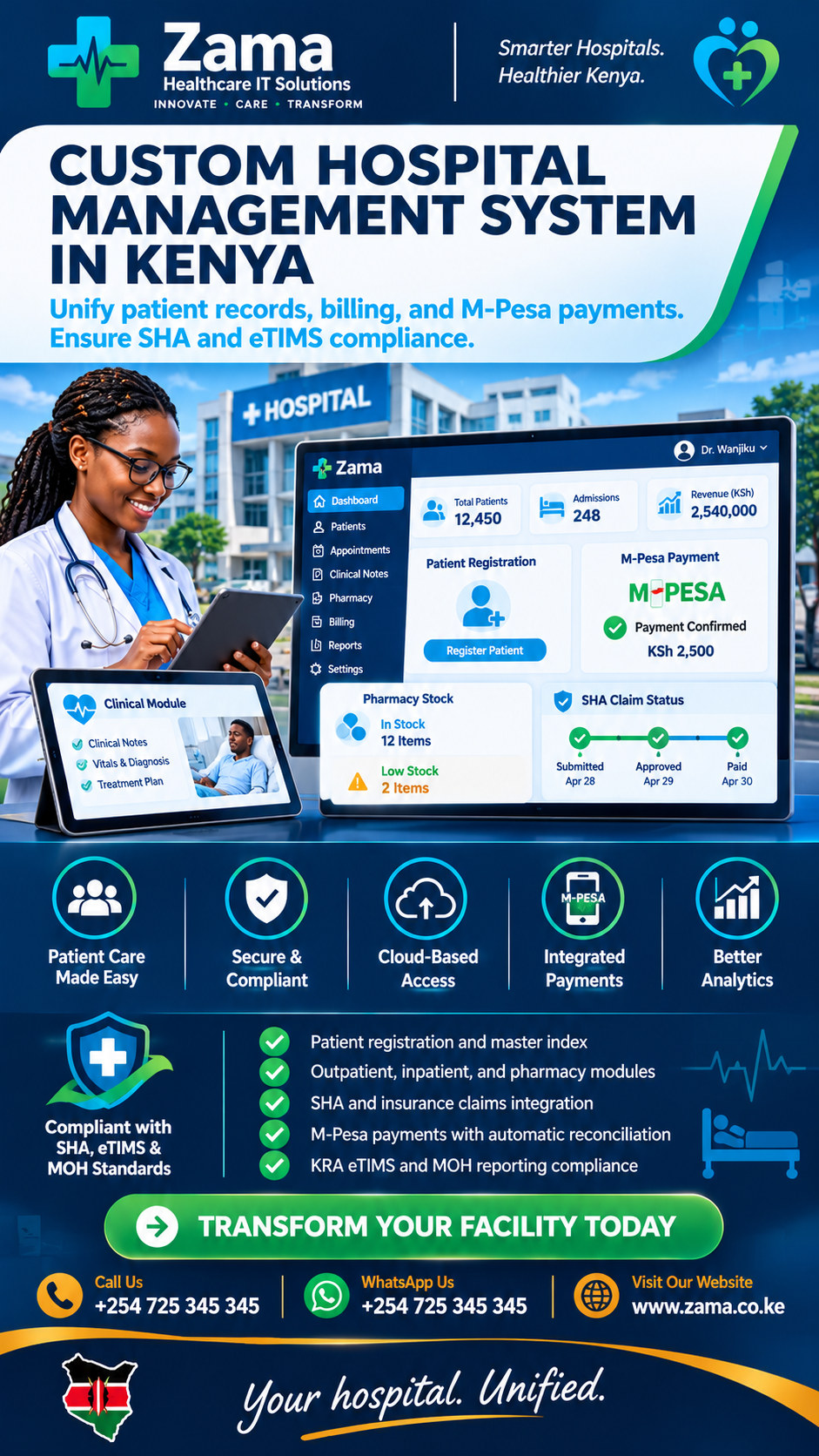
Custom hospital management system in Kenya is a question that every hospital administrator, clinical director, and healthcare entrepreneur must answer in 2026. With Kenyan hospitals handling rising patient volumes, the Social Health Authority reshaping healthcare financing, KRA eTIMS compliance mandatory for every invoice, and the Data Protection Act governing sensitive patient records, generic software can no longer keep pace with the operational reality of running a healthcare facility. At zama.co.ke, we’ve helped numerous healthcare facilities across Kenya implement custom hospital management systems that unify patient records, streamline billing, and connect clinical workflows with financial operations. This comprehensive guide explores the custom hospital management system in Kenya, from understanding what these systems deliver to selecting the right development approach for your facility.
What a Custom Hospital Management System Actually Delivers
Before diving into the custom hospital management system in Kenya, it’s essential to understand what this technology actually does. A custom hospital management system is a tailored digital platform that integrates the full patient journey with the full financial journey—from registration and triage through consultation, laboratory, pharmacy, admissions, billing, and discharge. Unlike generic software that forces a hospital to adapt its clinical workflows to a fixed template, a custom system is built around how the facility actually operates.
A proper custom hospital management system in Kenya does far more than store patient names. It manages outpatient and inpatient registration, queues and appointments, clinical records and encounter notes, laboratory orders and results, pharmacy dispensing with batch and expiry control, ward and bed management, billing with insurance and SHA integration, M-Pesa payment collection, and reporting required by the Ministry of Health.
For a Kenyan hospital, the practical definition of a custom hospital management system in Kenya is this: the platform that tells you exactly who is in the facility right now, exactly what care they have received, exactly what they owe, exactly what has been paid, and exactly how the facility is performing—all in real time, from any device, with workflows that match your clinical and financial operations.
Why Kenyan Hospitals Need Custom Management Systems
When evaluating the custom hospital management system in Kenya, consider the compelling reasons for adoption:
The Limits of Paper and Fragmented Systems
Most Kenyan hospitals operate with a patchwork of paper files, spreadsheets, and disconnected software. Patient records sit in filing cabinets. Laboratory results are collected by hand. Pharmacy stock is tracked in exercise books. Billing happens at a separate window, disconnected from clinical activity. When a patient asks about a bill, staff must reconstruct the visit from multiple sources.
A modern custom hospital management system in Kenya eliminates this fragmentation. Every clinical and financial event is recorded in one system. The patient’s visit is a single, continuous record. Billing reflects what was actually done because the clinical system generated the charges.
The SHA Transition
The Social Health Authority has fundamentally changed healthcare financing in Kenya, replacing NHIF with new structures for claims, capitation, and facility accreditation. Hospitals are still adapting. The SHA digitisation push offers real-time claim verification, transparent tracking of claim status, and faster, more predictable reimbursements through automated platforms. But this requires hospitals to submit claims digitally and track them systematically.
A proper custom hospital management system in Kenya integrates with SHA systems to verify eligibility, submit claims, track claim status, and reconcile reimbursements. It reduces the claim rejections that consume finance team time and delay cash flow.
KRA eTIMS Compliance
Since January 2024, all VAT-registered businesses in Kenya must transmit invoices to KRA through eTIMS. Hospitals issuing invoices for services, procedures, and pharmaceuticals must comply. Manual invoicing at hospital volume is impractical, and penalties for non-compliance are severe.
A comprehensive custom hospital management system in Kenya generates KRA-compliant tax invoices automatically and transmits them to eTIMS in real time. Every billable service is invoiced correctly and compliantly as it occurs.
M-Pesa Payment Integration
Kenyan patients expect to pay via M-Pesa. Hospital billing windows that only accept cash or card create queues, frustration, and revenue leakage. A quality custom hospital management system in Kenya integrates M-Pesa Daraja API for STK Push, PayBill, and Till Number payments, confirming payment instantly and updating patient accounts automatically.
Data Protection Act Compliance
Hospital records contain the most sensitive personal data—diagnoses, treatments, reproductive health information, and mental health records. Kenya’s Data Protection Act, with the Office of the Data Protection Commissioner actively enforcing, imposes strict requirements on how this data is handled. A compliant custom hospital management system in Kenya implements role-based access, encryption, audit trails, and retention policies aligned with the Act.
Clinical Safety and Continuity
Paper records create clinical risk. A patient treated in the morning is seen by a different doctor in the evening who cannot find the file. Allergy information is not visible at prescribing. Previous test results are unknown. Duplicate tests are ordered, wasting money and delaying care.
A proper custom hospital management system in Kenya makes the patient’s full clinical history available to every authorised clinician, instantly. Allergies alert at prescribing. Previous results are visible. Duplicate investigations are prevented.
Ministry of Health Reporting
Kenyan hospitals must submit regular reports to the Ministry of Health—MOH 705A and 705B, MOH 711, MOH 710, MOH 717, MOH 505, MOH 706, and MOH 643. Compiling these reports manually consumes days each month and introduces errors.
A quality custom hospital management system in Kenya generates MOH reports automatically from the data captured during routine care. Reporting becomes a button press rather than a monthly scramble.
Key Modules of a Custom Hospital Management System in Kenya
When evaluating the custom hospital management system in Kenya, focus on these core modules:
1. Patient Registration and Master Index
Every hospital journey begins with registration. A proper system maintains a master patient index that prevents duplicate records, captures demographic details, links dependants, and issues a unique patient identifier used across all departments.
2. Outpatient Department Management
Outpatient management covers appointment scheduling, walk-in queuing, triage and vitals, consultation, and referral. A comprehensive custom hospital management system in Kenya manages queues so patients know their position, supports clinician workflows with structured notes and clinical decision support, and triggers downstream orders for laboratory, radiology, and pharmacy.
3. Inpatient and Ward Management
Inpatient management covers admissions, bed allocation, ward rounds, nursing notes, medication administration, and discharge. A quality custom hospital management system in Kenya shows real-time bed occupancy, supports nursing workflows, tracks medication administration, and produces discharge summaries automatically.
4. Laboratory Management
Laboratory management covers order entry, sample tracking, result entry, validation, and reporting. A proper custom hospital management system in Kenya connects laboratory orders directly from clinical encounters, tracks sample status, delivers results back to the requesting clinician, and stores results in the patient record permanently.
5. Pharmacy Management
Pharmacy management covers prescribing, dispensing, stock control, batch and expiry tracking, and controlled substance registers. A comprehensive custom hospital management system in Kenya alerts at prescribing for allergies, interactions, and stock availability, dispenses against the electronic prescription, deducts stock in real time, enforces FEFO for expiry, and maintains PPB-compliant records.
6. Billing and Revenue Cycle
Billing covers charge capture, invoice generation, SHA and insurance claims, patient billing, payment collection, and reconciliation. A quality custom hospital management system in Kenya captures charges as clinical activity occurs, eliminates the revenue leakage that comes from disconnected billing, generates KRA-compliant eTIMS invoices, processes M-Pesa payments with automatic reconciliation, and tracks claims through to reimbursement.
7. Radiology and Diagnostics
Radiology management covers imaging orders, scheduling, reporting, and result delivery. A proper custom hospital management system in Kenya connects imaging orders to clinical encounters, tracks image acquisition and reporting status, and delivers reports to the ordering clinician and the patient record.
8. Theatre and Procedure Management
For surgical facilities, theatre management covers scheduling, pre-operative assessment, intra-operative documentation, and post-operative recovery. A comprehensive custom hospital management system in Kenya coordinates surgeon, anaesthetist, theatre, and equipment availability, tracks implants and consumables, and captures charges accurately.
9. Reporting and Analytics
Hospital leadership needs visibility. A quality custom hospital management system in Kenya provides dashboards on patient volumes, revenue, bed occupancy, departmental performance, claims status, and financial position—alongside automated MOH reporting.
10. Security and Access Control
Patient data is sensitive. A proper custom hospital management system in Kenya implements role-based access aligned with clinical roles, encryption at rest and in transit, comprehensive audit trails showing who accessed what and when, and retention policies aligned with medical records regulations.
What Makes a Custom Hospital Management System Different in Kenya
The custom hospital management system in Kenya has unique characteristics that global solutions often lack:
SHA Integration
Kenyan healthcare now runs through the Social Health Authority. A system built for Kenya integrates eligibility verification, claim submission, and reimbursement tracking with SHA from the ground up.
M-Pesa as the Primary Payment Rail
Kenyan patients pay via M-Pesa. A system built for Kenya integrates Daraja API natively for STK Push, PayBill, and Till Number payments, with automatic reconciliation against patient accounts.
KRA eTIMS Invoicing
Every invoice a VAT-registered facility issues must be eTIMS compliant. A system built for Kenya transmits invoices to KRA in real time and stores the validation receipt.
Ministry of Health Reporting
Kenyan hospitals must submit specific MOH reports. A system built for Kenya generates MOH 705A and 705B, MOH 711, MOH 710, MOH 717, MOH 505, MOH 706, and MOH 643 automatically.
Low-Bandwidth and Offline Operation
Connectivity in Kenyan healthcare facilities varies widely. A system built for Kenya operates offline for critical functions and syncs when connectivity returns, rather than halting patient care during outages.
Data Protection Act Alignment
Kenya’s Data Protection Act imposes requirements on patient data. A system built for Kenya implements consent, access controls, and audit trails aligned with the Act and with medical records regulations.
Local Support
Kenyan hospitals need support in their timezone and language, from teams who understand the facility’s reality. Local support is a practical requirement, not a luxury.
Key Factors That Determine Cost
When analysing cost, several factors directly influence pricing:
1. Facility Size and Complexity
A small clinic with outpatient services has simpler requirements than a county referral hospital with inpatient wards, theatre, ICU, and multiple specialty clinics.
2. Number of Modules
Each module—registration, outpatient, inpatient, laboratory, pharmacy, radiology, billing, theatre—adds development and configuration effort.
3. SHA and Insurance Integration Depth
Eligibility verification, claim submission, and reimbursement tracking integrations add complexity.
4. M-Pesa and eTIMS Integration
Payment and tax compliance integrations must be built carefully and maintained.
5. Clinical Documentation Depth
Structured clinical notes, decision support, and specialty-specific workflows add to the build.
6. Number of Locations
Multiple facilities or branches add configuration and consolidated reporting complexity.
7. Deployment Model
Cloud, on-premise, or hybrid deployment affects cost and ongoing support.
8. Data Migration
Migrating existing patient records and historical data requires careful validation.
9. Training and Ongoing Support
Training clinical and administrative staff, plus ongoing support, contributes to total cost.
For a transparent quote based on your facility’s specific requirements, contact zama.co.ke today.
Use Cases
Private Hospitals
Private hospitals use custom systems to manage the full patient journey, integrate SHA and insurance claims, and collect M-Pesa payments efficiently.
County and Referral Hospitals
Large public facilities use custom systems to manage high patient volumes, generate MOH reports automatically, and control pharmaceutical stock across departments.
Specialised Clinics
Fertility, dental, optical, and specialised clinics use custom systems tailored to their specific clinical workflows and billing structures.
Mission and Faith-Based Hospitals
Mission hospitals use custom systems to manage sliding-scale billing, donor-funded programs, and community outreach alongside standard clinical care.
Diagnostic Centres
Diagnostic and imaging centres use custom systems for order management, result reporting, and billing.
Maternity and Paediatric Facilities
Specialised maternity facilities use custom systems for antenatal records, delivery documentation, and newborn tracking.
The Zama.co.ke Approach to Custom Hospital Management System Development
When considering the custom hospital management system in Kenya, zama.co.ke follows a structured approach:
Clinical and Operational Discovery
We map your patient pathways, departmental workflows, clinical documentation requirements, billing structures, and reporting obligations.
System Design
We design the module architecture, data model, role-based access, and integration points.
Development and Integration
We build the system, integrate M-Pesa Daraja API, KRA eTIMS, SHA, and laboratory and radiology equipment where required, and configure workflows.
Testing and Data Migration
We test clinical scenarios, billing accuracy, and integration reliability, then migrate patient records and historical data.
Training and Support
We train clinicians, nurses, pharmacists, laboratory staff, and administrators, and provide go-live support.
Post-Launch Optimization
We monitor system performance, gather user feedback, and refine workflows to improve clinical and financial outcomes.
The ROI
When evaluating the custom hospital management system in Kenya, the ROI is compelling:
Reduced Revenue Leakage: Charges captured automatically as clinical activity occurs.
Faster Claims Reimbursement: SHA and insurance claims submitted and tracked digitally.
Eliminated Duplicate Records: A master patient index prevents duplicate files and duplicated investigations.
Improved Clinical Safety: Allergy and interaction alerts at prescribing; full history available to every clinician.
Reduced Stock Losses: Real-time pharmacy stock control with batch and expiry tracking.
Faster Patient Flow: Queue and appointment management reduce waiting times.
Automated MOH Reporting: Reporting becomes a button press rather than a monthly project.
Compliance Protection: eTIMS and Data Protection Act controls built in from day one.
Implementation Considerations
Assess Your Facility’s Requirements
Document patient volumes, departmental workflows, clinical documentation needs, billing structures, and reporting obligations before designing.
Choose the Right Solution
Match complexity to your facility. A small clinic needs less than a referral hospital with theatre and ICU.
Plan for Data Migration
Migrate patient records, historical billing, and pharmacy stock carefully, validating accuracy.
Train Your Team
Clinicians, nurses, pharmacists, and administrators all interact with the system and need role-specific training.
Ensure Compliance
Build eTIMS, Data Protection Act, and MOH reporting controls in from day one.
Test Thoroughly
Test clinical scenarios, billing accuracy, M-Pesa payments, SHA claims, and offline behaviour.
Consider a Phased Rollout
Start with registration, outpatient, and billing, then add laboratory, pharmacy, and inpatient modules.
The Cost of Delaying
While hospitals evaluate the custom hospital management system in Kenya, the cost of inaction compounds daily. Every day of fragmented records is clinical risk. Every day of manual billing is revenue leakage. Every day of manual claims is delayed reimbursement. Every day of paper records is a Data Protection Act exposure.
Why Contact Zama.co.ke
When researching the custom hospital management system in Kenya, hospitals should contact zama.co.ke because:
Healthcare Expertise: We understand clinical workflows, hospital billing, and SHA processes.
M-Pesa Expertise: We integrate Daraja API for patient payments and automatic reconciliation.
eTIMS Expertise: We transmit compliant invoices to KRA in real time.
MOH Reporting: We automate the MOH reports your facility must submit.
Data Protection: We build role-based access, audit trails, and retention controls aligned with the Act.
Custom Development: We build systems matched to your clinical pathways and billing structures.
Transparent Pricing: No hidden fees and full source-code ownership.
Ongoing Support: We stay available as your facility grows.
For a custom quote based on your facility’s specific requirements, contact zama.co.ke today.
The custom hospital management system in Kenya is essential for any healthcare facility seeking to unify clinical records, eliminate revenue leakage, accelerate claims reimbursement, and ensure regulatory compliance. From patient registration and clinical documentation to billing, pharmacy, laboratory, and SHA integration, the right system changes how your hospital operates.
At zama.co.ke, we’ve helped healthcare facilities across Kenya implement custom hospital management systems that deliver measurable results. Our approach ensures you get exactly what your facility needs—nothing more, nothing less.
Don’t let the complexity of a custom hospital management system in Kenya hold you back. Whether you run a small clinic, a specialised centre, or a county referral hospital, we have the expertise to guide you through every step.
Contact zama.co.ke today for a custom quote based on your facility’s specific requirements.