
Custom Portal Development Kenya: The Ultimate Guide to Secure, Scalable, and Business-Focused Portal Solutions
What Is Custom Portal Development?
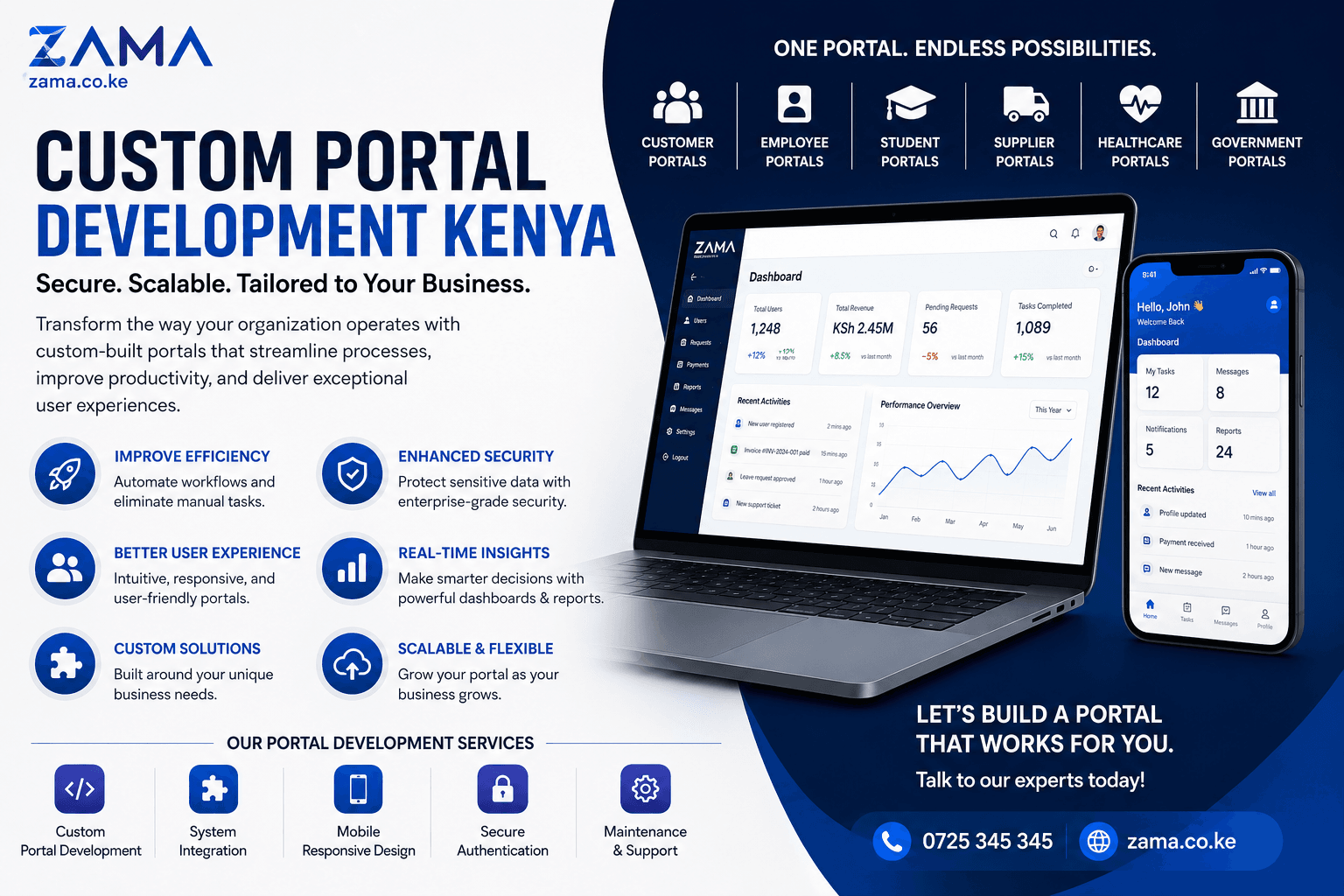
Custom Portal Development Kenya refers to the design and development of secure, web-based portals tailored to meet the specific needs of businesses, organizations, schools, hospitals, government agencies, SACCOs, NGOs, and other institutions in Kenya. Unlike off-the-shelf software, custom portals are built around your unique workflows, allowing users to access information, perform tasks, collaborate, and manage services from one centralized platform.
A custom portal acts as a secure gateway where different users—employees, customers, suppliers, students, tenants, members, or administrators—can log in and access information based on their assigned roles and permissions.
For example:
- Employees can apply for leave and download payslips.
- Customers can track orders and invoices.
- Tenants can pay rent and report maintenance issues.
- Students can access results and assignments.
- Suppliers can upload quotations and monitor payments.
- Patients can schedule appointments and view medical records.
This flexibility makes Custom Portal Development Kenya an essential investment for organizations seeking digital transformation.
Why Businesses Are Investing in Custom Portal Development Kenya
Digital transformation is no longer optional. Kenyan businesses are increasingly embracing technology to improve customer experience, reduce operational costs, and increase productivity.
A custom portal helps businesses achieve these goals by automating repetitive processes while ensuring that users can access services online 24/7.
Some of the key drivers behind the growing demand for Custom Portal Development Kenya include:
- Increased remote work
- Demand for online self-service
- Need for secure document sharing
- Business process automation
- Better customer engagement
- Reduced paperwork
- Faster approvals
- Real-time reporting
- Integration with existing software
- Mobile accessibility
Organizations that invest in modern portals enjoy improved efficiency, happier customers, and better decision-making.
Types of Custom Portals
One of the biggest advantages of Custom Portal Development Kenya is that portals can be customized for almost any industry.
1. Customer Portal
A customer portal enables clients to manage their accounts without contacting customer support.
Typical features include:
- Profile management
- Order tracking
- Invoice downloads
- Payment history
- Support tickets
- Live chat
- Notifications
This reduces support costs while improving customer satisfaction.
2. Employee Portal
Employee portals centralize HR and internal communication.
Employees can:
- Apply for leave
- View payslips
- Update personal information
- Download HR documents
- Submit reimbursement requests
- Access company announcements
- Track attendance
Managers can approve requests from anywhere.
3. Supplier Portal
Businesses dealing with many vendors benefit significantly from supplier portals.
Functions include:
- Tender applications
- Purchase order tracking
- Invoice submission
- Delivery schedules
- Payment tracking
- Contract management
Everything is digitized, eliminating paperwork.
4. Student Portal
Educational institutions use portals to improve communication between students, teachers, and administrators.
Students can:
- Register courses
- View exam results
- Download notes
- Access assignments
- Pay school fees
- View timetables
Parents may also receive progress reports through the same portal.
5. Patient Portal
Healthcare providers use patient portals for:
- Appointment booking
- Medical history
- Laboratory results
- Online consultation
- Prescription renewals
- Billing
Patients receive better care while hospitals improve efficiency.
6. Member Portal
Associations, churches, clubs, SACCOs, and NGOs benefit from member portals.
Members can:
- Update profiles
- Pay subscriptions
- Register for events
- Download documents
- Participate in forums
- Access newsletters
7. Government Service Portal
Government institutions increasingly provide digital services.
Citizens can:
- Submit applications
- Track approvals
- Download certificates
- Make payments
- Book appointments
- Receive notifications
This improves transparency and service delivery.
Essential Features of a Modern Custom Portal
Every successful Custom Portal Development Kenya project should include features that enhance usability, security, and scalability.
Secure Login
Users should authenticate using:
- Phone number
- Two-factor authentication
- Single Sign-On (SSO)
- Biometric authentication where applicable
Security is always a priority.
Role-Based Access Control
Different users should only see what they are authorized to access.
Examples:
Administrator
- Full access
Manager
- Department reports
- Staff approvals
Employee
- Personal records only
Customer
- Own orders and invoices
This prevents unauthorized access.
Dashboard
Every user should have a personalized dashboard displaying:
- Notifications
- Pending tasks
- Reports
- Analytics
- Recent activities
- Messages
Dashboards improve productivity.
Document Management
Organizations store thousands of files.
A portal should provide:
- Secure uploads
- Version control
- Search functionality
- Downloads
- Sharing permissions
This eliminates physical filing cabinets.
Messaging
Integrated messaging improves communication.
Users can:
- Send messages
- Receive notifications
- Share files
- Start discussions
Everything remains inside the portal.
Reports and Analytics
Managers need insights for better decision-making.
Examples include:
- Sales reports
- Attendance reports
- Payment reports
- User activity
- Revenue analysis
- Performance dashboards
Reports can be exported to Excel or PDF.
Workflow Automation
Manual approvals waste valuable time.
Automation enables:
- Leave approvals
- Purchase approvals
- Loan approvals
- Expense approvals
- Contract approvals
Notifications keep everyone informed.
Search Functionality
Powerful search enables users to locate:
- Documents
- Records
- Users
- Transactions
- Messages
within seconds.
Mobile Responsive Design
Modern users access systems using:
- Smartphones
- Tablets
- Laptops
- Desktop computers
Responsive portals provide a consistent experience across all devices.
Benefits of Custom Portal Development Kenya
Organizations investing in Custom Portal Development Kenya experience numerous benefits.
Improved Productivity
Employees spend less time searching for information.
Automated workflows reduce repetitive tasks.
This allows staff to focus on strategic activities.
Better Customer Experience
Customers prefer self-service options.
Instead of calling support, they can:
- Track requests
- Download invoices
- Make payments
- Update profiles
This improves satisfaction and loyalty.
Reduced Operational Costs
Paperwork, printing, and manual processes are expensive.
A digital portal significantly lowers operational expenses.
Increased Transparency
Managers can monitor activities in real time.
Audit logs record:
- User actions
- Login history
- Document changes
- Approval timelines
This improves accountability.
Enhanced Security
Modern portals include:
- Data encryption
- Multi-factor authentication
- User permissions
- Automatic backups
- Activity logs
Sensitive information remains protected.
Centralized Information
Instead of using multiple disconnected systems, organizations manage everything from one platform.
This improves collaboration and reduces duplication.
Scalability
As businesses grow, custom portals can expand with new modules and integrations.
Organizations avoid replacing entire systems every few years.
Industries That Benefit from Custom Portal Development Kenya
Nearly every industry can benefit from a tailored portal solution.
Healthcare
Hospitals improve patient management and appointment scheduling.
Education
Schools streamline admissions, fees, learning materials, and examinations.
Real Estate
Property managers manage tenants, maintenance, rent collection, and leases.
Manufacturing
Factories track production, inventory, and suppliers.
Financial Services
Banks, SACCOs, and microfinance institutions automate customer services and loan processing.
Logistics
Transport companies monitor deliveries, drivers, and fleet operations.
NGOs
Organizations manage donors, beneficiaries, volunteers, and projects from a centralized platform.
Case Study: Transforming Operations with a Custom Client Portal
A fast-growing professional services firm in Kenya struggled with managing client requests through email, spreadsheets, and phone calls. Important documents were difficult to locate, approval times were slow, and clients frequently requested status updates.
The company partnered with Zama to develop a secure client portal that centralized communication, document sharing, project tracking, and billing information.
Within six months of implementation, the firm reported:
- A significant reduction in email traffic as clients used the portal for requests and updates.
- Faster turnaround times for approvals through automated workflows.
- Improved client satisfaction due to real-time project visibility.
- Better internal collaboration because all project information was stored in one secure location.
- Stronger data security through role-based access and activity logs.
The portal became a core part of the company’s operations, enabling it to scale while maintaining a high standard of customer service.