
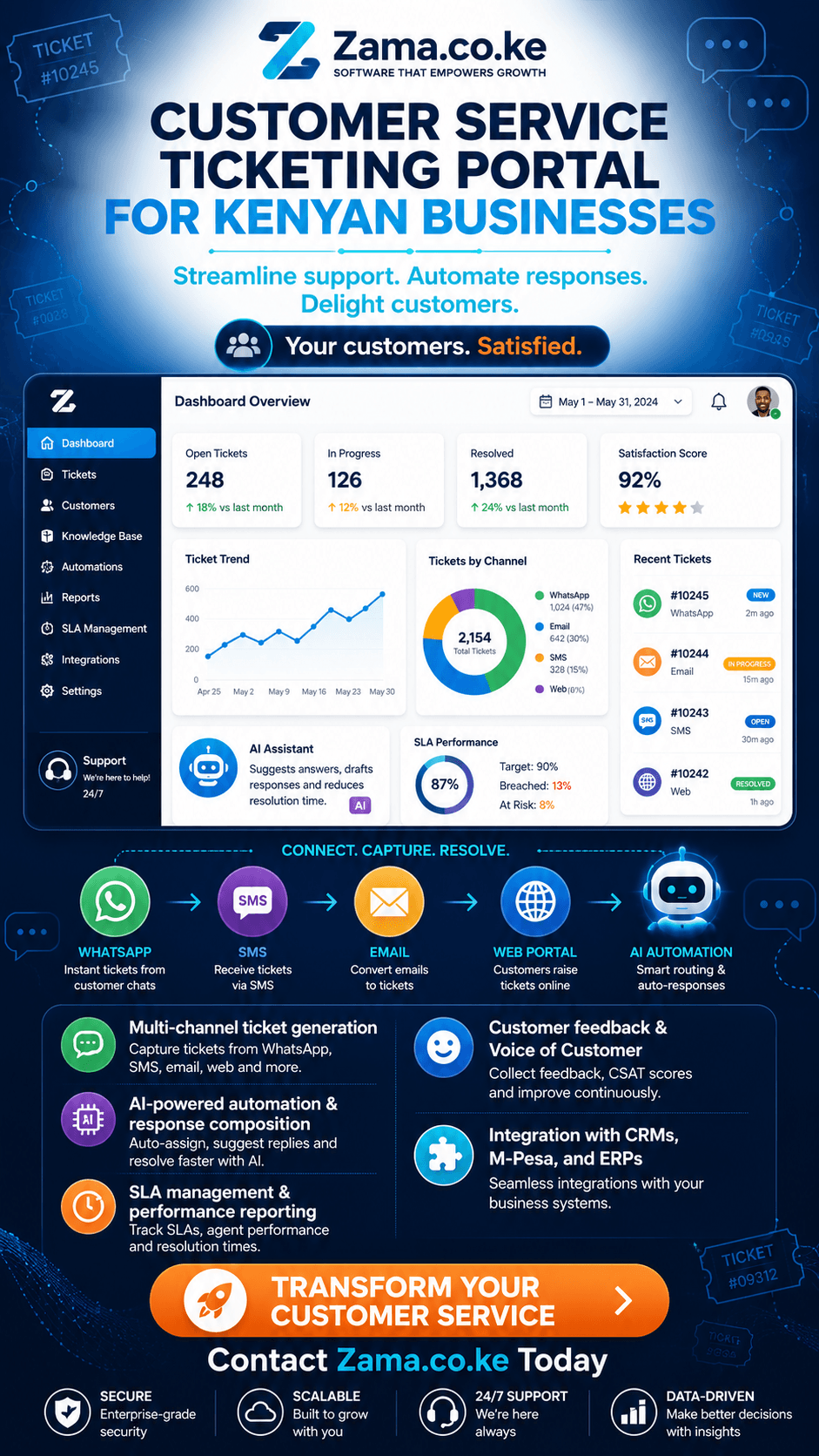
Customer service ticketing portal for Kenyan businesses is a question that every operations manager, customer experience director, and business owner must answer in 2026. With Kenyan utility firms reporting customer interactions on self-service platforms rising by 22.1 percent to over 2 million and customer calls dropping by approximately 900,000, the shift to digital customer service is undeniable . At zama.co.ke, we’ve helped numerous businesses across Kenya build custom customer service ticketing portals that streamline support operations, improve response times, and deliver measurable improvements in customer satisfaction. This comprehensive guide explores customer service ticketing portal for Kenyan businesses, from understanding core requirements to selecting the right solution for your organization.
The Reality of Customer Service in Kenya Today
Before diving into customer service ticketing portal for Kenyan businesses, it’s essential to understand the current landscape. Kenya’s leading utility firms are rapidly phasing out manual systems in favour of digital platforms, with entities such as Kenya Power and Nairobi Water adopting automation to streamline customer service processes . Kenya Power has revamped its MyPower App and the USSD *977# platform, while Nairobi Water has shifted all customer applications and billing to online portals, marking a full-scale transformation in how citizens access essential services .
The Business Registration Service (BRS) recently operationalized a queue management system serving more than 5,000 customers monthly, enhancing service delivery and satisfaction through digital ticketing . Similarly, Kenya Power’s successful implementation of queue management and customer experience systems at eight regional service centres created smoother operations and improved service delivery .
The impact is substantial. Kenya Power’s customer interactions through MyPower App hit 2.02 million during the year to June 2025, while its USSD requests stood at 1.84 million, indicating rising preference for self-service platforms . The increased uptake has reduced customer calls by about 900,000, underscoring the impact of automation in cutting pressure on contact centres .
When evaluating customer service ticketing portal for Kenyan businesses, understanding this shift toward digital service delivery is essential.
The Cost of Poor Customer Service
Before implementing customer service ticketing portal for Kenyan businesses, consider the cost of inadequate support:
Manual Support Overhead: Without a structured ticketing system, teams rely heavily on individual follow-ups and coordination, making it difficult to maintain consistency as volumes increase . One Kenyan retail chain handling nearly 10,000 inquiries per month struggled with duplicate responses, unclear ticket ownership, and inability to track workload across the team .
Customer Frustration: Crowded waiting areas and unpredictable service times create frustration for both customers and employees . Without systematic tools to streamline complaint resolution and measure service quality, the overall experience remains suboptimal .
Lost Opportunities: Poor customer service drives customers to competitors and damages brand reputation. Businesses operating without a proper ticketing system risk losing customers to competitors offering better digital experiences.
What a Customer Service Ticketing Portal Does
A comprehensive customer service ticketing portal for Kenyan businesses centralizes all support requests, providing a single point of contact where customers can submit issues and track resolution progress. According to USIU-Africa’s ICT team, a helpdesk system provides the user community with a single point of contact so that access to appropriate levels of computing and technical support is provided in an efficient and effective manner .
Every support request is assigned a unique ticket number which customers can use to track progress and responses online . This transparency builds trust and reduces follow-up inquiries.
When considering customer service ticketing portal for Kenyan businesses, the platform should consolidate all communication channels—email, WhatsApp, SMS, social media, and phone—into one unified system, ensuring no customer request falls through the cracks.
Essential Features of a Customer Service Ticketing Portal
When evaluating customer service ticketing portal for Kenyan businesses, focus on these core features:
1. Multi-Channel Ticket Generation
Modern customers expect to reach businesses through their preferred channels. A proper customer service ticketing portal for Kenyan businesses should:
Automate Ticket Creation: Automatically create tickets from emails, WhatsApp messages, SMS, and social media interactions . HelloDuty, for example, offers automatic ticketing for voice, WhatsApp Business API, SMS, and USSD channels .
Support Multiple Channels: Integration with voice (VOIP), 2-way SMS and bulk SMS, WhatsApp Business API, and USSD codes . Kenyan businesses are increasingly adopting WhatsApp Business API for customer service, with HelloDuty providing this capability for businesses in Kenya and across Africa .
Provide a Unified Dashboard: All customer interactions visible in one place, regardless of the original channel.
2. Structured Ticket Management
A comprehensive customer service ticketing portal for Kenyan businesses should provide:
Ticket Assignment: Assign tickets to specific team members with clear ownership. Optica’s internal support workflow uses Shared Inboxes where team members review incoming requests and assign them based on availability, dynamically distributing work while ensuring every request is picked up .
Categorization and Tagging: Tags to categorize requests based on issue type, giving agents immediate context and helping them understand next steps .
Priority Management: Escalation workflows for urgent issues with defined service level agreements.
Status Tracking: Customers can track ticket status from submission to resolution.
3. Automation and AI Capabilities
The Kenya Helpdesk Automation Market is expanding rapidly, with increasing adoption of advanced technologies such as artificial intelligence and machine learning driving demand for automated helpdesk solutions . A modern customer service ticketing portal for Kenyan businesses should incorporate:
Automation Rules: Automatic routing of requests between departments without manual forwarding .
AI-Powered Responses: AI chatbots handling routine queries. Kenya Power introduced an AI chatbot named ‘Nuru’ to accelerate customer responses to complaints and queries on its digital platforms, handling real-time queries through its website and social media channels .
AI Compose: AI-powered response composition to speed up agent replies .
Behaviour Forecasting: Over 90% accuracy in behaviour forecasting for proactive issue resolution.
4. Knowledge Base and Self-Service
Customers increasingly prefer self-service options. Good customer service ticketing portal for Kenyan businesses should include:
Knowledge Base: FAQ, articles, and troubleshooting guides .
AI-Powered Search: Customers find answers without contacting support.
Self-Service Portals: Customers can submit requests and track progress independently.
5. SLA Management and Reporting
SLAs are critical for service quality. A proper customer service ticketing portal for Kenyan businesses should:
Define SLAs: Set response and resolution time targets.
Monitor Performance: Track response times, resolution rates, and customer satisfaction .
Generate Reports: Comprehensive reporting on ticket volume, resolution time, team performance, and customer satisfaction metrics.
6. Integration Capabilities
Integration is essential for modern customer service ticketing portal for Kenyan businesses. The platform should:
API Integration: Connect with CRMs, ERPs, and other business systems . HelloDuty features API integrations with Salesforce, Odoo, Zoho, Zendesk, Freshdesk, and Intercom .
Payment Integration: Support for M-Pesa and other payment channels.
CRM Integration: Customer data accessible within the ticketing system.
7. Feedback and Voice of Customer
Understanding customer experience is essential. A comprehensive customer service ticketing portal for Kenyan businesses should:
Collect Feedback: In-branch kiosks or mobile device links for instant feedback .
Track Satisfaction: Managers can track satisfaction levels over time to identify areas for improvement .
Customer Experience Portal: A platform to collect and analyse customer feedback .
8. Mobile-First Design and Offline Capability
With over 80% of internet users in Kenya accessing the web via mobile phones, a proper customer service ticketing portal for Kenyan businesses should:
Work on Mobile Devices: Accessible from any device.
Low-Bandwidth Optimization: Optimised for low-bandwidth networks.
USSD Support: USSD services accommodate users without smartphones, ensuring essential functions remain accessible .
What Makes Kenyan Ticketing Portals Different
Customer service ticketing portal for Kenyan businesses has unique characteristics that global solutions often lack:
M-Pesa Integration
Kenyan businesses must integrate customer service with mobile money payment reconciliation. A customer reports a payment issue, and the system checks M-Pesa transaction status automatically.
WhatsApp Integration
WhatsApp is the dominant communication channel in Kenya. A proper customer service ticketing portal for Kenyan businesses should support WhatsApp Business API with automatic ticketing .
USSD Support
Many Kenyans still rely on feature phones. A comprehensive customer service ticketing portal for Kenyan businesses should retain USSD services to accommodate users without smartphones, ensuring essential functions remain accessible to those outside internet coverage zones .
Local Regulatory Compliance
Compliance with KRA eTIMS, Data Protection Act, and sector-specific regulations.
Multi-Language Support
Kenyan businesses serve customers across diverse language backgrounds. English and Swahili interface options ensure all customers can use the system effectively.
Kenyan Ticketing Portal Solutions
Several solutions are emerging to address customer service ticketing portal for Kenyan businesses:
Marezi Queue Management and CX Portal
Marezi implemented a queue management system and Customer Experience Portal at BRS and Kenya Power . The system enables customers to pick digital tickets, track queue positions on screens, and automatically get called to available counters. The CX Portal allows customers to share satisfaction ratings and comments through in-branch kiosks or mobile device links . This demonstrates the value of integrated queue and ticketing solutions for businesses with physical customer service locations.
HelloDuty
HelloDuty is a no-code Cloud PBX system built for businesses in Africa that interact with customers over Voice, 2-way SMS, WhatsApp Business API, and USSD codes . It offers automatic ticketing for all contact center channels and features API integrations with major CRMs .
Hiver for Internal Support
Hiver is designed for teams managing high volumes of support requests. Optica uses Hiver to manage internal support requests across its growing branch network, bringing structure to how teams handle support . The team uses Shared Inboxes, Tags, Automation Rules, AI features, SLA policies, and Email Templates to handle nearly 10,000 SAP inquiries per month .
ProSupport
ProSupport specializes in multi-channel technical support solutions, offering helpdesk and ticketing system management, remote diagnostics, and SLA-based service delivery .
Zendesk
Zendesk is currently installed on 36 ecommerce stores in Kenya, including notable brands like Moringa School and Happy Wishy . The platform is powerful and flexible, scaling to meet the needs of any business .
The Zama.co.ke Approach
When considering customer service ticketing portal for Kenyan businesses, zama.co.ke follows a structured approach:
Workflow Discovery
We define your customer service workflows: ticket submission channels, escalation rules, SLA targets, integration requirements, and reporting needs. This includes mapping current pain points and identifying automation opportunities.
System Design
Modules, data structure, permissions, user journeys, and reporting layers are planned so the platform supports the business model coherently.
Integration Build
We implement integrations with communication channels (WhatsApp, SMS, email), payment systems (M-Pesa), CRMs, and ERPs.
Testing and Validation
We test all customer scenarios, ticket flows, and reporting requirements before launch.
Post-Launch Support
After go-live, we support stabilization, user feedback, ongoing maintenance, and refinements informed by real usage.
Customer service ticketing portal for Kenyan businesses is essential for any organization seeking to improve customer experience, streamline support operations, and drive growth. From multi-channel ticket generation and AI-powered automation to SLA management and Voice of Customer insights, the right portal transforms how businesses serve their customers.
At zama.co.ke, we’ve helped businesses across Kenya build custom customer service ticketing portals that deliver measurable results. Our approach ensures you get exactly what your business needs—nothing more, nothing less.
Don’t let the complexity of customer service ticketing portal for Kenyan businesses hold you back. Whether you’re a small retail chain or a large utility company, we have the expertise to guide you through every step.
Contact zama.co.ke today and let us help you build a customer service ticketing portal that transforms your customer experience.