
Data Analytics Solutions Kenya: The Ultimate Guide to Smarter Business Decisions in 2026
Businesses in Kenya are generating more data than ever before. Every customer interaction, sales transaction, mobile payment, website visit, employee activity, inventory movement, and marketing campaign creates valuable information. However, collecting data is only the beginning. Businesses need the right technology and expertise to turn this information into meaningful insights that support better decisions. This is where Data Analytics Solutions Kenya can make a major difference.
Modern businesses cannot rely entirely on intuition when making important decisions. Business leaders need accurate information to understand customer behavior, identify operational problems, measure performance, forecast demand, control costs, and discover new opportunities. With Data Analytics Solutions Kenya, organizations can transform raw data into actionable intelligence that supports growth, efficiency, and competitiveness.
From small and medium-sized enterprises to large corporations, financial institutions, healthcare organizations, manufacturers, logistics companies, universities, retailers, government agencies, and technology businesses can benefit from data analytics. The technology allows organizations to move beyond simply storing information and begin using that information strategically.
This comprehensive guide explores how Data Analytics Solutions Kenya can help businesses improve decision-making, automate reporting, understand customers, optimize operations, reduce costs, improve forecasting, and create sustainable competitive advantages.
What Are Data Analytics Solutions Kenya?
Data Analytics Solutions Kenya are technologies, processes, platforms, and services used to collect, organize, process, analyze, visualize, and interpret data.
The objective is to turn raw information into useful insights.
For example, a retail company may have thousands of sales transactions every month. Raw transaction records do not automatically tell management which products are performing best, which branches are underperforming, when customers buy most frequently, or why certain products are becoming less popular.
Data Analytics Solutions Kenyacan identify these patterns.
A business can discover:
- Best-selling products
- Poor-performing products
- Most profitable customers
- Peak sales periods
- High-performing branches
- Marketing campaign performance
- Customer purchasing patterns
- Operational inefficiencies
- Revenue trends
- Expense trends
- Future demand
This is the fundamental purpose of Data Analytics Solutions Kenya: transforming information into insights that businesses can act upon.
Why Data Analytics Solutions Kenya Matters for Kenyan Businesses
Kenyan businesses operate in an increasingly competitive environment.
Organizations need to manage changing customer expectations, increasing operating costs, digital transformation, competition, supply chain challenges, and rapidly changing market conditions.
Traditional management methods may not provide enough visibility into these challenges.
Data analytics provides a more objective approach.
Instead of asking, “Why are sales declining?” management can analyze actual sales data.
Instead of asking, “Which customers are most valuable?” businesses can examine customer behavior and purchasing history.
Instead of asking, “Why are expenses increasing?” finance and operations teams can analyze expenditure patterns.
This makes Data Analytics Solutions Kenya increasingly important for organizations that want to make decisions based on evidence instead of assumptions.
How Data Analytics Solutions Kenya Work
A complete analytics environment normally involves several stages.
1. Data Collection
The first step is collecting information from relevant sources.
Data may come from:
- Websites
- Mobile applications
- Point-of-sale systems
- ERP platforms
- CRM systems
- Accounting software
- E-commerce platforms
- Social media
- Customer service systems
- IoT devices
- Surveys
- Spreadsheets
- Databases
- Cloud applications
The goal is to bring relevant information into an environment where it can be analyzed.
2. Data Integration
Many businesses store information in different systems.
For example, sales information may exist in one platform while customer records are stored in a CRM system and financial data is maintained in accounting software.
Data integration connects these sources.
This provides a more complete view of business performance.
3. Data Cleaning
Raw data can contain errors, duplicates, incomplete records, inconsistent formats, or outdated information.
Before analysis, data needs to be cleaned and standardized.
This improves the accuracy of insights.
Poor-quality data can produce misleading conclusions, so data quality is an essential component of successful analytics.
4. Data Analysis
Once information has been prepared, analytics tools can identify patterns, relationships, trends, and anomalies.
Businesses can analyze historical performance and current activity.
Advanced analytics can also support forecasting and predictive modeling.
5. Data Visualization
Complex datasets can be difficult to understand when presented as rows and columns.
Data visualization converts information into:
- Charts
- Graphs
- Dashboards
- Maps
- Scorecards
- Interactive reports
Visualizations help executives and employees understand important information quickly.
6. Decision-Making
The final step is acting on insights.
Analytics becomes valuable when organizations use findings to improve operations, adjust strategies, control costs, increase revenue, or improve customer experiences.
Major Types of Data Analytics
Businesses can use different forms of analytics depending on their objectives.
Descriptive Analytics
Descriptive analytics answers:
What happened?
It analyzes historical data to explain previous performance.
Examples include:
- Monthly sales reports
- Annual revenue
- Customer numbers
- Website traffic
- Inventory levels
Diagnostic Analytics
Diagnostic analytics asks:
Why did it happen?
For example, a company may discover that sales declined by analyzing customer segments, regions, product categories, and sales channels.
Predictive Analytics
Predictive analytics asks:
What is likely to happen next?
It uses historical information and statistical models to forecast future outcomes.
Businesses can use predictive analytics for:
- Demand forecasting
- Sales forecasting
- Customer churn prediction
- Fraud detection
- Inventory planning
- Risk management
Prescriptive Analytics
Prescriptive analytics goes a step further by asking:
What should we do?
It can help businesses evaluate potential actions and identify strategies that may produce better outcomes.
Together, these analytical approaches enable organizations to understand the past, explain the present, anticipate the future, and improve decision-making.
Benefits of Data Analytics Solutions Kenya
Organizations implementing Data Analytics Solutions Kenya can benefit in many ways.
Better Decision-Making
One of the most important advantages is improved decision-making.
Managers can access reliable information instead of depending solely on intuition.
Data can show which strategies are working and which ones need improvement.
Improved Operational Efficiency
Analytics can identify bottlenecks, delays, waste, and inefficient processes.
For example, a logistics company can analyze delivery times and discover routes that consistently experience delays.
Management can then investigate and optimize those processes.
Increased Revenue
Data analytics can identify opportunities to increase revenue.
Businesses can analyze customer preferences, purchasing behavior, pricing patterns, and product performance.
These insights can support better sales strategies.
Better Customer Understanding
Customers leave valuable data whenever they interact with a business.
Analytics can reveal:
- What customers buy
- How frequently they buy
- Which products they prefer
- What channels they use
- When they interact with the company
- Which customers are likely to stop purchasing
This information enables more personalized customer experiences.
Reduced Business Costs
Analytics can help organizations identify unnecessary expenses.
For example, companies can analyze:
- Procurement costs
- Energy consumption
- Employee productivity
- Inventory waste
- Logistics expenses
- Operational overhead
This can help management identify areas where costs can be controlled.
Data Analytics Solutions Kenya for SMEs in Kenya
Small and medium-sized businesses are an important part of the Kenyan economy.
Many SMEs operate with limited resources, making efficient decision-making particularly important.
Analytics can help SMEs understand their business without requiring large analytical departments.
A small retailer can analyze sales trends.
A restaurant can identify popular meals.
An online business can analyze customer acquisition.
A professional services firm can monitor revenue and client performance.
Therefore, Data Analytics Solutions Kenya are not limited to large corporations.
Affordable cloud-based analytics platforms can make advanced reporting and business intelligence increasingly accessible to SMEs.
Data Analytics for Financial Institutions
Financial institutions generate enormous amounts of data through transactions, customer accounts, loan applications, payments, and digital banking interactions.
Analytics can help financial organizations identify:
- Fraudulent activity
- Unusual transactions
- Customer trends
- Credit risk
- Loan performance
- Product profitability
- Customer churn
Predictive models can help institutions assess patterns and identify potential risks.
Data analytics can therefore support both operational efficiency and risk management.
Data Analytics for Retail Businesses
Retailers need to understand customer demand.
Analytics can help retailers determine which products sell fastest and which remain on shelves for too long.
Businesses can analyze:
- Sales by branch
- Product performance
- Customer demographics
- Seasonal demand
- Promotional campaigns
- Inventory levels
- Average order values
This helps retailers make more informed inventory and marketing decisions.
Data Analytics for Manufacturing
Manufacturers can use analytics to monitor production and identify inefficiencies.
Manufacturing analytics can examine:
- Production output
- Machine performance
- Downtime
- Defect rates
- Production costs
- Raw material consumption
- Delivery schedules
Predictive maintenance can also help organizations identify potential equipment problems before failures occur.
This can reduce downtime and improve productivity.
Data Analytics for Logistics and Transport
Kenya’s logistics industry depends heavily on efficient movement of goods and people.
Analytics can support:
- Route optimization
- Fuel monitoring
- Delivery tracking
- Fleet performance
- Driver performance
- Maintenance planning
- Delivery forecasting
A logistics company can use historical delivery information to identify routes that regularly experience delays and optimize transportation operations.
Data Analytics for Healthcare
Healthcare organizations manage large quantities of information.
Analytics can support:
- Patient management
- Resource allocation
- Appointment analysis
- Hospital performance
- Inventory planning
- Operational reporting
Healthcare providers can use data to understand service demand and allocate resources more effectively.
Any healthcare analytics environment must, however, prioritize privacy, security, governance, and applicable legal requirements.
Data Analytics for Real Estate
Real estate companies can use analytics to understand property performance and market trends.
Analytics can help organizations monitor:
- Rental income
- Occupancy
- Property expenses
- Tenant behavior
- Vacancy rates
- Maintenance costs
- Property demand
For property managers, analytics can provide a centralized view of portfolio performance.
Data Analytics for E-Commerce
Online businesses generate extensive behavioral data.
An e-commerce company can analyze:
- Website visits
- Product views
- Cart abandonment
- Purchases
- Customer acquisition
- Repeat purchases
- Marketing performance
These insights can improve online conversion rates and customer retention.
Business Intelligence and Data Analytics
Business intelligence and data analytics are closely related but are not identical.
Business intelligence commonly focuses on reporting and understanding business performance.
Data analytics can involve broader analytical techniques, including statistical analysis, predictive modeling, and advanced data science.
Organizations can combine both capabilities to create a comprehensive data-driven environment.
Dashboards can show management what is happening while analytics can explain why it is happening and what may happen next.
Real-Time Data Analytics
Traditional reporting often relies on historical information.
Real-time analytics allows organizations to monitor information as it is generated.
This can be particularly useful for:
- Financial transactions
- E-commerce
- Logistics
- Customer support
- Manufacturing
- Security monitoring
For example, an e-commerce company can monitor orders in real time and identify unusual activity or sudden changes in demand.
Real-time analytics can help organizations respond faster to emerging situations.
Predictive Analytics in Kenya
Predictive analytics is becoming increasingly valuable because organizations want to anticipate future events rather than simply analyze historical results.
Businesses can use predictive models to forecast:
- Sales
- Customer churn
- Product demand
- Cash flow
- Inventory requirements
- Maintenance requirements
- Fraud risks
Predictive analytics does not guarantee future outcomes.
Instead, it uses available data and statistical techniques to estimate likely patterns and outcomes.
Artificial Intelligence and Data Analytics
Artificial intelligence is expanding the capabilities of data analytics.
AI-powered systems can process large datasets, recognize patterns, classify information, identify anomalies, and generate insights.
Businesses can combine AI with analytics to automate tasks such as:
- Data classification
- Forecasting
- Anomaly detection
- Customer segmentation
- Recommendation systems
- Automated reporting
- Natural-language querying
This can make analytics more accessible to employees who may not have advanced technical skills.
Data Analytics Dashboards
Dashboards provide a visual overview of important performance indicators.
A management dashboard might display:
- Revenue
- Sales
- Expenses
- Profit
- Customer numbers
- Conversion rates
- Inventory
- Employee performance
Different departments can have different dashboards.
A finance team may focus on revenue and expenses.
A sales team may monitor leads and conversions.
A marketing department may track campaigns and customer acquisition.
This ensures that employees see information relevant to their responsibilities.
Key Performance Indicators
A successful analytics project should focus on measurable objectives.
Key Performance Indicators, commonly known as KPIs, help organizations monitor performance.
Examples include:
- Revenue growth
- Customer retention
- Customer acquisition cost
- Gross margin
- Sales conversion rate
- Inventory turnover
- Delivery time
- Employee productivity
- Customer satisfaction
The best KPIs depend on the organization’s objectives.
Analytics should not overwhelm users with unnecessary information. It should highlight the metrics that matter most.
Data Analytics and Customer Experience
Customer experience can significantly influence business performance.
Analytics can help businesses understand where customers encounter difficulties.
For example, an online business may discover that customers abandon purchases at a particular stage of checkout.
A telecommunications company may identify common reasons for customer complaints.
A bank may discover which digital services customers use most frequently.
These insights can support targeted improvements.
Data Analytics and Marketing
Marketing teams need to know whether campaigns are producing results.
Analytics can help measure:
- Website traffic
- Leads
- Conversions
- Customer acquisition cost
- Campaign engagement
- Social media performance
- Email performance
- Return on marketing investment
Instead of treating marketing as an expense that is difficult to measure, businesses can evaluate campaigns based on actual data.
Data Analytics for Sales Teams
Sales teams can use analytics to improve their performance.
Managers can identify:
- High-performing sales representatives
- Best-performing products
- Strongest customer segments
- Sales pipeline value
- Conversion rates
- Average sales cycle
- Revenue trends
Sales analytics can also identify opportunities that might otherwise be overlooked.
Data Analytics for Human Resources
HR departments can use analytics to understand workforce trends.
Possible applications include:
- Employee turnover
- Recruitment performance
- Absenteeism
- Workforce planning
- Training outcomes
- Employee engagement
- Performance indicators
Workforce analytics can help organizations identify patterns that may require management attention.
However, employee analytics should be implemented responsibly, with appropriate privacy and ethical safeguards.
Data Analytics and Supply Chain Management
Supply chains involve many interconnected processes.
Analytics can help organizations monitor:
- Supplier performance
- Procurement costs
- Inventory
- Delivery times
- Demand
- Stockouts
- Warehousing
A company can use analytics to identify suppliers that consistently deliver late or products that frequently experience shortages.
This can support stronger procurement and inventory decisions.
Data Security and Analytics
As organizations collect more data, security becomes increasingly important.
Analytics environments should incorporate appropriate measures such as:
- Access controls
- User authentication
- Data encryption
- Backups
- Monitoring
- Secure integrations
- Data governance
- Role-based permissions
Organizations should ensure that sensitive information is handled responsibly.
Data protection should be integrated into the analytics strategy rather than treated as an afterthought.
Data Governance
Data governance establishes rules for how data is collected, stored, accessed, used, and maintained.
Effective governance can define:
- Data ownership
- Data quality standards
- Access permissions
- Retention policies
- Security requirements
- Data usage responsibilities
Without governance, organizations may have large amounts of information but struggle to trust or use it effectively.
Choosing the Right Data Analytics Partner
Selecting a technology partner is an important decision.
Businesses should consider:
Technical Expertise
Does the provider understand analytics, databases, visualization, cloud technology, and data integration?
Industry Understanding
Does the provider understand your industry and business challenges?
Scalability
Can the solution grow as data volumes and business requirements increase?
Security
Does the platform provide appropriate safeguards for business information?
Integration
Can it connect with existing systems?
Reporting
Can the solution produce dashboards and reports that management can actually use?
Support
Will the provider offer ongoing assistance and maintenance?
The cheapest solution is not always the best solution. Businesses should evaluate long-term value.
Implementing Data Analytics Solutions Kenya
A successful analytics project requires more than installing software.
Step 1: Define Business Objectives
Start by identifying the questions you want data to answer.
For example:
- Why are sales declining?
- Which customers are most profitable?
- Which products have the strongest margins?
- Where are operational costs increasing?
Clear questions produce more useful analytics projects.
Step 2: Identify Data Sources
Determine where the required information exists.
It could be stored in:
- CRM systems
- ERP software
- Accounting systems
- Databases
- Spreadsheets
- Websites
- Mobile applications
Step 3: Assess Data Quality
Review whether the data is complete, accurate, consistent, and up to date.
Step 4: Build the Analytics Environment
The technical environment may include databases, cloud services, data warehouses, analytics tools, visualization platforms, and integrations.
Step 5: Develop Dashboards
Create dashboards that focus on relevant KPIs.
Step 6: Train Users
Employees need to understand how to interpret dashboards and use insights correctly.
Step 7: Measure Results
Analytics projects should produce measurable business value.
Businesses should monitor whether analytics is improving:
- Revenue
- Efficiency
- Cost control
- Customer retention
- Productivity
- Decision-making
Common Challenges in Data Analytics
Organizations implementing analytics may encounter challenges.
Poor Data Quality
If the underlying information is inaccurate, the resulting insights may be unreliable.
Data Silos
Information stored across disconnected systems makes analysis more difficult.
Lack of Skills
Organizations may need data engineers, analysts, developers, or consultants to build and maintain analytics systems.
Resistance to Change
Employees accustomed to traditional processes may initially resist new technology.
Security Risks
More data access can increase the importance of strong security controls.
Unclear Objectives
Analytics projects can fail when businesses focus on technology without identifying specific business problems.
These challenges can be addressed through careful planning, appropriate technology, training, and governance.
How Data Analytics Can Create Competitive Advantage
Businesses that use data effectively can respond more quickly to market changes.
They can understand customers better.
They can identify problems earlier.
They can forecast demand.
They can optimize resources.
They can measure performance.
They can make more informed strategic decisions.
This creates a competitive advantage because the organization is able to learn from its own operations and continuously improve.
The Future of Data Analytics in Kenya
The future of analytics in Kenya is likely to be influenced by cloud computing, artificial intelligence, automation, mobile technology, Internet of Things devices, and increasingly sophisticated business systems.
As organizations digitize more operations, the amount of available information will continue to grow.
Businesses will increasingly need technologies capable of processing and interpreting that information.
Future analytics environments may become more automated, allowing executives to ask questions in natural language and receive instant insights.
For example, instead of manually examining several reports, a manager may ask:
“What caused the decline in sales this quarter?”
An advanced analytics system could identify relevant trends and provide a summary based on available data.
This represents a shift from static reporting toward intelligent decision support.
Why Businesses Should Invest in Data Analytics Now
Waiting until competitors become more data-driven can create a disadvantage.
Organizations that begin building strong data foundations today can gradually improve their reporting, analytics capabilities, and data culture.
The process does not need to happen all at once.
A business can start with one department or problem.
For example, a company could begin by analyzing sales.
Once the process proves successful, it can expand into finance, marketing, operations, customer service, and HR.
This gradual approach reduces implementation risks while allowing organizations to demonstrate value.
Case Study: Analytics for a Kenyan Retail Business
Consider a hypothetical Kenyan retail company operating multiple branches.
Management notices that total revenue is growing but profits are not increasing at the same rate.
Traditional reporting shows sales numbers but does not explain the problem.
The company introduces analytics.
The analysis reveals that some high-volume products have very low margins. It also identifies unusually high inventory holding costs in several branches.
Management responds by reviewing pricing, inventory levels, and product selection.
The result is better financial visibility and more informed decision-making.
The lesson is that revenue alone does not provide a complete picture of business performance.
Analytics helps reveal the relationships between different metrics.
Case Study: Analytics for a Logistics Company
Imagine a logistics company experiencing increasing fuel costs.
Management wants to understand why expenses are rising.
Analytics combines fleet information, delivery routes, fuel consumption, mileage, and maintenance records.
The company discovers that certain routes and vehicles consistently have higher fuel consumption.
Management can investigate route planning, vehicle maintenance, and driver behavior.
Instead of applying a general cost-cutting strategy, the company can target the areas responsible for the highest expenses.
This demonstrates how analytics can convert a broad business problem into specific actionable insights.
Data Analytics Solutions Kenya ROI
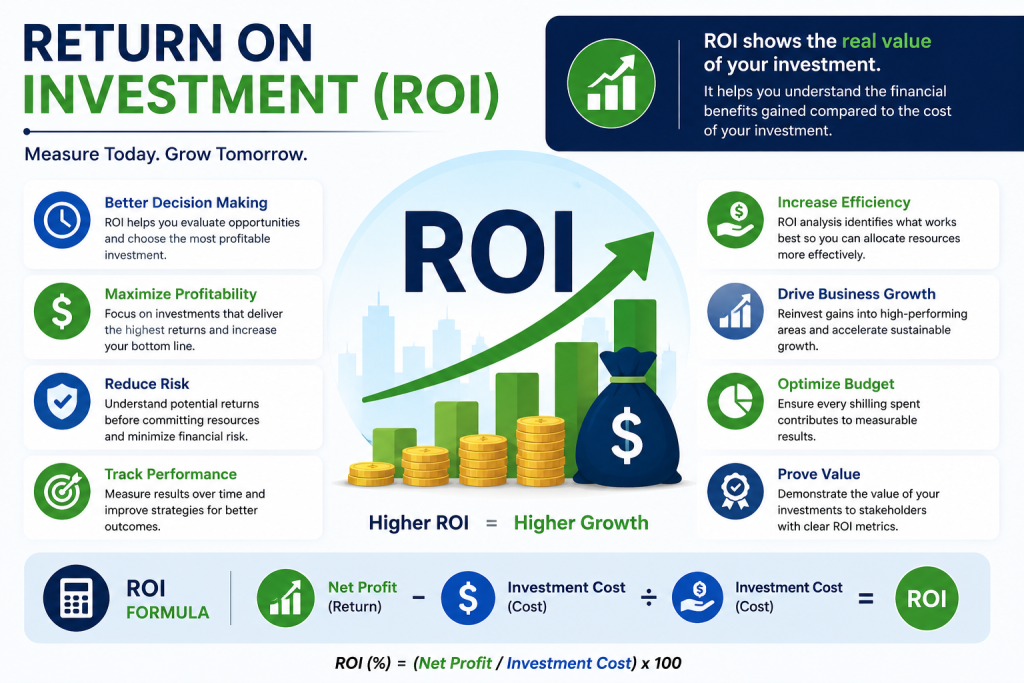
Businesses should consider return on investment when evaluating analytics projects.
ROI may come from:
- Increased revenue
- Reduced expenses
- Lower customer churn
- Better inventory management
- Improved productivity
- Reduced fraud
- Faster reporting
- Better resource allocation
Not every benefit will immediately appear as direct revenue.
Saving management several hours every week by automating reports can also provide meaningful value.
The most successful analytics initiatives connect technical capabilities to measurable business outcomes.
Frequently Asked Questions
What are Data Analytics Solutions Kenya?
Data Analytics Solutions Kenya are technologies and professional services that help Kenyan organizations collect, integrate, process, analyze, visualize, and interpret business information for better decision-making.
Why should Kenyan businesses invest in analytics?
Analytics can help organizations understand customers, improve operations, reduce costs, forecast demand, measure performance, and identify opportunities for growth.
Can SMEs use Data Analytics Solutions Kenya?
Yes. Cloud-based tools and scalable analytics platforms make it possible for SMEs to begin with focused analytics projects and expand over time.
What industries can benefit from Data Analytics Solutions Kenya
Almost every industry can benefit, including finance, retail, manufacturing, logistics, healthcare, telecommunications, education, real estate, hospitality, agriculture, and professional services.
Can Data Analytics Solutions Kenya help increase sales?
Yes. Analytics can identify customer preferences, profitable segments, high-performing products, sales trends, and opportunities for improving conversion and retention.
Is Data Analytics Solutions Kenya the same as artificial intelligence?
No. Data analytics involves analyzing information to generate insights, while artificial intelligence involves systems capable of performing tasks that typically require human-like intelligence. AI can, however, be used within analytics.
How long does implementation take?
The timeline depends on the size of the project, data sources, integrations, complexity, and desired functionality. A focused dashboard project can be considerably faster than a large enterprise-wide analytics platform.
Is Data Analytics Solutions Kenya expensive?
Costs vary depending on the technology, number of users, data volume, integrations, customization, and level of support. Businesses should evaluate analytics based on expected business value rather than initial cost alone.
Does Data Analytics Solutions Kenya require specialized employees?
Complex analytics projects may require data analysts, engineers, data scientists, developers, or consultants. However, modern visualization and business intelligence tools can allow non-technical employees to consume insights through user-friendly dashboards.
How can a business start using Data Analytics Solutions Kenya?
Start by identifying one important business problem, determine which data can answer it, assess data quality, select appropriate technology, develop a focused dashboard or analytical model, and measure the resulting business impact.
How to Get Started With Data Analytics Solutions Kenya
Businesses interested in analytics should begin with a clear objective.
Do not start with technology alone.
Start with a business question.
Determine what management needs to know and why that information matters.
Next, identify the available data.
Then evaluate the quality of that information.
After establishing a strong foundation, businesses can introduce dashboards, reporting systems, predictive models, automation, or AI capabilities according to their needs.
A phased approach can be particularly useful for organizations that are beginning their digital transformation journey.
Conclusion: Unlock the Power of Data With Data Analytics Solutions Kenya
Data has become one of the most valuable resources available to modern businesses. However, raw information has limited value until an organization can transform it into meaningful insights. Data Analytics Solutions Kenya provide businesses with the tools, technologies, and processes required to turn complex information into practical intelligence that supports smarter decisions.
For organizations struggling with disconnected information, manual reporting, limited visibility, or uncertain decision-making, Data Analytics Solutions Kenya can provide a structured path toward becoming more data-driven. Instead of waiting until the end of the month to understand performance, businesses can use Data Analytics Solutions Kenya to monitor important metrics and identify emerging trends more quickly.
The value of Data Analytics Solutions Kenya extends across virtually every industry. Retailers can analyze customer purchases, manufacturers can monitor production, logistics companies can optimize routes, financial institutions can identify risks, healthcare organizations can improve resource planning, and service businesses can understand customer behavior.
By adopting Data Analytics Solutions Kenya, organizations can also improve operational efficiency. Analytics can reveal bottlenecks, unnecessary expenses, poor-performing processes, and areas where resources are being underutilized. Management can then use these insights to improve processes and allocate resources more effectively.
Customer experience is another area where Data Analytics Solutions Kenya can deliver significant value. Businesses can analyze customer interactions, purchasing patterns, complaints, preferences, and engagement levels. These insights can help organizations develop more personalized experiences and strengthen customer relationships.
The growing importance of predictive analytics makes Data Analytics Solutions Kenya even more valuable. Businesses no longer have to focus only on understanding what happened in the past. With appropriate data and analytical models, organizations can forecast demand, identify potential customer churn, anticipate maintenance needs, and estimate future business trends.
At the same time, organizations must recognize that implementing Data Analytics Solutions Kenya requires more than purchasing a dashboard tool. Successful analytics depends on data quality, integration, governance, security, skilled implementation, user adoption, and clearly defined business objectives.
Businesses should therefore approach analytics as a strategic initiative rather than simply an IT project. When Data Analytics Solutions Kenya are aligned with specific business goals, they can deliver much greater value than analytics implemented without a clear purpose.
The right Data Analytics Solutions Kenya can also help organizations build a culture of evidence-based decision-making. Employees can move away from relying exclusively on assumptions and instead use reliable information to evaluate performance and identify opportunities.
For growing businesses, Data Analytics Solutions Kenya provide a scalable foundation for digital transformation. As an organization generates more data through websites, mobile applications, payment platforms, CRM systems, ERP software, e-commerce platforms, and other digital channels, analytics can help ensure that this information remains useful rather than becoming an overwhelming collection of disconnected records.
Security should remain a central consideration when implementing Data Analytics Solutions Kenya. Businesses should establish appropriate access controls, authentication, data protection, backups, governance procedures, and other safeguards to protect sensitive information.
Another important consideration is scalability. The best Data Analytics Solutions Kenya should be capable of growing with the organization. A business may begin with sales reporting but later require marketing analytics, financial dashboards, predictive models, customer analytics, or operational intelligence.
This is why organizations should select technology partners carefully. A capable analytics provider should understand both technology and business requirements. The provider should be able to assess existing data sources, identify integration requirements, design useful dashboards, establish appropriate security controls, and provide ongoing support.
For SMEs, Data Analytics Solutions Kenya can provide access to capabilities that were once available primarily to large enterprises. Cloud technologies, scalable platforms, and modern visualization tools can make it possible for smaller organizations to begin their analytics journey without building massive internal technology departments.
For larger enterprises, Data Analytics Solutions Kenya can provide a foundation for enterprise-wide data strategies. Multiple departments can share reliable information while maintaining appropriate access controls and governance.
Ultimately, the goal of Data Analytics Solutions Kenya is not simply to create attractive charts. The real objective is to help organizations understand what is happening, why it is happening, what may happen next, and what actions should be considered.
Businesses that successfully use Data Analytics Solutions Kenya can make faster decisions, identify opportunities earlier, control costs more effectively, improve customer experiences, and respond more confidently to changing market conditions.
The Kenyan business environment is becoming increasingly digital and competitive. Organizations that learn how to use their data effectively will be better positioned to adapt and grow.
Now is the time to evaluate your organization’s information and ask an important question: Are you simply collecting data, or are you using it to make better decisions?
With the right Data Analytics Solutions Kenya, your business can turn scattered information into actionable insights, transform reporting into intelligence, and use data as a strategic asset.
Whether you are a startup, SME, established company, financial institution, retailer, manufacturer, logistics provider, healthcare organization, real estate company, or large enterprise, the opportunity is significant.
Investing in Data Analytics Solutions Kenya can help you build a stronger data foundation, improve visibility, enhance decision-making, and create sustainable competitive advantage.
The future belongs to businesses that do more than collect data. It belongs to businesses that understand it, learn from it, and act on it.
Turn your business data into meaningful intelligence today and take the next step toward smarter, faster, and more confident decision-making with modern analytics
.