
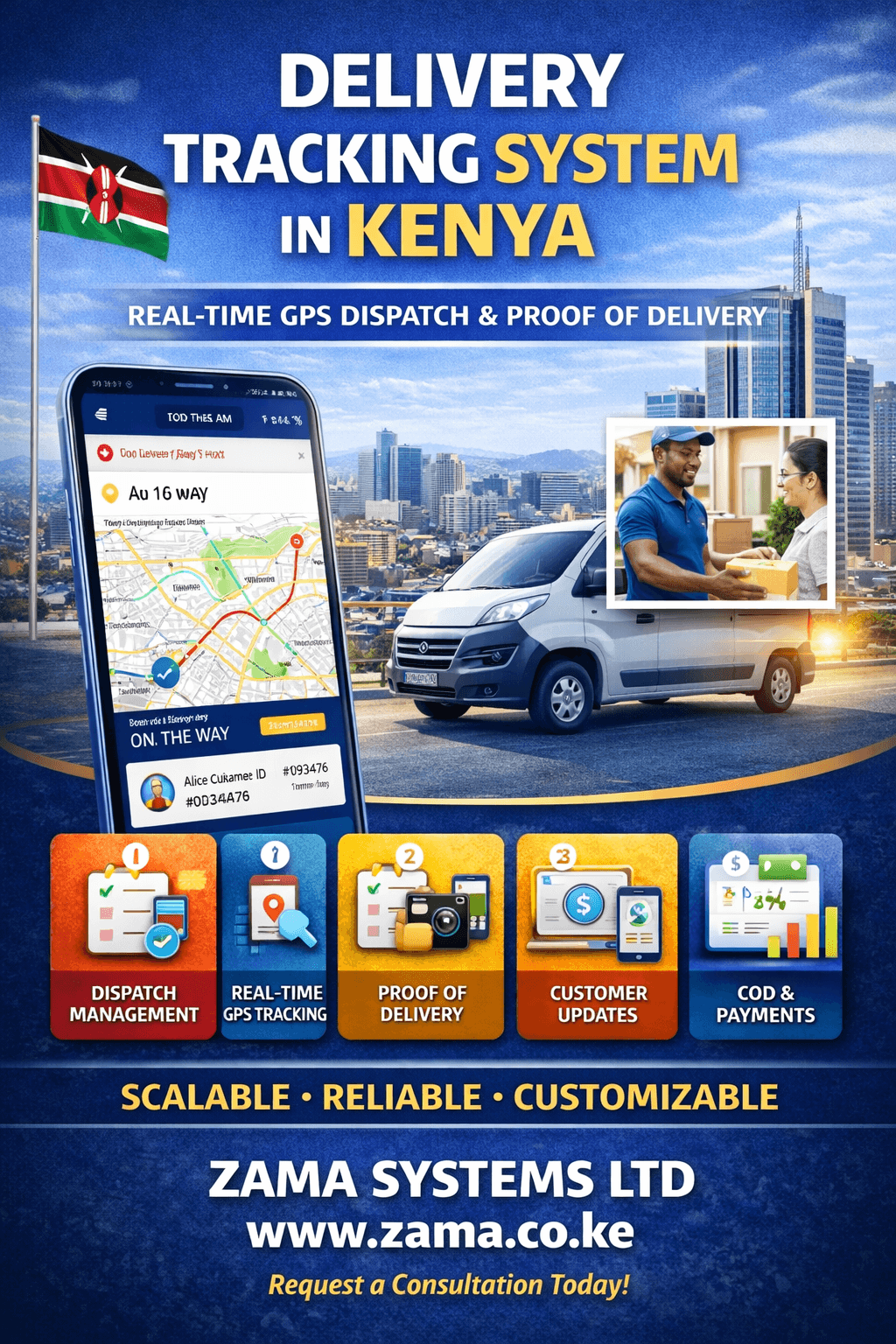
In today’s fast-moving digital economy, customers expect speed, visibility, and reliability. Whether you run a courier company, e-commerce store, supermarket chain, gas distribution business, or logistics operation, a Delivery Tracking System is no longer optional — it is essential.
Businesses that invest in a modern delivery tracking system improve efficiency, reduce losses, increase customer trust, and scale operations faster.
This comprehensive guide explains everything you need to know about delivery tracking systems, how they work, key features, benefits, implementation strategies, and why your business needs one now.
What Is a Delivery Tracking System?
A Delivery Tracking System is software that enables businesses to monitor, manage, and optimize deliveries from dispatch to final confirmation.
It allows companies to:
Create and assign delivery orders
Track drivers in real time via GPS
Monitor delivery progress
Capture proof of delivery (POD)
Notify customers automatically
Generate performance and financial reports
The system acts as a centralized control center for last-mile logistics.
Why a Delivery Tracking System Is Critical in 2026
Modern customers demand:
Real-time updates
Fast delivery
Transparent tracking
Accurate delivery times
Secure confirmation
Without a delivery tracking system, businesses face:
Lost parcels
Driver inefficiencies
Cash reconciliation issues
Customer complaints
Poor accountability
Limited scalability
A digital tracking solution eliminates these risks.
Core Features of a Modern Delivery Tracking System
1. Order & Dispatch Management
Manual or automated order creation
Auto-assign drivers based on location
Scheduled deliveries
Priority tagging (urgent, same-day, next-day)
Batch dispatching
This ensures structured delivery planning.
2. Driver / Rider Mobile App
A professional delivery tracking system includes a mobile app where drivers can:
Receive assigned orders
View delivery details
Access integrated navigation
Update delivery status
Upload photos
Capture digital signatures
Collect OTP verification
This creates accountability and traceability.
3. Real-Time GPS Tracking
With GPS integration, businesses can:
Track driver location live
View route history
Calculate ETA automatically
Monitor idle time
Detect route deviations
This improves operational efficiency and reduces fuel wastage.
4. Proof of Delivery (POD)
To prevent disputes, the system supports:
Digital signatures
OTP verification codes
Photo evidence
Timestamp verification
GPS confirmation
Receiver details capture
Proof of delivery increases trust and reduces false claims.
5. Customer Notification System
Customers receive automatic updates such as:
Order dispatched
Driver on the way
Delivery successful
Delivery failed (if applicable)
Notifications can be sent via:
SMS
WhatsApp
Email
Web tracking links
This improves transparency and customer experience.
6. Cash-on-Delivery (COD) Management
For businesses handling cash collections:
Track COD per delivery
Monitor daily collections
Reconcile driver cash balances
Integrate M-Pesa confirmation logs
Generate settlement reports
This reduces revenue leakage.
7. Reporting & Analytics Dashboard
A powerful delivery tracking system provides:
Delivery success rate
Failed delivery reasons
Driver performance ranking
Average delivery time
Revenue per route
Fuel efficiency insights
Data-driven decisions improve growth.
Benefits of Implementing a Delivery Tracking System
Increased Operational Efficiency
Automated dispatch and route tracking reduce delays.
Improved Customer Satisfaction
Real-time tracking builds confidence.
Reduced Delivery Errors
Digital records eliminate guesswork.
Stronger Driver Accountability
GPS logs and proof-of-delivery create transparency.
Better Financial Control
COD tracking reduces revenue loss.
Scalable Growth
Systems support expansion to multiple regions.
Who Needs a Delivery Tracking System?
A delivery tracking system is ideal for:
Courier & logistics companies
E-commerce platforms
Supermarkets
Wholesale distributors
Pharmaceutical suppliers
Food & water delivery businesses
Gas distribution companies
Construction material suppliers
Field service teams
Multi-branch businesses
If your company delivers goods or services, you need structured tracking.
Advanced Features for Enterprise Businesses
Modern delivery tracking systems can include:
AI route optimization
Geofencing alerts
Fleet maintenance tracking
Driver behavior monitoring
Integration with POS systems
Integration with e-commerce platforms
Multi-branch centralized dashboards
API integration for third-party systems
These features support enterprise-level operations.
Delivery Tracking System for Multi-Branch Businesses
If your business operates across multiple branches, a centralized delivery tracking platform enables:
Unified dispatch center
Regional driver management
Consolidated reporting
Centralized financial reconciliation
Cross-branch visibility
This prevents operational fragmentation.
Integration Capabilities
A professional delivery tracking system can integrate with:
POS systems
Inventory management software
E-commerce platforms
CRM systems
Accounting software
Payment gateways
M-Pesa APIs
ERP systems
This creates a connected digital ecosystem.
Key SEO Keywords Naturally Embedded
Delivery tracking system
Delivery tracking system in Kenya
Courier tracking software
Dispatch management system
Proof of delivery app
Fleet tracking software
Last-mile delivery management
Rider tracking system
GPS delivery tracking software
Delivery management platform
How to Choose the Right Delivery Tracking System
When selecting a delivery tracking system, consider:
Real-time GPS capability
Secure data storage
Mobile app quality
Integration options
Scalability
Reporting features
Security compliance
Customization flexibility
A cheap system that lacks scalability can cost more long term.
Future Trends in Delivery Tracking Systems
The future of delivery tracking includes:
AI-powered route optimization
Predictive delivery time analytics
Drone delivery integration
Blockchain-based delivery verification
Automated dispatch intelligence
Smart fuel efficiency monitoring
Businesses that adopt modern systems early gain competitive advantage.
Why Your Business Cannot Ignore Delivery Tracking Technology
Without a delivery tracking system, you risk:
Operational chaos
Revenue loss
Customer dissatisfaction
Limited expansion capacity
Poor driver management
Inaccurate reporting
With a proper system, you gain:
Control
Visibility
Scalability
Profitability
Final Thoughts
A Delivery Tracking System is the backbone of any serious logistics, distribution, or last-mile business. It transforms manual dispatch into intelligent, data-driven operations.
Whether you manage 5 drivers or 500, investing in a scalable delivery tracking system ensures structured growth, operational transparency, and long-term profitability.
If your business depends on delivery, it is time to implement a professional delivery tracking solution and position yourself ahead of the competition.
How a Delivery Tracking System Transforms Your Business Operations
A powerful Delivery Tracking System does more than track parcels — it becomes the operational backbone of your logistics ecosystem. When implemented properly, it connects dispatch, drivers, finance, customer service, and management into one unified digital workflow.
Let’s go deeper into how this transformation happens.
End-to-End Delivery Lifecycle Automation
A modern delivery tracking system automates the full journey:
1️⃣ Order Creation
Orders can originate from:
E-commerce platforms
POS systems
ERP software
Manual entry by dispatch team
API integrations
The system centralizes all orders instantly.
2️⃣ Smart Dispatching
Instead of manually calling drivers, the system:
Assigns the nearest available driver
Calculates optimized routes
Balances driver workload
Prioritizes urgent deliveries
Reduces delivery overlap
This minimizes delays and improves speed.
3️⃣ Live Tracking & Status Updates
Management can monitor:
Active deliveries
Driver location
Route efficiency
Delivery progress
Estimated arrival times
Customers can track their orders in real time, reducing support calls.
4️⃣ Proof of Delivery & Confirmation
Upon delivery, the system captures:
Digital signature
Photo evidence
GPS location stamp
Timestamp
OTP verification
This eliminates disputes and protects your business.
5️⃣ Financial Reconciliation
For cash-on-delivery businesses:
COD amounts are logged
Driver collections are tracked
Settlement summaries are generated
Revenue leakage is minimized
Financial control becomes structured and transparent.
Delivery Tracking System & Customer Experience
Customer trust increases when:
They receive automatic delivery notifications
They see driver location on a live map
They receive confirmation instantly
They have digital delivery proof
This builds brand loyalty and repeat business.
In competitive markets, customer visibility is a major advantage.
Scaling Your Delivery Business with Technology
If you plan to expand:
From one town to multiple counties
From 5 riders to 100 riders
From 50 deliveries per day to 5,000
You cannot scale with spreadsheets or manual coordination.
A delivery tracking system supports:
Multi-region operations
Centralized dashboards
Role-based management
Regional supervisors
Performance-based driver incentives
Technology makes expansion predictable.
Security & Data Protection in Delivery Tracking Systems
Security is critical when handling:
Customer data
Delivery addresses
Payment information
Route logs
Driver details
A professional system includes:
Encrypted communication
Role-based access control
Secure authentication
Cloud backup
Audit logs
Activity monitoring
This protects both your business and your customers.
Delivery Tracking for Different Industries
Courier & Logistics Companies
Manage bulk parcel deliveries with route optimization and live monitoring.
E-Commerce Platforms
Integrate directly into checkout systems for seamless tracking.
Supermarkets & Wholesalers
Schedule same-day deliveries with automated dispatch.
Pharmaceutical & Medical Supply
Track sensitive deliveries with accountability and compliance.
Gas & Water Distribution
Manage recurring delivery schedules with route efficiency.
Field Service & Installation Teams
Track technician visits, installations, and repair confirmations.
ROI of a Delivery Tracking System
Businesses typically see improvements in:
20–40% faster delivery times
Reduced fuel costs
Fewer failed deliveries
Lower customer complaint rates
Improved cash reconciliation accuracy
Better driver productivity
The system pays for itself through efficiency gains.
Delivery Tracking System vs Manual Dispatch
| Manual Dispatch | Delivery Tracking System |
|---|---|
| Phone-based coordination | Automated assignment |
| No real-time tracking | Live GPS visibility |
| Paper-based confirmation | Digital proof of delivery |
| Manual reconciliation | Automated COD tracking |
| Limited scalability | Unlimited scalability |
| High human error | Structured automation |
The difference is operational control.
Common Challenges Solved by Delivery Tracking Systems
Drivers claiming false deliveries
Lost packages
Fuel misuse
Cash discrepancies
Late deliveries
Customer disputes
Lack of accountability
Poor route planning
Digital tracking eliminates these pain points.
Choosing the Right Delivery Tracking Software
When evaluating options, ensure your system supports:
Real-time GPS tracking
Mobile driver app
Proof of delivery capture
Customer notification system
COD management
Integration capability
Scalable architecture
Cloud-based infrastructure
Avoid systems that cannot grow with your business.
Future of Delivery Tracking Systems
The next generation of delivery tracking includes:
AI-based route optimization
Predictive delivery time models
Driver performance scoring
Automated dispatch intelligence
IoT vehicle tracking
Smart fuel analytics
Integration with autonomous delivery solutions
Early adopters gain competitive advantage.
Final Conclusion: Why Delivery Tracking Is a Growth Investment
A Delivery Tracking System is not just logistics software — it is a strategic growth tool.
It enables:
Operational visibility
Financial control
Customer satisfaction
Scalable expansion
Performance optimization
Reduced risk
In a world where speed and transparency define business success, delivery tracking technology separates growing companies from stagnant ones.
If your business depends on movement, dispatch, or last-mile delivery, investing in a professional delivery tracking system is the smartest operational decision you can make today.
Technical Architecture of a Modern Delivery Tracking System
To build a scalable and reliable Delivery Tracking System, the technical architecture must be strong from the beginning. A poorly built system may work for 10 deliveries per day but collapse at 1,000.
Here is how a professional delivery tracking platform is structured.
Core System Architecture
1. Cloud-Based Backend Infrastructure
A modern delivery tracking system runs on secure cloud servers that provide:
High availability
Automatic scaling
Secure data storage
Real-time processing
Fast API response times
Cloud infrastructure ensures the system can grow as delivery volume increases.
2. Mobile Driver Application
The driver app connects directly to the cloud system and allows:
Live GPS tracking
Delivery status updates
Proof of delivery uploads
Route navigation integration
Issue reporting
The app must work even in low-network environments with offline sync capability.
3. Centralized Admin Dashboard
Management accesses a web-based dashboard where they can:
View all active deliveries
Monitor drivers on a map
Generate reports
Manage users
Configure routes
Track COD collections
This dashboard acts as the command center.
4. Customer Tracking Portal
Customers can receive a tracking link that allows them to:
View delivery progress
See estimated time of arrival
Receive delivery confirmation
Contact support
This reduces inbound calls and improves transparency.
Database & Data Flow Structure
A delivery tracking system typically includes:
Orders database
Driver database
GPS logs database
Payment records
Delivery status history
Proof-of-delivery storage
All data must be encrypted and backed up regularly.
Multi-Branch & Enterprise Deployment Model
For large organizations operating in multiple cities:
Each branch can manage local drivers
Head office can view all branches
Regional managers can monitor assigned zones
Consolidated reports can be generated centrally
This ensures both local autonomy and central control.
KPIs Measured by Delivery Tracking Systems
A powerful delivery tracking system tracks performance metrics such as:
Delivery success rate
Average delivery time
On-time delivery percentage
Failed delivery rate
Fuel efficiency per driver
Cost per delivery
COD reconciliation accuracy
These metrics enable strategic decision-making.
Implementation Strategy for Businesses
If your company is considering implementing a delivery tracking system, follow this roadmap:
Step 1: Assess Delivery Volume
Understand:
Daily order count
Number of drivers
Geographic coverage
Step 2: Define Operational Goals
Do you want to:
Reduce delivery time?
Improve accountability?
Scale to new regions?
Reduce COD discrepancies?
Step 3: Choose Scalable Infrastructure
Avoid solutions that cannot handle growth.
Step 4: Train Drivers & Staff
Adoption is critical. The system must be user-friendly.
Step 5: Monitor & Optimize
Use data analytics to continuously improve operations.
Cost Factors of a Delivery Tracking System
The investment depends on:
Number of drivers
Level of customization
Integration requirements
GPS tracking complexity
Reporting needs
Cloud infrastructure scale
Businesses should view it as an operational investment, not an expense.
Common Mistakes to Avoid
When adopting a delivery tracking system, avoid:
Choosing cheap, non-scalable solutions
Ignoring mobile app quality
Skipping staff training
Failing to integrate with accounting systems
Not monitoring performance metrics
Technology without proper implementation loses value.
Delivery Tracking System & Digital Transformation
Delivery tracking systems are part of a larger digital transformation strategy that includes:
Cloud infrastructure
ERP integration
Multi-branch management systems
Escrow payment systems
CRM platforms
Inventory management software
When connected properly, they create a fully automated logistics ecosystem.
Competitive Advantage in the Logistics Market
In Kenya and globally, logistics competition is increasing. Businesses that offer:
Real-time tracking
Instant proof of delivery
Reliable ETA updates
Transparent operations
Will win customer trust and long-term contracts.
Companies still operating manually will struggle to compete.
Long-Term Vision: Smart Logistics Ecosystem
The future of delivery tracking systems includes:
AI-based route learning
Smart traffic prediction
Automated dispatch optimization
Real-time fuel consumption monitoring
Smart vehicle telematics
Integration with warehouse automation
Technology will define logistics leadership.
Final Extended Conclusion
A Delivery Tracking System is the foundation of modern logistics management. It improves transparency, enhances operational control, reduces risk, and supports scalable expansion.
From small courier startups to enterprise-level logistics providers, implementing a reliable delivery tracking system is a strategic move toward:
Higher efficiency
Increased profitability
Improved customer satisfaction
Reduced operational chaos
Sustainable long-term growth
If your business depends on delivery operations, investing in structured digital tracking technology is not just an upgrade — it is a transformation.