
E-commerce Website vs Physical Store: Which Business Model Should You Choose?
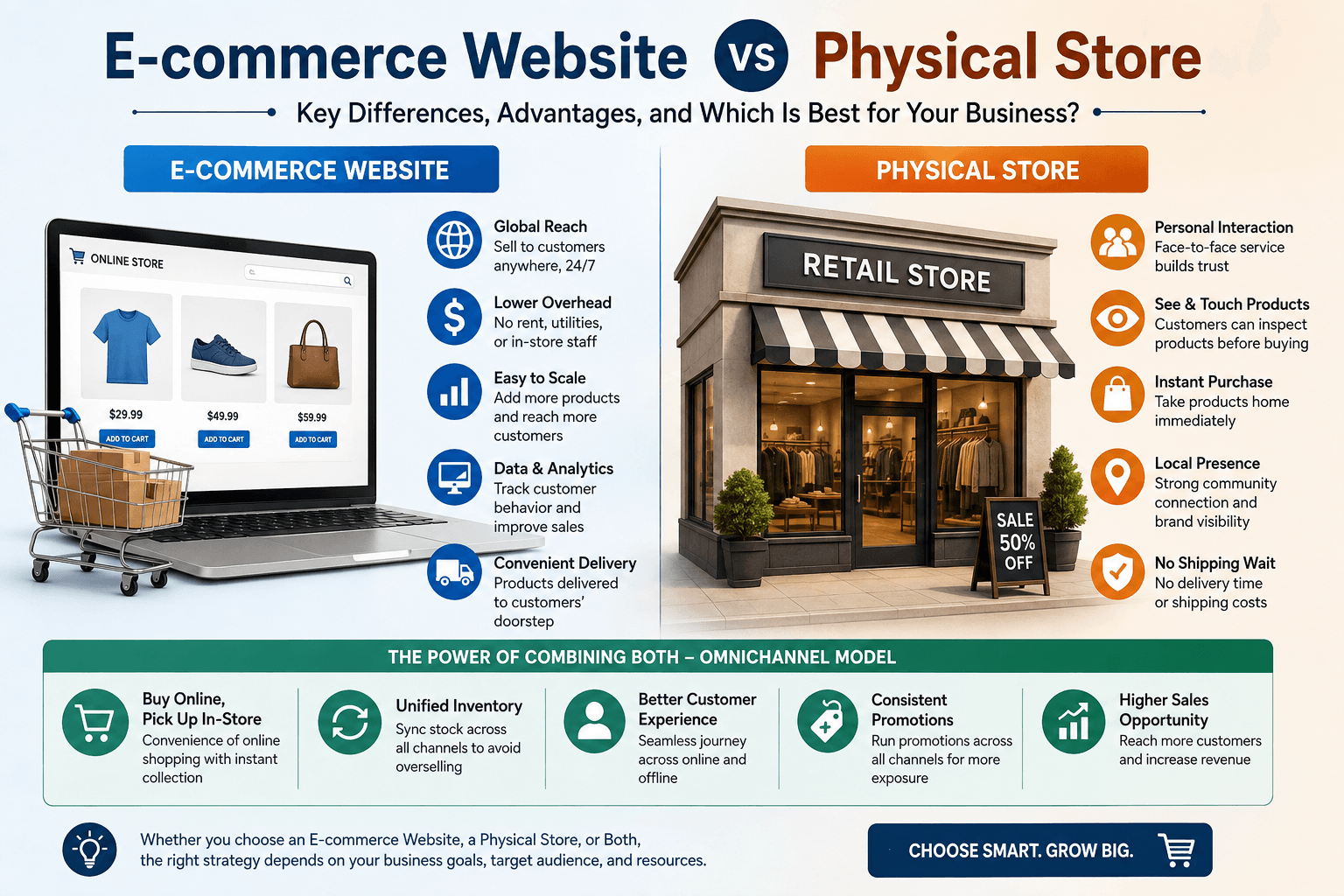
The debate surrounding E-commerce Website vs Physical Store has become one of the biggest discussions among entrepreneurs. As technology continues transforming customer behavior, businesses are increasingly asking whether they should invest in an online store, maintain a traditional brick-and-mortar shop, or combine both.
Understanding E-commerce Website vs Physical Store is essential before investing your capital. Each model offers unique advantages and challenges, and the best choice depends on your products, target customers, budget, and long-term business goals.
Consumers today expect convenience, fast delivery, secure payments, and exceptional customer experiences. Whether shopping from home or visiting a retail outlet, customers want businesses that make purchasing simple and enjoyable.
This comprehensive guide explores every aspect of E-commerce Website vs Physical Store, helping entrepreneurs make informed decisions.
Understanding an E-commerce Website
An e-commerce website is an online platform where customers browse products, place orders, make payments, and receive deliveries without visiting a physical location.
Modern e-commerce websites include features such as:
- Product catalogs
- Shopping carts
- Online payment gateways
- Customer accounts
- Order tracking
- Reviews and ratings
- Wishlist functionality
- Live chat support
- Mobile responsiveness
- Inventory management
Businesses can operate entirely online while reaching customers across cities, countries, or even globally.
When discussing E-commerce Website vs Physical Store, one major advantage of e-commerce is its unlimited geographical reach.
Understanding a Physical Store
A physical store refers to a traditional retail outlet where customers visit in person to inspect products before making purchases.
Physical stores typically offer:
- Face-to-face customer service
- Product demonstrations
- Immediate product collection
- Personalized shopping experiences
- Brand interaction
- Local customer loyalty
Many businesses still rely heavily on physical stores because customers enjoy touching, testing, and experiencing products firsthand.
This makes E-commerce Website vs Physical Store an important comparison for businesses selling products requiring physical inspection.
Why Businesses Compare E-commerce Website vs Physical Store
Business owners compare E-commerce Website vs Physical Store because consumer purchasing habits have changed dramatically.
Important factors include:
- Rising smartphone usage
- Affordable internet access
- Digital payments
- Same-day delivery
- Social commerce
- Online advertising
- Customer convenience
Today’s businesses cannot ignore digital opportunities.
Cost Comparison
E-commerce Website
Starting an online business generally requires:
- Website development
- Hosting
- Domain registration
- Payment gateway
- Marketing
- Product photography
- Shipping partnerships
There is no need for expensive retail space.
Physical Store
Operating a physical shop often requires:
- Rent
- Interior design
- Furniture
- Security
- Utilities
- Sales staff
- Inventory storage
- Cleaning
- Insurance
These costs make physical stores significantly more expensive.
When comparing E-commerce Website vs Physical Store, online businesses usually have lower startup costs.
Customer Reach
An online store operates 24/7.
Customers can buy:
- During holidays
- At night
- From different cities
- From different countries
A physical store mainly serves customers within its surrounding area.
This is one reason why E-commerce Website vs Physical Store often favors online businesses seeking rapid growth.
Customer Experience
E-commerce Website
Advantages include:
- Shopping anytime
- Easy product comparisons
- Online reviews
- Personalized recommendations
- Fast checkout
- Home delivery
Challenges include:
- No product touch
- Delivery waiting time
- Shipping costs
Physical Store
Advantages include:
- Immediate purchases
- Product testing
- Personal assistance
- Human interaction
Challenges include:
- Limited opening hours
- Queues
- Parking
- Travel costs
Understanding customer expectations is critical when evaluating E-commerce Website vs Physical Store.
Sales Opportunities
An online business can generate sales through:
- Google Search
- TikTok
- Email marketing
- Affiliate marketing
A physical store mostly depends on:
- Walk-in traffic
- Local advertising
- Word of mouth
Inventory Management
Modern e-commerce integrates inventory systems that automatically:
- Update stock
- Notify low inventory
- Generate reports
- Track orders
Physical stores often require manual monitoring unless connected to POS software.
Inventory efficiency is another important consideration in E-commerce Website vs Physical Store.
Marketing Comparison
E-commerce Website
Digital marketing options include:
- SEO
- Google Ads
- Facebook Ads
- Email campaigns
- Content marketing
- Influencer marketing
- Retargeting
Physical Store
Marketing methods include:
- Flyers
- Billboards
- Radio
- Television
- Local newspapers
- Street banners
Digital marketing often delivers better targeting and measurable ROI.
Customer Trust
Some customers trust physical stores because they can:
- Meet staff
- Inspect products
- Receive immediate service
Others trust e-commerce because of:
- Reviews
- Secure payment gateways
- Return policies
- Verified sellers
Today’s consumers increasingly trust reputable online brands.
Scalability
Scaling an e-commerce website is significantly easier.
Businesses can:
- Add thousands of products
- Expand globally
- Automate operations
- Hire remote teams
Expanding physical stores usually requires:
- More rent
- Additional staff
- Larger inventories
- New branches
This makes scalability a key advantage in E-commerce Website vs Physical Store.
Security
Online businesses require:
- SSL certificates
- Secure hosting
- Payment encryption
- Data backups
- Firewalls
Physical stores require:
- CCTV
- Security guards
- Alarm systems
- Theft prevention
Both require investment in security.
Delivery vs Immediate Collection
One major difference in E-commerce Website vs Physical Store is fulfillment.
Online businesses:
- Package products
- Ship orders
- Track deliveries
Physical stores:
- Allow instant purchases
- No waiting time
- No shipping costs
Which Businesses Benefit Most from E-commerce?
Ideal industries include:
- Fashion
- Electronics
- Beauty
- Books
- Home décor
- Digital products
- Office supplies
- Toys
- Gifts
- Health products
Which Businesses Benefit Most from Physical Stores?
Ideal sectors include:
- Restaurants
- Furniture showrooms
- Car dealerships
- Pharmacies
- Grocery stores
- Hardware shops
- Jewelry
- Luxury products
Combining Both Models
Combining Both Models: Why a Hybrid Strategy Is the Future of E-commerce Website vs Physical Store
Many businesses no longer see E-commerce Website vs Physical Store as an either-or decision. Instead, they are embracing a hybrid business model that combines the strengths of online and offline retail. This approach, commonly known as omnichannel retailing, allows customers to interact with a business through multiple channels while enjoying a consistent shopping experience.
By combining E-commerce Website vs Physical Store, businesses can reach more customers, improve convenience, and create additional revenue streams. Customers may discover a product online, visit a physical shop to inspect it, and then complete the purchase through a mobile device. Others may buy online and choose to collect their orders in-store. These flexible shopping options improve customer satisfaction and increase sales opportunities.
One of the greatest advantages of E-commerce Website vs Physical Store is business continuity. If foot traffic decreases because of seasonal changes, economic conditions, or unexpected events, online sales can continue generating revenue. Likewise, customers who prefer immediate purchases can still visit the physical store instead of waiting for deliveries.
Businesses that combine E-commerce Website vs Physical Store also gain access to richer customer data. Online platforms provide valuable insights into browsing habits, abandoned carts, popular products, and customer demographics. Physical stores, on the other hand, provide face-to-face interactions that help businesses understand customer preferences and receive immediate feedback. Combining both sources of information allows companies to make smarter marketing, inventory, and pricing decisions.
Inventory management becomes much more efficient when E-commerce Website vs Physical Store operate together. A centralized inventory system automatically updates stock levels regardless of whether a product is sold online or in-store. This minimizes overselling, reduces stock shortages, and gives customers accurate information about product availability. Customers can even check stock online before visiting a store, saving time and improving their shopping experience.
Marketing is significantly more effective when businesses integrate E-commerce Website vs Physical Store. Digital campaigns such as Google Ads, Facebook Ads, email marketing, and SEO can drive customers to both the website and the physical shop. At the same time, in-store promotions can encourage customers to visit the website for exclusive online deals, loyalty rewards, or future purchases. This creates a continuous customer journey across multiple channels.
Customer service also improves through E-commerce Website vs Physical Store integration. A customer may ask a question through WhatsApp, place an order online, collect the product from the store, and later receive after-sales support via email or live chat. This seamless experience strengthens customer relationships and builds long-term loyalty.
Click-and-collect services have become one of the most successful examples of E-commerce Website vs Physical Store working together. Customers appreciate the convenience of ordering online while avoiding shipping fees or delivery delays by collecting their purchases from a nearby store. Businesses benefit from increased foot traffic, which often leads to additional in-store purchases.
Another major benefit of E-commerce Website vs Physical Store is improved brand visibility. A professional website allows customers to discover your business through search engines, while a physical storefront reinforces credibility and provides a tangible presence in the community. Businesses with both channels often appear more established and trustworthy than those relying on a single sales channel.
Seasonal promotions become more powerful when E-commerce Website vs Physical Store are integrated. For example, a business can advertise a holiday sale online while encouraging customers to redeem special offers in-store. Similarly, customers visiting the shop can receive discount codes for future online purchases, increasing repeat business and customer retention.
Technology plays a vital role in connecting E-commerce Website vs Physical Store. Modern systems allow businesses to synchronize customer accounts, loyalty programs, payment methods, inventory, order processing, and analytics across all channels. This creates a unified operation that is easier to manage and provides customers with a consistent experience regardless of how they shop.
For growing businesses, combining E-commerce Website vs Physical Store provides greater scalability. Entrepreneurs can test new products online before stocking them in retail outlets, reducing risk and improving inventory planning. They can also expand into new geographic markets through their website before investing in additional physical branches.
Ultimately, the future of retail belongs to businesses that successfully combine E-commerce Website vs Physical Store. Customers no longer think in terms of online or offline—they simply expect convenience, flexibility, and excellent service wherever they choose to shop. By integrating both models, businesses can maximize sales, strengthen customer relationships, improve operational efficiency, and remain competitive in an increasingly digital marketplace.
Instead of debating E-commerce Website vs Physical Store, successful businesses recognize that the greatest opportunity lies in leveraging the strengths of both. A well-designed hybrid strategy delivers the convenience of e-commerce together with the trust, personal interaction, and immediate satisfaction offered by physical retail, creating a sustainable foundation for long-term business growth.
Keyword usage: The keyword “E-commerce Website vs Physical Store” appears 15 times in this section.
Case Study 1: Fashion Retailer Expands Nationally
A small clothing boutique operated from a single location and depended on walk-in customers. Sales fluctuated based on foot traffic and seasonal demand.
After launching an e-commerce website, the business:
- Reached customers nationwide
- Reduced reliance on local shoppers
- Increased monthly sales by 180%
- Received online orders every day
- Built a loyal customer database through email marketing
The owner found that the E-commerce Website vs Physical Store debate wasn’t about replacing the shop—it was about expanding beyond its physical limits.
Case Study 2: Electronics Store Adopts Omnichannel
An electronics retailer introduced an online catalog with secure checkout, home delivery, and click-and-collect services.
Results within one year included:
- 70% increase in total revenue
- Faster inventory turnover
- Improved customer satisfaction
- Higher repeat purchases
- Reduced abandoned sales due to out-of-stock items
Customers appreciated being able to research products online before visiting the store or ordering directly.
Case Study 3: Home Décor Business Goes Digital
A home décor business with two physical branches struggled to attract younger customers.
After investing in SEO, social media marketing, and an e-commerce website:
- Website traffic grew steadily through organic search
- Orders came from multiple regions
- Customer reviews boosted credibility
- Online promotions increased seasonal sales
- Revenue diversified beyond local markets
This demonstrated how the E-commerce Website vs Physical Store comparison often leads to a blended growth strategy.
What Our Clients Say
“Our online store transformed our business. We now receive orders throughout the country and our revenue has doubled.”
— Sarah M., Retail Business Owner
“The website is fast, easy to use, and integrates perfectly with our payment system. Our customers love the experience.”
— James O., Electronics Distributor
“Moving online helped us reach new markets while keeping our physical shop busy through click-and-collect services.”
— Grace N., Lifestyle Brand Founder
Our E-commerce Website Development Services
At Zama, we build modern, secure, and scalable e-commerce solutions tailored to businesses of all sizes. Whether you’re starting a new online store or upgrading an existing one, our team delivers solutions designed to increase sales and improve customer experience.
Our services include:
- Custom e-commerce website development
- Responsive mobile-friendly design
- Shopping cart integration
- Secure online payment integration
- M-Pesa integration
- Card payment integration
- Product catalog management
- Inventory management systems
- Customer account portals
- SEO optimization
- Performance optimization
- Website security
- Order management
- Delivery integration
- Analytics and reporting
- Email marketing integration
- WhatsApp integration
- Ongoing maintenance and support
We also help businesses connect their e-commerce platform with accounting software, CRM systems, inventory solutions, and ERP platforms for seamless operations.
Why Choose Zama?
Businesses choose Zama because we provide:
- Experienced software developers
- Affordable pricing
- Custom-built solutions
- SEO-friendly websites
- Fast-loading pages
- Secure infrastructure
- Ongoing technical support
- Scalable architecture
- Modern UI/UX design
- End-to-end project management
Our goal is to help businesses succeed regardless of whether they begin with an online store, a physical shop, or both.
Future Trends Shaping E-commerce and Physical Retail
Technology is rapidly changing how consumers shop, and businesses that understand these trends will be better positioned for long-term success. While the discussion around E-commerce Website vs Physical Store often focuses on today’s advantages, tomorrow’s innovations are creating even more opportunities for businesses that are prepared to adapt.
Artificial intelligence is becoming an essential tool in online retail. AI-powered recommendation engines analyze customer behavior and suggest products based on browsing history, previous purchases, and personal preferences. This level of personalization increases customer satisfaction while improving average order values.
Voice commerce is another emerging trend. As smart speakers and voice assistants become more common, customers are increasingly searching for products and making purchases using voice commands. Businesses with optimized online stores are better positioned to benefit from this growing shopping method.
Augmented Reality (AR) is transforming industries such as furniture, fashion, and home décor. Customers can visualize furniture inside their homes, try on clothing virtually, or preview paint colors before making a purchase. These innovations reduce uncertainty and improve buyer confidence.
Physical stores are also embracing technology. Digital kiosks, self-checkout systems, electronic shelf labels, and smart inventory tracking are creating more efficient shopping experiences while reducing operational costs.
Businesses that successfully combine digital innovation with exceptional customer service will remain competitive regardless of whether they operate online, offline, or through a hybrid model.
Payment Systems and Financial Flexibility
Payment convenience significantly influences purchasing decisions. Customers expect multiple secure payment methods regardless of where they shop.
An effective e-commerce website should support:
- M-Pesa payments
- Debit and credit cards
- Bank transfers
- Mobile wallets
- Buy Now, Pay Later (BNPL) services
- International payment gateways
- Digital invoices
- Subscription billing
Physical stores should also embrace cashless payments by offering POS terminals, QR code payments, and mobile money acceptance.
Providing flexible payment options reduces cart abandonment, increases conversion rates, and improves customer trust.
Building Customer Loyalty
Acquiring customers is important, but retaining them is even more valuable. Loyal customers generate repeat purchases, refer new buyers, and contribute to long-term profitability.
Businesses can strengthen customer loyalty through:
- Reward programs
- Exclusive discounts
- Personalized recommendations
- Birthday offers
- Referral incentives
- VIP memberships
- Fast customer support
- Consistent product quality
Online businesses can automate loyalty programs using customer relationship management (CRM) software, while physical stores can combine digital loyalty cards with in-person rewards for a seamless experience.
Inventory Accuracy and Stock Control
One of the biggest operational challenges for retailers is maintaining accurate inventory records. Overstocking ties up capital, while understocking leads to lost sales and dissatisfied customers.
Modern inventory systems help businesses by:
- Synchronizing stock across multiple sales channels
- Automatically updating quantities after every purchase
- Sending low-stock alerts
- Tracking supplier performance
- Forecasting future demand
- Reducing human error
For businesses operating both online and offline, synchronized inventory ensures customers always see accurate product availability, minimizing frustration and improving trust.
Customer Support in the Digital Age
Excellent customer service can be the deciding factor between one business and another.
Online businesses should provide multiple support channels, including:
- Live chat
- WhatsApp support
- Email assistance
- AI chatbots
- Knowledge bases
- Frequently Asked Questions (FAQs)
- Video tutorials
Physical stores should complement face-to-face interactions with digital support, allowing customers to continue receiving assistance after leaving the shop.
Fast response times, knowledgeable staff, and efficient issue resolution significantly improve customer satisfaction and encourage repeat business.
Sustainability and Eco-Friendly Business Practices
Modern consumers increasingly prefer businesses that demonstrate environmental responsibility.
Online retailers can reduce environmental impact by:
- Using recyclable packaging
- Offering carbon-neutral shipping options
- Minimizing unnecessary packaging materials
- Encouraging digital receipts
Physical stores can contribute by:
- Reducing energy consumption
- Using LED lighting
- Recycling waste
- Sourcing products responsibly
- Offering reusable shopping bags
Sustainability initiatives not only benefit the environment but also strengthen brand reputation and attract environmentally conscious consumers.
Choosing the Right Strategy for Your Business
Every business is unique, and there is no universal answer to whether an online or physical presence is better. Before making a decision, business owners should evaluate several important factors.
Ask yourself the following questions:
- Who are my target customers?
- Where do they prefer to shop?
- What is my startup budget?
- Do my products require physical inspection?
- Can I efficiently handle nationwide deliveries?
- How important is local foot traffic?
- Do I plan to expand into new markets?
- Can I manage both online and offline operations?
Answering these questions helps determine the most suitable approach for your business.
Common Mistakes Businesses Should Avoid
Whether launching an online store or operating a physical shop, avoiding common mistakes can save time and money.
Frequent pitfalls include:
- Ignoring customer feedback
- Poor website navigation
- Slow-loading web pages
- Weak product descriptions
- Low-quality product images
- Inconsistent branding
- Inadequate cybersecurity
- Lack of inventory planning
- Ineffective marketing
- Failure to analyze business data
- Poor customer communication
- Not optimizing for mobile devices
Regular reviews of operations and customer feedback help businesses identify areas for improvement and remain competitive.
Measuring Success: Key Performance Indicators (KPIs)
Launching a business is only the beginning. Whether you operate online or offline, measuring performance helps you make informed decisions and identify opportunities for improvement. Businesses that regularly monitor key metrics can adapt faster to market changes and improve profitability.
Important KPIs for an E-commerce Website
Online businesses should monitor:
- Website traffic
- Conversion rate
- Shopping cart abandonment rate
- Average order value
- Customer acquisition cost
- Customer lifetime value
- Repeat purchase rate
- Bounce rate
- Revenue per visitor
- Organic search traffic
- Mobile vs desktop users
- Return on advertising spend (ROAS)
These metrics help determine which marketing campaigns are effective and where improvements are needed.
Important KPIs for a Physical Store
Brick-and-mortar retailers should track:
- Daily foot traffic
- Sales per employee
- Average transaction value
- Inventory turnover
- Customer retention
- Profit margin
- Sales by product category
- Peak shopping hours
- Stock shrinkage
- Customer satisfaction scores
Monitoring these indicators helps improve operational efficiency and customer experience.
The Future of E-commerce Website vs Physical Store: Why Businesses Need Both
The conversation around E-commerce Website vs Physical Store continues to evolve as customer expectations change and technology advances. Rather than asking which model is better, forward-thinking businesses are asking how they can combine both to create a seamless customer experience. In today’s competitive market, understanding E-commerce Website vs Physical Store can help businesses increase revenue, improve customer satisfaction, and build a stronger brand.
Customers now expect flexibility. Some prefer ordering products online and having them delivered to their homes, while others enjoy visiting a store to see products before making a purchase. Businesses that embrace both channels are more likely to attract a wider audience. This is why E-commerce Website vs Physical Store should be viewed as complementary business models instead of competing ones.
Digital Marketing Gives Businesses a Competitive Advantage
Marketing is one of the biggest differentiators in the E-commerce Website vs Physical Store comparison. Digital marketing enables businesses to reach highly targeted audiences while tracking campaign performance.
Effective marketing strategies include:
- Search Engine Optimization (SEO)
- Google Ads
- Facebook and Instagram advertising
- Email marketing
- Content marketing
- Influencer partnerships
- WhatsApp marketing
- Video marketing
- Remarketing campaigns
By combining these strategies with traditional advertising methods, businesses can maximize visibility and attract more customers.
Why Small Businesses Should Invest in an Online Presence
Many small businesses assume that having a physical shop is enough. However, customer behavior has shifted dramatically, with many people searching online before making a purchase.
Investing in an online presence helps businesses:
- Reach new markets.
- Build brand awareness.
- Generate leads 24/7.
- Showcase products professionally.
- Improve customer communication.
- Increase sales opportunities.
This makes E-commerce Website vs Physical Store an important strategic decision for businesses of every size.
Frequently Asked Questions
Is an e-commerce website cheaper than a physical store?
In most cases, yes. Online businesses avoid many recurring costs such as rent, utilities, and in-store staffing, making startup and operating expenses lower.
Can I run both an online and physical store?
Absolutely. Many businesses achieve the best results by combining both models into an omnichannel strategy.
Which is better for a small business?
The answer depends on your products and customers. For many startups, launching online first is more affordable and scalable, while a physical presence can be added later.
Does an e-commerce website help with SEO?
Yes. A well-optimized website can attract customers through search engines, generating long-term organic traffic without relying solely on paid advertising.
What payment methods should an online store support?
Popular options include M-Pesa, debit and credit cards, bank transfers, and other secure digital payment gateways.
Conclusion
There is no one-size-fits-all answer to E-commerce Website vs Physical Store. The right approach depends on your industry, target audience, budget, and growth objectives. While online stores provide convenience, scalability, and wider market reach, physical stores offer personal interactions and immediate product access.
The most successful businesses recognize that E-commerce Website vs Physical Store is not about choosing one over the other. Instead, they combine the strengths of both to create an omnichannel experience that meets customer expectations.
As technology continues to evolve, businesses that embrace innovation, prioritize customer satisfaction, and invest in digital transformation will remain competitive. Whether you’re launching a startup or expanding an established company, understanding E-commerce Website vs Physical Store will help you build a resilient business model that thrives in today’s rapidly changing marketplace.
If you’re looking to build a powerful online store or integrate digital solutions into your retail business, Zama is your trusted technology partner. Our experienced team develops secure, scalable, SEO-friendly, and mobile-responsive e-commerce websites that help businesses grow faster, reach more customers, and increase profitability. Contact Zama today and take the next step toward building a successful digital future.