
Electronic Signature Workflow Kenya: A Practical Guide for Faster Approvals
Electronic signature workflow Kenya solutions help organisations approve contracts, forms, purchase requests and customer documents without printing, scanning or chasing email attachments. For a growing Kenyan business, the real opportunity is not simply placing a digital mark on a PDF. It is building a controlled process that sends the right document to the right person, verifies identity, records every action and stores the completed file where authorised staff can find it.
That distinction matters. A signature image pasted into a document may look convenient, but it does not automatically create a reliable approval record. A well-designed workflow connects preparation, review, signing, reminders, completion and archiving. It also gives managers visibility into delays while protecting confidential information.
This guide explains the features, controls and implementation decisions Kenyan organisations should consider before commissioning or buying a digital signing platform.
What is an electronic signature workflow?
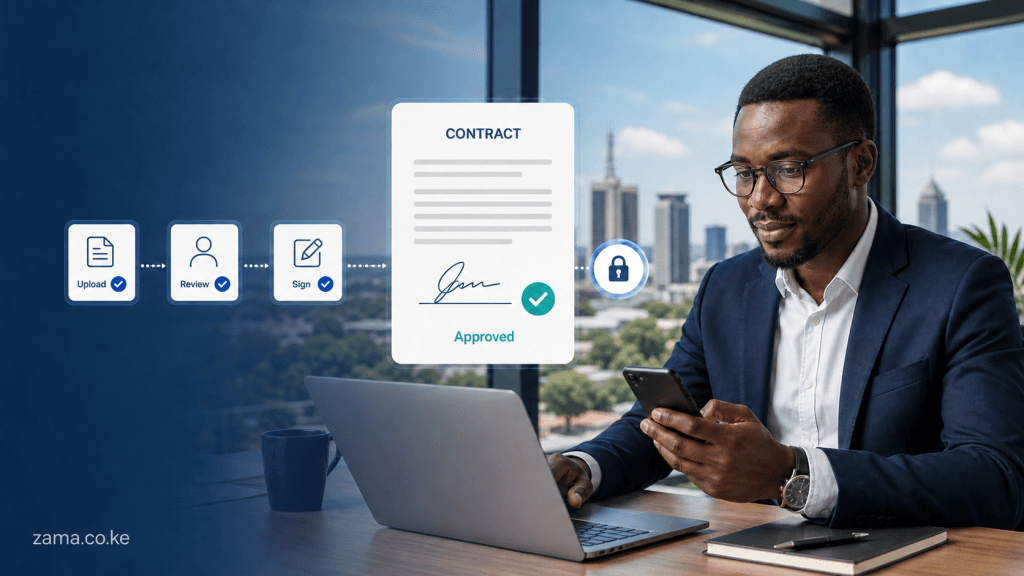
An electronic signature workflow Kenya platform is a web or mobile system that moves a document through a defined signing process. An authorised employee uploads or generates the document, identifies the required signers, chooses the signing order and sends secure invitations. Each participant reviews the document and completes the action assigned to them. The system then creates a final copy together with evidence showing what happened and when.
The workflow may be simple, such as one customer accepting a quotation, or complex, such as a procurement contract that requires review by a department head, finance manager, legal officer and director. The right design should support both without forcing staff to rebuild the process every time.
Common uses include employment contracts, supplier agreements, loan documentation, tenancy forms, school admission forms, board resolutions, service contracts, delivery acknowledgements, policy acceptance and internal approvals.
Why Kenyan businesses are moving beyond paper
Paper-based signing creates delays that become expensive as transaction volume grows. Documents are printed, physically transported, scanned and emailed. Staff may not know which version is current or who has not signed. Completed files can remain in private inboxes, and managers cannot easily measure turnaround time.
A structured electronic signature workflow Kenya process reduces those gaps. Customers can sign from a phone, employees can work across branches and managers can monitor pending actions from one dashboard. The business also gains a consistent record instead of depending on memory or informal follow-up.
Speed is useful, but governance is the larger benefit. The organisation can define who may create documents, who may approve them, when a transaction must be escalated and how long records should be retained.
1. Start with document templates and controlled fields
Reusable templates improve consistency. A template can contain approved wording, company details, standard clauses and clearly positioned fields for names, dates, signatures, initials or comments. Staff then enter transaction-specific details without rewriting the entire document.
Templates should be versioned. When legal wording, pricing terms or regulatory requirements change, an administrator should publish a new version and retire the old one. The system should record which version was used for every completed transaction.
Required fields prevent incomplete submissions. Validation can confirm that a phone number, email address, identification reference or date follows the expected format before the signer continues.
2. Define signing order and approval rules
A reliable electronic signature workflow Kenya implementation separates signing from approval. Some participants review the document, some approve the business decision and others provide the final signature. These actions may happen sequentially or in parallel.
For example, a sales contract might first go to a sales manager for commercial approval, then to the customer and finally to a director. A supplier agreement may require finance and legal review before it is released externally. Conditional routing can send high-value transactions through additional checks while allowing routine cases to move faster.
Clear rules prevent employees from bypassing authority limits. They also make the process easier to audit because the system can explain why a particular person received an approval task.
3. Verify signer identity appropriately
The level of identity verification should match the risk of the transaction. A low-risk acknowledgement may use a unique email link. Higher-risk documents may require a one-time code, account login, identity information or an additional verification step.
The goal is to create proportionate assurance without making every transaction unnecessarily difficult. Businesses should document the reason for the chosen method and apply it consistently. Where personal data is collected, the organisation should provide an appropriate privacy notice and limit access to authorised roles.
Kenyan organisations should also assess their specific legal and regulatory obligations with qualified advisers. General software features do not replace transaction-specific legal review.
4. Protect documents in transit and storage
Security must be designed into the electronic signature workflow Kenya platform. Connections should be encrypted, documents should be stored securely and access should follow the principle of least privilege. Employees should see only the records needed for their work.
Administrative actions deserve special controls. Creating templates, changing retention settings, exporting large volumes of documents and modifying user permissions should be restricted and logged. Multi-factor authentication is valuable for administrators and staff handling sensitive records.
Backups, recovery testing and incident procedures are equally important. A signing system becomes part of the organisation’s operating record, so availability and recoverability should be evaluated before launch.
5. Create a complete audit trail
A strong audit trail records the document identifier, template version, participants, timestamps, actions, delivery events, authentication method and completion status. It should make changes visible rather than silently replacing information.
The final document and its evidence record should remain connected. If staff download only the signed PDF and lose the supporting history, the organisation may struggle to explain the process later. Completed packages should therefore be archived together and protected from unauthorised editing.
An electronic signature workflow Kenya system should also show cancelled, expired and declined requests. Those outcomes are operationally important and should not disappear from reporting.
6. Design for mobile users and low-friction completion
Many customers and field employees will open signing invitations on a mobile phone. The document must be readable, the required fields must be easy to find and the signing process must work without precise desktop-style clicking.
Keep instructions short and place the most important information before the action button. Show progress when a document contains several steps. If a signer leaves midway, preserve safe progress where appropriate and provide a secure way to resume.
Performance also matters. Avoid unnecessarily large files and test the experience on realistic mobile connections. A technically correct process can still fail commercially if customers abandon it because pages load slowly or controls are confusing.
7. Automate reminders, expiry and escalation
Manual follow-up is one of the main costs of paper and email approvals. A practical electronic signature workflow Kenya solution sends reminders according to defined rules. It can notify a signer after a reasonable period, alert the document owner when a request is approaching expiry and escalate an internal approval that exceeds its service target.
Notifications should be useful rather than excessive. Every message should identify the document clearly, explain the required action and use a secure link. Sensitive document details should not be exposed in an email or SMS preview.
Managers need dashboards showing pending requests, average completion time, rejection reasons and bottlenecks by department or document type. That information supports process improvement instead of merely reporting activity.
8. Integrate signing with existing business systems
The greatest value appears when signing is connected to the system where work begins. A CRM can generate a contract from approved customer and quotation data. An HR platform can prepare an employment document after recruitment approval. A procurement system can create a supplier agreement and return the completed record to the supplier profile.
Integration reduces duplicate typing and inconsistent data. It can also trigger the next step automatically: activate a customer account, create an onboarding task, update a contract status or notify the responsible team.
APIs and webhooks should be documented and protected. Failed integrations must create visible exceptions so staff can correct them. No workflow should silently mark a transaction complete when the final document was not stored successfully.
9. Apply privacy and retention controls
An electronic signature workflow Kenya project often handles names, contact information, identification data, contracts and financial details. Organisations should identify the personal data involved, define a lawful business purpose and avoid collecting information that is not needed.
Retention should follow document type and organisational requirements. Keeping everything forever increases exposure and makes records harder to manage. Deletion, legal hold and archive rules should be approved, documented and tested.
Review guidance from Kenya’s Office of the Data Protection Commissioner and obtain professional advice where the transaction is regulated or high risk. Customers should receive clear information about how their data is used and whom to contact with a privacy question.
10. Plan implementation around real workflows
Successful implementation starts with process discovery. List the documents currently signed, the people involved, the approval limits, the common exceptions and the systems that hold related data. Measure the present turnaround time so the business can evaluate improvement after launch.
Begin with one or two high-volume document types. Configure templates and permissions, test normal and unusual scenarios, train users and review the evidence generated by completed transactions. A phased launch makes errors easier to identify before the platform is expanded.
For each electronic signature workflow Kenya use case, assign an owner responsible for template accuracy, access review and operational performance. Software cannot compensate for unclear ownership.
How to choose the right development partner
Ask potential providers to demonstrate the full journey, not just the signature screen. The demonstration should include document creation, identity checks, reminders, refusal, expiry, audit history, download, integration failure and administrative reporting.
Evaluate security practices, hosting options, support response, data export and the ability to adapt the workflow as policies change. Confirm what happens when a user leaves the organisation and how access reviews are performed.
Zama Web Experts develops custom business systems and web platforms in Kenya that connect approval, customer service, payments, documents and management reporting. A tailored electronic signature workflow Kenya solution can be integrated with the processes and systems your team already uses instead of operating as another isolated tool.
Frequently asked questions
Can customers sign from a mobile phone?
Yes. A responsive workflow allows customers and employees to review documents and complete assigned fields from a modern phone browser. Mobile testing should cover readability, loading speed, field placement and secure resumption.
Does every document need the same identity check?
No. Verification should reflect transaction risk, legal requirements and the sensitivity of the information. The organisation should define approved methods for each document category and record the method used.
Can the system connect to CRM, HR or accounting software?
Yes. A custom electronic signature workflow Kenya platform can use APIs and webhooks to generate documents from existing data, update transaction status and store completed files against the correct customer, employee or supplier record.
How long does implementation take?
Timing depends on the number of document types, integrations, approval rules and migration needs. A focused pilot with one workflow is faster and creates evidence for a wider rollout. Complex projects should include discovery, security review, user testing and training.
Final recommendation
The best electronic signature workflow Kenya solution combines convenience with control. It should make signing easy for customers while giving the organisation reliable identity evidence, approval rules, secure storage, audit history and measurable turnaround times.
Start with a clear business process, choose proportionate security and test the entire document lifecycle. If your organisation needs a signing platform connected to CRM, HR, procurement, finance or customer portals, contact Zama Web Experts on 0725 345 345 to discuss a practical implementation.