
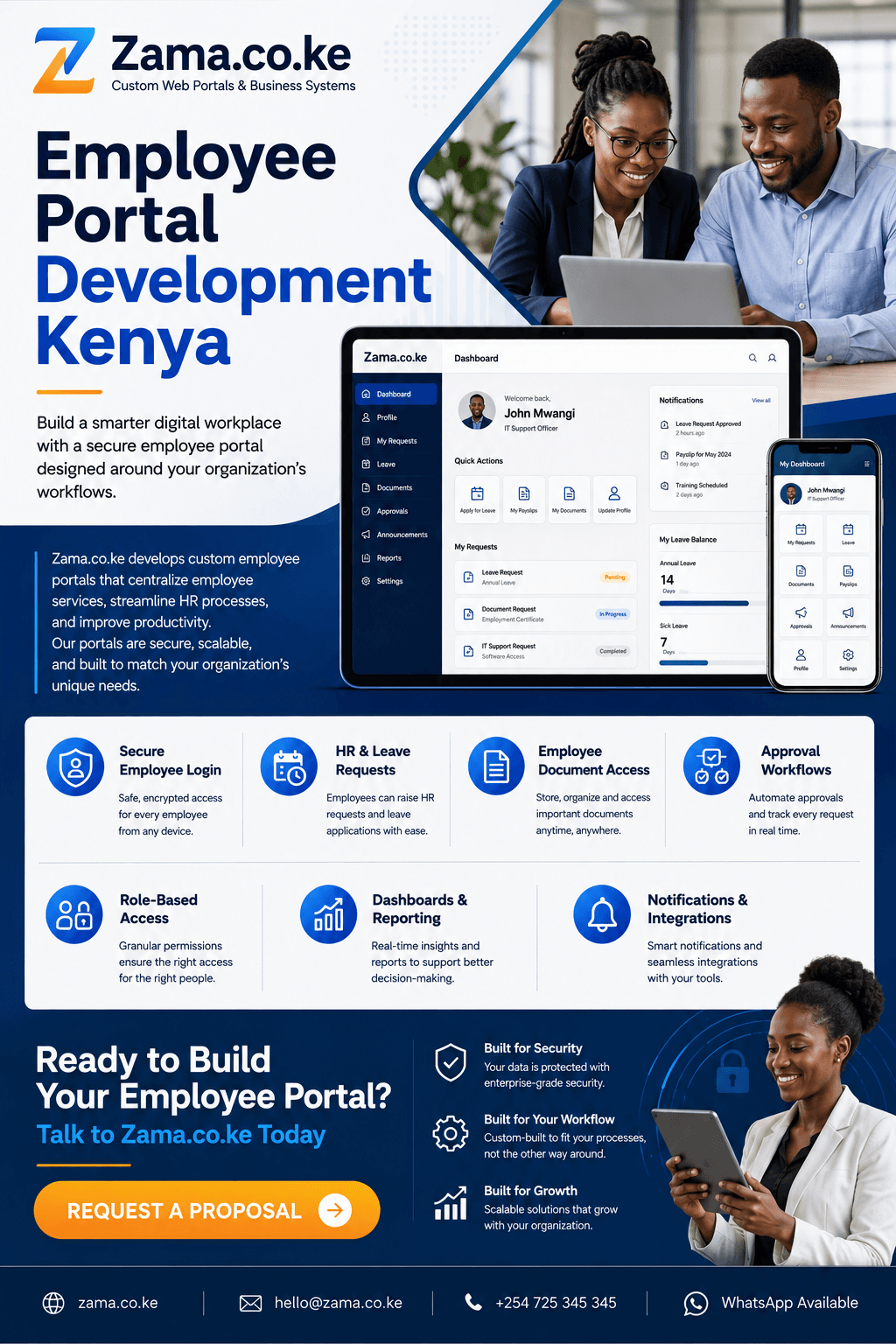
Employee portal development in Kenya is becoming an important part of digital transformation for organizations that want to create more efficient, secure, and connected workplaces. As businesses grow, managing employees, documents, requests, approvals, communication, and internal processes manually can become increasingly difficult. Zama.co.ke provides custom web portal development solutions designed around organizational workflows, user roles, reporting requirements, integrations, and operational needs. With the right employee portal, an organization can create one secure digital environment where employees and authorized administrators can access information and complete important workplace tasks.
An employee portal is more than a website with a login page. It is an interactive business platform that can allow employees to submit requests, access documents, follow approval processes, receive announcements, manage permitted information, and interact with internal workflows. This makes employee portal development in Kenya particularly valuable for organizations that want to reduce repetitive administrative work and create a more structured employee experience.
Zama.co.ke specializes in custom web portals and enterprise-grade digital systems for Kenyan organizations. Its portal development services include employee portals designed around HR requests, document access, collaboration, role-based access, workflows, reporting, integrations, and other business requirements.
For organizations considering employee portal development in Kenya, the most important consideration is not simply whether a portal can be built. The important question is how the portal should work for the organization’s employees, managers, administrators, and leadership teams. Zama.co.ke takes a workflow-focused approach, helping organizations define the business problem, user roles, workflows, integrations, and technical requirements before development begins.
What Is Employee Portal Development in Kenya?
Employee portal development in Kenya is the process of designing, developing, testing, deploying, and supporting a secure online platform that employees can use to access workplace information and complete internal activities.
Unlike a standard informational website, an employee portal allows users to interact with business processes. Employees can log in, submit information, access approved documents, request services, monitor activities, and complete tasks based on their assigned permissions.
A portal can also provide different experiences for different users.
For example, an employee could have access to personal requests and workplace documents. A supervisor could have additional approval responsibilities. An HR administrator could have access to broader employee-related workflows. Senior management could receive dashboards and reports showing important organizational activity.
This is one reason employee portal development in Kenya needs to be approached as a business-system project rather than simply a website project.
Zama.co.ke describes its web portals as secure, user-friendly self-service platforms tailored to their intended audiences. Its employee portal offering specifically includes HR requests, document access, and collaboration tools.
The portal can therefore become a central digital workplace where employees know where to go when they need information or need to initiate an internal process.
Why Employee Portal Development in Kenya Matters
Organizations handle many employee-related processes every day.
Employees may need to request leave, access documents, submit forms, receive internal announcements, make requests, or follow up on approvals. Managers may need to review requests, while administrators may need to monitor workflows and prepare reports.
When these processes are handled manually, information can become distributed across emails, paper forms, spreadsheets, messages, and individual conversations.
Employee portal development in Kenya provides an opportunity to bring many of these activities into one controlled digital environment.
A well-designed employee portal can help an organization:
- Centralize employee services
- Digitize internal requests
- Organize approval workflows
- Provide controlled document access
- Improve internal communication
- Support employee self-service
- Provide management dashboards
- Improve workflow visibility
- Reduce repetitive administration
- Create structured records
- Support different employee roles
- Connect relevant systems and services
Zama.co.ke focuses on building portals that support real organizational workflows rather than relying on generic templates. Its portal approach emphasizes role-based architecture, integrations, reporting, workflows, and long-term support.
For organizations that have outgrown manual coordination, employee portal development in Kenya can therefore provide a practical path toward a more organized digital workplace.
Employee Portal Development in Kenya for Employee Self-Service
Employee self-service is one of the most useful applications of an employee portal.
Employees frequently need access to routine services. If every request has to be handled manually by HR or administration, employees may spend time waiting for responses while administrators spend time processing repetitive tasks.
Employee portal development in Kenya can introduce self-service workflows that allow employees to complete appropriate tasks themselves.
Depending on the organization’s requirements, a portal can provide access to:
- Leave requests
- Internal forms
- Documents
- Announcements
- Approval status
- Employee requests
- Task information
- Notifications
- Internal resources
- Other authorized services
Zama.co.ke identifies employee portals as secure self-service environments and describes HR requests and document access as part of its employee portal capabilities.
The purpose of employee self-service is not to remove the human element from an organization. Instead, it allows employees and administrators to spend less time on repetitive coordination and more time on activities that require human judgment.
Employee Portal Development in Kenya for Leave Management
Leave management is an example of an employee process that can benefit significantly from digitization.
A traditional leave request may involve an employee completing a form, sending it to a supervisor, waiting for approval, and then having an administrator update the appropriate records.
When employee numbers increase, tracking these requests can become challenging.
Employee portal development in Kenya can transform this process into a structured digital workflow.
An employee can submit a leave request through the portal. The request can then be routed to the appropriate person for review. Once an authorized user takes action, the status can be updated so the relevant users have better visibility.
The workflow can be designed around the organization’s own policies.
For example, different departments may have different approval structures. Some requests may require one approval while others may require several levels of authorization.
Zama.co.ke emphasizes workflow-first portal planning, meaning system logic is designed around what users and teams need to accomplish rather than around a generic feature checklist.
This makes employee portal development in Kenya suitable for organizations that want to create more transparent and trackable internal processes.
Employee Portal Development in Kenya for HR Requests
HR departments handle many employee requests.
These may include document requests, internal forms, leave-related processes, employee information updates, and other organization-specific activities.
An employee portal can provide a central place for employees to initiate approved HR workflows.
Employee portal development in Kenya can allow employees to see available services, select the appropriate request, submit the required information, and track the status of the request.
For HR teams, the portal can provide a structured view of incoming requests.
This can make it easier to identify pending activities, prioritize work, review request histories, and maintain better visibility.
Zama.co.ke specifically lists HR requests among the capabilities of its employee portals.
The exact HR functionality should be defined during the discovery phase so the portal reflects the organization’s processes.
Employee Portal Development in Kenya for Document Management
Employees often need access to organizational documents.
These may include policies, procedures, forms, training resources, manuals, notices, guides, and other approved information.
Employee portal development in Kenya can provide a centralized document area where authorized employees can find relevant materials.
Instead of relying on employees to ask administrators for documents repeatedly, the portal can make approved resources accessible through a structured interface.
Document management can include:
- Categories
- Search
- Access permissions
- Document uploads
- File downloads
- Version management
- Department-specific documents
- Administrative controls
Security is particularly important because some documents may only be intended for certain employees or departments.
Zama.co.ke lists document access and document management among the capabilities that can be incorporated into custom portal solutions.
A well-designed employee portal can therefore help organizations make internal information easier to access while maintaining appropriate controls.
Employee Portal Development in Kenya for Internal Communication
Communication is another important area where employee portals can provide value.
Organizations need a reliable way to share internal announcements, updates, policies, notices, and other information.
Employee portal development in Kenya can provide a central location for these communications.
Instead of employees searching through multiple conversations to find an important notice, the organization can publish approved information through the portal.
Depending on the requirements, an employee portal can support:
- Announcements
- Notifications
- Internal news
- Department updates
- Document publishing
- Alerts
- Communication dashboards
Zama.co.ke’s portal services include collaboration-oriented functionality, while its broader portal content describes communication tools, document sharing, task management, and internal staff functionality.
The portal can therefore become an important source of structured internal information.
Employee Portal Development in Kenya and Role-Based Access
Security should be considered from the beginning of employee portal development in Kenya.
Employee portals may contain organizational information that should not be visible to every user.
Role-based access allows the system to determine which users can access particular information and perform specific actions.
Possible user categories could include:
- Employees
- Supervisors
- Managers
- HR administrators
- Department administrators
- System administrators
The exact roles should be determined according to the organization’s structure.
An employee may have permission to submit a request but not approve it. A manager may be able to approve requests for a particular team. An administrator may have access to broader management functionality.
Zama.co.ke describes role-based architecture, permissions, data visibility, approval visibility, and access control as core considerations in its portal development approach.
For this reason, role-based access should be treated as a foundational component of employee portal development in Kenya.
Employee Portal Development in Kenya and Secure Login
Authentication is another fundamental component.
Employees need a secure method of accessing their portal accounts.
Employee portal development in Kenya can incorporate secure authentication processes appropriate to the organization’s needs.
The portal architecture should also consider how users are created, how permissions are assigned, and how access can be managed when employees join, change roles, or leave the organization.
Zama.co.ke states that secure logins, permissions, access control, and data visibility are considered as part of its portal architecture.
Security should not be added only after the portal has been developed. It should influence the architecture from the beginning.
Employee Portal Development in Kenya for Approval Workflows
Approvals are common in organizations.
Employees may need approval for leave, requests, documents, expenses, internal activities, or other processes.
Employee portal development in Kenya can turn these approval processes into defined digital workflows.
A portal can record:
- Who submitted a request
- When it was submitted
- Who needs to review it
- What the current status is
- When an action was taken
- What the next step should be
This provides better visibility than relying entirely on informal follow-ups.
Zama.co.ke’s portal development services emphasize approvals, workflow visibility, role-based permissions, and action history as important components of operational portal systems.
The result can be a more accountable and organized internal process.
Employee Portal Development in Kenya for Dashboards and Reporting
Management needs visibility into organizational activity.
An employee portal can collect workflow information and present relevant data through dashboards and reports.
Depending on the project, management dashboards can show information such as:
- Pending requests
- Completed requests
- Approval activity
- Department activity
- Workflow performance
- Outstanding tasks
- Other organization-specific KPIs
Employee portal development in Kenya can therefore provide more than employee self-service. It can also provide management information.
Zama.co.ke develops operational dashboards and reporting systems that can surface approvals, performance information, alerts, KPIs, and workflow visibility.
The important principle is that dashboards should be designed around the decisions managers need to make.
Employee Portal Development in Kenya and Notifications
Employees need to know when action is required.
For example, an employee may need to know whether a request has been approved, whether additional information is required, or whether an important internal announcement has been published.
Employee portal development in Kenya can incorporate notification functionality into these workflows.
Notifications can potentially be delivered through the portal and, depending on the project’s requirements, through connected email or SMS services.
Zama.co.ke identifies email, SMS, dashboards, and API integrations among the capabilities that can be connected to portal systems.
Notifications should be designed carefully so employees receive relevant information without being overwhelmed.
Employee Portal Development in Kenya and Mobile Access
Modern employees may access digital services using smartphones, tablets, laptops, and desktop computers.
This makes responsive design an important consideration for employee portal development in Kenya.
A portal should provide an interface that adapts appropriately to different screen sizes.
Mobile accessibility can be especially useful for employees who work away from traditional office desks.
Zama.co.ke describes responsive and mobile-friendly portal experiences among its web application and portal development capabilities.
The most important workflows should be tested across the devices employees are expected to use.
Employee Portal Development in Kenya and Integrations
An employee portal may need to communicate with other systems and services.
For example, an organization may need to connect notifications, databases, APIs, reporting tools, or other business services.
Employee portal development in Kenya can include integration planning as part of the overall architecture.
Zama.co.ke states that its portal systems can connect services such as M-Pesa, SMS, email, CRMs, ERPs, and external APIs depending on project requirements.
For an employee portal, integrations should be selected according to actual business requirements.
The goal should be to create a smoother workflow and avoid unnecessary duplication of information.
Employee Portal Development in Kenya and Workflow Automation
Automation is one of the strongest advantages of a digital employee portal.
Organizations perform many repetitive processes every day.
Employee portal development in Kenya can help automate parts of these processes.
Examples include:
- Request submission
- Request routing
- Approval notifications
- Workflow status changes
- Report generation
- Document handling
- Task assignment
- Internal alerts
Zama.co.ke’s development methodology emphasizes defining business workflows before development and building system logic around those workflows.
Automation should always have a clear purpose. The objective is to reduce unnecessary manual work while maintaining appropriate human oversight.
Employee Portal Development in Kenya for Different Departments
Different departments may have different responsibilities.
HR may need employee-related workflows. Managers may need approval dashboards. Administration may need document management. Leadership may need reporting.
Employee portal development in Kenya can support these different requirements through role-based access and modular functionality.
The portal does not have to provide the same interface to every user.
Instead, each user can receive an experience based on their responsibilities.
Zama.co.ke describes internal operations portals as staff-facing systems that can support approvals, task management, reporting, documents, and cross-team coordination in one controlled environment.
This makes custom portal development useful for organizations with complex internal structures.
Employee Portal Development in Kenya for Growing Organizations
An organization’s requirements can change as it grows.
The number of employees can increase. Departments can expand. New workflows can emerge. Reporting requirements can become more sophisticated.
Employee portal development in Kenya should therefore consider scalability from the beginning.
A portal can begin with essential functionality and later expand with additional modules.
Potential future additions could include:
- Additional employee workflows
- New reporting dashboards
- Department-specific modules
- New integrations
- More sophisticated notifications
- Additional administrative controls
- Expanded document management
Zama.co.ke describes scalable architecture and modular portal development as part of its approach to long-term digital systems.
Planning for future growth can reduce the risk of creating a system that becomes difficult to expand.
Employee Portal Development in Kenya for Multi-Branch Organizations
Organizations with multiple locations can face additional coordination challenges.
Employees may belong to different branches, departments, or management structures.
Employee portal development in Kenya can provide centralized digital access while allowing information and workflows to be organized according to branches and departments.
For example, the system could assign employees to particular organizational units and provide managers with relevant permissions.
This approach can give leadership centralized visibility while maintaining appropriate local access.
The architecture should be determined during the discovery phase according to the organization’s actual structure.
Employee Portal Development in Kenya and Data Management
Employee portals can contain significant amounts of organizational data.
This can include user information, requests, approval histories, documents, notifications, workflow records, and reports.
Employee portal development in Kenya should therefore include a clear data architecture.
Important considerations include:
- What information is collected?
- Where is it stored?
- Who can access it?
- Who can update it?
- How is it reported?
- How are permissions controlled?
- How are backups handled?
- How will the system scale?
Zama.co.ke describes structured architecture, data handling, role-based access, and secure portal design as important considerations in its systems.
Good data management helps make the portal reliable and easier to administer.
Employee Portal Development in Kenya and User Experience
An employee portal should be easy to understand.
Employees should be able to identify the information and actions they need without unnecessary complexity.
Employee portal development in Kenya should therefore consider the complete user journey.
Important user experience questions include:
- Can employees find important functions quickly?
- Are forms easy to understand?
- Is the navigation logical?
- Can users see request statuses?
- Are error messages understandable?
- Does the portal work well on mobile devices?
- Can employees access the documents they need?
Zama.co.ke describes user-friendly self-service portals and custom interfaces designed around the intended audience.
A technically advanced portal is only useful when employees can use it comfortably.
Employee Portal Development in Kenya and Performance
Employees expect business applications to respond quickly.
Slow pages, unreliable forms, and complicated workflows can reduce adoption.
Employee portal development in Kenya should therefore consider performance during architecture, development, testing, and deployment.
Zama.co.ke describes performance optimization and scalable infrastructure among its portal development capabilities.
The appropriate technology stack depends on workflow complexity, expected data volume, integrations, performance requirements, and long-term support.
Zama.co.ke identifies technologies including Laravel, React, Vue.js, Node.js, MySQL, PostgreSQL, cloud infrastructure, APIs, and M-Pesa integrations within its broader technology capabilities.
Employee Portal Development in Kenya and Security
Security should be central to the entire project.
An employee portal may contain information that requires controlled access.
Employee portal development in Kenya should therefore consider:
- Authentication
- Authorization
- Role-based permissions
- Data visibility
- Secure data handling
- Audit history
- Backup processes
- Monitoring
- Access management
Zama.co.ke describes security-conscious architecture where permissions, visibility rules, access control, and data handling are treated as core business requirements.
Organizations should also identify their own privacy, governance, and compliance requirements during the discovery stage.
Employee Portal Development in Kenya and Reporting
Reporting can help management understand what is happening within the organization.
Instead of manually collecting information from multiple sources, an employee portal can provide structured reports based on activity within the system.
Reports could cover:
- Employee requests
- Approval status
- Department activity
- Workflow performance
- Pending actions
- Completed activities
- Other organization-specific measurements
Employee portal development in Kenya can therefore contribute to better operational visibility.
Zama.co.ke emphasizes dashboards and operational reporting as part of its portal development services.
Employee Portal Development in Kenya: The Development Process at Zama.co.ke
A successful employee portal requires a structured development process.
Zama.co.ke describes a five-stage delivery approach consisting of discovery, system design, development, testing, and deployment, followed by ongoing support.
1. Discovery
The first step is understanding the organization.
During discovery, important areas can include:
- Business objectives
- Employee groups
- User roles
- Existing workflows
- Approval processes
- Reporting requirements
- Document requirements
- Integration requirements
- Security considerations
- Technical requirements
This stage creates the foundation for employee portal development in Kenya.
2. System Design
The next stage involves translating requirements into a system structure.
This can include:
- Portal architecture
- Database structure
- User interfaces
- User journeys
- Permissions
- Workflow logic
- Reporting requirements
- Integration planning
Zama.co.ke states that system design includes mapping architecture, interfaces, permissions, and rollout plans before development begins.
3. Development
During development, the approved architecture is transformed into a working portal.
This can involve building authentication, dashboards, workflows, forms, document management, reporting, notifications, integrations, and other agreed functionality.
The scope depends on the organization’s requirements.
4. Testing
Testing is critical.
The portal should be tested to ensure workflows work correctly, users receive appropriate permissions, integrations operate properly, and the interface performs across expected devices.
Zama.co.ke describes testing processes that verify workflows, permissions, integrations, responsiveness, and stability before launch.
5. Deployment
After testing and approval, the system can be deployed.
Deployment can include hosting configuration, security optimization, user setup, monitoring, and launch preparation.
6. Ongoing Support
A portal is a long-term digital system.
After launch, organizations may require updates, enhancements, fixes, monitoring, backups, and additional modules.
Zama.co.ke provides ongoing maintenance, troubleshooting, enhancements, and platform support after launch.
Employee Portal Development in Kenya and Scalability
Scalability should be considered before the system is launched.
An organization may begin with a few hundred users and later grow significantly.
It may also introduce new departments, workflows, reports, and integrations.
Employee portal development in Kenya should therefore be planned with both current and future needs in mind.
Zama.co.ke describes growth-ready architecture and scalable portal solutions as part of its broader development approach.
Scalability includes technical capacity as well as the ability to add functionality without rebuilding the entire system.
Employee Portal Development in Kenya: What Features Can Be Included?
The features of an employee portal should be determined by the organization’s needs.
Possible features include:
Secure Employee Login
Provides authenticated access to the portal.
Employee Dashboard
Shows relevant information and actions in one place.
Leave Requests
Allows employees to initiate and track leave workflows.
HR Requests
Provides structured access to approved HR services.
Document Management
Provides controlled access to workplace documents.
Approval Workflows
Routes requests to authorized users.
Notifications
Alerts employees and managers when actions are required.
Reporting
Provides management with relevant information.
User Management
Allows authorized administrators to manage employee accounts and roles.
Audit History
Records important actions within the system.
Mobile Responsiveness
Provides access across appropriate devices.
API Integrations
Allows the portal to communicate with approved external or internal services.
Zama.co.ke lists role-based access, secure login, forms, document uploads, dashboards, reporting, API integrations, notifications, workflow automation, search, file storage, and scalable database structures among the capabilities of its custom portal solutions.
Employee Portal Development in Kenya for Productivity
Productivity is one of the primary reasons organizations invest in digital workflows.
Employees should not have to spend excessive time searching for documents, following up on routine requests, or determining where to submit internal information.
Employee portal development in Kenya can create a consistent digital location for these activities.
Employees can have a clear starting point for routine tasks.
Managers can receive structured approval requests.
Administrators can monitor workflows.
Leadership can receive relevant reports.
The overall result can be a more organized workplace where information and processes are easier to manage.
Employee Portal Development in Kenya for Better Management Visibility
Management visibility is another important benefit.
Without structured reporting, managers may struggle to understand what is happening across departments.
Employee portal development in Kenya can bring workflow activity into dashboards and reports.
For example, management may want to know:
- Which requests are pending?
- Which approvals require action?
- Which departments have outstanding tasks?
- How many requests have been completed?
- Where are workflow delays occurring?
Zama.co.ke develops operational dashboards that can provide reporting, alerts, KPI visibility, approval information, and workflow monitoring.
This can give management a clearer view of internal activity.
Employee Portal Development in Kenya for a Digital Workplace
A digital workplace is not simply a collection of online tools.
It is an environment where employees can access the information and services required to perform their work.
Employee portal development in Kenya can create a central digital workplace for employee-facing activities.
The portal can provide a consistent interface for requests, documents, announcements, approvals, dashboards, and internal services.
This can make the employee experience more structured.
Zama.co.ke’s approach focuses on building software that teams can use every day, with secure logins, reports, integrations, workflows, and business logic designed around real operations.
Employee Portal Development in Kenya and Business Growth
A digital portal can support organizational growth by creating repeatable processes.
As employee numbers increase, manual processes may become increasingly difficult to manage.
Employee portal development in Kenya can help organizations establish standardized digital workflows.
For example, a new employee can receive portal access according to their role, while existing workflows remain structured regardless of employee volume.
The portal can also evolve as the organization introduces new requirements.
This is why scalability should be considered during initial planning rather than after the system has already reached its limits.
How Much Does Employee Portal Development in Kenya Cost?
The cost of employee portal development in Kenya depends on the complexity and scope of the project.
There is no single price that applies to every organization.
Factors that influence cost can include:
- Number of users
- Number of modules
- Workflow complexity
- Number of roles
- Dashboard requirements
- Document management
- Integrations
- Notification requirements
- Security requirements
- Mobile functionality
- Reporting
- Hosting
- Ongoing maintenance
These published starting points illustrate why organizations should define their requirements before determining the final project cost.
For an accurate employee portal development in Kenya proposal, the organization should provide information about its users, workflows, required features, integrations, reporting requirements, and expected growth.
Why Choose Zama.co.ke for Employee Portal Development in Kenya?
Zama.co.ke is a Kenya-based software development agency specializing in custom web portals and enterprise-grade digital systems.
For organizations considering employee portal development in Kenya, Zama.co.ke’s approach focuses on practical business requirements.
Custom Portal Development
Zama.co.ke develops portals around specific organizational requirements rather than treating every project as identical.
Workflow-First Planning
The portal logic is designed around the processes employees and teams need to complete every day.
Role-Based Access
The portal can be structured around user roles, permissions, approvals, and data visibility.
Reporting and Dashboards
Management can receive dashboards and operational reports based on portal activity.
Integration Capability
Relevant services and APIs can be connected into the portal according to project requirements.
Scalable Architecture
The system can be planned with future users, workflows, data, and modules in mind.
Ongoing Support
Zama.co.ke remains available for maintenance, enhancements, troubleshooting, and continued platform improvement.
Questions to Answer Before Starting Employee Portal Development in Kenya
Before starting a project, an organization should clearly understand what it expects the portal to accomplish.
What problem should the portal solve?
Identify the biggest operational challenges.
Who will use the portal?
Define employees, managers, administrators, and other users.
What should each user be able to do?
Create clear permission requirements.
Which workflows should be automated?
Identify repetitive processes that can benefit from structured digital workflows.
Which documents should employees access?
Determine the document categories and permission requirements.
Which reports does management need?
Identify the information leadership needs for decision-making.
Which integrations are required?
Determine whether email, SMS, APIs, databases, payment services, or other systems need to connect.
How should the portal evolve?
Consider future users, departments, workflows, and modules.
Answering these questions makes employee portal development in Kenya more focused and can help create a clearer project scope.
Common Benefits of Employee Portal Development in Kenya
A properly planned employee portal can provide several organizational benefits.
Centralized Information
Employees can access approved workplace information from one digital environment.
Better Workflow Visibility
Requests and approvals can be tracked through defined processes.
Employee Self-Service
Employees can complete appropriate tasks without relying on administrators for every step.
Better Reporting
Managers can access dashboards and reports based on portal activity.
Improved Organization
Documents, requests, approvals, and notifications can be structured in one system.
Reduced Administrative Repetition
Automated workflows can reduce repetitive manual coordination.
Improved Accessibility
Responsive design can allow employees to access appropriate portal functions from different devices.
Better Control
Role-based permissions can help ensure users only access functions and information appropriate to their roles.
These benefits explain why employee portal development in Kenya can be valuable for organizations seeking to modernize their internal operations.
Employee Portal Development in Kenya for Kenyan Organizations
A portal should reflect the organization using it.
Kenyan businesses and organizations may have specific operational requirements involving communication, payments, reporting, departments, branches, and employee workflows.
Zama.co.ke develops systems for Kenyan organizations and describes its solutions as being built around local operational requirements.
This local understanding can be useful when planning employee portal development in Kenya.
The project should take into account the organization’s employees, workflows, connectivity requirements, devices, reporting structure, and operational environment.
The Future of Employee Portal Development in Kenya
Employee portals are likely to become increasingly important as organizations continue to digitize internal processes.
Future employee portal development in Kenya may place greater emphasis on automation, analytics, mobile accessibility, integrations, personalization, and intelligent workflow management.
However, the most important principle will remain the same: the system should solve real organizational problems.
A portal should make it easier for employees to complete tasks, managers to approve activities, administrators to manage workflows, and leadership to understand organizational performance.
Zama.co.ke’s focus on scalable architecture, integrations, reporting, secure access, and long-term support provides a foundation for organizations that want their portal to evolve as their needs change.
Getting Started with Employee Portal Development in Kenya
The first step is to identify what your organization wants the portal to achieve.
You do not need to have every technical detail figured out before beginning.
Instead, start by identifying the processes that create the most administrative work.
Ask:
- Which employee requests are currently manual?
- Which approvals are difficult to track?
- Which documents do employees frequently request?
- Which internal processes require repeated follow-up?
- Which reports does management need?
- Which notifications should be automated?
- Which employees need access?
- What permissions should each user have?
- Which systems or services need integration?
These answers can provide the foundation for employee portal development in Kenya.
Zama.co.ke’s discovery process is designed to define the business problem, user roles, workflows, integrations, and technical requirements before development begins.
Build Your Employee Portal with Zama.co.ke
Employee portal development in Kenya provides organizations with an opportunity to create a more organized, secure, accessible, and efficient digital workplace.
A well-designed employee portal can bring employee self-service, HR requests, document access, approval workflows, internal communication, notifications, reporting, dashboards, and role-based access into one structured environment.
The most effective portal is not necessarily the one with the largest number of features. It is the one that solves the organization’s actual problems.
This is why employee portal development in Kenya should begin with understanding workflows, users, permissions, reporting requirements, integrations, security needs, and future growth.
Zama.co.ke provides custom web portal development services for organizations that need secure and scalable digital systems. Its employee portal capabilities can support HR requests, document access, collaboration, workflows, reporting, role-based access, dashboards, and integrations according to project requirements.
With a workflow-first approach, Zama.co.ke can help organizations transform manual employee processes into structured digital experiences.
If your organization is ready to improve employee self-service, simplify internal workflows, centralize information, and strengthen management visibility, employee portal development in Kenya can be an important step toward a smarter digital workplace.
Zama.co.ke can help you define the requirements, design the portal, develop the required functionality, test the workflows, deploy the system, and support its continued improvement.
Ready to build a smarter employee experience? Start your employee portal development in Kenya project with Zama.co.ke.