
Table of Contents
ToggleEmployee Self Service Portal Kenya: The Complete Guide for Modern Businesses
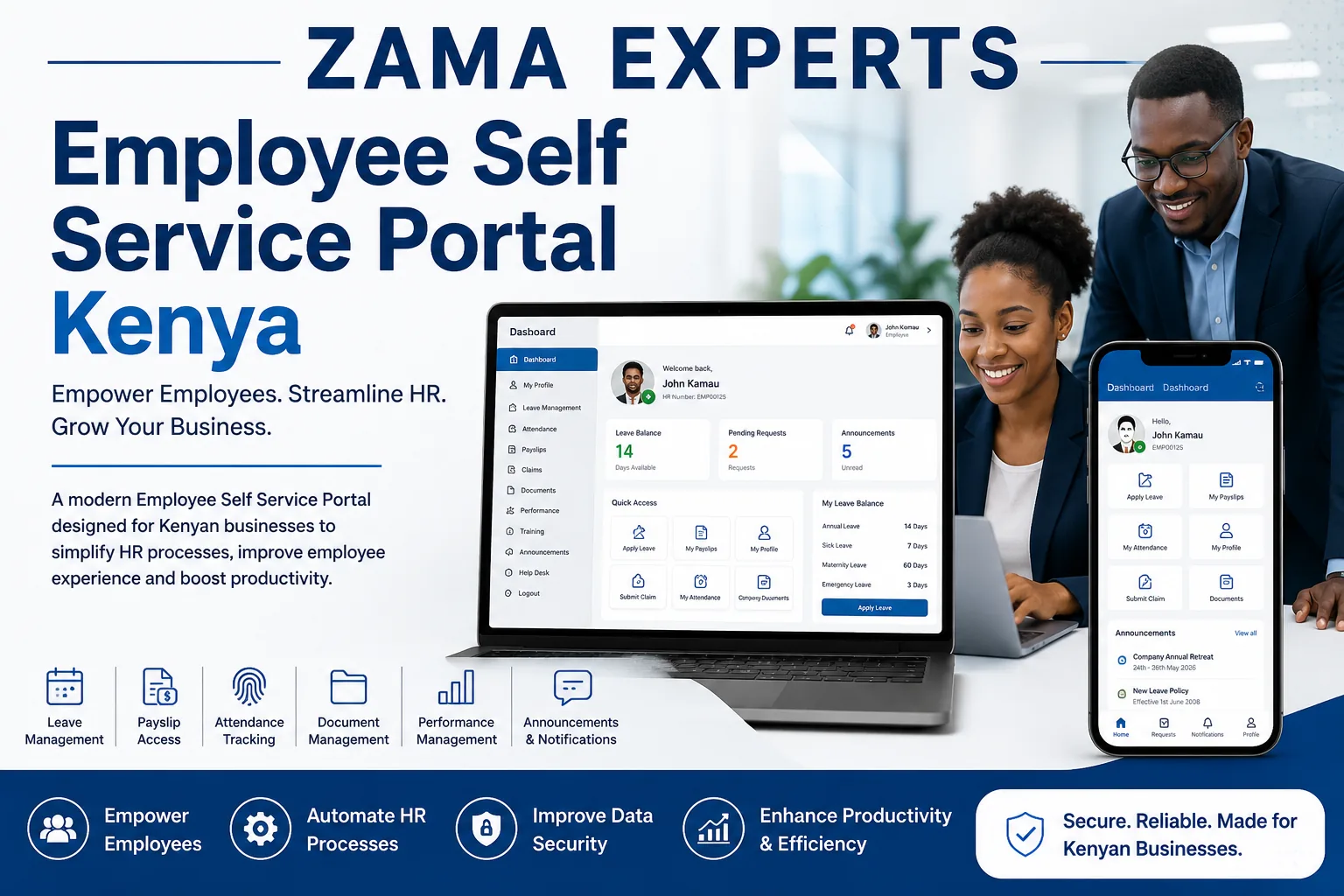
In today’s digital workplace, employees expect quick access to information, self-service tools, and seamless communication with their employers. Traditional HR processes that rely on paperwork, emails, and manual approvals are no longer sufficient for businesses seeking efficiency and employee satisfaction.
This is where an Employee Self Service Portal Kenya becomes a game changer.
An Employee Self Service Portal Kenya empowers employees to manage their personal information, apply for leave, access payslips, submit claims, view company announcements, update personal records, and communicate with HR—all through a secure online portal or mobile application.
Across Kenya, organizations are investing in digital HR solutions to reduce administrative costs, improve compliance, and enhance workforce productivity. Whether you’re managing 20 employees or 5,000, implementing an Employee Self Service Portal Kenya can transform the way your organization operates.
In this comprehensive guide, you’ll learn everything about Employee Self Service Portal Kenya, including its features, benefits, implementation strategies, industry applications, and why it has become an essential investment for modern businesses.
What is an Employee Self Service Portal?
An Employee Self Service Portal Kenya is a secure online platform that enables employees to perform HR-related tasks independently without requiring constant assistance from the HR department.
Employees can:
- Apply for leave
- View payslips
- Update personal details
- Download employment letters
- Access company policies
- Submit reimbursement requests
- Track leave balances
- View attendance records
- Access training materials
- Receive company announcements
Instead of HR manually processing every request, employees complete most routine activities themselves, saving time for everyone involved.
The portal is accessible via:
- Desktop computers
- Smartphones
- Tablets
- Company intranet
- Secure cloud platforms
Modern organizations prefer cloud-based systems because they enable employees to access HR services anytime and anywhere.
Why Kenyan Businesses Need an Employee Self Service Portal Kenya
The workplace has changed dramatically over the past decade. Hybrid work, remote teams, and digital transformation have made manual HR processes increasingly inefficient.
An Employee Self Service Portal Kenya helps organizations overcome these challenges by automating repetitive tasks and improving access to information.
Businesses in Kenya often struggle with:
- Manual leave approvals
- Lost employee files
- Payroll inquiries
- Delayed HR responses
- Paper-based forms
- Attendance disputes
- Inaccurate employee records
- Slow onboarding
- Poor communication
These issues reduce productivity and create unnecessary administrative work.
By implementing an Employee Self Service Portal Kenya, organizations can digitize HR operations and improve service delivery.
The Rise of Digital HR in Kenya
Kenyan businesses are rapidly embracing digital transformation.
Organizations are replacing spreadsheets and paper files with cloud-based HR software that offers:
- Automation
- Employee empowerment
- Faster decision-making
- Better compliance
- Improved reporting
- Enhanced security
From SMEs to multinational corporations, digital HR has become a strategic investment rather than just an operational improvement.
Government institutions, hospitals, schools, manufacturing companies, NGOs, financial institutions, and retail businesses are increasingly deploying employee self-service platforms to improve efficiency.
How an Employee Self Service Portal Kenya Works
The system connects employees, HR managers, supervisors, payroll officers, and executives within one secure environment.
Here’s a typical workflow:
Employee Login
Employees securely log in using:
- Username
- Password
- Single Sign-On
- Two-Factor Authentication
Dashboard
Once logged in, employees can instantly view:
- Leave balance
- Upcoming holidays
- Payroll notifications
- Company announcements
- Attendance summary
- Pending approvals
- Performance goals
Everything is centralized within a user-friendly dashboard.
Employee Requests
Employees can submit requests for:
- Leave
- Overtime
- Travel
- Expense reimbursement
- Salary advance
- Training
- Equipment
- HR letters
Manager Approval
Managers receive automatic notifications.
They can:
- Approve
- Reject
- Request clarification
All approvals are recorded for auditing purposes.
HR Processing
HR receives approved requests automatically.
No paperwork.
No email chains.
No duplicate data entry.
Automatic Notifications
Employees receive:
- Email notifications
- SMS alerts
- Mobile push notifications
This improves communication while reducing HR follow-up.
Key Features of an Employee Self Service Portal Kenya
A modern Employee Self Service Portal Kenya should include comprehensive HR automation features designed to simplify workforce management.
Employee Profile Management
Employees can:
- Update contacts
- Change addresses
- Upload documents
- Update emergency contacts
- Modify banking information
- Manage next-of-kin details
This keeps employee records accurate without HR intervention.
Leave Management
Employees can:
- Apply for leave
- Check balances
- Cancel leave
- View leave history
- Upload supporting documents
Managers approve requests digitally.
The system automatically updates balances.
Payroll Access
Instead of contacting HR every month, employees simply log in to:
- Download payslips
- View salary history
- Access tax documents
- Review deductions
- Check allowances
Payroll inquiries reduce significantly.
Attendance Management
Employees can monitor:
- Clock-in times
- Clock-out times
- Overtime
- Absences
- Shift schedules
Managers gain real-time visibility into workforce attendance.
Expense Claims
Employees submit:
- Travel expenses
- Fuel reimbursements
- Accommodation claims
- Medical claims
- Business expenses
Receipts can be uploaded digitally.
Approvals happen electronically.
Document Management
Important HR documents remain available anytime.
Examples include:
- Employment contracts
- Promotion letters
- Warning letters
- HR policies
- Staff handbook
- Insurance forms
- Performance reviews
Employees no longer request copies from HR.
Company Announcements
Management can communicate with all employees instantly.
Examples include:
- Holiday notices
- Training schedules
- Policy updates
- Company events
- Internal vacancies
- Emergency alerts
Communication becomes centralized and transparent.
Performance Management
Employees can:
- View KPIs
- Track goals
- Receive evaluations
- Complete self-assessments
- Request coaching
Managers gain better visibility into employee performance.
Training Portal
Organizations can upload:
- Learning materials
- Training videos
- SOPs
- Company manuals
- Compliance courses
Employees complete training online.
Certificates are stored automatically.
Help Desk Integration
Employees can raise HR tickets for:
- Payroll issues
- IT support
- Benefits questions
- Leave concerns
- General inquiries
Requests are tracked until resolved.
Benefits of Employee Self Service Portal Kenya for Employers
An Employee Self Service Portal Kenya delivers measurable advantages for employers by streamlining HR operations and reducing administrative burdens.
Reduced Administrative Work
HR teams spend less time handling repetitive tasks like updating employee records, printing payslips, or processing leave forms. Employees manage many of these activities independently, allowing HR professionals to focus on strategic initiatives such as talent development and workforce planning.
Improved Data Accuracy
Since employees update their own personal information, the likelihood of errors caused by manual data entry is significantly reduced. Accurate employee records improve payroll processing, statutory compliance, and communication.
Faster Decision-Making
Real-time dashboards and automated workflows provide managers with instant access to attendance reports, leave requests, workforce analytics, and performance data. This enables quicker, data-driven decisions.
Enhanced Compliance
Digital records create a secure audit trail for approvals, policy acknowledgments, and employee transactions. This helps organizations meet Kenyan labor regulations and simplifies compliance reporting.
Lower Operational Costs
Reducing paperwork, manual processes, and repetitive HR tasks leads to cost savings in printing, storage, and administrative labor. Organizations can reallocate resources toward growth and innovation.
Benefits of Employee Self Service Portal Kenya for Employees
Employees also gain significant advantages from using an Employee Self Service Portal Kenya.
Convenience
Employees can access HR services anytime, whether they are in the office, working remotely, or traveling. Routine tasks no longer require visits to the HR department.
Greater Transparency
Access to leave balances, attendance records, payslips, and request statuses fosters trust and reduces uncertainty. Employees always know where they stand.
Faster Service
Automated workflows accelerate approvals for leave, expense claims, and other requests, improving employee satisfaction and reducing waiting times.
Empowerment
By managing their own information and accessing important documents independently, employees feel more engaged and in control of their work experience.
Improved Communication
Company announcements, policy updates, and important notices are delivered directly through the portal, ensuring everyone stays informed.
Industries Benefiting from Employee Self Service Portal Kenya
An Employee Self Service Portal Kenya is valuable across a wide range of industries, including:
- Manufacturing: Manage shift workers, attendance, overtime, and safety documentation.
- Healthcare: Coordinate medical staff schedules, leave, and compliance training.
- Education: Enable teachers and administrative staff to access HR services efficiently.
- Financial Services: Securely manage employee records and payroll while maintaining regulatory compliance.
- Retail: Simplify workforce management across multiple branches and locations.
- Hospitality: Streamline scheduling, leave requests, and communication for large teams.
- Logistics and Transport: Support field employees with mobile access to HR services.
- Government and NGOs: Improve transparency, documentation, and administrative efficiency.
Advanced Features of an Employee Self Service Portal Kenya
As organizations grow, HR processes become increasingly complex. A modern Employee Self Service Portal Kenya goes beyond basic leave applications and payslip downloads by offering intelligent automation, real-time reporting, and seamless integrations.
These advanced capabilities help businesses improve efficiency, reduce administrative overhead, and enhance employee satisfaction.
Workflow Automation
One of the biggest advantages of an Employee Self Service Portal Kenya is workflow automation.
Instead of manually routing requests through emails or paper forms, the system automatically directs each request to the appropriate manager or department based on predefined rules.
Examples include:
- Leave approvals
- Travel requests
- Salary advance requests
- Expense reimbursements
- Promotion approvals
- Training requests
- Asset allocation
- Exit clearance
Benefits include:
- Faster approvals
- Reduced paperwork
- Increased accountability
- Complete audit trails
- Consistent policy enforcement
Real-Time HR Dashboards
Managers require accurate information to make informed decisions.
An Employee Self Service Portal provides interactive dashboards displaying:
- Employee attendance
- Leave trends
- Department headcount
- Overtime reports
- Staff turnover
- Recruitment progress
- Performance indicators
- Payroll summaries
Executives can quickly identify workforce trends and make strategic decisions without waiting for manual reports.
Mobile Accessibility

Today’s workforce expects access from anywhere.
A cloud-based Employee Self Service Portal Kenya allows employees to use smartphones and tablets to:
- Apply for leave
- Download payslips
- Check attendance
- Update personal information
- Submit claims
- Receive company announcements
- Complete performance reviews
This is especially beneficial for:
- Sales teams
- Field officers
- Drivers
- Healthcare workers
- Construction staff
- Remote employees
Integration with Other Business Systems
An Employee Self Service Portal becomes even more powerful when integrated with existing enterprise systems.
Payroll Integration
Payroll integration eliminates duplicate data entry.
Employee information automatically synchronizes with payroll software, including:
- Leave deductions
- Overtime
- Allowances
- Salary adjustments
- Tax calculations
- Statutory deductions
Benefits include:
- Faster payroll processing
- Fewer payroll errors
- Improved compliance
- Accurate salary calculations
HRMS Integration
Organizations using Human Resource Management Systems can connect them with the Employee Self Service Portal.
This allows seamless sharing of:
- Employee records
- Contracts
- Job positions
- Performance reviews
- Promotions
- Transfers
- Training history
Everything remains centralized.
Biometric Attendance Integration
Biometric integration automatically captures attendance data from:
- Fingerprint scanners
- Facial recognition devices
- RFID cards
- Mobile GPS check-ins
Attendance records instantly appear in the employee portal.
Managers can monitor:
- Late arrivals
- Early departures
- Overtime
- Shift compliance
- Absenteeism
Employees can also review their attendance history and report discrepancies.
ERP Integration
Businesses using Enterprise Resource Planning (ERP) software benefit from seamless data sharing.
The portal can integrate with modules such as:
- Finance
- Procurement
- Inventory
- Asset Management
- Project Management
- CRM
This ensures employee-related information flows securely across the organization.
Case Study 1: Manufacturing Company in Nairobi
A manufacturing company with over 600 employees relied on paper leave forms and manual attendance registers.
Challenges
- Long leave approval cycles
- Payroll discrepancies
- High administrative workload
- Missing employee records
- Delayed communication
Solution
The company implemented an Employee Self Service Portal Kenya integrated with payroll and biometric attendance.
Results After Six Months
- Leave approvals reduced from four days to less than one day.
- Payroll-related employee inquiries dropped by over 60%.
- HR administrative workload reduced significantly.
- Attendance accuracy improved.
- Employee satisfaction scores increased due to faster HR service delivery.
Case Study 2: Multi-Branch Retail Business
A retail chain operating multiple branches across Kenya struggled to manage staff spread across different locations.
Challenges
- Inconsistent attendance tracking
- Manual shift scheduling
- Slow dissemination of company announcements
- Difficulty accessing employee records
Solution
The retailer deployed a cloud-based Employee Self Service Portal Kenya with mobile access for all employees.
Results
- Managers gained real-time visibility into attendance across branches.
- Employees accessed payslips and leave balances without contacting HR.
- Internal communication became faster and more consistent.
- HR processing times for routine requests were dramatically reduced.
Customer Testimonials
Human Resources Manager – Logistics Company
“The Employee Self Service Portal has transformed the way our HR department operates. Employees now manage routine requests independently, and our team has more time to focus on strategic initiatives.”
Finance Director – Private Hospital
“Payroll inquiries reduced significantly after implementation. Staff appreciate having instant access to payslips, leave balances, and personal records.”
Operations Manager – Construction Firm
“The integration with biometric attendance has improved accountability and eliminated many attendance disputes. Reporting is now much more accurate.”
Why Businesses Choose an Employee Self Service Portal Kenya
Organizations invest in an Employee Self Service Portal Kenya because it delivers measurable business value.
Key advantages include:
- Reduced HR administration
- Faster approvals
- Better employee experience
- Improved compliance
- Enhanced data accuracy
- Centralized document management
- Mobile accessibility
- Real-time reporting
- Secure employee records
- Scalability for growing businesses
Zama Employee Self Service Portal Implementation Services
At Zama, we build secure, scalable, and fully customizable Employee Self Service Portal solutions tailored to the unique needs of Kenyan businesses.
Our services include:
Requirements Analysis
We assess your HR processes, organizational structure, and operational goals to design a solution that aligns with your business.
Custom Portal Development
We develop a branded portal with features such as:
- Employee profiles
- Leave management
- Payslip access
- Attendance tracking
- Expense claims
- Performance management
- Internal communication
- Document management
System Integration
Our team integrates your portal with:
- Payroll systems
- HRMS platforms
- ERP software
- Biometric devices
- Microsoft 365
- Google Workspace
- Email and SMS gateways
Data Migration
We securely migrate existing employee records into the new system while maintaining data integrity.
User Training
We provide comprehensive training for HR teams, managers, and employees to ensure smooth adoption.
Ongoing Support and Maintenance
Our support services include:
- Software updates
- Performance monitoring
- Security enhancements
- Technical assistance
- Feature upgrades
A dedicated support team ensures your Employee Self Service Portal continues to operate reliably as your organization grows.
Frequently Asked Questions (FAQs)
1. What is an Employee Self Service Portal Kenya?
An Employee Self Service Portal Kenya is a secure web-based or mobile platform that allows employees to manage HR-related tasks such as applying for leave, downloading payslips, updating personal information, submitting expense claims, accessing company documents, and viewing attendance records without relying on the HR department.
2. Which businesses can benefit from an Employee Self Service Portal Kenya?
Organizations of all sizes can benefit, including:
- SMEs
- Manufacturing companies
- Hospitals
- Schools and universities
- Banks
- SACCOs
- NGOs
- Government institutions
- Hotels
- Retail chains
- Construction companies
- Logistics firms
3. Is the system cloud-based?
Yes.
Most modern Employee Self Service Portal Kenya solutions are cloud-based, allowing employees to securely access the platform anytime using:
- Computers
- Smartphones
- Tablets
Cloud deployment also minimizes IT infrastructure costs and simplifies maintenance.
4. Can employees access payslips online?
Absolutely.
Employees can securely:
- Download monthly payslips
- View payroll history
- Access tax documents
- Review salary deductions
- Check allowances and bonuses
This reduces repetitive payroll inquiries and improves transparency.
5. Can the portal integrate with payroll software?
Yes.
A professionally developed Employee Self Service Portal Kenya can integrate with:
- Payroll systems
- HRMS software
- ERP platforms
- Accounting software
- Biometric attendance systems
- Microsoft 365
- Google Workspace
- Email and SMS gateways
6. Is employee information secure?
Yes.
Security features typically include:
- Role-based access control
- Encrypted databases
- SSL-secured communication
- Two-factor authentication
- Automatic backups
- Audit logs
- Password policies
These measures protect sensitive employee data and support compliance with Kenya’s Data Protection Act.
7. Can managers approve requests remotely?
Yes.
Managers can approve or reject:
- Leave requests
- Expense claims
- Overtime
- Travel requests
- Performance reviews
- Training requests
from anywhere using a web browser or mobile device.
8. How long does implementation take?
Implementation timelines vary depending on organizational size and required integrations.
Typical durations are:
- Small organizations: 2–4 weeks
- Medium-sized businesses: 4–8 weeks
- Large enterprises: 8–16 weeks
Future Trends in Employee Self Service Portal Kenya
The future of HR technology is intelligent, mobile, and data-driven. Organizations investing in an Employee Self Service Portal Kenya today position themselves to benefit from emerging innovations.
Artificial Intelligence (AI)
AI will increasingly automate routine HR tasks such as:
- Answering employee questions through virtual assistants
- Guiding onboarding processes
- Predicting workforce trends
- Recommending training programs
- Automating repetitive approvals
Predictive HR Analytics
Organizations will use advanced analytics to forecast:
- Employee turnover
- Staffing requirements
- Leave patterns
- Training needs
- Performance trends
This enables proactive workforce planning rather than reactive management.
Mobile-First Employee Experience
With a growing mobile workforce, future portals will prioritize mobile functionality, allowing employees to complete nearly every HR task directly from their smartphones.
Paperless HR Departments
Digital document management will continue replacing physical files, reducing costs while improving accessibility and security.
Personalized Employee Dashboards
Future portals will present personalized information based on each employee’s role, department, goals, approvals, and training needs, creating a more engaging user experience.
Why Choose Zama?
When selecting an HR technology partner, experience, customization, and long-term support matter.
At Zama, we develop robust Employee Self Service Portal solutions that help Kenyan organizations modernize HR operations and improve employee engagement.
Our solutions are designed to be:
- Secure and scalable
- User-friendly
- Mobile responsive
- Fully customizable
- Cloud-ready
- Easy to integrate with existing systems
What Sets Zama Apart?
- Experienced software development professionals
- Tailor-made HR solutions
- Integration with payroll, ERP, HRMS, and biometric systems
- Secure cloud deployment
- Comprehensive staff training
- Ongoing technical support
- Competitive pricing
- Fast implementation
- Continuous product improvements
Whether you’re a startup, SME, NGO, or large enterprise, Zama delivers technology that grows with your organization.
Why Invest in an Employee Self Service Portal Kenya Today?
Organizations that delay digital transformation often face:
- Higher administrative costs
- Slower HR service delivery
- Employee frustration
- Data inaccuracies
- Compliance risks
- Limited workforce visibility
By adopting an Employee Self Service Portal Kenya, businesses can streamline operations, empower employees, and build a more agile organization prepared for future growth.
Call to Action
Your employees deserve a modern HR experience, and your HR team deserves tools that eliminate repetitive manual work.
At Zama, we specialize in designing and implementing customized Employee Self Service Portal Kenya solutions that simplify HR processes, improve communication, enhance compliance, and increase organizational productivity.
Whether you need a new employee portal, integration with existing payroll and HR systems, or a complete digital HR transformation, our experts are ready to help.
Contact Zama Experts Today
📞 Phone: 0725 345 345
Our consultants will:
- Understand your HR requirements
- Demonstrate the system
- Recommend the best solution
- Customize the platform for your organization
- Provide implementation, training, and ongoing support
Transform your workplace with a reliable Employee Self Service Portal Kenya and give your employees secure, convenient, and self-service access to the HR tools they need every day.
Conclusion
The modern workplace demands speed, transparency, and convenience. An Employee Self Service Portal Kenya empowers organizations to automate routine HR tasks, improve employee engagement, strengthen compliance, and make smarter business decisions through real-time data.
From leave management and payroll access to attendance tracking, performance management, and secure document sharing, an Employee Self Service Portal Kenya centralizes essential HR services into one intuitive platform. Businesses across Kenya are embracing these solutions to reduce administrative costs, improve operational efficiency, and create a better employee experience.
As organizations continue their digital transformation journeys, investing in an Employee Self Service Portal Kenya is no longer optional—it’s a strategic necessity. Companies that implement an Employee Self Service Portal Kenya gain a competitive advantage through increased productivity, improved workforce satisfaction, and streamlined HR operations.
Whether you’re a growing SME, a healthcare provider, a school, a manufacturing company, or a large enterprise, the right Employee Self Service Portal Kenya can transform how your workforce interacts with HR. With expert implementation, seamless integrations, and ongoing support from Zama, your organization can confidently adopt an Employee Self Service Portal Kenya that meets today’s needs while scaling for tomorrow’s growth.
Take the next step toward a smarter workplace by partnering with Zama. Contact 0725 345 345 today to discover how an Employee Self Service Portal Kenya can help your business achieve greater efficiency, stronger employee engagement, and long-term success.