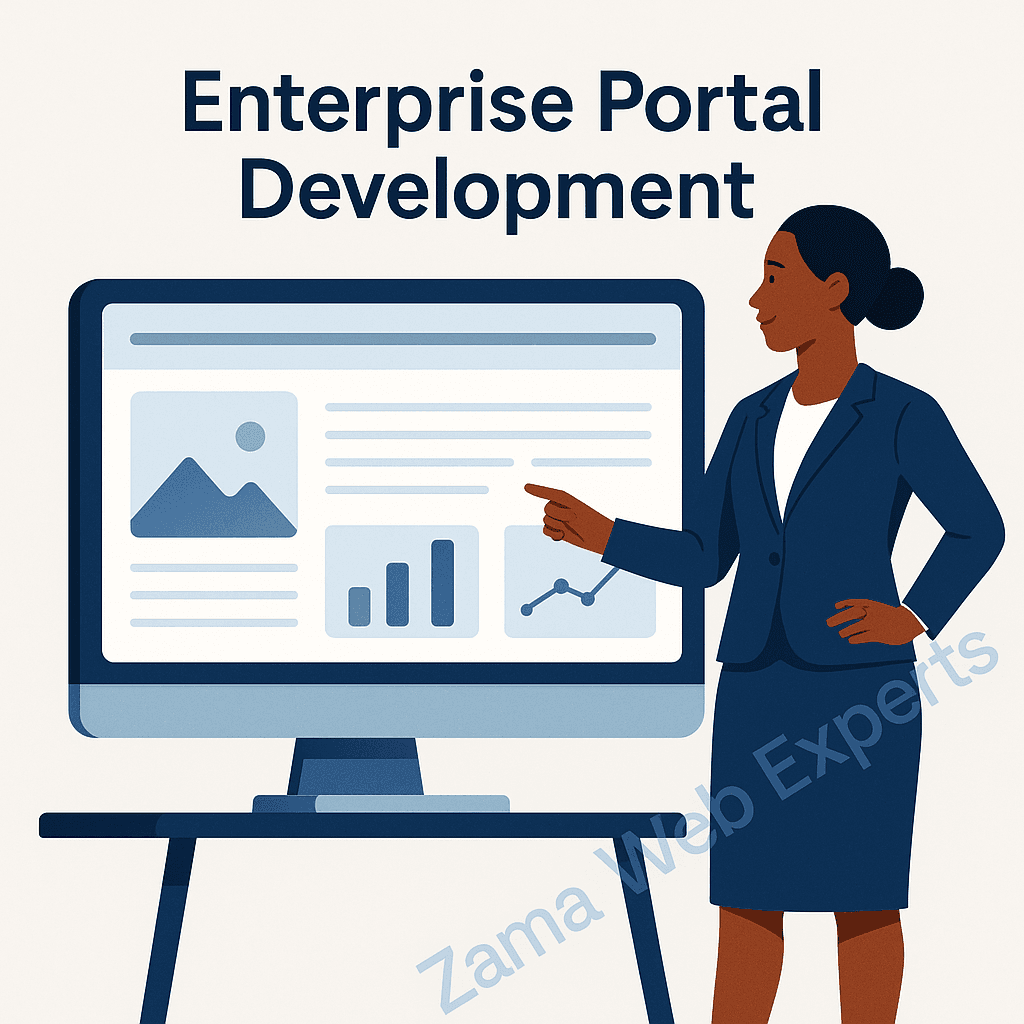
In an era of rapid digital change, enterprise portal development empowers large organizations to centralize data, streamline processes, and foster collaboration across departments. A well-built portal becomes the single source of truth—housing documents, applications, and analytics in one secure, user-friendly interface.
Why Invest in Enterprise Portal Development?
Centralized Information Hub
Aggregate disparate systems (ERP, CRM, HRM) into a unified dashboard.
Reduce data silos and duplicate entry with real-time integrations.
Empower employees with instant access to the tools and reports they need.
Enhanced Security & Compliance
Role-based access controls ensure users see only what they’re permitted.
Audit trails and encryption protocols protect sensitive corporate data.
Ensure compliance with industry standards (ISO, GDPR, HIPAA).
Improved Collaboration & Productivity
Built-in messaging, document sharing, and task-management modules.
Social features—news feeds, polls, and forums—encourage cross-team engagement.
Mobile-responsive design keeps remote and field staff connected.
Scalability & Flexibility
Modular architecture lets you add features—e-learning, e-procurement, analytics—as you grow.
Headless APIs support bespoke front-ends and third-party extensions.
Cloud or on-premises deployment adapts to your performance and compliance needs.
Key Features of Our Enterprise Portals : Enterprise Portal Development
Single Sign-On (SSO): Seamless authentication across all corporate applications.
Custom Dashboards: Role-specific widgets and KPI visualizations.
Workflow Automation: Automate approvals, notifications, and document routing.
Content Management: Version control, scheduling, and rich-media support.
Advanced Search & Reporting: Full-text search, saved queries, and exportable reports.
API Integrations: Connect to SAP, Salesforce, Microsoft 365, and more.
Our Development Process : Enterprise Portal Development
Discovery & Requirements Gathering
Stakeholder interviews to map business needs and user journeys.
Technical audit of existing systems and data sources.
Architecture & Design
Define portal topology: modules, data models, and integration layers.
UX wireframes and prototypes ensure intuitive navigation.
Agile Development & Integration
Iterative sprints deliver core features quickly for early feedback.
Robust API integration layers unify third-party applications.
Testing & Quality Assurance
Security penetration testing and performance load testing.
User acceptance testing (UAT) with real-world scenarios.
Deployment & Training
Zero-downtime rollout with data migration and DNS cutover.
Admin and end-user training, plus comprehensive documentation.
Ongoing Support & Optimization
24/7 monitoring, patch management, and feature enhancements.
Quarterly reviews to align the portal roadmap with business goals.
FAQ: Enterprise Portal Development
Q: How long does an enterprise portal project take?
A: Typically 4–6 months from discovery to launch, depending on scope and integrations.
Q: Can you integrate with our existing ERP/CRM?
A: Yes—we’ve connected with SAP, Oracle, Microsoft Dynamics, Salesforce, and more via secure APIs.
Q: What’s the cost of an enterprise portal?
A: Budgets usually start at USD 25,000 (KES 3 million+) for core portal functionality and scale with complexity.
Q: Do you offer mobile app versions?
A: Absolutely. We provide responsive web portals and can build native/hybrid mobile front-ends.
Case Study: Streamlining Operations with Acme Corp Portal : Enterprise Portal Development
Client: Acme Corp (Manufacturing)
Challenge: Disparate systems for inventory, HR, and sales resulted in data silos and slow decision-making.
Solution: We built a custom enterprise portal integrating SAP ERP, Salesforce CRM, and an in-house inventory API. Role-based dashboards provided real-time KPIs for production, sales, and HR.
Results:
40% faster report generation
25% reduction in manual data entry errors
15% increase in cross-department collaboration metrics
Measuring Portal ROI : Enterprise Portal Development
Time Savings: Track reduction in time spent toggling between applications.
Error Reduction: Monitor drop in manual entry mistakes and support tickets.
User Adoption: Measure active logins and feature usage rates post-launch.
Process Efficiency: Compare throughput of critical workflows (e.g., purchase orders) before and after implementation.
Revenue Impact: Correlate faster decision cycles with sales uplift or cost savings.
Why Choose Zama for Your Enterprise Portal : Enterprise Portal Development
Deep Domain Expertise: We’ve delivered portals for manufacturing, finance, healthcare, and more.
Trusted Architecture: ISO-standard security, scalable microservices, and cloud-agnostic deployments.
End-to-End Service: From discovery and design through training and long-term support.
Agile & Transparent: Regular demos, clear roadmaps, and prioritized backlogs ensure you stay in control.
Next Steps : Enterprise Portal Development
Free Discovery Workshop: We’ll map your current systems, pain points, and target KPIs.
Solution Blueprint: Receive a detailed portal architecture, feature list, and project timeline.
Kickoff & Sprint Planning: Begin agile development with prioritized sprints and milestone deliverables.
Ready to transform your business with a scalable, secure enterprise portal?
Contact Zama.co.ke now to schedule your free workshop and accelerate your digital transformation.