
ERP Software Development Kakamega: The Complete Guide for Businesses Looking to Automate and Grow
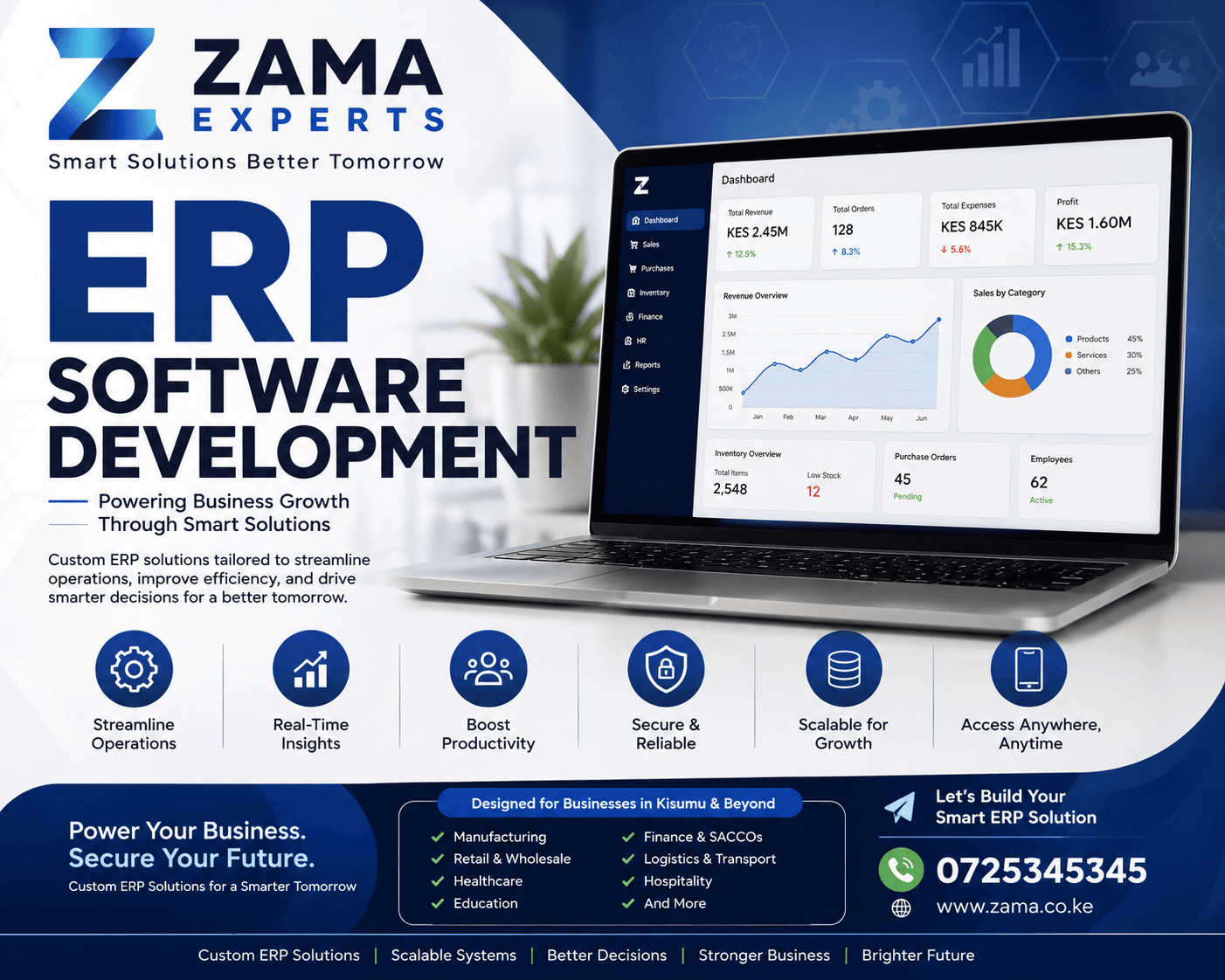
ERP Software Development Kakamega
Businesses in Kakamega are becoming increasingly digital. Whether you operate a wholesale shop, manufacturing company, supermarket, school, SACCO, pharmacy, hospital, construction company, or distribution business, relying on manual records and disconnected software is becoming costly.
This is where ERP Software Development Kakamega becomes essential.
Enterprise Resource Planning (ERP) software integrates every department of your business into one centralized system. Instead of managing accounting in one application, inventory in another, payroll manually, and customer records in spreadsheets, ERP combines everything into one powerful platform.
Organizations that invest in ERP Software Development Kakamega enjoy improved productivity, reduced operational costs, better reporting, accurate inventory management, and enhanced customer service.
As Kakamega continues to grow as one of Kenya’s commercial hubs in Western Kenya, businesses require technology that can support expansion without increasing administrative complexity.
What is ERP Software?
Enterprise Resource Planning (ERP) software is a centralized business management system that integrates all major operations into one platform.
Instead of departments working independently, ERP allows information to flow seamlessly across your organization.
Typical ERP modules include:
- Finance
- Accounting
- Inventory
- Sales
- Purchasing
- Human Resources
- Payroll
- CRM
- Manufacturing
- Project Management
- Procurement
- Asset Management
Through ERP Software Development Kakamega, businesses gain complete visibility into daily operations from one dashboard.
Why Businesses Need ERP Software Development Kakamega
Many businesses experience similar operational challenges.
These include:
- Duplicate data entry
- Lost documents
- Delayed reporting
- Stock shortages
- Poor inventory tracking
- Payroll errors
- Manual invoicing
- Slow customer service
- Weak communication between departments
Custom ERP Software Development Kakamega eliminates these issues by automating repetitive tasks while ensuring every department accesses accurate, real-time information.
Signs Your Business Needs ERP Software
Your company may require ERP Software Development Kakamega if you experience any of the following:
- Employees spend hours entering data.
- Reports take days to prepare.
- Inventory discrepancies occur regularly.
- Financial reports are inaccurate.
- Customers complain about delays.
- Departments use separate software.
- Payroll processing consumes excessive time.
- Procurement lacks transparency.
- Management lacks real-time insights.
These are indicators that your business has outgrown manual processes.
Benefits of ERP Software Development Kakamega
1. Centralized Business Management
ERP stores all company information in one secure database.
This means:
- Sales teams access customer information.
- Finance views revenue instantly.
- Inventory updates automatically.
- HR manages employee records efficiently.
No more duplicated information.
2. Better Decision Making
One of the biggest advantages of ERP Software Development Kakamega is access to real-time reports.
Management can instantly monitor:
- Revenue
- Expenses
- Stock levels
- Sales performance
- Customer payments
- Employee productivity
These insights support informed decision-making.
3. Increased Productivity
Employees spend less time performing repetitive manual tasks.
Automation enables:
- Faster invoicing
- Automated purchase orders
- Payroll processing
- Stock updates
- Financial reporting
Staff can focus on strategic activities rather than paperwork.
4. Improved Inventory Management
Inventory challenges are common among wholesalers and retailers.
ERP helps businesses:
- Track stock movement
- Monitor reorder levels
- Reduce stock losses
- Eliminate overstocking
- Generate barcode reports
- Manage warehouses
With ERP Software Development Kakamega, inventory becomes easier to control.
5. Financial Accuracy
ERP integrates accounting with all business transactions.
Benefits include:
- Automated bookkeeping
- Profit and loss reports
- Cash flow monitoring
- Tax reporting
- Budget management
- Expense tracking
This reduces accounting errors significantly.
Industries That Benefit from ERP Software Development Kakamega
Nearly every industry can benefit from ERP software.
These include:
Manufacturing
Manufacturers use ERP for:
- Production planning
- Raw material tracking
- Machine scheduling
- Cost management
- Quality assurance
Wholesale Businesses
Wholesalers manage:
- Bulk inventory
- Supplier orders
- Customer pricing
- Delivery schedules
- Purchase management
ERP automates these processes.
Retail Stores
Retailers use ERP to manage:
- POS integration
- Inventory
- Customer loyalty
- Sales analytics
- Supplier management
Schools
Educational institutions benefit through:
- Student management
- Fee collection
- Payroll
- Procurement
- Staff management
Hospitals
Healthcare organizations automate:
- Patient records
- Pharmacy inventory
- Billing
- Staff scheduling
- Procurement
Construction Companies
Construction firms manage:
- Projects
- Materials
- Equipment
- Contractors
- Payroll
- Budgets
SACCOs
SACCOs use ERP for:
- Member management
- Loans
- Savings
- Accounting
- Reporting
NGOs
NGOs automate:
- Finance
- Grants
- Procurement
- HR
- Asset tracking
Essential ERP Modules
Finance Module
Handles:
- Accounting
- Expenses
- Banking
- Budgets
- Tax
- Financial reports
Inventory Module
Tracks:
- Stock
- Warehouses
- Transfers
- Purchases
- Suppliers
Sales Module
Supports:
- Quotations
- Orders
- Invoices
- Customer management
- Payments
Procurement Module
Automates:
- Purchase requests
- Supplier management
- Approvals
- Deliveries
Human Resource Module
Includes:
- Employee records
- Leave
- Attendance
- Payroll
- Performance
Customer Relationship Management (CRM)
Helps businesses manage:
- Leads
- Sales pipeline
- Customer communication
- Follow-ups
- Marketing campaigns
Why Choose Custom ERP Software Development Kakamega?
Off-the-shelf ERP solutions often contain unnecessary features while missing functionality specific to Kenyan businesses.
Custom ERP provides:
- M-Pesa integration
- KRA compliance
- Customized workflows
- Local reporting
- Role-based permissions
- Scalable architecture
- Industry-specific modules
Businesses receive software designed around their operations instead of adapting their processes to generic software.
Future of ERP Software in Kakamega
Businesses embracing digital transformation are becoming more competitive.
Future ERP trends include:
- Artificial Intelligence
- Business Intelligence dashboards
- Cloud ERP
- Mobile ERP applications
- Predictive analytics
- Workflow automation
- IoT integration
- Advanced cybersecurity
- API integrations
Organizations investing in ERP Software Development Kakamega today position themselves for long-term growth and operational excellence.
Key Features of ERP Software Development Kakamega
A professionally developed ERP system includes a wide range of features designed to simplify business operations while improving productivity.
1. Centralized Dashboard
A centralized dashboard gives business owners and managers an overview of all critical operations in real time.
The dashboard can display:
- Daily sales
- Monthly revenue
- Outstanding invoices
- Inventory levels
- Purchase orders
- Employee attendance
- Customer statistics
- Financial performance
- Pending approvals
- Business growth trends
With ERP Software Development Kakamega, managers no longer need to gather reports from different departments manually. Everything is available in one place.
2. Role-Based User Access
Not every employee should access every part of the system.
Custom ERP software allows administrators to define permissions for:
- Directors
- Accountants
- Sales representatives
- Cashiers
- Procurement officers
- HR managers
- Warehouse staff
- Supervisors
- Branch managers
- System administrators
This improves data security while reducing unauthorized access.
3. Multi-Branch Management
Many businesses in Kakamega operate multiple branches.
An ERP system allows management to monitor all branches from a single dashboard.
Features include:
- Branch-specific inventory
- Individual sales reports
- Centralized accounting
- Employee allocation
- Consolidated financial reports
- Branch comparisons
This makes ERP Software Development Kakamega ideal for businesses planning to expand across Western Kenya and beyond.
4. Inventory Automation
Inventory management is one of the biggest challenges facing businesses.
ERP automates inventory by providing:
- Real-time stock tracking
- Barcode support
- Warehouse transfers
- Batch management
- Product categorization
- Supplier tracking
- Automatic reorder alerts
- Stock valuation
- Stock movement history
Businesses avoid losses caused by inaccurate inventory records.
5. Automated Financial Management
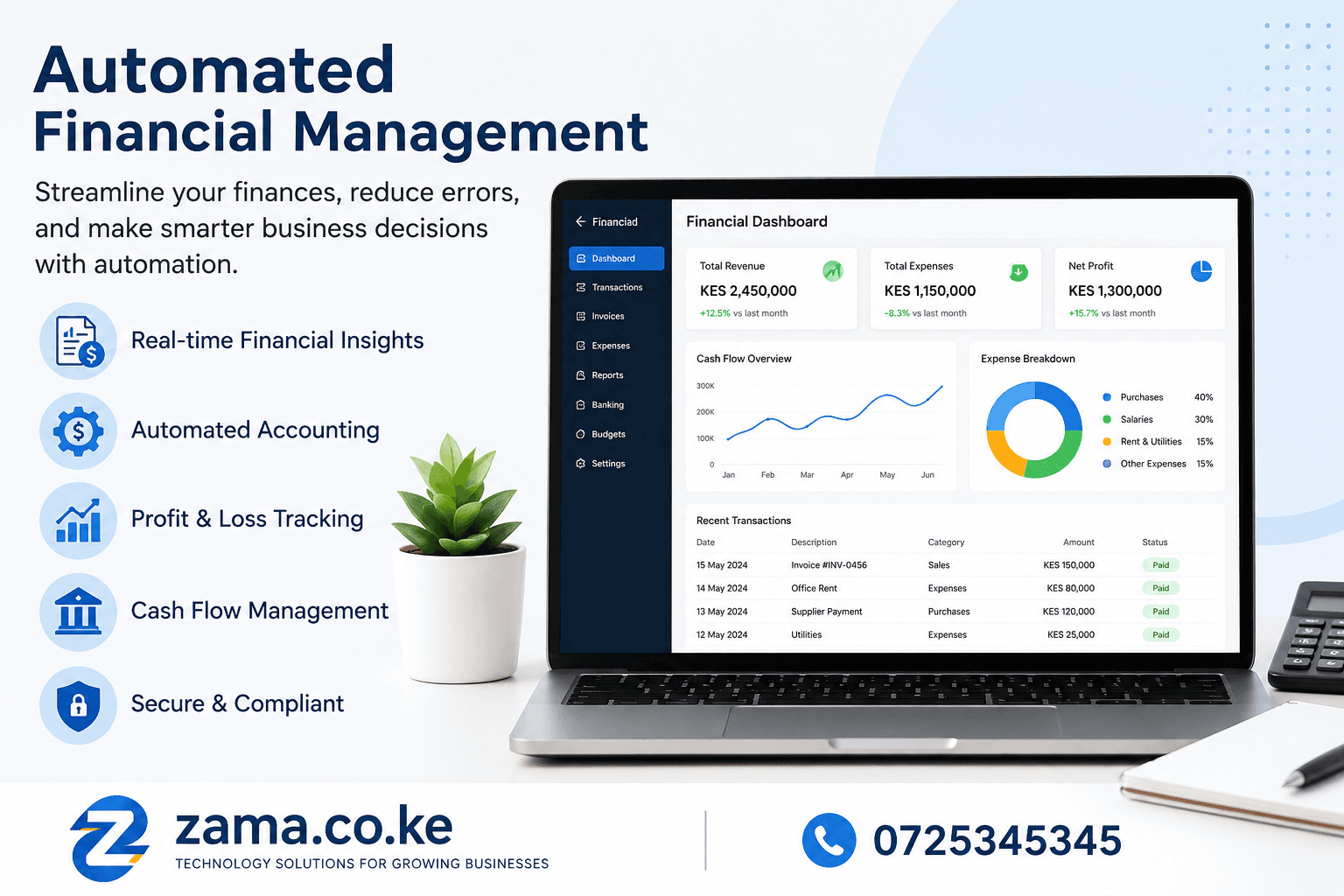
Accounting becomes significantly easier through automation.
ERP can automatically generate:
- Income statements
- Balance sheets
- Cash flow reports
- Trial balances
- VAT reports
- Expense summaries
- Customer statements
- Supplier statements
- Profitability reports
With ERP Software Development Kakamega, financial data is always accurate and available when needed.
6. Customer Relationship Management (CRM)
Customer satisfaction is critical for business growth.
An integrated CRM enables businesses to:
- Store customer profiles
- Track communication history
- Record inquiries
- Manage sales opportunities
- Schedule follow-ups
- Send automated reminders
- Track customer purchases
This improves customer retention while increasing sales opportunities.
7. Procurement Management
Managing purchases manually often leads to delays and unnecessary spending.
ERP automates procurement through:
- Purchase requisitions
- Approval workflows
- Purchase orders
- Supplier quotations
- Goods received notes
- Supplier evaluation
- Invoice matching
Businesses achieve better transparency and accountability.
8. Payroll Automation
Payroll processing can be time-consuming.
ERP automates:
- Salary calculations
- PAYE deductions
- NSSF contributions
- NHIF deductions
- Leave balances
- Overtime calculations
- Employee benefits
- Payslip generation
This minimizes payroll errors while saving valuable time.
9. Document Management
ERP provides secure digital storage for business documents.
Examples include:
- Contracts
- Employee files
- Purchase orders
- Invoices
- Receipts
- Delivery notes
- Financial reports
- Compliance documents
Documents can be searched and retrieved instantly.
10. Business Intelligence Reporting
Modern ERP systems include advanced analytics.
Businesses can generate reports showing:
- Sales trends
- Customer behavior
- Inventory performance
- Employee productivity
- Department performance
- Financial growth
- Procurement efficiency
- Profit margins
These reports enable better strategic planning.
ERP Development Process
Professional ERP Software Development Kakamega follows a structured implementation process to ensure successful deployment.
Step 1: Business Analysis
Developers first study your organization by understanding:
- Current processes
- Existing challenges
- Business objectives
- Departments
- Workflow bottlenecks
- Reporting needs
This ensures the ERP system matches your operations.
Step 2: Requirement Gathering
Every business has unique requirements.
Developers identify:
- Required modules
- User roles
- Integrations
- Security requirements
- Reporting expectations
- Automation opportunities
Detailed documentation prevents costly changes later.
Step 3: System Design
Designers create:
- Database architecture
- User interface mockups
- Workflow diagrams
- Module structures
- Navigation flow
- Security framework
Good design improves usability and scalability.
Step 4: ERP Software Development
Developers build the ERP modules based on approved requirements.
Typical modules include:
- Finance
- HR
- CRM
- Inventory
- Procurement
- Manufacturing
- Sales
- Projects
- Asset management
Each module is thoroughly tested before integration.
Step 5: Integration
Most businesses already use other software.
ERP can integrate with:
- M-Pesa
- Banks
- Payment gateways
- SMS platforms
- WhatsApp Business
- E-commerce websites
- Point of Sale systems
- Biometric attendance systems
- Barcode scanners
ERP Software Development Kakamega ensures these systems communicate seamlessly.
Step 6: Testing
Before deployment, developers conduct extensive testing.
This includes:
- Functional testing
- Security testing
- Performance testing
- User acceptance testing
- Integration testing
- Load testing
Testing guarantees system reliability.
Step 7: Staff Training
Technology only succeeds when employees understand how to use it.
Training covers:
- Navigation
- Daily operations
- Report generation
- Data entry
- User permissions
- Troubleshooting
Well-trained users maximize ERP benefits.
Step 8: Deployment
Deployment may involve:
- Cloud hosting
- On-premise servers
- Hybrid deployment
- Mobile applications
Businesses can continue operations with minimal disruption.
Step 9: Ongoing Support
ERP requires continuous improvement.
Support services include:
- Software updates
- Bug fixes
- Feature enhancements
- Security patches
- Performance optimization
- Technical support
Reliable support ensures your investment continues delivering value.
Technologies Used in ERP Software Development Kakamega
Professional ERP solutions are built using modern technologies that provide speed, security, and scalability.
Common technologies include:
Backend Technologies
- Laravel (PHP)
- ASP.NET Core
- Node.js
- Python (Django)
- Java Spring Boot
Frontend Technologies
- React
- Vue.js
- Angular
- HTML5
- CSS3
- JavaScript
Databases
- MySQL
- PostgreSQL
- Microsoft SQL Server
- MariaDB
Cloud Platforms
- AWS
- Microsoft Azure
- Google Cloud Platform
- DigitalOcean
These technologies ensure ERP Software Development Kakamega delivers reliable and high-performing systems.
Cloud ERP vs On-Premise ERP
Cloud ERP
Advantages include:
- Accessible from anywhere
- Automatic backups
- Lower hardware costs
- Easy scalability
- Remote collaboration
- Faster deployment
Cloud ERP is ideal for businesses with multiple locations or remote teams.
On-Premise ERP
Benefits include:
- Full control over data
- Local server hosting
- Offline capabilities
- Custom security configurations
- Internal infrastructure management
This option suits organizations with strict data governance requirements.
Common Integrations for ERP Software Development Kakamega
A modern ERP system can connect with a wide range of business tools to create a seamless digital ecosystem.
Popular integrations include:
- M-Pesa for automated payment reconciliation
- Commercial bank APIs for transaction syncing
- Email platforms for notifications
- SMS gateways for alerts and reminders
- WhatsApp Business API for customer communication
- Barcode and QR code scanners
- E-commerce platforms
- Accounting software migration tools
- Business Intelligence dashboards
- Biometric attendance systems
- Customer support ticketing systems
- Delivery and logistics platforms
These integrations reduce manual work, improve data accuracy, and help businesses make faster decisions.
By choosing ERP Software Development Kakamega, organizations gain a scalable solution that grows with their operations, supports digital transformation, and improves efficiency across every department.