
ERP Software Development Kisumu: The Complete Guide to Transforming Businesses with Custom ERP Solutions
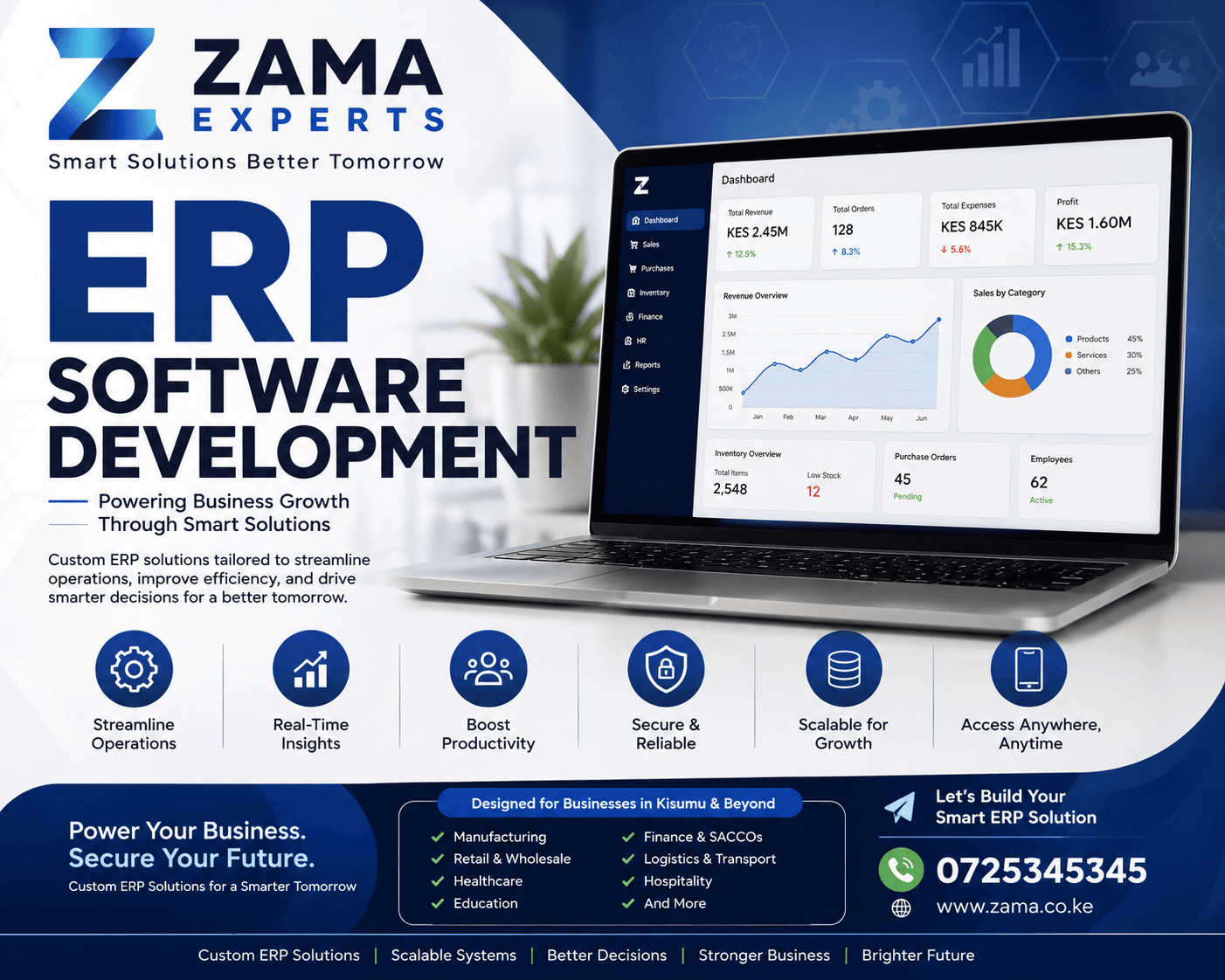
ERP Software Development Kisumu
Running a successful business in today’s competitive environment requires more than hard work. Whether you own a manufacturing company, retail store, hospital, school, SACCO, logistics company, hotel, or wholesale business in Kisumu, managing operations manually can quickly become overwhelming. As businesses grow, handling inventory, accounting, human resources, procurement, customer relationships, and reporting using separate systems often leads to inefficiencies and costly mistakes.
This is where ERP Software Development Kisumu becomes a game changer. Enterprise Resource Planning (ERP) software integrates all critical business functions into one centralized platform, allowing organizations to manage their operations efficiently while making informed decisions based on real-time data.
Businesses in Kisumu are increasingly embracing digital transformation to remain competitive in both local and international markets. An ERP system not only automates repetitive tasks but also enhances collaboration across departments, improves customer satisfaction, and provides business owners with accurate insights into their operations.
At Zama Experts, we specialize in designing and developing customized ERP systems tailored to the unique needs of Kenyan businesses. Our ERP solutions are scalable, secure, cloud-enabled, and built to support organizations of all sizes—from startups and SMEs to large enterprises.
Whether your goal is to reduce operational costs, improve efficiency, automate workflows, or increase profitability, investing in ERP Software Development Kisumu is one of the smartest business decisions you can make.
What is ERP Software Development Kisumu?
Enterprise Resource Planning (ERP) software is an integrated business management solution that connects various departments into one unified system. Instead of using separate applications for accounting, inventory, payroll, procurement, customer management, and reporting, ERP combines everything into a single platform.
Every department shares the same database, ensuring that information is always accurate and updated in real time.
A typical ERP system manages:
- Finance
- Accounting
- Sales
- Procurement
- Inventory
- Human Resources
- Customer Relationship Management
- Manufacturing
- Supply Chain
- Project Management
- Reporting and Analytics
With ERP Software Development Kisumu, businesses gain complete visibility into their operations, enabling managers to make faster and more informed decisions.
Why Businesses in Kisumu Need ERP Systems
Kisumu has grown into one of Kenya’s leading commercial hubs. The city hosts businesses across numerous sectors, including manufacturing, agriculture, logistics, healthcare, hospitality, education, wholesale trade, retail, and financial services.
As businesses expand, they encounter challenges such as:
- Increasing operational costs
- Poor inventory tracking
- Delayed financial reporting
- Duplicate data entry
- Inefficient communication
- Human errors
- Slow customer service
- Limited visibility into business performance
Many organizations still rely on spreadsheets or disconnected software applications that do not communicate with each other.
This creates several problems:
- Employees waste time entering the same information multiple times.
- Managers struggle to obtain accurate reports.
- Inventory discrepancies become common.
- Financial records may contain errors.
- Customer service suffers due to delayed access to information.
ERP Software Development Kisumu addresses these challenges by centralizing all business processes into one secure and intelligent system.
Common Problems Businesses Experience Without ERP
Businesses without ERP often encounter operational inefficiencies that slow growth.
These include:
Poor Inventory Control
Businesses frequently experience:
- Overstocking
- Stock shortages
- Lost inventory
- Manual stock counts
- Inaccurate inventory reports
ERP automates inventory management while providing real-time stock visibility.
Financial Errors
Manual accounting often leads to:
- Duplicate entries
- Missing invoices
- Incorrect tax calculations
- Payroll mistakes
- Delayed reporting
ERP automates financial processes, improving accuracy and compliance.
Inefficient Communication
Departments often work independently without sharing information effectively.
For example:
- Sales may promise products that are out of stock.
- Procurement may reorder items already available.
- Finance may approve payments without complete purchase records.
ERP ensures all departments access the same up-to-date information.
Poor Customer Experience
Customers expect:
- Fast service
- Accurate billing
- Quick order processing
- Real-time order updates
Without ERP, businesses struggle to meet these expectations.
Benefits of ERP Software Development Kisumu
Investing in ERP Software Development Kisumu offers significant long-term benefits.
1. Centralized Information
ERP stores all business data in one secure location.
Employees no longer search through multiple spreadsheets or software applications.
Everyone works from the same reliable information.
2. Improved Productivity
Automation eliminates repetitive manual work.
Employees spend less time:
- Entering data
- Preparing reports
- Reconciling accounts
- Tracking inventory
- Processing paperwork
Instead, they focus on strategic activities that drive business growth.
3. Better Decision Making
ERP provides dashboards with real-time insights into:
- Sales performance
- Cash flow
- Inventory levels
- Employee productivity
- Profitability
- Customer trends
Managers can make informed decisions based on accurate data rather than guesswork.
4. Cost Reduction
Automation helps reduce:
- Administrative expenses
- Paperwork
- Inventory losses
- Human errors
- Operational delays
- Unnecessary labor costs
This improves overall profitability.
5. Increased Customer Satisfaction
Customers receive:
- Faster quotations
- Accurate invoices
- Timely deliveries
- Better communication
- Improved service quality
Satisfied customers are more likely to return and recommend your business.
6. Enhanced Data Security
Modern ERP systems include advanced security features such as:
- Role-based access control
- Data encryption
- Multi-factor authentication
- Automated backups
- Audit trails
- Activity logs
This protects sensitive business information from unauthorized access.
7. Business Growth
As your organization expands, your ERP system grows with you.
You can easily add:
- New users
- Additional branches
- New departments
- Advanced modules
- Integrations with third-party systems
Scalable ERP software supports long-term business success.
How ERP Improves Productivity
Productivity is one of the biggest advantages of ERP Software Development Kisumu.
Instead of performing repetitive tasks manually, ERP automates everyday business processes.
Examples include:
Automated Purchase Orders
The system automatically generates purchase orders when inventory reaches predefined minimum levels.
Automatic Invoicing
Invoices are generated instantly after sales transactions, reducing delays and minimizing errors.
Payroll Automation
Employee salaries, statutory deductions, taxes, and benefits are calculated automatically.
Inventory Updates
Whenever sales or purchases occur, stock levels update in real time without manual intervention.
Financial Reporting
Managers can generate comprehensive reports with a few clicks instead of spending days compiling data.
These automations significantly improve operational efficiency and allow businesses to focus on innovation and customer service.
Key Features of a Modern ERP System
An effective ERP solution should include:
- User-friendly dashboard
- Cloud accessibility
- Mobile compatibility
- Real-time reporting
- Inventory management
- Procurement management
- Financial accounting
- Payroll management
- Human resource management
- CRM integration
- Sales management
- Role-based permissions
- Audit logs
- Workflow automation
- Multi-branch support
- Multi-company support
- Tax management
- Business intelligence dashboards
- API integrations
- Automated notifications
These features help businesses streamline operations, improve collaboration, and make data-driven decisions.
ERP Modules Explained
One of the greatest advantages of ERP Software Development Kisumu is that businesses can implement only the modules they need initially and expand as they grow. Every module works together within a single database, ensuring seamless information flow across the organization.
Finance and Accounting Module
The finance module is the backbone of every ERP system. It provides real-time visibility into your company’s financial health while automating repetitive accounting tasks.
Features
- General ledger
- Accounts payable
- Accounts receivable
- Bank reconciliation
- Cash flow management
- Budgeting
- Fixed asset management
- Financial reporting
- Tax management
- Profit and loss statements
Benefits
Businesses using ERP Software Development Kisumu can generate financial reports within minutes instead of spending days compiling spreadsheets. This improves decision-making and helps organizations remain compliant with Kenyan tax regulations.
Inventory Management Module
Inventory control is essential for retailers, wholesalers, manufacturers, pharmacies, and distributors.
An ERP inventory module enables businesses to:
- Track stock levels in real time
- Monitor stock movement
- Receive low-stock alerts
- Manage multiple warehouses
- Perform stock transfers
- Conduct stock audits
- Track batch and serial numbers
- Manage product expiry dates
Instead of relying on manual stock counts, businesses gain complete visibility into inventory at any time.
Procurement Management Module
Purchasing inventory manually often results in delays and unnecessary costs.
The procurement module automates the purchasing process.
Features include:
- Supplier management
- Purchase requisitions
- Purchase approvals
- Purchase orders
- Goods received notes
- Supplier invoices
- Vendor performance analysis
Businesses implementing ERP Software Development Kisumu can reduce procurement costs while improving supplier relationships.
Sales Management Module
Sales teams require accurate information to serve customers efficiently.
The sales module includes:
- Quotations
- Sales orders
- Customer management
- Invoice generation
- Payment tracking
- Discount management
- Sales analytics
- Sales forecasting
Managers can easily monitor daily, weekly, monthly, and annual sales performance.
Customer Relationship Management (CRM)
Customer satisfaction drives business growth.
The CRM module helps businesses manage customer interactions effectively.
Capabilities include:
- Customer database
- Lead management
- Opportunity tracking
- Customer support tickets
- Follow-up reminders
- Email integration
- Marketing campaigns
- Customer communication history
When integrated into ERP Software Development Kisumu, businesses can improve customer retention while increasing sales.
Human Resource Management (HR)
Managing employees manually becomes increasingly difficult as businesses grow.
The HR module automates:
- Employee records
- Recruitment
- Leave management
- Attendance tracking
- Performance evaluation
- Employee contracts
- Training management
- Employee self-service portals
Human resource teams become more productive while employees enjoy improved service delivery.
Payroll Management
Payroll processing is one of the most time-consuming administrative tasks.
ERP payroll automates:
- Salary calculations
- Overtime
- Allowances
- Deductions
- PAYE
- NSSF
- SHA
- NHIF (where applicable)
- Payslip generation
- Bank transfers
- Payroll reports
Businesses reduce payroll errors while ensuring timely salary payments.
Manufacturing Module
Manufacturers require detailed control over production processes.
The manufacturing module manages:
- Bills of materials
- Production planning
- Work orders
- Quality control
- Machine utilization
- Production costing
- Production scheduling
- Material requirements planning
Manufacturers in Kisumu can increase efficiency while reducing production costs through ERP Software Development Kisumu.
Project Management Module
Service-based businesses benefit significantly from project management.
Features include:
- Project planning
- Resource allocation
- Task assignment
- Milestone tracking
- Budget monitoring
- Time tracking
- Expense management
- Project profitability reports
This ensures projects are completed on time and within budget.
Reporting and Business Intelligence
Modern ERP systems provide powerful reporting capabilities.
Managers can access:
- Executive dashboards
- Sales reports
- Inventory reports
- HR reports
- Procurement reports
- Financial reports
- Customer reports
- Performance indicators
Instead of waiting until month-end, management can monitor business performance daily.
Industries That Benefit from ERP Software Development Kisumu
Virtually every industry can benefit from ERP technology.
Manufacturing
Manufacturers use ERP to manage:
- Production
- Inventory
- Procurement
- Quality control
- Equipment maintenance
- Supply chain operations
Wholesale Businesses
ERP enables wholesalers to:
- Manage stock
- Process bulk orders
- Track deliveries
- Automate invoicing
- Analyze sales performance
Retail Stores
Retail businesses use ERP for:
- POS integration
- Inventory tracking
- Loyalty programs
- Customer management
- Financial reporting
Healthcare
Hospitals and clinics use ERP to manage:
- Patient billing
- Pharmacy inventory
- Procurement
- Staff scheduling
- Financial management
Educational Institutions
Schools and universities benefit from ERP through:
- Student management
- Fee management
- Payroll
- Procurement
- Library systems
- Financial reporting
SACCOs
ERP helps SACCOs manage:
- Member accounts
- Loan processing
- Savings
- Financial reporting
- Compliance
Hospitality
Hotels and restaurants use ERP for:
- Reservations
- Inventory
- Purchasing
- Staff management
- Customer billing
Logistics Companies
Transport businesses use ERP for:
- Fleet management
- Driver management
- Route optimization
- Fuel monitoring
- Maintenance scheduling
Agriculture
Agribusinesses use ERP to manage:
- Farm inventory
- Equipment
- Production planning
- Distribution
- Financial management
Custom ERP vs Off-the-Shelf ERP
Many businesses ask whether they should purchase ready-made ERP software or invest in a custom solution.
Off-the-Shelf ERP
Advantages
- Lower initial cost
- Faster deployment
- Standard features
- Large user community
Disadvantages
- Limited customization
- Monthly licensing fees
- Unnecessary features
- Vendor dependency
- Difficult integrations
Custom ERP
Advantages
- Built specifically for your business
- Highly scalable
- Easier integration
- Improved security
- Better user experience
- No unnecessary features
- Greater flexibility
For businesses seeking long-term efficiency and competitive advantage, ERP Software Development Kisumu offers a tailored solution that aligns perfectly with operational needs.
ERP Implementation Process
Successful ERP implementation requires careful planning.
Step 1: Business Analysis
The development team studies:
- Existing workflows
- Business challenges
- Current software
- Future objectives
Step 2: Requirements Gathering
Stakeholders define:
- Required modules
- User roles
- Reports
- Integrations
- Security requirements
Step 3: System Design
Developers create:
- Database architecture
- User interfaces
- Process flows
- Dashboard designs
Step 4: Development
Programmers build the ERP modules according to agreed specifications.
Each feature undergoes continuous testing during development.
Step 5: System Testing
Testing verifies:
- Performance
- Security
- Functionality
- Integration
- User experience
Issues are resolved before deployment.
Step 6: Data Migration
Existing business data is transferred into the new ERP system.
This may include:
- Customers
- Suppliers
- Products
- Employees
- Financial records
- Inventory
Step 7: User Training
Employees receive comprehensive training on:
- Daily operations
- Reporting
- Data entry
- Workflow management
- Troubleshooting
Proper training improves user adoption and productivity.
Step 8: Deployment
The ERP system goes live after successful testing and user acceptance.
Businesses often deploy in phases to minimize operational disruption.
Step 9: Ongoing Support
A reliable ERP partner provides:
- System maintenance
- Software updates
- Performance monitoring
- Technical support
- Feature enhancements
Common ERP Software Development Kisumu Implementation Challenges
While ERP delivers significant benefits, organizations should prepare for potential challenges.
These include:
- Resistance to change from employees
- Poor data quality
- Inadequate training
- Scope changes during development
- Lack of executive support
- Unrealistic timelines
Working with an experienced development partner such as Zama Experts helps mitigate these risks through proper planning, user engagement, and continuous support.
Why Choose Zama Experts for ERP Software Development Kisumu?
At Zama Experts, we develop ERP solutions that are designed around your unique business processes rather than forcing your business to adapt to generic software.
Our ERP solutions offer:
- Fully customized development
- Secure cloud and on-premise deployment
- Mobile-friendly interfaces
- M-Pesa and payment gateway integration
- API integration with third-party systems
- Business intelligence dashboards
- Scalable architecture
- Ongoing technical support and maintenance
- User training and documentation
- High-performance, secure, and reliable systems
Whether you’re a startup, SME, or large enterprise, our team works closely with you to deliver an ERP system that supports sustainable growth and operational excellence.
Artificial Intelligence in ERP Systems
Artificial Intelligence is transforming how businesses operate. Through ERP Software Development Kisumu, organizations can leverage AI to reduce manual work, identify trends, and improve decision-making.
AI enables ERP systems to:
- Predict future sales based on historical data.
- Forecast inventory requirements.
- Detect unusual financial transactions.
- Recommend optimal purchasing quantities.
- Automate customer service.
- Analyze employee performance.
- Improve production planning.
- Reduce operational costs.
Businesses that adopt ERP Software Development Kisumu with AI capabilities gain a significant competitive advantage by making faster and more informed decisions.
Business Process Automation
Automation eliminates repetitive tasks that consume valuable employee time. Through ERP Software Development Kisumu, organizations can automate end-to-end workflows across multiple departments.
Examples include:
- Automatic invoice generation.
- Purchase order approvals.
- Inventory replenishment.
- Employee leave approvals.
- Payroll processing.
- Customer follow-up notifications.
- Financial reconciliation.
- Expense approvals.
Automation improves accuracy, reduces delays, and allows employees to focus on strategic initiatives instead of repetitive administrative work.
Predictive Analytics
One of the biggest advantages of ERP Software Development Kisumu is access to predictive analytics. Instead of reacting to business events after they occur, organizations can anticipate future needs.
ERP systems analyze historical and real-time data to predict:
- Future sales trends.
- Customer purchasing behavior.
- Seasonal demand.
- Inventory shortages.
- Cash flow fluctuations.
- Production requirements.
These insights help businesses plan proactively and allocate resources more effectively.
Real-Time Business Dashboards
Modern ERP systems provide interactive dashboards that display critical business information in real time.
Executives can instantly monitor:
- Sales performance.
- Revenue growth.
- Expenses.
- Profit margins.
- Inventory levels.
- Employee productivity.
- Procurement activities.
- Customer satisfaction.
With ERP Software Development Kisumu, decision-makers no longer need to wait for end-of-month reports. They can access accurate information whenever they need it.
Cloud ERP vs. On-Premise ERP
Businesses considering ERP Software Development Kisumu often need to choose between cloud-based and on-premise deployment.
Cloud ERP
Cloud ERP is hosted on secure remote servers and accessed through the internet.
Advantages
- Lower upfront costs.
- Access from anywhere.
- Automatic software updates.
- High scalability.
- Secure backups.
- Faster deployment.
- Minimal IT infrastructure.
Cloud ERP is ideal for growing businesses with multiple branches or remote teams.
On-Premise ERP
On-premise ERP is installed on a company’s own servers.
Advantages
- Greater control over infrastructure.
- Full ownership of data.
- Custom security policies.
- Suitable for organizations with strict compliance requirements.
Which Option is Better?
For most small and medium-sized businesses, cloud ERP provides the flexibility, affordability, and scalability needed to support growth. However, organizations with specific regulatory or infrastructure requirements may prefer on-premise solutions.
A trusted provider of ERP Software Development Kisumu can assess your business needs and recommend the most suitable deployment model.
Digital Transformation Through ERP
Digital transformation involves integrating technology into every aspect of business operations.
ERP plays a central role by replacing disconnected systems with one integrated platform.
Businesses implementing ERP Software Development Kisumu can:
- Eliminate paperwork.
- Improve collaboration.
- Enhance customer experiences.
- Reduce operational costs.
- Increase employee productivity.
- Improve reporting accuracy.
- Support business expansion.
As businesses grow, ERP ensures that operations remain organized, efficient, and scalable.
Case Study 1: Manufacturing Company
A manufacturing company struggled with inventory discrepancies, delayed production schedules, and inaccurate financial reporting.
After implementing ERP Software Development Kisumu, the company achieved:
- 35% reduction in inventory holding costs.
- 50% faster production planning.
- 40% improvement in procurement efficiency.
- 25% increase in overall productivity.
- Real-time financial reporting.
Management gained complete visibility into operations, enabling faster and more informed decisions.
Case Study 2: Wholesale Distributor
A wholesale distributor relied on spreadsheets to manage inventory and customer orders.
Challenges included:
- Frequent stock shortages.
- Duplicate customer records.
- Delayed invoicing.
- Manual reporting.
Following the implementation of ERP Software Development Kisumu, the business experienced:
- 45% faster order processing.
- 98% inventory accuracy.
- 30% reduction in operating expenses.
- Improved customer satisfaction.
- Increased revenue through better inventory management.
Case Study 3: Healthcare Facility
A healthcare provider faced challenges in managing procurement, payroll, inventory, and financial reporting.
Through ERP Software Development Kisumu, the organization integrated all departments into one platform.
Results included:
- Automated procurement.
- Accurate payroll processing.
- Better inventory control.
- Improved financial reporting.
- Enhanced operational efficiency.
The healthcare facility significantly reduced administrative workload while improving service delivery.
Customer Testimonials
Manufacturing Director
“Our operations changed completely after implementing the ERP system. We now have real-time visibility across every department, and decision-making has become much faster.”
Retail Business Owner
“Inventory management used to be one of our biggest challenges. The ERP solution eliminated stock discrepancies and improved customer satisfaction.”
Hospital Administrator
“The system has streamlined payroll, procurement, and financial reporting. Our staff can now focus more on patient care instead of paperwork.”
Logistics Company Manager
“We wanted a system that could support our growing business. The customized ERP solution exceeded our expectations and continues to scale with us.”
Measuring Return on Investment (ROI)
Many business owners ask whether ERP is worth the investment.
The answer depends on long-term value rather than initial cost.
Organizations implementing ERP Software Development Kisumu typically experience measurable improvements in:
- Employee productivity.
- Operational efficiency.
- Inventory accuracy.
- Customer satisfaction.
- Financial reporting.
- Revenue growth.
- Cost reduction.
- Decision-making.
Most businesses recover their investment through improved efficiency, lower operating costs, and increased profitability.
Security Features of Modern ERP Systems
Data security is essential for every organization.
Modern ERP solutions include:
- Role-based user permissions.
- Multi-factor authentication.
- End-to-end encryption.
- Secure cloud hosting.
- Automatic backups.
- Audit logs.
- Activity monitoring.
- Disaster recovery capabilities.
These features protect sensitive business information while ensuring business continuity.
ERP Integration Capabilities
An effective ERP solution should integrate seamlessly with existing business systems.
Possible integrations include:
- M-Pesa payment integration.
- Banking systems.
- E-commerce platforms.
- Customer Relationship Management (CRM).
- Human Resource Management Systems.
- Business Intelligence tools.
- Point of Sale (POS) systems.
- Accounting software.
- Email platforms.
- SMS notification services.
Integration reduces duplicate data entry and creates a unified business ecosystem.
Future Trends in ERP Software Development Kisumu
The ERP landscape continues to evolve rapidly.
Businesses investing in ERP Software Development Kisumu can expect future innovations such as:
- AI-powered virtual assistants.
- Machine learning for demand forecasting.
- Robotic Process Automation (RPA).
- Voice-enabled ERP interfaces.
- Internet of Things (IoT) integration.
- Blockchain for secure transactions.
- Advanced predictive analytics.
- Low-code and no-code customization.
- Enhanced mobile ERP experiences.
- Sustainability and ESG reporting tools.
Organizations that embrace these technologies will be better positioned to adapt to changing market demands and maintain a competitive edge.
By adopting a modern ERP platform, businesses in Kisumu can improve efficiency, strengthen collaboration, and build a solid foundation for sustainable growth. The right ERP solution not only streamlines day-to-day operations but also equips organizations with the insights and automation needed to thrive in an increasingly digital
Why Choose Zama Experts for ERP Software Development Kisumu?
Choosing the right ERP development partner is just as important as choosing the ERP system itself. At Zama Experts, we understand that every business has unique processes, challenges, and growth objectives. That’s why we don’t believe in one-size-fits-all software. We build ERP systems that align with your business operations and can scale as your organization grows.
Our team consists of experienced software developers, UI/UX designers, database specialists, project managers, and quality assurance engineers who work together to deliver secure, scalable, and user-friendly ERP solutions.
What Makes Zama Experts Different?
1. Fully Customized ERP Solutions
We develop ERP software based on your specific workflows instead of forcing your business to adapt to generic software.
2. Industry Experience
We have experience developing solutions for:
- Manufacturing
- Retail
- Wholesale
- Healthcare
- Education
- Hospitality
- Logistics
- NGOs
- SACCOs
- Construction companies
- Professional service firms
3. Modern Technology Stack
We build ERP systems using modern technologies that ensure:
- High performance
- Excellent security
- Fast response times
- Easy maintenance
- Scalability
4. Cloud and On-Premise Deployment
Whether your organization prefers cloud hosting or an on-premise installation, we can deliver the solution that best fits your operational and compliance requirements.
5. Ongoing Technical Support
Our relationship with clients continues after deployment. We provide:
- Software updates
- Security patches
- Performance optimization
- User training
- Technical support
- Feature enhancements
Our ERP Development Process
A successful ERP project follows a structured methodology.
Step 1: Consultation
We begin by understanding:
- Your business goals
- Existing challenges
- Current systems
- Operational workflows
- Future growth plans
Step 2: Requirements Analysis
Our analysts document:
- Functional requirements
- Technical requirements
- User roles
- Approval workflows
- Reporting needs
- Integration requirements
Step 3: UI/UX Design
We create intuitive interfaces that make the ERP system easy to learn and use.
Step 4: Software Development
Our developers build each ERP module according to the approved specifications while following industry best practices.
Step 5: Quality Assurance
Every module undergoes rigorous testing to ensure:
- Reliability
- Security
- Accuracy
- Performance
- Compatibility
Step 6: Deployment
After successful testing, we deploy the ERP system with minimal disruption to your daily operations.
Step 7: Training and Support
We train administrators and end users to maximize system adoption and productivity.
Industries We Serve in Kisumu
Our ERP solutions are suitable for organizations across multiple sectors, including:
- Manufacturing companies
- Retail chains
- Supermarkets
- Wholesale distributors
- Hotels
- Restaurants
- Schools and universities
- Hospitals and clinics
- Pharmacies
- Logistics companies
- Construction firms
- NGOs
- Government agencies
- Financial institutions
- SACCOs
- Agricultural businesses
- Professional service providers
No matter your industry, our ERP systems are designed to improve efficiency and support long-term growth.
Frequently Asked Questions (FAQs)
1. What is ERP Software Development Kisumu?
ERP (Enterprise Resource Planning) software is an integrated platform that connects business functions such as finance, inventory, sales, procurement, HR, and reporting into one centralized system.
2. How long does ERP development take?
The timeline depends on the project’s complexity. Small ERP systems may take a few months, while larger enterprise solutions with multiple modules and integrations can take longer.
3. Can the ERP Software Development Kisumu integrate with M-Pesa?
Yes. We can integrate ERP systems with M-Pesa and other payment gateways to simplify payment processing and reconciliation.
4. Is the ERP system cloud-based?
Yes. We develop both cloud-based and on-premise ERP solutions depending on your organization’s requirements.
5. Can additional modules be added later?
Absolutely. Our ERP solutions are scalable, allowing new modules and features to be added as your business grows.
6. Is user training provided?
Yes. We provide comprehensive training, user manuals, and ongoing technical support to ensure successful adoption.
7. Is ERP suitable for small businesses?
Yes. ERP is valuable for businesses of all sizes. SMEs can start with essential modules and expand the system over time.
8. Is business data secure?
Yes. Our ERP solutions include advanced security measures such as role-based permissions, encryption, audit logs, and automated backups to protect your data.
The Future of ERP Software Development Kisumu
As Kisumu continues to grow as a commercial and industrial hub, businesses are increasingly embracing digital technologies to improve efficiency and remain competitive. ERP systems are evolving with innovations such as artificial intelligence, predictive analytics, robotic process automation, and cloud computing.
Organizations that invest in modern ERP solutions today will be better positioned to adapt to future market demands, enhance customer experiences, and make data-driven decisions.
Conclusion
In today’s competitive business environment, organizations need integrated technology solutions that improve efficiency, reduce operational costs, and support sustainable growth. ERP Software Development Kisumu provides businesses with a powerful platform to centralize operations, automate workflows, and gain real-time visibility into every aspect of their organization. Whether you operate a manufacturing company, retail store, healthcare facility, educational institution, logistics business, or professional services firm, ERP Software Development Kisumu enables you to replace manual processes with intelligent automation and data-driven decision-making.
By investing in ERP Software Development Kisumu, businesses can streamline accounting, inventory management, procurement, sales, customer relationship management, human resources, payroll, and reporting within a single system. This integration reduces duplication, minimizes errors, and allows teams to collaborate more effectively. As businesses continue to grow, ERP Software Development Kisumu offers the scalability needed to support additional branches, users, departments, and business processes without disrupting operations.
Modern organizations require software that adapts to changing market demands. ERP Software Development Kisumu empowers business owners and managers with accurate analytics, automated workflows, and secure access to critical information from anywhere. Instead of relying on disconnected systems and spreadsheets, companies can use ERP Software Development Kisumu to improve productivity, increase profitability, and deliver exceptional customer experiences.
At Zama Experts, we specialize in designing customized ERP solutions that align with your unique business goals. Our experienced team develops secure, scalable, and user-friendly systems that help organizations embrace digital transformation with confidence. From consultation and system design to implementation, training, and ongoing support, we ensure every ERP Software Development Kisumu project delivers measurable value and long-term success.
If your organization is ready to improve operational efficiency, enhance decision-making, and achieve sustainable growth, now is the perfect time to invest in ERP Software Development Kisumu. Partner with Zama Experts for ERP Software Development Kisumu and discover how the right technology can transform your business. With our expertise, innovation, and commitment to quality, ERP Software Development Kisumu becomes more than just software—it becomes the foundation for a smarter, more productive, and future-ready enterprise. Choose ERP Software Development Kisumu today and position your business for lasting success in Kisumu, across Kenya, and beyond.
Contact Zama Experts Today
Are you looking for a trusted partner for ERP Software Development Kisumu?
Zama Experts delivers custom ERP solutions that help businesses streamline operations, improve productivity, and drive growth.
Our Services
- Custom ERP Software Development
- CRM Software Development
- HR & Payroll Systems
- Inventory Management Systems
- Accounting Software
- Procurement Systems
- Manufacturing ERP
- Hospital Management Systems
- School Management Systems
- Mobile App Development
- AI Integration Services
- Cloud Software Solutions
- API Development & Integration
- Business Process Automation
Contact Zama Experts today for a free consultation and discover how a custom ERP solution can transform your business operations in Kisumu and across Kenya.