
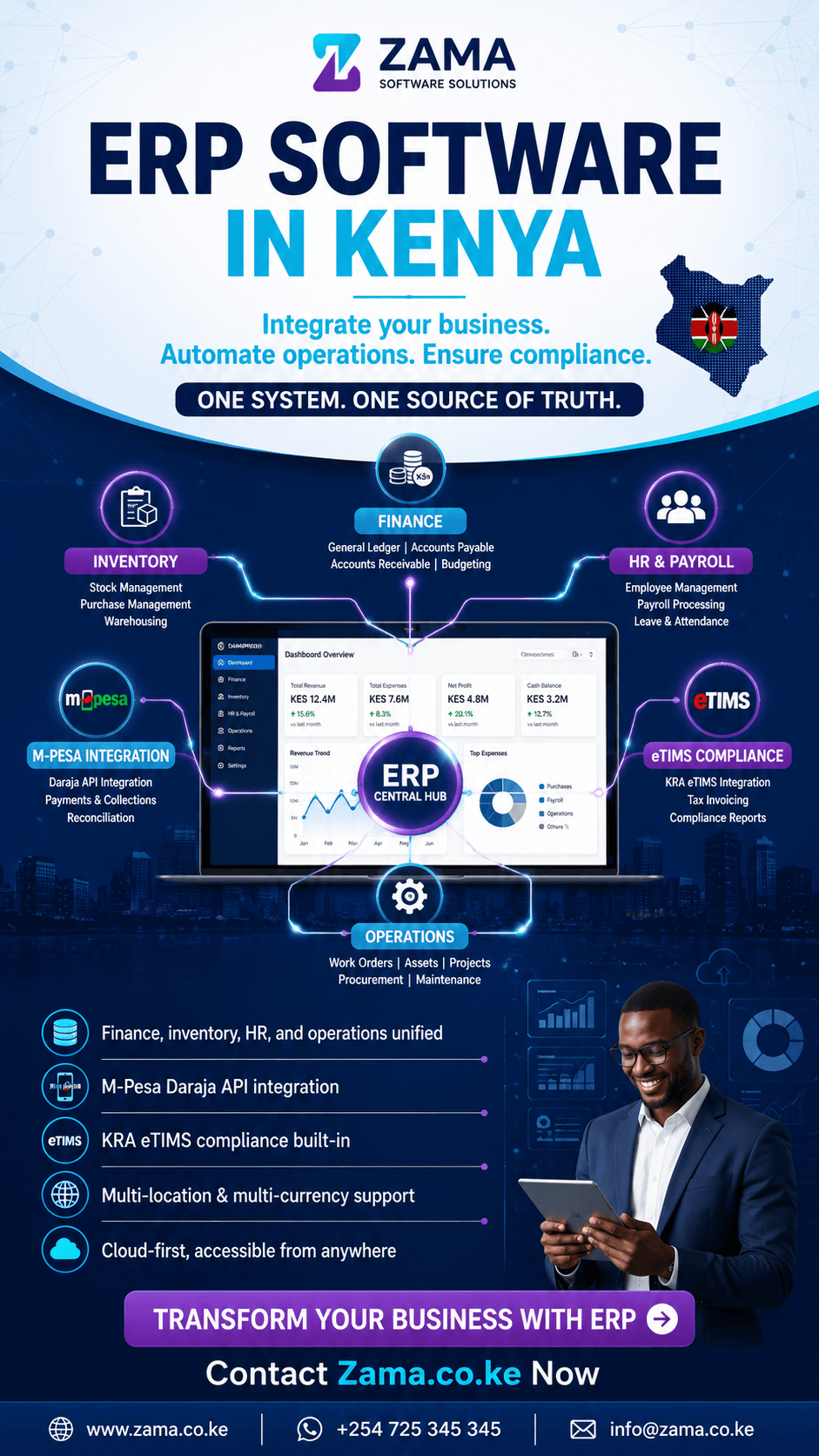
ERP software in Kenya is a question that every business owner, operations director, and finance manager must answer in 2026. With the Middle East and Africa ERP market projected to reach USD 10.20 billion by 2032 and Kenya’s Cloud ERP market estimated at USD 931 million in 2025, growing to USD 1,613 million by 2032 at a CAGR of 9.6%, the stakes have never been higher. At zama.co.ke, we’ve helped numerous organizations across Kenya build and implement ERP solutions that connect finance, operations, inventory, and compliance into one unified platform. This comprehensive guide explores ERP software in Kenya, from understanding what ERP does to selecting the right solution for your business.
What ERP Software Actually Does
Before diving into ERP software in Kenya, it’s essential to understand what enterprise resource planning software actually does. An ERP system integrates core business functions—finance, inventory, procurement, HR, sales, and operations—into a single, unified platform. It eliminates data silos, automates workflows, and provides real-time visibility across the entire organization.
For Kenyan businesses, ERP software in Kenya goes beyond traditional back-office accounting. As one analysis notes, Kenyan businesses are no longer buying ERP only to automate accounting. They are buying ERP to handle compliance, eTIMS invoicing, inventory visibility, payment reconciliation, data governance, multi-location operations, and faster finance decisions. This shift is especially important for growth-stage businesses in Kenya.
When considering ERP software in Kenya, businesses typically need to manage:
Financial Management: General ledger, accounts payable and receivable, cash management, budgeting, and multi-currency support.
Inventory and Supply Chain: Real-time stock tracking, procurement, warehouse management, and supplier relationships.
Sales and Customer Management: Order processing, CRM, POS integration, and customer history.
Human Resources: Payroll, recruitment, performance management, and employee records.
Compliance and Reporting: KRA eTIMS integration, Data Protection Act compliance, and real-time dashboards.
The Kenyan ERP Landscape: Why Context Matters
When evaluating ERP software in Kenya, context is everything. Global ERP platforms are designed for markets with different compliance frameworks, different currencies, and different operational realities. What Kenyan businesses need is a system that speaks their language from day one.
The M-Pesa Integration Gap
One of the most critical aspects of ERP software in Kenya is M-Pesa integration. Global software assumes payments work like they do in New York or London—Stripe, PayPal, bank transfers that clear in seconds. In Kenya? Your customers want to pay via M-Pesa, Airtel Money, and bank transfers that take time to clear.
I know of a retail chain that implemented a global point-of-sale system across 12 branches. Three months later, they still had staff maintaining separate Excel sheets for M-Pesa transactions because the system couldn’t integrate with local payment providers. They were essentially running two businesses—one in the software, one in reality. When implementing ERP software in Kenya, M-Pesa integration must be native, not an afterthought.
KRA eTIMS Compliance
The most important Kenya-specific driver for ERP software in Kenya is tax digitization. KRA’s eTIMS ERP integration requirements have changed the role of ERP in business operations. KRA states that all persons engaged in business must onboard eTIMS and issue electronic tax invoices. From 1 January 2024, business expenses must be supported by an electronic tax invoice.
Global software comes with “standard” tax configurations that were built for different jurisdictions—and getting them adapted to Kenyan requirements often requires expensive custom development or consultants who charge significant hourly rates. One accounting firm in Westlands now factors in an extra KSh 800,000 in “adaptation costs” whenever a client insists on global software.
The Support Timezone Challenge
When your inventory system goes down at 9 AM on a Tuesday morning in Nairobi, you need help now. But your software provider’s support team is just waking up in San Francisco. Their business hours don’t match yours. Their urgency doesn’t match yours. Kenyan businesses lose an average of KSh 340,000 per incident in downtime.
The Cost of Global Software Failure
The numbers are sobering. 78% of Kenyan SMEs that adopted global software solutions abandoned them within 18 months. Millions of shillings spent on systems that were supposed to transform operations—only to gather dust because they were built for a business environment that doesn’t exist in Kenya. One manufacturing company in Industrial Area spent KSh 4.2 million implementing a popular ERP system. Six months later, they were still manually reconciling M-Pesa payments because the software “couldn’t handle local payment flows.”
Key Drivers of ERP Adoption in Kenya
When evaluating ERP software in Kenya, several factors are driving adoption:
Cloud-First Architecture
Cloud ERP solutions in Kenya reduce barriers by delivering integrated systems without requiring the same infrastructure investment. The Kenya Cloud ERP market was estimated at USD 931 million in 2025 and is projected to reach USD 1,613 million by 2032. With teams spread across Nairobi, Mombasa, Kisumu, and beyond—and business owners who are rarely desk-bound—cloud-based access is not optional. You need a system that runs on any device, anywhere, and stays live even when your team is in the field.
Multi-Location Operations
Kenya’s growth-stage businesses are often distributed by design. Retailers operate multiple branches. Distributors manage warehouses and territories. Manufacturers coordinate procurement, production, inventory, and delivery. Service companies operate through field teams. For these businesses, ERP access cannot depend on one office, one server, or one finance team. Cloud-based ERP software enables multi-location access, reduced IT overhead, remote collaboration, and centralized oversight.
Real-Time Insights
Businesses need real-time insights, migration from legacy systems, and business continuity. The region is no longer treating ERP as a back-office accounting tool or an optional system upgrade. Businesses are now evaluating ERP as a core operating backbone that connects finance, tax compliance, payments, inventory, procurement, reporting, and regional expansion.
Industries Benefiting from ERP Software in Kenya
When considering ERP software in Kenya, every major sector is adopting integrated platforms:
Retail and Wholesale: Real-time stock control, POS, and sales tracking across branches. Uzalynx ERP serves retail, wholesale, manufacturing, logistics, agribusiness, schools, hospitality, and fuel stations.
Manufacturing: Production planning, BOMs, costing, and shop-floor visibility across plants in Kenya. Kidaftari, a cloud-native ERP built in Kenya’s “Silicon Savannah,” is designed specifically for African manufacturers, distributors, and SMEs.
Distribution and Logistics: Fleet coordination, supplier management, and work orders.
Healthcare: Appointment booking, inventory, and patient billing.
Real Estate and Construction: Rental unit management, contracts, and project tracking.
Education: Scheduling, fees, and employee management.
Implementation Considerations
Avoid the “Software Ready Before Business Is” Trap
The most common pattern in ERP projects is this: configuration completes on time, but key business decisions remain unresolved. Decisions that stall most often include tax treatment for intercompany transactions, approval hierarchy, item master structure, and inter-branch stock movement rules.
The resolution is to build a business validation buffer into the project timeline—a structured phase after requirements workshops where named business owners confirm their stream’s process decisions before configuration is locked. This single addition has consistently improved go-live quality and reduced post-live rework.
Data Migration: Not Just a Technical Task
Data migration is almost always the longest single thread in an ERP implementation, and it is almost always underestimated. Specific challenges include item master records created inconsistently across years, customer and supplier records with incorrect tax IDs, historical transactions with incomplete costing data, and opening balances that do not reconcile.
Data cleansing must begin during the project’s planning phase—not at migration. By the time cutover is approaching, the window for remediation is too small.
Training as a Process, Not an Event
Training conducted once before go-live, covering all roles in a single session, is one of the most reliable predictors of poor user adoption. The people who need the system the most—warehouse operators, procurement clerks, accounts receivable teams—absorb training through repetition and practice on real scenarios, not through a one-day demonstration.
Role-specific training, delivered closer to go-live, using the organization’s own data and actual business scenarios, consistently produces higher adoption rates and fewer post-live support calls.
Hypercare: The Critical Post-Launch Window
The first four to six weeks after go-live are the most operationally vulnerable period of any ERP project. Having a hypercare plan with dedicated support, quick escalation paths, and rapid response times is essential for stabilization.
The Zama.co.ke Approach
When considering ERP software in Kenya, zama.co.ke follows a structured approach:
Process-First Discovery
We define your business workflows: financial processes, inventory management, procurement cycles, sales operations, HR processes, and the reports leadership needs. This includes mapping current workflows, identifying pain points, and defining success metrics.
Compliance-First Design
We build ERP solutions with Kenya-specific compliance built in from day one—KRA eTIMS integration, M-Pesa Daraja API, payroll (PAYE, NSSF, SHIF, AHL), and Data Protection Act requirements.
Modular Architecture
We design systems that can start with core modules and expand as your business grows. A good software foundation makes it easier to add modules, integrations, and new user groups without rebuilding everything later.
Local Integration Patterns
We build for what Kenyan businesses actually use—M-Pesa, KRA eTIMS, local banks, and messaging platforms. Our practice is built for the local rails that matter, not Stripe and QuickBooks.
Phased Delivery
We launch core workflows first, then expand after users trust the data. This approach avoids the common mistake of implementing too many modules at once.
Post-Launch Support
After go-live, we support stabilization, user feedback, ongoing maintenance, and the next round of improvements informed by real usage.
Why Choose Zama.co.ke
When evaluating ERP software in Kenya, choose zama.co.ke because:
Local Context Mastery
We understand the Kenyan business landscape, regulatory environment, and user behavior patterns. We build solutions optimized for Kenyan realities, not Western assumptions.
End-to-End Capability
We build enterprise software in Kenya for organizations that need controlled workflows, approvals, integrations, reporting, and scalable architecture across departments or branches. Our modules include ERP, POS, HR, payroll, CRM, inventory, finance, procurement, and operations.
Transparent Partnership
No hidden fees, no “black box” development. We provide clear milestone timelines, upfront pricing, and full source-code ownership.
Reliable Support
We remain available to maintain, refine, and extend your ERP solution as your business evolves.
ERP software in Kenya is essential for any business seeking to integrate operations, automate workflows, and ensure compliance. From M-Pesa integration and KRA eTIMS compliance to real-time inventory visibility and multi-location management, the right ERP transforms how businesses operate.
At zama.co.ke, we’ve helped businesses across Kenya build and implement ERP solutions that deliver measurable results. Our approach ensures you get exactly what your business needs—nothing more, nothing less.
Don’t let the complexity of ERP software in Kenya hold you back. Whether you’re a growing SME or a large enterprise, we have the expertise to guide you through every step.
Contact zama.co.ke today and let us help you build an ERP solution that transforms your business operations.