
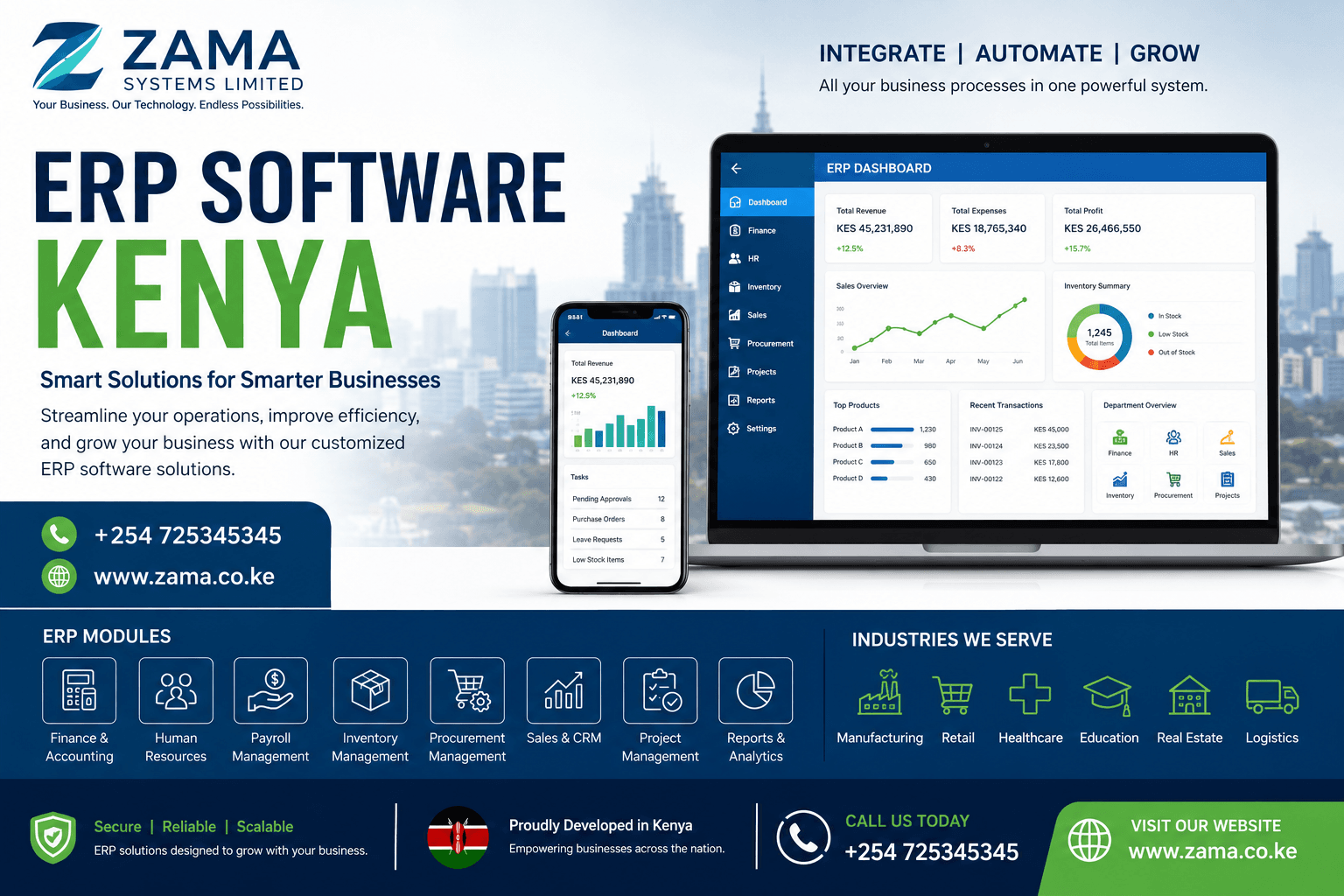
ERP Software Kenya: Transforming Business Operations with Smart Technology
In today’s highly competitive business environment, organizations across Kenya are seeking innovative ways to improve efficiency, reduce operational costs, and increase profitability. One of the most effective solutions available is ERP software in Kenya. Enterprise Resource Planning (ERP) systems help businesses integrate their core processes into a single centralized platform, enabling better decision-making, enhanced productivity, and sustainable growth.
Whether you operate a manufacturing company, retail business, school, hospital, logistics company, real estate agency, or service-based organization, implementing ERP software can significantly improve your operations.
At Zama Systems Limited, we specialize in developing customized ERP software solutions tailored to the unique needs of Kenyan businesses. Our goal is to help organizations automate processes, streamline workflows, and achieve digital transformation.
Contact Us:
Phone: +254 725345345
Website: www.zama.co.ke
What is ERP Software?
Enterprise Resource Planning (ERP) software is an integrated business management system that combines various departments and functions into one centralized platform. Instead of using separate software applications for accounting, inventory, human resources, sales, procurement, and customer management, ERP software connects all these processes into a unified system.
ERP software acts as the central nervous system of an organization by allowing different departments to share data in real-time.
Common ERP modules include:
- Finance and Accounting
- Human Resource Management
- Payroll Management
- Inventory Management
- Procurement Management
- Sales Management
- Customer Relationship Management (CRM)
- Project Management
- Manufacturing Management
- Asset Management
- Fleet Management
- Reporting and Analytics
Why ERP Software is Important for Kenyan Businesses
Many businesses in Kenya still rely on spreadsheets, manual records, and disconnected software systems. These methods often lead to:
- Data duplication
- Human errors
- Poor reporting
- Delayed decision-making
- Increased operational costs
ERP software solves these challenges by centralizing business operations and providing real-time visibility across departments.
Benefits include:
Improved Efficiency
ERP automates repetitive tasks such as data entry, invoicing, payroll processing, and inventory tracking.
Better Decision Making
Managers gain access to real-time reports and analytics that support strategic planning.
Cost Reduction
Automation reduces labor costs and minimizes errors that can lead to financial losses.
Enhanced Customer Service
Faster access to customer information improves response times and customer satisfaction.
Regulatory Compliance
ERP systems help businesses maintain compliance with tax regulations, labor laws, and financial reporting requirements.
ERP Software Modules Explained
1. Finance and Accounting Module
The accounting module is often the heart of an ERP system.
Features include:
- General ledger
- Accounts payable
- Accounts receivable
- Bank reconciliation
- Budgeting
- Financial reporting
- Tax management
- Cash flow monitoring
Benefits:
- Accurate financial records
- Faster audits
- Better cash flow management
- Improved financial visibility
2. Human Resource Management Module
Managing employees manually can be time-consuming and error-prone.
HR ERP features include:
- Employee records
- Attendance tracking
- Leave management
- Payroll processing
- Performance evaluation
- Recruitment management
Benefits:
- Reduced paperwork
- Improved employee management
- Automated payroll calculations
- Better compliance
3. Inventory Management Module
Inventory control is critical for wholesalers, retailers, manufacturers, and distributors.
Features:
- Stock tracking
- Inventory valuation
- Batch tracking
- Barcode integration
- Reorder alerts
- Warehouse management
Benefits:
- Reduced stock losses
- Prevention of stockouts
- Improved inventory accuracy
- Lower carrying costs
4. Procurement Management Module
Procurement processes can become complicated without proper systems.
ERP procurement features include:
- Purchase requisitions
- Supplier management
- Purchase orders
- Goods receipt tracking
- Invoice verification
Benefits:
- Improved supplier relationships
- Reduced procurement costs
- Better purchasing decisions
5. Customer Relationship Management (CRM)
CRM functionality helps businesses manage customer interactions.
Features:
- Lead management
- Opportunity tracking
- Customer database
- Sales pipeline management
- Customer support tracking
Benefits:
- Increased sales
- Improved customer retention
- Better customer engagement
Industries Using ERP Software in Kenya
Manufacturing Companies
Manufacturers use ERP systems to manage:
- Production planning
- Raw materials
- Quality control
- Inventory
- Supply chains
Retail Businesses
Retailers use ERP software for:
- Inventory tracking
- Point of sale integration
- Supplier management
- Customer loyalty programs
Hospitals and Clinics
Healthcare organizations use ERP systems to manage:
- Patient records
- Billing
- Inventory
- Human resources
- Financial reporting
Schools and Universities
Educational institutions use ERP solutions for:
- Student management
- Fee collection
- Staff management
- Examination management
Real Estate Companies
Property management ERP systems help manage:
- Tenant records
- Rent collection
- Maintenance requests
- Property accounting
Features of Modern ERP Software
Cloud-Based Access
Modern ERP systems allow users to access business data from anywhere using internet-connected devices.
Benefits include:
- Remote work support
- Reduced hardware costs
- Automatic updates
- Enhanced scalability
Mobile Accessibility
Mobile ERP solutions enable business owners and managers to access information from smartphones and tablets.
Benefits:
- Real-time monitoring
- Faster approvals
- Increased flexibility
Real-Time Reporting
ERP dashboards provide instant access to:
- Sales reports
- Financial reports
- Inventory reports
- HR reports
This enables faster decision-making.
Integration Capabilities
ERP systems can integrate with:
- Payment gateways
- E-commerce platforms
- Banking systems
- Mobile money platforms
- Customer portals
This creates seamless workflows across the organization.
Challenges Businesses Face Without ERP Software
Organizations without ERP systems often struggle with:
Data Silos
Departments operate independently, making collaboration difficult.
Duplicate Records
Information is entered multiple times in different systems.
Delayed Reporting
Generating reports becomes slow and inefficient.
Poor Inventory Control
Businesses experience stock discrepancies and losses.
Customer Service Issues
Employees struggle to access customer information quickly.
ERP software eliminates these challenges through centralized data management.
How ERP Software Increases Profitability
ERP software directly impacts profitability through:
Operational Efficiency
Automation reduces labor requirements and processing times.
Inventory Optimization
Businesses avoid overstocking and understocking.
Improved Customer Retention
Better service increases repeat business.
Better Financial Management
Real-time financial insights improve budgeting and cash flow control.
Strategic Decision Making
Executives gain access to accurate business intelligence.
Custom ERP Software vs Off-the-Shelf ERP Software
Off-the-Shelf ERP
Advantages:
- Faster implementation
- Lower initial cost
Disadvantages:
- Limited customization
- Unnecessary features
- Ongoing licensing fees
Custom ERP Software
Advantages:
- Tailored to business processes
- Greater flexibility
- Better scalability
- Competitive advantage
Disadvantages:
- Higher initial investment
For many Kenyan businesses, custom ERP software provides greater long-term value because it aligns perfectly with operational requirements.
Why Choose Zama Systems Limited for ERP Software Development in Kenya?
Zama Systems Limited is a trusted software development company in Kenya specializing in custom ERP software solutions.
Our ERP systems are designed to:
- Automate business operations
- Improve productivity
- Reduce costs
- Increase profitability
- Support business growth
We develop ERP systems for:
- Manufacturing companies
- Retail businesses
- Hospitals
- Schools
- NGOs
- SACCOs
- Logistics companies
- Real estate firms
- Service providers
Our solutions are scalable, secure, and customized to meet your specific business requirements.
Our ERP Development Services
- ERP consultation
- ERP design and development
- ERP customization
- ERP integration
- ERP maintenance
- ERP training and support
Contact Zama Systems Limited
Phone: +254 725345345
Website: www.zama.co.ke
Email us today to discuss your ERP software requirements and receive a customized solution that drives business growth.