
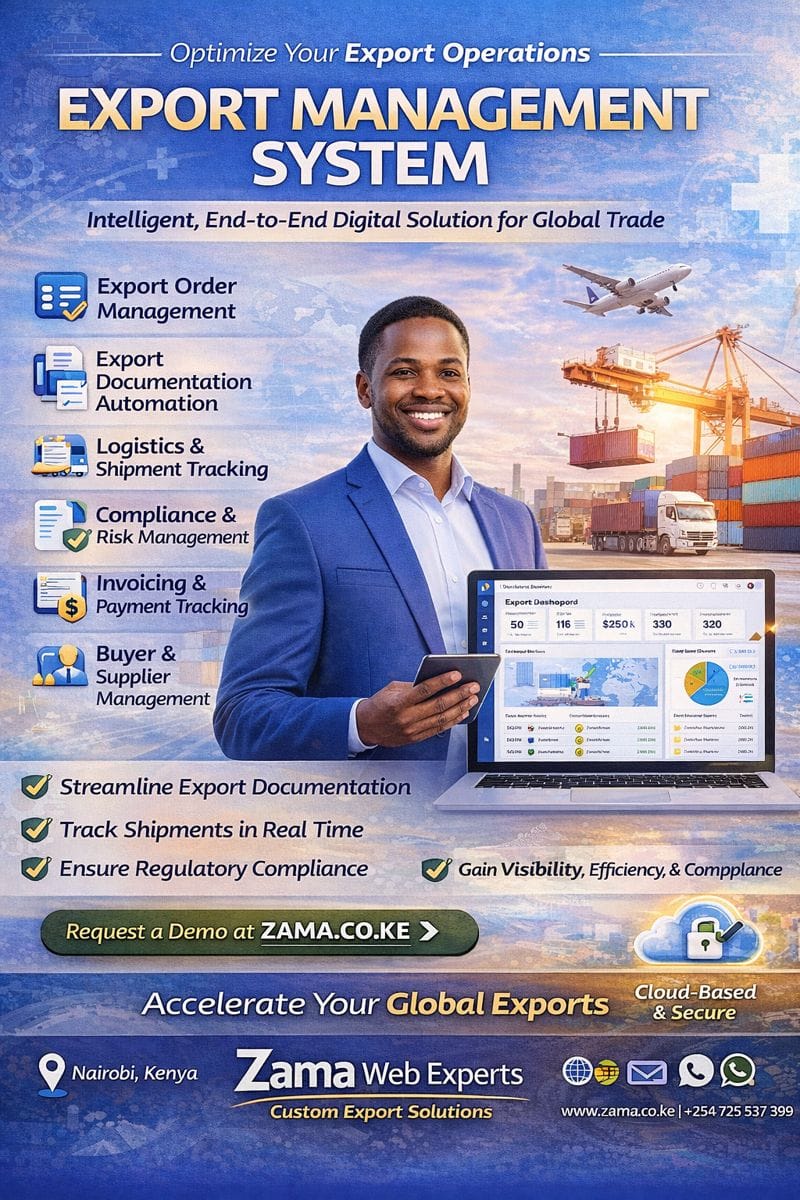
An export management system is a centralized digital platform that helps exporters manage international trade operations efficiently, compliantly, and profitably. As export businesses scale across borders, manual processes, spreadsheets, and emails quickly become unreliable and risky. A modern export management system eliminates these challenges by automating workflows, documentation, logistics, and compliance.
At zama.co.ke, we design custom export management systems tailored for exporters, aggregators, manufacturers, and trading companies operating in Africa and global markets.
What Is an Export Management System?
An export management system is software that manages the complete export lifecycle—from buyer inquiry to final delivery and payment. It brings together export documentation, logistics, compliance, invoicing, and reporting into one secure platform.
An export management system typically handles:
Export orders and contracts
Buyer and supplier management
Export documentation
Logistics and shipment tracking
Compliance and certifications
Invoicing and payment tracking
Export performance analytics
This ensures exporters operate efficiently while meeting international trade regulations.
Why Businesses Need an Export Management System
Export operations are complex and highly regulated. Without a proper system, exporters face:
Missing or incorrect documents
Delayed shipments
Compliance penalties
Poor shipment visibility
Revenue leakage
A professional export management system solves these issues by standardizing processes, reducing errors, and improving visibility across the export chain.
Core Modules of an Export Management System
Our export management system is modular and scalable, allowing businesses to deploy only what they need and expand later.
1. Export Order Management
Manage export orders from inquiry to fulfillment, including quantities, pricing, Incoterms, and delivery schedules.
2. Buyer & Supplier Management
Centralized profiles for international buyers, local aggregators, farmers, manufacturers, and logistics partners.
3. Export Documentation Management
Generate, store, and track critical export documents such as:
Proforma invoices
Commercial invoices
Packing lists
Certificates of origin
Phytosanitary certificates
Bills of lading
4. Logistics & Shipment Tracking
Track shipments by container, pallet, or consignment with real-time status updates.
5. Compliance & Certification Tracking
Manage export compliance requirements including:
Country-specific regulations
Product certifications
Inspection reports
6. Invoicing & Payment Tracking
Track export invoices, partial payments, balances, and settlement status.
Export Management System for Different Industries
An export management system can be customized for various export sectors, including:
Agricultural exports (fruits, vegetables, grains)
Manufacturing and industrial goods
Commodities and raw materials
FMCG and packaged products
Machinery and equipment
Each system is configured to match product-specific workflows and regulations.
Export Management System for African Exporters
African exporters face unique challenges such as fragmented supply chains, certification requirements, and logistics coordination. Our export management system is built with these realities in mind and supports:
Aggregator-based sourcing models
Multi-country export workflows
Regional and international compliance
Scalability for growing exporters
This makes it ideal for exporters targeting Europe, the Middle East, Asia, and North America.
Benefits of an Export Management System
Implementing an export management system delivers significant advantages:
📦 Faster export processing
📑 Accurate and compliant documentation
🚢 Improved shipment visibility
💰 Better cash-flow tracking
📊 Data-driven export decisions
🌍 Scalability for global markets
Exporters gain control, transparency, and confidence in their operations.
Export Management System vs Manual Export Processes
| Feature | Manual Process | Export Management System |
|---|---|---|
| Documentation | Error-prone | Automated & standardized |
| Compliance | Risky | Controlled & tracked |
| Shipment visibility | Limited | Real-time |
| Reporting | Manual | Instant |
| Scalability | Poor | Excellent |
Cloud-Based Export Management System
Our export management system is cloud-ready, enabling exporters to:
Access data from anywhere
Collaborate with international partners
Enjoy automatic backups and updates
Reduce infrastructure costs
This is ideal for exporters managing operations across multiple countries.
Security & Data Protection
Export data is sensitive. Our export management system includes:
Secure authentication
Role-based access control
Encrypted data storage
Audit logs and backups
This ensures confidentiality and compliance with data protection standards.
Reporting & Export Analytics
Data visibility is key to export growth. Our export management system provides reports such as:
Export volumes by product and market
Shipment timelines and delays
Revenue and margin analysis
Buyer performance reports
These insights help exporters optimize pricing, logistics, and market strategy.
Customization & Integration
Every export business is different. We customize the export management system to integrate with:
Accounting systems
ERP platforms
Payment gateways
Logistics and inspection partners
This creates a unified export technology ecosystem.
Long-Term Value of an Export Management System
An export management system is a strategic investment that delivers:
Reduced operational risk
Lower administrative costs
Faster export cycles
Stronger buyer confidence
Sustainable export growth
As export volumes grow, the system scales without disruption.
Why Choose Zama Web Experts?
At zama.co.ke, we specialize in building custom export management systems for African and global exporters.
Why exporters work with us:
Custom-built systems (not generic software)
Deep understanding of export workflows
Scalable and secure architecture
Integration-ready design
Ongoing support and upgrades
We focus on practical systems that exporters actually use.
Future-Ready Export Management System
Our export management system is designed for future expansion, including:
AI-driven export insights
Advanced shipment analytics
Multi-currency and multi-country support
Buyer and supplier portals
This future-proofs your export operations.
Get a Custom Export Management System Today
If you want to streamline export operations, improve compliance, and scale into global markets, an export management system is the right solution.
👉 Visit https://zama.co.ke to request a demo or consultation and deploy a secure, scalable export management system tailored to your export business.
Export Management System: The Complete Guide for Modern Exporters
An export management system is no longer optional for businesses involved in international trade. As global markets become more competitive and compliance requirements tighten, exporters must move beyond spreadsheets, emails, and manual documentation. A robust export management system provides visibility, control, and efficiency across the entire export lifecycle.
At Zama Web Experts, we design custom export management systems that help exporters in Africa and beyond scale safely, comply with regulations, and operate profitably in global markets.
Understanding the Export Lifecycle
To appreciate the value of an export management system, it’s important to understand the complexity of export operations. A typical export lifecycle includes:
Buyer inquiry and quotation
Contract confirmation and Incoterms agreement
Product sourcing or aggregation
Quality checks and inspections
Export documentation preparation
Logistics and shipment coordination
Customs clearance
Delivery and payment reconciliation
Managing these steps manually increases risk. An export management system brings all these processes into one controlled digital workflow.
What Makes an Export Management System Critical in 2025+
International trade today involves multiple stakeholders, strict regulations, and time-sensitive logistics. An export management system helps exporters handle:
Multiple buyers across countries
Complex export documentation
Changing trade regulations
Currency fluctuations
Shipping delays and disruptions
Exporters using digital systems respond faster to market demands and gain a strong competitive advantage.
Core Components of an Export Management System
A modern export management system is built around several interconnected modules that work together seamlessly.
Export Order & Contract Management
Track buyer inquiries, quotations, confirmed orders, contract terms, Incoterms, pricing, and delivery timelines.
Supplier & Aggregator Management
Manage farmers, manufacturers, aggregators, and suppliers with traceability, volumes, and quality metrics.
Export Documentation Automation
Generate, store, and track documents such as:
Proforma invoices
Commercial invoices
Packing lists
Certificates of origin
Phytosanitary and quality certificates
Bills of lading and airway bills
Automation reduces errors and ensures compliance.
Export Compliance & Regulatory Management
Compliance is one of the most critical aspects of exporting. An export management system helps exporters stay compliant by:
Tracking destination-country regulations
Managing certifications and inspections
Storing compliance evidence
Flagging missing or expired documents
This minimizes the risk of shipment rejection, penalties, or delays.
Logistics & Shipment Visibility
Shipment tracking is a major challenge for exporters. A professional export management system provides:
Container-level tracking
Shipment milestones (loaded, in transit, arrived)
Logistics partner coordination
Delay and exception alerts
This visibility improves planning and buyer communication.
Financial Management in Export Operations
Export transactions often involve partial payments, multiple currencies, and delayed settlements. An export management system supports:
Export invoicing
Payment milestones
Outstanding balance tracking
Revenue and margin analysis
This gives exporters full control over cash flow and profitability.
Export Management System for Agricultural Exports
Agricultural exports—such as fruits, vegetables, grains, and flowers—require additional traceability and compliance. A customized export management system supports:
Farm and batch traceability
Quality inspection reports
Cold-chain logistics tracking
Seasonal volume planning
This is essential for exporters targeting EU, Middle East, and Asian markets.
Export Management System for Manufacturing & Commodities
Manufacturers and commodity exporters benefit from an export management system through:
Product specification management
Bulk shipment tracking
Contract volume monitoring
Multi-destination exports
The system ensures consistency and efficiency across high-volume operations.
Role-Based Access & Security
Export data is highly sensitive. A professional export management system includes:
Role-based access (admin, logistics, finance, compliance)
Secure authentication
Encrypted data storage
Audit logs for accountability
This protects business intelligence and trade data.
Cloud-Based Export Management System Advantages
A cloud-enabled export management system allows exporters to:
Access operations from anywhere
Collaborate with international partners
Scale without infrastructure limits
Enjoy automatic backups and updates
This is ideal for exporters with distributed teams and global buyers.
Reporting & Analytics for Strategic Growth
Data-driven decisions fuel export growth. An export management system provides analytics such as:
Export volumes by market
Shipment performance and delays
Buyer profitability analysis
Product performance trends
These insights guide pricing, market expansion, and logistics optimization.
Export Management System vs Manual Export Operations
| Area | Manual Process | Export Management System |
|---|---|---|
| Documentation | Error-prone | Automated & accurate |
| Compliance | High risk | Controlled & tracked |
| Shipment tracking | Limited | Real-time |
| Reporting | Time-consuming | Instant |
| Scalability | Low | High |
The difference directly impacts profitability and risk.
Implementation Strategy for Export Management Systems
Successful adoption requires a structured approach:
Export workflow assessment
System customization
Data migration
Staff training
Phased rollout
Continuous optimization
At Zama Web Experts, we guide exporters through every stage to ensure smooth adoption.
Common Challenges Solved by an Export Management System
Exporters without systems often struggle with:
Lost documents
Shipment delays
Compliance penalties
Poor buyer communication
Revenue leakage
A centralized export management system eliminates these inefficiencies.
Scalability for Growing Export Businesses
As export volumes increase, manual systems fail. A scalable export management system allows exporters to:
Add new markets easily
Onboard more suppliers
Handle higher shipment volumes
Expand into multi-country operations
This ensures long-term sustainability.
Integration with Other Business Systems
A modern export management system integrates with:
Accounting and ERP systems
Payment gateways
Logistics partners
Inspection agencies
Integration creates a seamless export technology ecosystem.
Long-Term ROI of an Export Management System
Although digital systems require investment, the returns are significant:
Reduced operational errors
Faster export cycles
Improved compliance
Stronger buyer trust
Higher margins
Most exporters see measurable ROI within months.
The Future of Export Management Systems
Future-ready exporters are adopting:
AI-driven demand forecasting
Predictive logistics analytics
Digital trade documentation
Supplier and buyer portals
A strong export management system lays the foundation for these innovations.
Final Thoughts: Why Exporters Must Go Digital
An export management system is not just software—it is a strategic enabler. It empowers exporters to operate efficiently, comply confidently, and compete globally.
Exporters who digitize today are the ones who dominate tomorrow’s global markets.
Get a Custom Export Management System Today
If you want to streamline export operations, reduce risk, and scale into global markets, a custom export management system is the solution.
👉 Visit https://zama.co.ke to request a demo or consultation and deploy a secure, scalable export management system built for your export business.
Export Management System: Deep-Dive into Architecture, Workflows, and Real-World Scenarios
To truly unlock value, an export management system must be designed around real export workflows—not theory. Below is a deeper exploration of how exporters use the system day-to-day, how modules interact, and how businesses gain measurable advantages across markets.
System Architecture: How an Export Management System Is Built
A modern export management system typically follows a modular, service-oriented architecture:
Core Data Layer – Buyers, suppliers, products, contracts, shipments
Workflow Engine – Order → compliance → logistics → invoicing → settlement
Integration Layer – Payments, accounting, logistics, inspections
Analytics Layer – Dashboards, KPIs, trend analysis
Security Layer – Roles, permissions, audit trails
This architecture ensures scalability, security, and performance as export volumes grow.
Day-to-Day Operations: A Practical Walkthrough
Morning Operations
Export manager reviews pending orders and shipment statuses
Compliance officer checks expiring certifications
Logistics team reviews container bookings and ETAs
Midday Operations
Documentation team generates invoices and packing lists
Quality inspectors upload reports and photos
Finance team reconciles partial payments
End of Day
Management reviews dashboards (volumes, delays, revenue)
Buyer updates sent automatically
Exception alerts flagged for follow-up
All teams work from the same system—no duplication, no confusion.
Export Documentation: Accuracy at Scale
Documentation errors are among the most expensive export mistakes. An export management system ensures:
Templates aligned to destination-country requirements
Auto-filled data from orders and shipments
Version control and approval workflows
Secure storage and easy retrieval
This dramatically reduces document-related delays and penalties.
Compliance by Destination Market
Different markets impose different rules. A robust export management system supports:
EU & UK
Traceability requirements
Phytosanitary and quality certificates
Sustainability and compliance documentation
Middle East (UAE, KSA)
Product conformity and labeling
Halal and quality certifications
Fast customs clearance coordination
Asia
Strict documentation accuracy
Timely inspection coordination
Multi-port logistics planning
The system adapts workflows per destination to ensure compliance.
Logistics Optimization & Exception Handling
Logistics disruptions are inevitable. What matters is response speed. An export management system provides:
Milestone-based tracking (booked, loaded, sailed, arrived)
Delay alerts and root-cause tagging
Alternate routing and contingency planning
Historical performance comparisons by carrier
Exporters move from reactive to proactive logistics management.
Financial Controls: From Invoice to Settlement
Export finance is complex. A professional export management system handles:
Multi-currency invoicing
Payment milestones (deposit, balance, LC stages)
Credit exposure per buyer
Margin analysis by shipment and product
Finance teams gain clarity, control, and predictability.
Buyer & Supplier Portals
To scale efficiently, exporters increasingly use portals:
Buyer Portal
Order status and shipment tracking
Document downloads
Invoices and statements
Secure communication
Supplier/Aggregator Portal
Supply commitments and schedules
Quality and inspection feedback
Payment status
Portals reduce email traffic and improve trust.
Quality Management & Traceability
For regulated exports, traceability is non-negotiable. An export management system supports:
Batch and lot tracking
Farm/factory-level records
Inspection reports linked to shipments
Recall readiness if required
This is essential for agri-exports and regulated goods.
Performance Analytics: Turning Data into Strategy
Beyond operations, analytics drive growth. An export management system enables:
Market profitability analysis
Buyer reliability scoring
Logistics performance benchmarking
Seasonal demand forecasting
Leadership uses these insights to refine strategy and pricing.
Scaling Across Countries & Entities
As exporters expand, complexity multiplies. A scalable export management system supports:
Multiple legal entities
Multi-country operations
Shared services with local controls
Consolidated and entity-level reporting
Growth happens without system fragmentation.
Security, Audits, and Governance
Export data is commercially sensitive. A professional system includes:
Role-based permissions
Audit logs for every change
Data encryption and backups
Compliance-ready reporting
This supports internal governance and external audits.
Implementation Lessons from Successful Exporters
Exporters who succeed with digital systems typically:
Start with core workflows
Involve operations, compliance, and finance early
Roll out in phases
Measure KPIs post-implementation
Technology works best when paired with change management.
Cost Considerations & ROI
While pricing varies, an export management system typically replaces:
Manual documentation labor
Error-related penalties
Shipment delays and demurrage
Lost revenue from poor visibility
Most exporters achieve ROI within the first export season.
Common Pitfalls (and How to Avoid Them)
Over-customization too early → Start simple, iterate
Ignoring user training → Invest in onboarding
Siloed deployments → Integrate across teams
No analytics → Track KPIs from day one
A thoughtful rollout avoids these issues.
The Road Ahead: Digital Trade & Automation
The future of exporting includes:
Electronic trade documents
AI-powered demand and logistics forecasting
Deeper supply-chain visibility
Faster customs integration
A strong export management system is the gateway to this future.
Final Perspective
An export management system is not just operational software—it’s a strategic platform. It reduces risk, improves margins, builds buyer confidence, and enables exporters to compete globally with discipline and speed.
Exporters who digitize thoroughly today will lead tomorrow’s trade networks.
Start Building Your Export Advantage
If you’re ready to move beyond manual processes and scale your global trade operations, a custom export management system is the next step.
👉 Visit https://zama.co.ke to request a demo or consultation and deploy a secure, scalable export management system tailored to your export business.
Export Management System: Advanced Use-Cases, Governance, and Competitive Advantage
As export businesses mature, the value of an export management system goes far beyond automation. At scale, it becomes a control tower—governing risk, ensuring compliance, optimizing margins, and strengthening buyer trust across international markets.
This section explores advanced use-cases, governance structures, and how exporters use an export management system to outperform competitors.
Export Governance & Internal Controls
Strong governance is critical in international trade. A well-implemented export management system introduces discipline and accountability through:
Approval workflows for pricing, contracts, and shipments
Segregation of duties (sales, compliance, logistics, finance)
Audit trails for every document and transaction
Controlled document versioning
These controls protect exporters from fraud, errors, and regulatory exposure—especially as teams grow.
Managing Export Risk with a Centralized System
Exporting involves multiple risks: buyer default, logistics delays, regulatory non-compliance, and currency exposure. An export management system helps mitigate these risks by:
Tracking buyer credit limits and payment behavior
Monitoring shipment delays and demurrage risks
Flagging compliance gaps before shipment
Reporting currency exposure by market
Risk moves from reactive firefighting to proactive management.
Buyer Relationship Management in Export Operations
International buyers expect transparency and reliability. A professional export management system strengthens buyer relationships through:
Consistent documentation accuracy
Real-time order and shipment updates
Faster dispute resolution with shared data
Clear invoicing and payment tracking
This professionalism directly impacts repeat business and long-term contracts.
Supplier & Aggregator Accountability
For exporters working with farmers, factories, or aggregators, traceability and accountability are essential. An export management system enables:
Supplier performance tracking (quality, volumes, reliability)
Historical supply records by batch or season
Quality inspection feedback loops
Transparent settlement and payment tracking
This improves supply chain discipline and long-term sourcing reliability.
Quality Assurance as a Competitive Advantage
Quality failures are costly in exports. A robust export management system embeds quality assurance into daily workflows:
Pre-shipment inspection checklists
Photo and document uploads linked to batches
Inspector approvals before documentation release
Historical quality performance analytics
Exporters move from quality control to quality leadership.
Multi-Currency & International Finance Management
Global trade means dealing with multiple currencies and payment terms. An export management system supports:
Multi-currency pricing and invoicing
Exchange-rate tracking
Margin analysis by currency
Payment milestones (advance, balance, LC stages)
Finance teams gain clarity even in volatile currency environments.
Contract & Incoterms Management
Misunderstood Incoterms are a major cause of disputes. A professional export management system ensures:
Clear Incoterm assignment per order
Automated cost allocation (freight, insurance, duties)
Consistent contract documentation
Reduced liability disputes
Everyone—from sales to logistics—works from the same contract logic.
Export Analytics for Strategic Decisions
Data is the most underutilized asset in export businesses. An export management system unlocks analytics such as:
Market profitability ranking
Buyer lifetime value
Carrier and route performance
Seasonal demand trends
Product margin analysis
Leadership uses this intelligence to decide where to scale and where to exit.
Market Expansion with Confidence
Entering new markets without systems is risky. An export management system supports market expansion by:
Reusing proven workflows
Applying destination-specific compliance rules
Monitoring early-stage performance
Controlling risk during scale-up
Exporters expand with structure instead of guesswork.
Collaboration Across Export Teams
Export operations involve multiple teams and time zones. A centralized export management system enables:
Shared dashboards across departments
Real-time updates instead of email chains
Clear task ownership
Reduced internal friction
Operations become coordinated, not chaotic.
Digital Readiness for Large Buyers & Institutions
Large international buyers, supermarkets, and distributors increasingly require digital traceability and reporting. An export management system helps exporters meet:
Buyer audit requirements
Traceability documentation demands
ESG and sustainability reporting needs
Digital compliance expectations
This opens doors to higher-value contracts.
Export Management System for ESG & Sustainability
Sustainability is becoming a trade requirement, not a choice. A modern export management system can support:
Farm-level traceability
Certification tracking (organic, fair trade, etc.)
Sustainability data collection
Reporting for buyers and regulators
Exporters position themselves for future-proof trade relationships.
Organizational Maturity & System Evolution
As exporters grow, their systems should evolve:
Phase 1: Core order, documents, shipments
Phase 2: Compliance, finance, analytics
Phase 3: Portals, integrations, AI insights
A scalable export management system grows with the organization—without disruption.
Change Management: Making the System Stick
Technology alone doesn’t guarantee success. Exporters who succeed focus on:
Clear ownership of modules
Training aligned to job roles
KPI tracking post-implementation
Continuous improvement cycles
When teams trust the system, adoption becomes natural.
Cost of NOT Using an Export Management System
Exporters without systems often face:
Repeated documentation errors
Shipment delays and penalties
Lost buyers due to poor communication
Inability to scale confidently
The hidden cost of manual processes often exceeds system investment.
Long-Term Strategic Impact
Over time, an export management system delivers:
Lower operational risk
Higher margins
Faster growth
Stronger buyer confidence
Better enterprise valuation
It becomes a strategic asset, not just operational software.
Final Strategic Insight
In global trade, discipline beats speed and systems beat improvisation. An export management system provides the discipline exporters need to operate confidently across borders, regulations, and markets.
Exporters who invest in structured digital systems today are the ones who dominate tomorrow’s global supply chains.
Build Your Export Control Tower
If your export business is ready to move from reactive operations to controlled, data-driven growth, a custom export management system is the next step.
👉 Visit https://zama.co.ke to request a consultation and deploy a secure, scalable export management system built for serious exporters.