
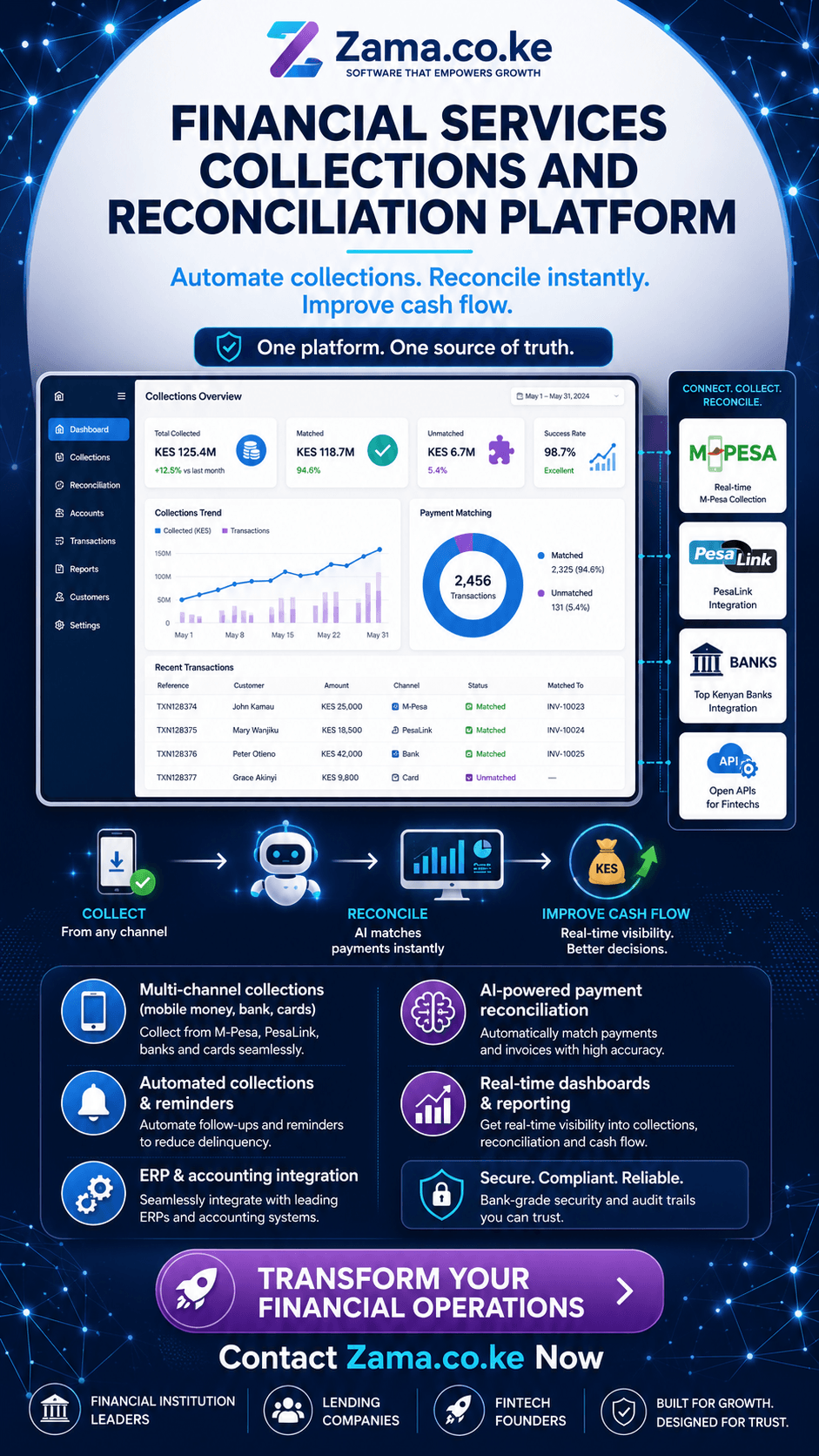
Financial services collections and reconciliation platform is a question that every financial institution, lending company, and fintech leader must answer in 2026. With Kenya’s digital payments market surpassing Sh8.6 trillion in annual transaction volumes and mobile money penetration exceeding 98 percent of the adult population, the need for automated collections and reconciliation has never been greater . At zama.co.ke, we’ve helped numerous financial services organizations across Kenya build custom collections and reconciliation platforms that streamline payment processing, automate payment matching, and deliver real-time cash visibility. This comprehensive guide explores financial services collections and reconciliation platform, from understanding core requirements to selecting the right solution for your organization.
The Reality of Collections and Reconciliation in Kenya Today
Before diving into financial services collections and reconciliation platform, it’s essential to understand the current challenges financial organizations face. Traditional, human-dependent data entry and reconciliation create critical bottlenecks that slow down revenue velocity . Many organizations are currently operating with outdated systems that cannot handle the volume and complexity of modern payments.
Manual Reconciliation Burden: Finance teams are struggling to manually reconcile the sheer volume of incoming and outgoing transactions, facing an increased risk of financial losses and an inability to pass audits . The manual effort involved in matching payments to invoices consumes countless hours that could be directed toward more strategic work.
Fragmented Financial Data: The fragmented data caused by a lack of communication between the number of banks, payment processors, accounting software, ERPs, and databases that make up a company’s financial stack is crippling, causing limited visibility into a company’s cash flow .
Collection Challenges: Account managers chase 50-100 borrowers per day, with payment proof lost in emails, spreadsheets, and SMS threads . Without automated collections, recovery rates suffer and operational costs balloon.
Delayed Reconciliation: Processing cycles often take days rather than minutes, delaying funding and creating cash flow gaps. One case study showed that for a $500M AUM lender, teams spend 6+ hours per day matching messy wire payments, with 16-20 errors per month and 3-day processing cycles .
Understanding these realities is the first step in identifying financial services collections and reconciliation platform that actually works.
What a Collections and Reconciliation Platform Does
A modern financial services collections and reconciliation platform automates the end-to-end process of collecting payments and reconciling them against outstanding obligations. According to industry experts, such platforms leverage AI-driven predictive collections and intelligent reconciliation to clear transactions in seconds rather than days .
By unifying disparate collection channels into a single, AI-native architecture, these platforms empower financial institutions to reduce Days Sales Outstanding (DSO) by up to 32% and achieve up to 95% straight-through processing, transforming receivables from an adversarial process into a collaborative, customer-centric experience .
When considering financial services collections and reconciliation platform, the platform should consolidate payment data, reference information, and customer instructions, enabling intelligent matching, faster exception handling, and real-time cash visibility .
Essential Features of a Collections and Reconciliation Platform
When evaluating financial services collections and reconciliation platform, focus on these core features:
1. Multi-Channel Collections
Financial institutions collect payments through numerous channels. A proper financial services collections and reconciliation platform should support:
Electronic Collections: Integration with real-time payment rails like Pesalink, mobile money (M-Pesa, Airtel Money), bank transfers, and cards. Automated collection systems reduce cost and fees for both parties .
Cash and Cheque Collections: Support for physical collections with automated lodgment, MICR & image processing, and real-time MIS generation. An 80% reduction in manual data entry is achievable for physical collections .
Payment Gateway Integration: Connections with payment processors like Paystack and Flutterwave to centralize payment data .
Direct Debit Management: Support for E-NACH and mandate-based collections with AI-powered mandate extraction and signature verification. Mandate processing drops from days to minutes with 95% improvement in registration TAT .
2. Intelligent Payment Reconciliation
The heart of any financial services collections and reconciliation platform is the reconciliation engine:
Automated Matching: Setting up of matching rules including FIFO, LIFO, and higher outstanding priority. The system reconciles payments across multiple payment sources .
AI-Powered Matching: Leveraging AI-powered matching to achieve an 80% auto-match rate for corporate accounts . The platform should achieve an 80% auto-reconciliation rate, reducing reconciliation time from hours to minutes .
Real-Time Cash Visibility: Consolidating payment data, reference information, and customer instructions into one unified view, providing real-time visibility into cash position .
Exception Management: Handling unmatched payments through exception queues with workflow automation and manual review capabilities .
3. Collections Automation
A comprehensive financial services collections and reconciliation platform should automate the collections workflow:
Automated Reminders: Intelligent agents send timely reminders with built-in payment links and escalate when needed . Collections run on autopilot, with the system tracking debtors and improving working capital .
Payment Link Generation: Easy-to-share payment links that can be sent via WhatsApp, email, or SMS. Nobuk Collect, for example, enables organizations to collect, reconcile, and track payments through easy-to-share payment links and automated reminders .
Behavior Forecasting: Over 90% accuracy in behavior forecasting, allowing proactive risk management of high-risk accounts .
Customer Communication: Digital communication engine supporting WhatsApp, chat, and chatbot integration for collections follow-ups .
4. Multi-Currency and Cross-Border Support
Modern financial services collections and reconciliation platform should handle:
Multi-Currency Transactions: Support for collections in multiple currencies, with plans to expand to regional currencies .
International Remittances: Support for international payments and remittances .
5. Integration Capabilities
A robust financial services collections and reconciliation platform must connect with existing systems:
Bank Integration: Connections with local and international banks to centralize financial data into one dashboard . TendePay, for example, has partnered with Pesalink to offer a CBK-regulated platform with automatic reconciliation for efficiency .
ERP and Accounting Integration: Seamless integration with major ERP systems (SAP, Oracle, Microsoft Dynamics, Odoo, NetSuite) and accounting software (QuickBooks, Sage) without custom code .
Mobile Money Integration: Direct connection with mobile money providers for real-time transaction tracking.
6. Dashboards and Reporting
Real-time visibility is critical for financial services collections and reconciliation platform:
Real-Time Dashboards: Access powerful business analytics and financial insights at your fingertips . The platform should provide a single view to manage all transactions .
Collections Analytics: Collections analytics dashboard providing insight into collections performance and trends .
Dealer and Customer Reporting: Invoice and customer-wise reconciliation reporting, dealer-wise outstanding reporting, and MIS reporting with customized information .
Cashflow Summaries: Cashflow summaries, runway analysis, ageing reports, and TDS breakdowns generated and shared automatically .
7. Security and Compliance
Data security is paramount for any financial services collections and reconciliation platform:
Audit Trail: Complete audit trail and compliance monitoring for all transactions .
Data Encryption: Secure handling of financial data with encryption in transit and at rest.
KRA Compliance: Support for KRA reporting and compliance requirements. Integration with eTIMS for automated tax invoice generation.
The Kenyan Collections and Reconciliation Landscape
Several platforms are emerging to address financial services collections and reconciliation platform needs in Kenya:
Paykit
Paykit is a unified payments platform that allows individuals and businesses to collect payments, manage funds, and make disbursements through a single interface . The digital wallet enables users to send money, pay bills, purchase airtime, and transfer funds to mobile money and bank accounts. Paykit offers merchant services like paybill collections, bulk payouts, and automated settlement into bank accounts .
“We seek to merge collections, wallet management, disbursements, settlement and reconciliation into a single platform, so businesses and individuals don’t have to juggle multiple systems,” said Beatrice Okeyo, CEO of Paykit .
The company claims to have intelligent systems that can reconcile all payments and allocate them to the correct customers, eliminating the reconciliation headache .
TendePay
TendePay is a Nairobi-based fintech that has evolved from a petty cash tool into a comprehensive spend management platform . Through its partnership with Pesalink, organizations can handle payroll, supplier settlements, utility bills, and customer collections seamlessly on a CBK-regulated platform with automatic reconciliation .
“This partnership reflects our evolution into a full spend management platform,” said Abel Masai, CEO of TendePay. “With Pesalink’s trusted infrastructure, we are giving businesses a reliable, secure, and affordable tool to manage every payment” .
Klak
Klak is a B2B SaaS provider building automation tools for finance teams with a cash flow management and finance automation platform designed to help SMBs streamline their financial operations and optimize cash flow .
Klak connects with local and international banks, integrates with existing systems like accounting software (QuickBooks, Sage), ERPs (Microsoft Dynamics, Oracle NetSuite, Odoo), and payment processors (Paystack, Flutterwave) to centralize financial data into one dashboard and provide real-time cash flow analysis .
“We have built Klak as an ‘all-in-one finance automation platform’ for companies working with multiple banks, managing liquidity, offering credit sales through invoices, and reconciling an immense number of transactions,” said CEO Seun Ayegbusi .
Nobuk Collect
Nobuk Collect specializes in facilitating group fund collections across various sectors. The platform allows individuals and organizations to collect, reconcile, and track payments providing tools such as easy-to-share payment links, real-time tracking of contributions, and automated reminders for payment obligations .
In just over a year, Nobuk has supported over 800 communities and helped them raise more than KES50 million . The platform integrates with WhatsApp, sending automatic notifications when a payment is made, ensuring transparency and real-time updates .
The Zama.co.ke Approach
When considering financial services collections and reconciliation platform, zama.co.ke follows a structured approach:
Workflow Discovery
We define the collections and reconciliation workflows: payment sources, matching rules, collection strategies, exception handling, and the reports leadership needs.
System Design
Modules, data structure, permissions, user journeys, and reporting layers are planned so the platform supports the business model coherently.
Integration Build
We implement integrations with banks, payment processors (M-Pesa, Pesalink, Airtel Money), accounting software, and ERPs to centralize financial data.
Reconciliation Engine Development
We build the automated reconciliation engine with intelligent matching rules, exception handling, and real-time reporting.
Testing and Validation
We test all collections scenarios, reconciliation cases, and reporting requirements before launch.
Post-Launch Support
After go-live, we support stabilization, user feedback, ongoing maintenance, and the next round of improvements informed by real usage.
The ROI of Collections and Reconciliation Platforms
When evaluating financial services collections and reconciliation platform, the ROI is compelling:
Reduced Reconciliation Time: Reducing reconciliation time from hours to minutes, with 80% auto-reconciliation rate achievable .
Lower DSO: Reducing DSO by up to 32% .
Improved Collection Efficiency: Automated collections with over 90% accuracy in behavior forecasting, allowing proactive risk management .
Reduced Manual Work: 80% reduction in manual data entry for physical collections .
Faster Funding: Enabling faster funding and improved cash flow for lending institutions .
Financial services collections and reconciliation platform is essential for any financial institution operating in 2026. From multi-channel collections and intelligent reconciliation to real-time dashboards and automated collections, the right platform transforms how financial organizations manage payments and cash flow.
At zama.co.ke, we’ve helped financial institutions across Kenya build custom collections and reconciliation platforms that automate payment processing, reduce manual work, and improve cash flow visibility. Our approach ensures you get exactly what your organization needs—nothing more, nothing less.
Don’t let the complexity of financial services collections and reconciliation platform hold you back. Whether you’re a bank, lending company, fintech, or SACCO, we have the expertise to guide you through every step.
Contact zama.co.ke today and let us help you build a collections and reconciliation platform that transforms your financial operations.