
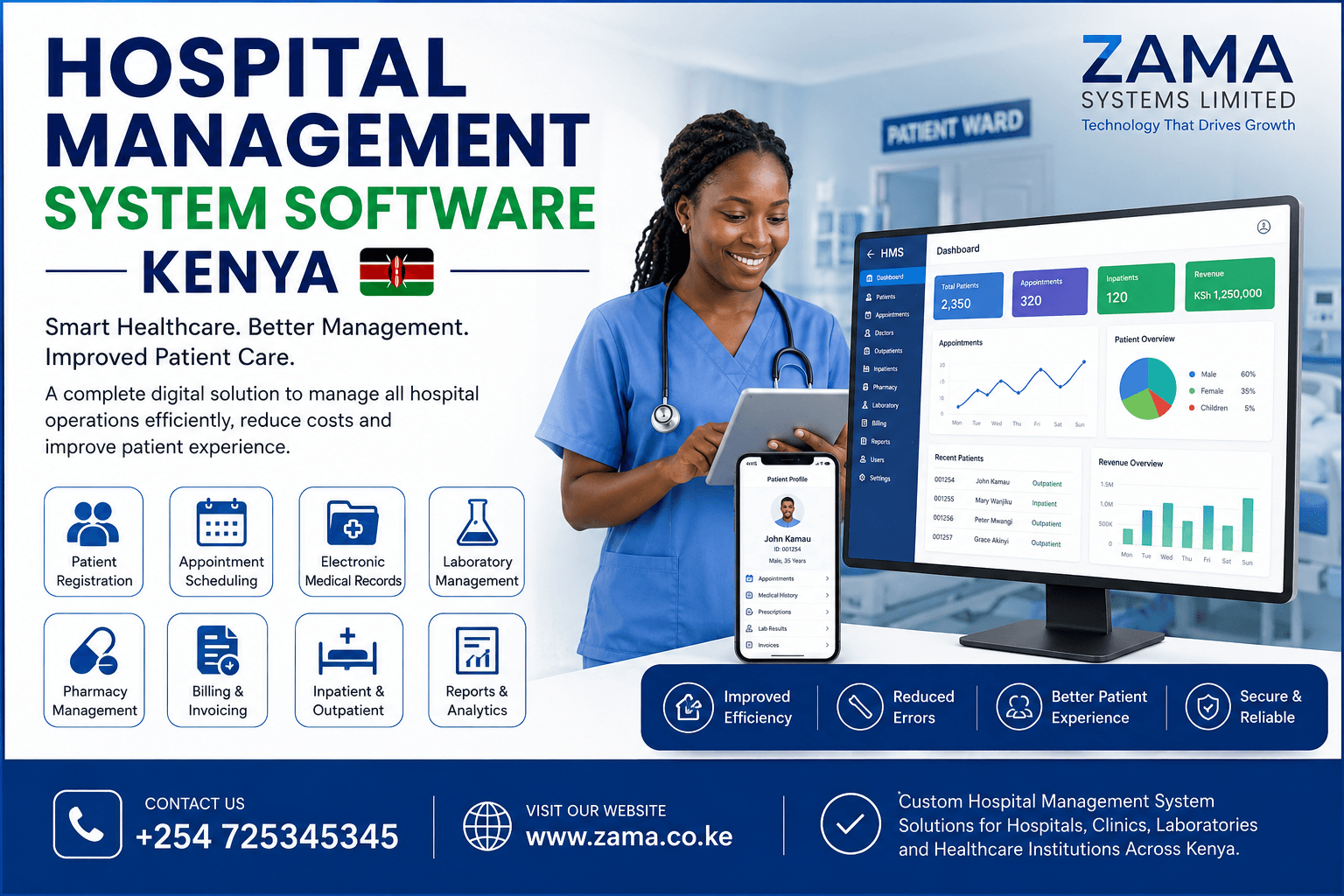
In today’s fast-growing healthcare sector, Hospital Management System Software in Kenya is no longer a luxury—it is a necessity. Hospitals, clinics, dispensaries, and private medical facilities are increasingly shifting from manual records to fully digital systems that improve efficiency, reduce errors, and enhance patient care.
At the center of this transformation is the need for reliable, secure, and scalable healthcare software solutions that can handle everything from patient registration to billing, laboratory results, pharmacy management, and reporting.
This guide explains everything you need to know about hospital management system software Kenya, its benefits, features, costs, and how your facility can implement a modern system successfully.
For customized hospital software development solutions, you can reach out to Zama Systems Limited at
Zama Systems Official Website
Contact: +254 725345345
What is Hospital Management System Software?
A Hospital Management System (HMS) is a digital platform designed to manage all hospital operations in a centralized system. It replaces paper-based processes with automated workflows, ensuring that healthcare providers can focus more on patients and less on administrative tasks.
A typical HMS integrates multiple departments such as:
- Reception & Patient Registration
- Doctor Consultation Management
- Laboratory & Diagnostics
- Pharmacy Management
- Billing & Insurance Processing
- Inpatient & Outpatient Management
- Electronic Medical Records (EMR)
In Kenya, hospitals are adopting HMS solutions to improve service delivery, comply with regulatory standards, and reduce operational costs.
Why Hospital Management System Software is Important in Kenya
Healthcare facilities in Kenya face several challenges, including overcrowding, manual record keeping, billing errors, and delayed patient service delivery.
A well-designed hospital management system software Kenya solves these challenges by introducing automation and accuracy.
1. Improved Efficiency
Hospital staff can quickly register patients, retrieve records, and process payments without delays.
2. Reduced Human Errors
Manual record keeping often leads to duplication and data loss. Digital systems eliminate these issues.
3. Better Patient Experience
Patients spend less time waiting and receive faster service.
4. Centralized Data Management
All departments access the same database, ensuring consistency and accuracy.
5. Enhanced Reporting
Hospitals can generate real-time reports for decision-making and compliance.
Key Features of Hospital Management System Software Kenya
A modern HMS includes several modules designed to manage different hospital operations.
1. Patient Registration System
This module captures patient details such as:
- Name
- Age
- Gender
- Contact information
- Medical history
It assigns each patient a unique ID for tracking.
2. Appointment Scheduling System
Patients can book appointments with doctors easily, reducing queues and congestion.
3. Electronic Medical Records (EMR)
This is one of the most important components. It stores:
- Diagnosis history
- Treatment plans
- Lab results
- Prescriptions
4. Pharmacy Management System
Tracks:
- Drug inventory
- Prescriptions
- Stock levels
- Expiry dates
5. Laboratory Information System
Manages:
- Test requests
- Sample tracking
- Result entry
- Report generation
6. Billing & Payment System
Handles:
- Patient invoices
- Insurance claims
- Payment tracking
- Receipts generation
7. Inpatient & Outpatient Management
Tracks patient admission, discharge, and ward allocation.
8. Reporting Dashboard
Provides hospital administrators with insights such as:
- Revenue reports
- Patient statistics
- Department performance
Benefits of Hospital Management System Software in Kenya
1. Faster Service Delivery
Automation reduces waiting times and improves workflow.
2. Cost Reduction
Hospitals save money on paper, storage, and manual labor.
3. Data Security
Digital systems secure patient records using encryption and backups.
4. Regulatory Compliance
Hospitals can meet healthcare compliance requirements more easily.
5. Scalability
Systems can grow with the hospital—from small clinics to large institutions.
Hospital Management System Software Development in Kenya
Many healthcare institutions in Kenya prefer custom-built solutions rather than off-the-shelf software. This is because each hospital has unique workflows.
A custom system allows:
- Personalized dashboards
- Custom reporting formats
- Integration with existing systems
- Local payment gateway integration (M-Pesa, bank systems)
- Multi-branch hospital management
Why Custom Software is Better
Unlike generic software, custom HMS solutions are tailored to your hospital’s exact needs. This improves usability and efficiency.
For example, a small clinic in Kiambu may need a simple patient registration system, while a large hospital in Nairobi may require advanced multi-department integration.
Who Needs Hospital Management System Software in Kenya?
This software is suitable for:
- Public hospitals
- Private hospitals
- Clinics and dispensaries
- Medical laboratories
- Pharmacies
- Health NGOs
- Specialist medical centers
Challenges Solved by Hospital Management Systems
1. Long Queues
Patients are served faster through digital check-ins.
2. Lost Patient Records
All data is stored securely in a centralized system.
3. Billing Errors
Automated billing reduces miscalculations.
4. Stock Mismanagement in Pharmacies
Inventory tracking prevents shortages and overstocking.
5. Poor Communication Between Departments
All departments share real-time information.
Technology Used in Hospital Management Systems
Modern HMS platforms in Kenya are built using reliable technologies such as:
- Java (Enterprise applications)
- C# (.NET systems)
- PHP (Laravel frameworks)
- MySQL / PostgreSQL databases
- Cloud computing (AWS, Azure, or local hosting)
- Mobile integration (Android apps for doctors/nurses)
Integration with Kenyan Systems
A strong hospital management system software Kenya should support local integrations such as:
- M-Pesa payment system
- NHIF billing and claims
- Insurance providers
- SMS notifications for patients
- Email appointment reminders
This ensures smooth operation within the Kenyan healthcare ecosystem.
Cost of Hospital Management System Software in Kenya
The cost varies depending on:
- Size of hospital
- Number of users
- Features required
- Customization level
- Support and maintenance
Estimated Pricing Ranges:
- Small clinics: Affordable entry-level systems
- Medium hospitals: Mid-range customized systems
- Large hospitals: Enterprise-level solutions with full integration
Custom systems may require higher initial investment but offer long-term savings.
Choosing the Right Hospital Management System Provider in Kenya
When selecting a software provider, consider:
1. Experience
Choose developers with healthcare software experience.
2. Scalability
Ensure the system can grow with your hospital.
3. Support Services
24/7 technical support is essential.
4. Security Features
Data protection must meet healthcare standards.
5. Customization Options
The system should match your hospital workflow.
Why Choose Zama Systems Limited
Zama Systems Limited is a Kenyan-based IT company specializing in:
- Custom software development
- Hospital management systems
- Web development
- Enterprise IT solutions
We build scalable and secure healthcare systems designed specifically for Kenyan hospitals and clinics.
Learn more at
Zama Systems Official Website
📞 Contact: +254 725345345
Future of Hospital Management Systems in Kenya
The future of healthcare in Kenya is digital. Hospital management systems are evolving to include:
- Artificial Intelligence (AI) for diagnosis support
- Telemedicine integration
- Mobile health applications
- Cloud-based hospital systems
- Predictive analytics for patient care
Hospitals that adopt these technologies early will have a significant advantage in service delivery.