
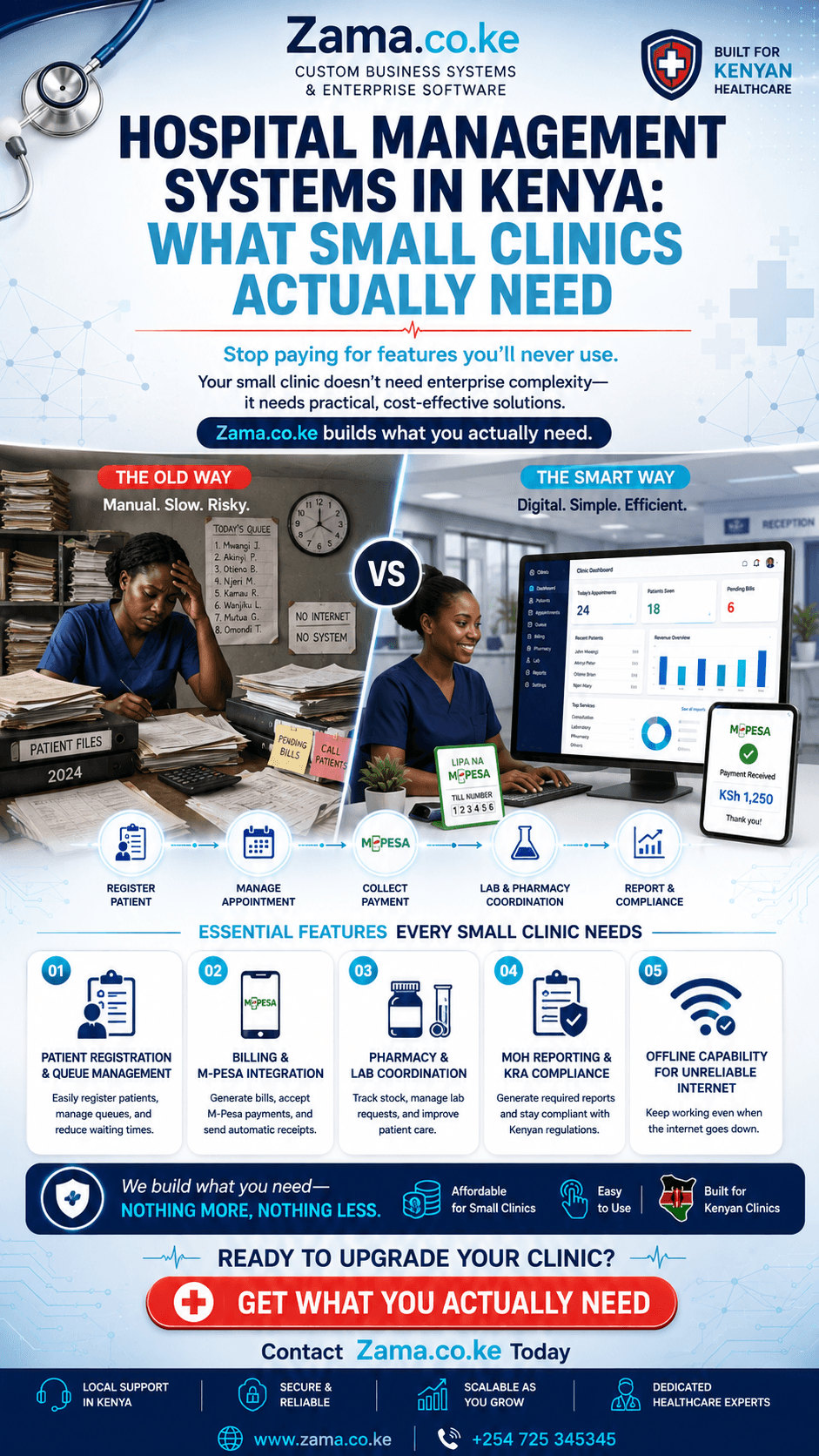
Hospital management systems in Kenya: what small clinics actually need is a question that every private clinic owner, medical practitioner, and healthcare entrepreneur in Kenya must answer in 2026. With over 3,000 small private clinics across Kenya serving millions of patients, the pressure to digitize operations has never been greater. At zama.co.ke, we’ve helped numerous healthcare providers across Kenya build custom clinic management solutions that address their unique operational challenges. This comprehensive guide explores hospital management systems in Kenya: what small clinics actually need, from patient registration to billing, pharmacy coordination, and regulatory compliance.
The Reality of Running a Small Clinic in Kenya Today
Before diving into hospital management systems in Kenya: what small clinics actually need, it’s important to understand the operational environment. Small clinics in Kenya face a unique set of challenges that larger hospitals don’t experience:
Paper-Based Chaos: Across Kenya, more than 1 million pages of paper patient records are turned over each year—costs that could be redirected to better care. Small clinics typically operate with filing cabinets, handwritten notes, and manual processes that slow everything down.
High Patient Volumes, Limited Staff: Kenyan clinics, especially in Nairobi and Mombasa, juggle high patient volumes with limited staff, making efficiency critical.
Strict Regulatory Requirements: Clinics must comply with Kenya Revenue Authority (KRA) reporting, the Data Protection Act, and Ministry of Health reporting requirements like MOH 705A & 705B, 711, 710, 717, and MOH 505.
Financial Constraints: Most small clinics operate on tight margins, making cost-effective solutions essential. A 200-bed hospital can reduce its paper spend from KSh 2.4 million to KSh 450,000 within six months by going digital.
Limited Internet and Power: Many clinics face unreliable internet and electricity, requiring systems that work offline.
Understanding these realities is the first step in identifying hospital management systems in Kenya: what small clinics actually need.
Essential Features Small Clinics Actually Need
When evaluating hospital management systems in Kenya: what small clinics actually need, focus on these core features:
1. Patient Registration and Queue Management
Small clinics need a simple way to register patients and manage queues. This is often the most immediate pain point. Features should include:
Registration: Capturing patient demographics, medical history, allergies, and medications in one place.
Queue Tracking: Appointments, walk-ins, visit status, and movement from front desk to discharge should be visible to all staff.
Visit History: Quick access to a patient’s full medical history without digging through filing cabinets.
When implementing hospital management systems in Kenya: what small clinics actually need, queue visibility is often the most valued improvement. One clinic reported reducing waiting room time from 30 to 12 minutes after implementing a digital system.
2. Billing, Cashier, and Claims Management
Revenue visibility weakens when invoices, receipts, claims records, and cashier actions are not tied cleanly to the visit flow. Small clinics need:
Invoice Generation: Automatic invoicing linked to services provided.
Payment Tracking: Integration with M-Pesa for automated payment reconciliation. Clinics that integrated M-Pesa payments reduced billing disputes by 73%.
Insurance Claims: Tracking claims records and insurance reimbursements.
KRA Compliance: Generating invoices that feed directly into the Kenya Revenue Authority portal, reducing manual entry errors that currently cost an average clinic KSh 120,000 per year.
Revenue Reports: Dashboards showing revenue streams at a glance.
3. Pharmacy and Laboratory Coordination
Requests, results, dispensing, and handoffs are harder to track when each department operates on isolated records. Small clinics need:
Lab Requests: Digital submission of lab tests from clinicians.
Results Status: Visibility of pending and completed results.
Dispensing Logs: Tracking of medication dispensing.
Department History: Complete view of patient activity across pharmacy and lab services.
4. Electronic Medical Records (EMR)
A shared system keeps the patient and visit context visible as clinical activity moves through the workflow. Small clinics need:
Digital Patient Records: Moving from paper charts to digital records saves significant costs. A Nairobi hospital reported saving KSh 12 million annually by switching from paper charts to a digital system.
Secure Storage: Cloud-based records reduce physical space costs by up to 70% and ensure records can’t be lost.
Role-Based Access: Only authorized staff can view sensitive records. A nurse sees vitals, a pharmacist sees prescriptions, and the CFO sees financials.
Audit Trails: Tracking who accessed what, when, and from which device to comply with data protection regulations.
5. Appointment Scheduling
Patients prefer to book consultations from their phones—especially in urban centers like Nairobi, Mombasa, Nakuru, and Kisumu. Small clinics need:
Calendar Views: Scheduling with resource assignment for doctors, rooms, and equipment.
Patient Reminders: Automated SMS reminders to reduce no-shows.
Online Booking: Patients booking consultations online through a clinic website or portal.
6. Management Dashboards and Reporting
Leaders often depend on manually compiled reports that arrive too late to guide action. Small clinics need:
KPI Dashboards: Monitoring bed occupancy, drug stock, and revenue streams at a glance.
Trend Reports: Identifying patterns in patient volumes, revenue, and clinical outcomes.
Operational Summaries: Actionable management summaries reducing dependence on manual compilation.
MOH Reports: One-touch access to MOH Reports including MOH 705A & 705B, 711, 710, 717, MOH 505 – Weekly IDSR, MOH 706, and MOH 643.
7. Document and Record Management
Shared folders and email attachments create version confusion, weak access control, and difficulty retrieving the latest record when teams are under pressure. Small clinics need:
Role-Based Access: Structured access based on job function.
Document History: Tracking changes to patient records over time.
Searchability: Quick retrieval of patient records.
Record Views: Clear presentation of patient information.
8. Offline Capability
In parts of Nairobi and Mombasa, bandwidth can be spotty. Small clinics need:
Offline Mode: Systems that work without internet and sync when connection is restored.
Lightweight Architecture: Systems optimized for low-bandwidth networks.
Local Data Storage: Data stored locally with automatic cloud backup.
9. M-Pesa Integration
Kenyan patients expect to pay via mobile money. Small clinics need:
M-Pesa Payment Collection: Patients paying directly from their phones.
Automated Reconciliation: Payment confirmation automatically updating patient accounts.
Payment-Triggered Workflows: Confirming enrollment or scheduling service delivery upon successful payment.
10. Multilingual Support
Avoid language barriers with English and Swahili interfaces. Small clinics need staff and patients to understand the system, making multilingual support essential.
What Small Clinics DON’T Need
When evaluating hospital management systems in Kenya: what small clinics actually need, it’s equally important to know what to avoid:
Complex Enterprise Features: Large hospital features like full ERP integration, advanced HR modules, or complex supply chain management are often overkill for small clinics.
Expensive Hardware Requirements: Systems requiring high-spec servers or specialized hardware create unnecessary costs.
Proprietary Lock-In: Solutions that make it difficult to move data to another system limit flexibility.
Overly Complex User Interfaces: Clinics need simple, intuitive systems that staff can learn quickly.
Features You’ll Never Use: Paying for features that don’t match your workflow wastes money.
Industry-Specific Considerations
Private Clinics in Nairobi and Mombasa
Urban clinics face high patient volumes and competition. Hospital management systems in Kenya: what small clinics actually need for urban clinics includes:
Online appointment booking
M-Pesa integration
Mobile-first design
Fast patient registration
Digital queue management
Rural and Peri-Urban Clinics
Rural clinics face infrastructure challenges. Hospital management systems in Kenya: what small clinics actually need for rural clinics includes:
Offline mode for unreliable internet
Low-bandwidth optimization
Solar power compatibility
Simple, easy-to-train interfaces
Specialized Clinics
Specialized clinics (fertility, dental, eye, etc.) have unique needs. Hospital management systems in Kenya: what small clinics actually need for specialized clinics includes:
Custom clinical forms and questionnaires
Specialized appointment scheduling
Patient-specific tracking
The Cost of Paper-Based Operations
Understanding what small clinics actually need starts with understanding what paper-based operations cost:
Paper and Storage Costs: A 200-bed hospital reduced its paper spend from KSh 2.4 million to KSh 450,000 within six months by digitizing.
Staff Inefficiency: Administrative time dropped from 30% to 12% of a nurse’s shift after digitization, freeing staff for patient care.
Revenue Loss: Faster billing cycles increased cash flow by 15%, allowing reinvestment in new equipment.
Regulatory Penalties: Manual compilation invites KRA penalties and compliance issues.
Customer Friction: Patients frustrated by long waiting times may seek care elsewhere.
The Zama.co.ke Approach
When considering hospital management systems in Kenya: what small clinics actually need, zama.co.ke follows a structured process:
Operational Discovery
We define the clinic’s patient intake, visits, finance handling, departmental handoffs, and management reports. This includes:
Current workflow mapping
Pain point identification
Key Performance Indicator definition
Integration requirements
System Design
Modules, data structure, permissions, user journeys, and reporting layers are planned so the platform supports the business model coherently.
Build and Integrate
Core modules, dashboards, automation logic, and external connections are developed in stages with review checkpoints against agreed requirements.
Validation and Rollout Readiness
Critical workflows, user roles, integrations, calculations, and reporting behavior are tested so the system can be adopted with confidence.
Post-Launch Support
After go-live, we support stabilization, user feedback, ongoing maintenance, and the next round of improvements informed by real usage.
The Business Case for Custom Solutions
When determining hospital management systems in Kenya: what small clinics actually need, the choice between off-the-shelf and custom solutions matters:
The Problem with Generic Software
Generic software is rarely designed specifically for the Kenyan clinic environment. It may lack:
M-Pesa integration
KRA compliance features
MOH reporting capabilities
Offline functionality
Swahili language support
The Custom Advantage
A custom hospital management systems in Kenya: what small clinics actually need solution built with zama.co.ke provides:
Workflow alignment with your actual operations
Only the features you need
Integration with tools you already use
Scalability as your clinic grows
Local compliance built-in
Real-World Examples
HIV Hospice in Nairobi uses a custom EHR, cutting filing costs by KSh 150,000 annually.
Karibu Hospital in Kilimani migrated to a cloud-based EHR and now boasts a 98% patient-record accuracy rate.
Common Implementation Challenges and Solutions
Challenge 1: Staff Resistance to Change
Solution: Training workshops with hands-on sessions, identifying tech-savvy champions who can mentor peers, and celebrating wins publicly. When a small clinic in Kisumu piloted a new system, saving KSh 5,000 in printing costs spurred the entire team to embrace the change.
Challenge 2: Infrastructure Limitations
Solution: Systems optimized for low-bandwidth networks, offline mode capabilities, and solar power compatibility where needed.
Challenge 3: Cost Constraints
Solution: Start with core features, implement in phases, and use open-source technology where possible to keep costs manageable.
Challenge 4: Data Security and Compliance
Solution: Role-based access controls, encryption meeting PDPA standards, regular backups, and audit trails built into the system.
ROI of Proper Clinic Management Systems
When considering hospital management systems in Kenya: what small clinics actually need, the return on investment is compelling:
Paper Savings: Clinics can reduce paper spend by up to 70%.
Staff Efficiency: Administrative time can drop from 30% to 12% of a nurse’s shift.
Revenue Growth: Faster billing cycles can increase cash flow by 15%.
Error Reduction: Data entry errors costing an average clinic KSh 120,000 per year can be eliminated.
Regulatory Compliance: Automated KRA and MOH reporting reduces penalties and compliance time.
Patient Satisfaction: Shorter waiting times and better service improve retention and referrals.
Hospital management systems in Kenya: what small clinics actually need is a question that requires understanding the unique operational context of Kenyan clinics. Small clinics don’t need enterprise-level complexity—they need practical, cost-effective solutions that address their specific challenges:
Patient registration and queue management
Billing and claims management
Pharmacy and lab coordination
Electronic medical records
Appointment scheduling
Management dashboards
Document management
Offline capability
M-Pesa integration
Multilingual support
At zama.co.ke, we’ve helped healthcare providers across Kenya build custom clinic management solutions that address their unique needs. Our approach ensures you get exactly what you need—nothing more, nothing less.
Don’t let the complexity of hospital management systems in Kenya: what small clinics actually need hold you back. Whether you’re starting from scratch or upgrading an existing system, we have the expertise to guide you through every step of the journey.
Contact zama.co.ke today and let us help you build a clinic management system that transforms your operations, improves patient care, and grows your practice.
The question isn’t whether you need hospital management systems in Kenya: what small clinics actually need—it’s whether you’ll implement it with the right partner. Choose Zama.co.ke for expertise, reliability, and results that matter.