
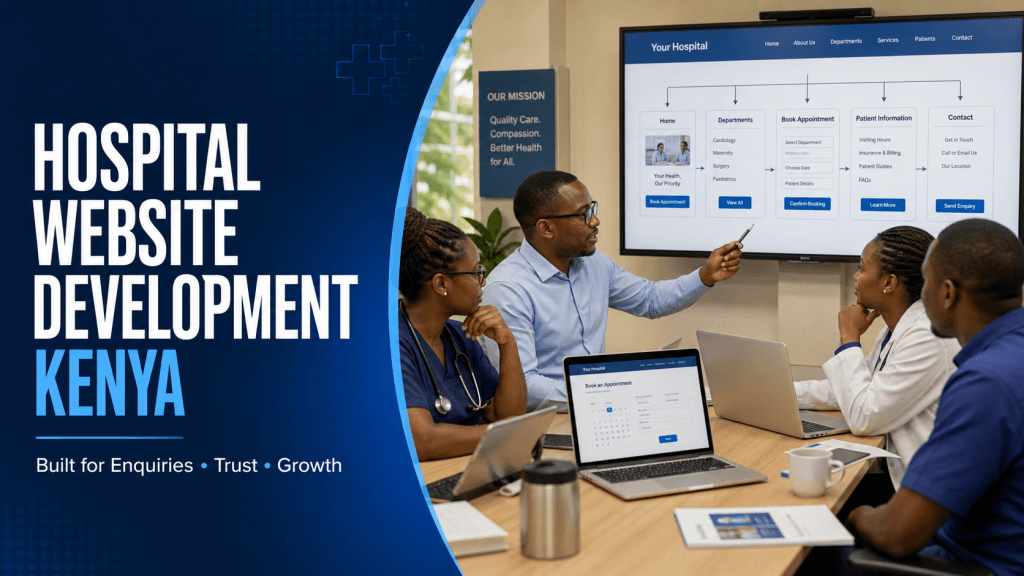
Primary keyword: Hospital Website Development Kenya
Hospital Website Development Kenya: Build Trust, Capture Enquiries and Support Real Workflows

A strong Hospital Website Development Kenya should do more than make an organisation look modern. It should help the right visitor understand the offer, verify credibility, complete the next step and receive a dependable response.
For hospitals, clinics, laboratories and specialist healthcare providers, the commercial problem is clear: patients struggle to find departments, specialists, opening hours, locations and dependable appointment pathways. The platform should therefore make trustworthy healthcare information and appointments easier to access.
Zama Systems approaches websites as part of a wider digital workflow. Public pages, forms, payments, portals, dashboards and business systems should work together.
Why Hospital Website Development Kenya Is a Business Priority
Prospects usually visit a website before calling, booking, requesting a quotation or submitting documents. They are testing whether the organisation is relevant, credible, current and capable.
When information is thin or outdated, serious visitors quietly leave. A weak website can hide lost demand: the organisation may think the market is slow when prospects simply cannot verify the offer or complete the next step.
Discovery should map what brought the visitor, which questions must be answered, what proof reduces risk, what information the organisation needs and who owns the response.
Essential Features for Hospital Website Development Kenya
Features should remove friction from a real decision or workflow:
- department and service pages planned around users, ownership, measurement and support.
- doctor profiles planned around users, ownership, measurement and support.
- appointment workflows planned around users, ownership, measurement and support.
- branch and emergency information planned around users, ownership, measurement and support.
- patient education resources planned around users, ownership, measurement and support.
- privacy-conscious enquiry handling planned around users, ownership, measurement and support.
| Capability | Implementation question |
|---|---|
| department and service pages | Define the user, required information, exception handling, success measure and accountable owner. |
| doctor profiles | Define the user, required information, exception handling, success measure and accountable owner. |
| appointment workflows | Define the user, required information, exception handling, success measure and accountable owner. |
| branch and emergency information | Define the user, required information, exception handling, success measure and accountable owner. |
| patient education resources | Define the user, required information, exception handling, success measure and accountable owner. |
| privacy-conscious enquiry handling | Define the user, required information, exception handling, success measure and accountable owner. |
The first release should focus on the actions most likely to create value, then improve using search, enquiry and user evidence.
Proof That Builds Buyer Confidence
The platform should provide licensed services, clinician profiles, facility information and accreditations. Proof must be specific, current and connected to the service being considered.
Generic claims such as “best quality” do little alone. Buyers need names, dates, locations, specifications, outcomes, credentials, references or a clearly described delivery process.
Real teams, facilities, projects, products and environments build more trust than unrelated stock photographs. Sensitive photographs and testimonials require permission.
Turn Visitors Into Qualified Enquiries
A conversion path should request enough information to route and assess an enquiry without creating unnecessary friction. A consultation differs from a booking, application, product order, viewing or quotation.
Calls, forms, WhatsApp, downloads, bookings and payments should be measured. Source data should be preserved so management can see which pages create opportunities.
Each enquiry needs an assigned team, expected response time, status and follow-up process. Otherwise a polished form only delivers leads into another unmanaged inbox.
Security, Privacy and Operational Risk
The project must explicitly address patient privacy, inaccurate medical claims and sensitive form data. Security includes role-based access, protected credentials, safe updates, backups, validation, monitoring and recovery.
Collect only information the organisation can protect and legitimately use. Sensitive uploads, health information, student data, payment records and commercial documents require appropriate controls.
How Zama Systems Delivers
1. Discovery and evidence audit
We identify target visitors, services, proof, existing rankings, integrations, responsibilities and the business measure the platform must improve.
2. Information architecture
We map service, industry, location, proof and resource pages so each important intent has one strong destination instead of duplicated thin articles.
3. Workflow and interface design
We design the visitor journey and internal response process together. Stakeholders review realistic flows before development becomes expensive to change.
4. Development and integration
The platform is built for mobile use, content management, search structure, analytics, security and agreed integrations. Working demonstrations make progress visible.
5. Migration and SEO protection
Existing URLs, metadata and useful content are inventoried. Redirects and canonicals protect accumulated authority.
6. Testing, launch and support
We test forms, permissions, devices, performance, analytics and critical integrations, then monitor launch and prioritise improvement.
Cost and Provider Selection
The cost of Hospital Website Development Kenya depends on content depth, workflows, integrations, migration, design, security, testing and support. Comparing proposals only by page count hides the work required for a reliable result.
Ask how the provider will protect rankings, validate enquiries, test mobile users, handle administrator access, document integrations and measure outcomes. Request relevant evidence.
A phased release is often safest: launch the highest-value journey, measure results and expand using evidence.
Discuss Your Hospital Website Development Kenya Project
Tell Zama Systems which visitors you need, what they must verify and what should happen after they enquire.
Frequently Asked Questions About Hospital Website Development Kenya
What should Hospital Website Development Kenya include?
It should combine clear service information, credible proof, mobile usability, focused calls to action, analytics and the workflows buyers expect.
How much does Hospital Website Development Kenya cost?
Cost depends on content, integrations, migration, security, design, testing and support. Discovery should define the first useful release before a responsible quotation.
How long does the project take?
A focused business website may take several weeks; an integrated portal can take longer. Content, decisions and integration access affect the schedule.
Can an existing website be improved?
Yes. An audit can identify which content, URLs, rankings and systems should be preserved before planning improvements.
Can the platform integrate M-Pesa, CRM or other systems?
Yes, subject to provider access. Integrations may include M-Pesa, email, WhatsApp, CRM, ERP, booking, identity and analytics.
Who owns the website and its data?
Ownership, hosting, administrator access, source files, licences and data-export rights should be documented in the agreement.
How will it generate enquiries?
Each page needs a specific visitor, question, proof point and next action. Calls, forms, WhatsApp and transactions should be measured.
Can Zama Systems provide support?
Yes. Support can cover updates, backups, security, monitoring, content, analytics and incident response.