
Hotel Management Software vs Manual Booking: Which Is Better for Modern Hotels?
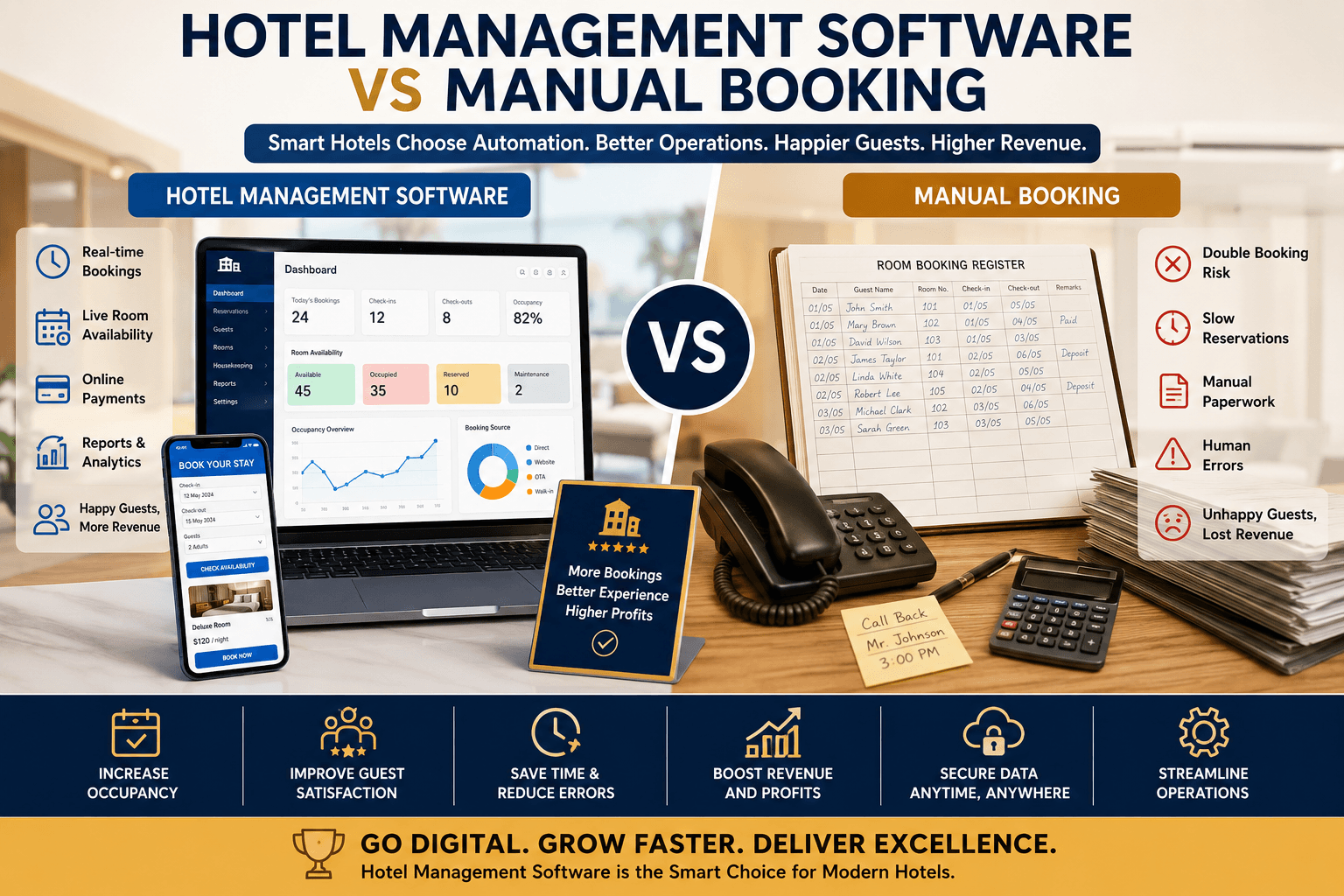
The hospitality industry has evolved rapidly over the last decade. Guests now expect instant confirmations, online reservations, seamless payments, and excellent customer service. This shift has forced hotel owners to rethink traditional operations. One of the biggest debates today is Hotel Management Software vs Manual Booking.
Many small hotels, guest houses, lodges, and resorts still rely on notebooks, spreadsheets, and manual reservation methods. While this approach may seem inexpensive, it often results in double bookings, lost revenue, poor customer experiences, and inefficient operations.
On the other hand, modern Hotel Management Software vs Manual Booking comparisons consistently show that software simplifies reservations, automates daily operations, improves guest satisfaction, and increases profitability.
In this comprehensive guide, we’ll explore every aspect of Hotel Management Software vs Manual Booking, helping hotel owners decide which solution best suits their business.
What Is Hotel Management Software?
Hotel Management Software is a digital platform designed to automate hotel operations including:
- Room reservations
- Guest check-ins
- Guest check-outs
- Online bookings
- Payment processing
- Housekeeping management
- Room availability
- Staff scheduling
- Financial reporting
- Customer relationship management
Instead of maintaining physical booking registers, hotel staff can manage everything through one centralized dashboard.
This is why discussions around Hotel Management Software vs Manual Booking have become increasingly important across the hospitality industry.
What Is Manual Booking?
Manual booking refers to handling reservations using traditional methods such as:
- Paper booking registers
- Diaries
- Phone calls
- Walk-in reservations
- Excel spreadsheets
- Physical receipts
- Handwritten guest records
Although this method has been used for decades, it becomes increasingly difficult as hotels grow.
This is the major reason many businesses compare Hotel Management Software vs Manual Booking before investing in technology.
Why This Comparison Matters
Choosing between Hotel Management Software vs Manual Booking affects nearly every part of your business.
It determines:
- Guest satisfaction
- Staff productivity
- Revenue generation
- Booking accuracy
- Business growth
- Operational efficiency
A poor reservation system can lead to unhappy customers, while an efficient one can significantly increase repeat bookings.
How Manual Booking Works
Traditional hotels often follow these steps:
- Customer calls.
- Staff checks the booking register.
- Room availability is confirmed manually.
- Reservation is written in a notebook.
- Payment details are recorded separately.
- Guest information is filed manually.
- Check-in is completed using paperwork.
While simple, the process is slow and prone to mistakes.
How Hotel Management Software Works
Modern software automates the entire booking journey.
A guest can:
- Book online
- Receive instant confirmation
- Pay securely
- Receive reminders
- Check in faster
- Receive digital invoices
Meanwhile, hotel managers monitor all reservations from one dashboard.
This demonstrates one of the biggest differences in Hotel Management Software vs Manual Booking.
Comparison Table
| Feature | Hotel Management Software | Manual Booking |
|---|---|---|
| Booking Speed | Instant | Slow |
| Online Reservations | Yes | No |
| Payment Integration | Yes | Limited |
| Double Booking Prevention | Automatic | Difficult |
| Reports | Automatic | Manual |
| Guest History | Stored | Paper Files |
| Mobile Access | Yes | No |
| Housekeeping Tracking | Automated | Manual |
| Revenue Reports | Real-time | Manual |
| Scalability | Excellent | Poor |
The comparison clearly favors Hotel Management Software vs Manual Booking for businesses aiming to scale efficiently.
Benefits of Hotel Management Software
When evaluating Hotel Management Software vs Manual Booking, the advantages of using hotel management software become clear. Modern hotels need speed, efficiency, and accuracy to remain competitive. Hotel management software provides all these benefits while reducing the workload on staff.
1. Eliminates Double Bookings
Double bookings are one of the most common problems with manual reservation systems. When multiple employees handle bookings simultaneously, mistakes can happen.
With hotel management software:
- Room availability updates automatically.
- Staff see real-time occupancy.
- Booking conflicts are prevented instantly.
- Guests receive immediate confirmation.
This is one of the strongest reasons businesses choose Hotel Management Software vs Manual Booking.
2. Faster Check-In and Check-Out
Guests value convenience. Waiting in long queues to check in or check out creates a poor first impression.
Hotel management software allows hotels to:
- Register guests in minutes.
- Store guest information securely.
- Generate invoices automatically.
- Process payments instantly.
- Email receipts immediately.
Compared to manual booking, this saves both staff and guests valuable time.
3. Online Booking Capability
Today’s travelers prefer booking accommodations online rather than making phone calls.
With hotel management software, hotels can:
- Accept bookings 24/7.
- Display live room availability.
- Process online payments.
- Reduce booking errors.
- Reach international customers.
In the debate of Hotel Management Software vs Manual Booking, online booking is a game changer that manual systems simply cannot match.
4. Better Guest Experience
Guest satisfaction is the foundation of a successful hotel business.
Hotel management software helps improve customer experience by:
- Sending booking confirmations instantly.
- Providing automated reminders.
- Recording guest preferences.
- Offering faster service.
- Reducing waiting times.
Happy guests are more likely to leave positive reviews and return for future stays.
5. Automated Billing
Manual invoices often contain calculation errors.
Hotel management software automatically calculates:
- Room charges
- Taxes
- Discounts
- Additional services
- Outstanding balances
Guests receive professional invoices while hotel staff save time and reduce mistakes.
6. Real-Time Room Availability
Managers always know:
- Occupied rooms
- Vacant rooms
- Reserved rooms
- Rooms under maintenance
- Rooms ready for cleaning
This visibility allows hotels to maximize occupancy and improve operational planning, making Hotel Management Software vs Manual Booking a clear winner in terms of efficiency.
7. Better Financial Reporting
Hotel owners need accurate financial information to make informed business decisions.
Hotel management software generates reports such as:
- Daily revenue
- Monthly income
- Occupancy rates
- Booking trends
- Payment summaries
- Outstanding balances
Manual booking requires hours of calculations and is more prone to human error.
8. Improved Staff Productivity
Automation reduces repetitive administrative tasks.
Instead of spending time on paperwork, employees can focus on:
- Guest service
- Housekeeping coordination
- Upselling hotel services
- Resolving guest requests
This increases productivity and enhances the overall guest experience.
9. Secure Data Storage
Paper records can be:
- Lost
- Damaged
- Misplaced
- Stolen
Hotel management software securely stores guest information, booking history, and financial records with backup options and controlled user access.
10. Multi-Property Management
If you own multiple hotels, manual booking becomes increasingly difficult.
Hotel management software enables managers to:
- Monitor all properties from one dashboard.
- Compare occupancy across locations.
- Generate consolidated reports.
- Manage centralized reservations.
This scalability is a major advantage when comparing Hotel Management Software vs Manual Booking.
Challenges of Manual Booking
Although manual booking may seem inexpensive at first, it presents several challenges as a hotel grows.
Human Errors
Employees can accidentally:
- Write incorrect dates.
- Assign the wrong room.
- Miss reservations.
- Duplicate bookings.
These mistakes often lead to guest dissatisfaction and lost revenue.
Slow Reservation Process
Every reservation requires manual verification, making the process slower during peak seasons.
Guests may become frustrated if they have to wait for confirmation.
Difficult Record Keeping
Over time, paper records accumulate, making it difficult to retrieve past reservations or guest information quickly.
Searching through files wastes valuable staff time.
Limited Business Insights
Manual systems do not provide instant reports on:
- Occupancy trends
- Revenue performance
- Booking channels
- Customer behavior
Managers must compile this information manually, delaying decision-making.
Increased Operational Costs
Although manual booking avoids software subscription fees, it often leads to higher hidden costs through:
- More administrative work
- Higher staffing requirements
- Lost bookings
- Revenue leakage
- Costly human errors
Over time, these costs can exceed the investment in hotel management software.
Cost Comparison: Hotel Management Software vs Manual Booking
Many hotel owners assume manual booking is cheaper because there is no software subscription. However, the long-term costs tell a different story.
Manual Booking Costs
- Paper registers
- Printing receipts
- Filing systems
- Additional administrative staff
- Human error losses
- Time spent on manual reporting
- Lost revenue from booking mistakes
Hotel Management Software Costs
- Monthly or annual subscription
- Initial setup and training
- Internet connection
- Occasional system upgrades
While software requires an upfront investment, it often delivers significant savings through improved efficiency and increased occupancy. In most cases, the return on investment makes Hotel Management Software vs Manual Booking an easy decision for growing hospitality businesses.
How Hotel Management Software Increases Revenue
One of the biggest reasons hotels invest in technology is to improve profitability. When comparing Hotel Management Software vs Manual Booking, revenue generation is one area where software consistently outperforms manual processes.
1. Higher Occupancy Rates
Hotel management software helps maximize room occupancy by:
- Displaying real-time room availability.
- Accepting online bookings 24/7.
- Reducing vacant rooms.
- Preventing booking conflicts.
- Managing reservations efficiently.
With manual booking, empty rooms may remain unsold because reservations are not updated quickly enough.
2. Fewer Lost Bookings
Manual booking often leads to:
- Missed phone calls
- Forgotten reservations
- Incorrect room allocation
- Delayed responses
Hotel management software records every inquiry and reservation automatically, reducing the chances of losing potential guests.
This is another major advantage in the Hotel Management Software vs Manual Booking comparison.
3. Better Pricing Management
Modern hotel software allows managers to:
- Adjust room rates instantly.
- Create seasonal pricing.
- Offer promotional discounts.
- Introduce weekend packages.
- Manage corporate rates.
Manual booking makes price management slow and inconsistent.
4. Upselling Opportunities
Hotel management software can help staff promote additional services such as:
- Airport transfers
- Breakfast packages
- Conference rooms
- Laundry services
- Spa treatments
- Guided tours
These additional services increase the average revenue per guest.
5. Repeat Business
The software stores guest profiles, making it easier to:
- Recognize returning guests.
- Offer personalized discounts.
- Send promotional emails.
- Celebrate birthdays and anniversaries.
- Build long-term customer loyalty.
Manual booking rarely provides this level of customer relationship management.
Security Comparison
Security is another important factor when comparing Hotel Management Software vs Manual Booking.
Manual Booking Risks
Hotels relying on paper records face risks such as:
- Fire damage
- Water damage
- Theft
- Misplaced files
- Unauthorized access
Once records are lost, recovering them is often impossible.
Hotel Management Software Security
Most modern systems include:
- Secure cloud backups.
- User permissions.
- Password protection.
- Activity logs.
- Data encryption.
- Automatic backups.
These features help protect sensitive guest information and financial records.
Staff Efficiency
Employees spend much of their day handling repetitive administrative tasks.
With manual booking, staff often:
- Answer repetitive booking inquiries.
- Search through reservation books.
- Calculate invoices manually.
- Prepare daily reports by hand.
- Update room availability manually.
Hotel management software automates these tasks, allowing staff to focus on delivering excellent guest experiences.
This operational efficiency is one of the strongest arguments for Hotel Management Software vs Manual Booking.
Customer Satisfaction
Happy guests are more likely to:
- Return for future stays.
- Recommend the hotel.
- Leave positive online reviews.
- Spend more on additional services.
Hotel management software enhances customer satisfaction by providing:
- Instant booking confirmations.
- Faster check-in and check-out.
- Accurate reservations.
- Personalized guest experiences.
- Quick responses to inquiries.
Manual booking, while functional, often struggles to meet the expectations of modern travelers.
Which Hotels Should Use Hotel Management Software?
Hotel management software is suitable for a wide range of accommodation businesses, including:
- Boutique hotels
- Resorts
- Guest houses
- Bed and breakfasts
- Lodges
- Hostels
- Serviced apartments
- Holiday rentals
- Vacation homes
Whether you operate 10 rooms or 500, adopting software can streamline operations and improve guest satisfaction.
When Manual Booking May Still Work
Despite its limitations, manual booking can still be practical in certain situations, such as:
- Very small lodges with only a few rooms.
- Newly established guest houses with limited budgets.
- Remote accommodations with unreliable internet access.
- Family-run businesses handling very few reservations.
However, as the business grows, the disadvantages of manual systems become increasingly apparent, making Hotel Management Software vs Manual Booking a crucial decision for long-term success.
Future Trends in Hotel Management
The hospitality industry continues to embrace digital innovation. Modern hotel management software is evolving with features such as:
- Artificial Intelligence (AI) for guest support.
- Mobile check-in and check-out.
- Contactless payments.
- Smart room integrations.
- Dynamic pricing based on demand.
- Automated housekeeping scheduling.
- Advanced analytics and forecasting.
Hotels that invest in these technologies will be better positioned to meet changing customer expectations and stay competitive.
Final Verdict: Hotel Management Software vs Manual Booking
After comparing every aspect of Hotel Management Software vs Manual Booking, the conclusion is clear. While manual booking may suit very small operations with minimal reservation volumes, it becomes inefficient and risky as a hotel grows.
Hotel management software offers:
- Faster reservations.
- Real-time room availability.
- Automated billing.
- Better financial reporting.
- Improved guest satisfaction.
- Stronger data security.
- Increased staff productivity.
- Higher occupancy rates.
- Greater revenue potential.
For hotels looking to improve efficiency, reduce operational costs, and deliver a superior guest experience, investing in hotel management software is a strategic decision that supports long-term growth.
As the hospitality industry becomes increasingly digital, choosing Hotel Management Software vs Manual Booking is no longer just about convenience—it is about staying competitive, maximizing profitability, and meeting the expectations of today’s travelers. Businesses that adopt modern hotel management software are better equipped to scale, adapt, and thrive in an increasingly competitive market.
Frequently Asked Questions (FAQs)
1. What is the main difference between Hotel Management Software vs Manual Booking?
The biggest difference is automation. Hotel Management Software vs Manual Booking compares a digital system that automates reservations, billing, reporting, and guest management against a manual process that relies on paper records, phone calls, and spreadsheets. Hotel management software reduces errors, saves time, and improves operational efficiency.
2. Is hotel management software suitable for small hotels?
Yes. Modern hotel management software is designed for businesses of all sizes, including:
- Small hotels
- Guest houses
- Lodges
- Boutique hotels
- Hostels
- Resorts
Many providers offer affordable monthly plans, making it easier for small businesses to adopt digital solutions.
3. Does hotel management software reduce double bookings?
Absolutely. One of the biggest advantages in Hotel Management Software vs Manual Booking is the prevention of double bookings. The software updates room availability in real time, ensuring that once a room is reserved, it is no longer available for another guest during the same dates.
4. Can hotel management software handle online reservations?
Yes. Most hotel management systems integrate with hotel websites and online booking platforms, allowing guests to:
- Check room availability
- Make reservations
- Pay online
- Receive instant booking confirmations
Manual booking usually requires phone calls or in-person reservations, limiting convenience.
5. Is hotel management software secure?
Modern hotel management software includes advanced security features such as:
- Data encryption
- Password-protected access
- Cloud backups
- User permissions
- Activity logs
These features help protect guest information and financial records far better than paper-based systems.
6. Does hotel management software improve customer service?
Yes. Hotel management software improves customer service by enabling:
- Faster check-ins and check-outs
- Accurate reservations
- Personalized guest profiles
- Quick billing
- Automated communication
These capabilities create a smoother and more enjoyable guest experience.
7. Is manual booking cheaper than hotel management software?
Manual booking may have lower upfront costs because it doesn’t require software subscriptions. However, hidden costs such as staff time, booking errors, lost reservations, and inefficient reporting often make it more expensive in the long run. This is why many businesses conclude that Hotel Management Software vs Manual Booking favors software for sustainable growth.
8. Can hotel management software generate reports?
Yes. Hotel management software can automatically generate reports including:
- Daily sales
- Occupancy rates
- Revenue summaries
- Booking trends
- Payment reports
- Guest history
These reports help managers make informed business decisions without spending hours compiling data manually.
Conclusion
The comparison between Hotel Management Software vs Manual Booking highlights how technology is transforming the hospitality industry. While manual booking may still work for very small accommodations with limited reservations, it struggles to meet the demands of modern hotel operations.
Hotel Management Software vs Manual Booking demonstrates that software delivers greater efficiency, fewer booking errors, improved guest experiences, stronger security, and better financial control. Hotels using modern software can automate reservations, streamline daily operations, monitor performance in real time, and provide the level of service today’s travelers expect.
For hotel owners planning long-term growth, the choice in Hotel Management Software vs Manual Booking is clear. Investing in hotel management software reduces administrative burdens, increases occupancy, supports smarter business decisions, and enhances profitability. As guest expectations continue to evolve, adopting digital solutions is no longer optional—it is a strategic investment in the future of your hospitality business.
By choosing hotel management software over manual booking, hotels can remain competitive, improve operational efficiency, and build stronger relationships with guests, ensuring sustainable success in an increasingly digital hospitality landscape.