
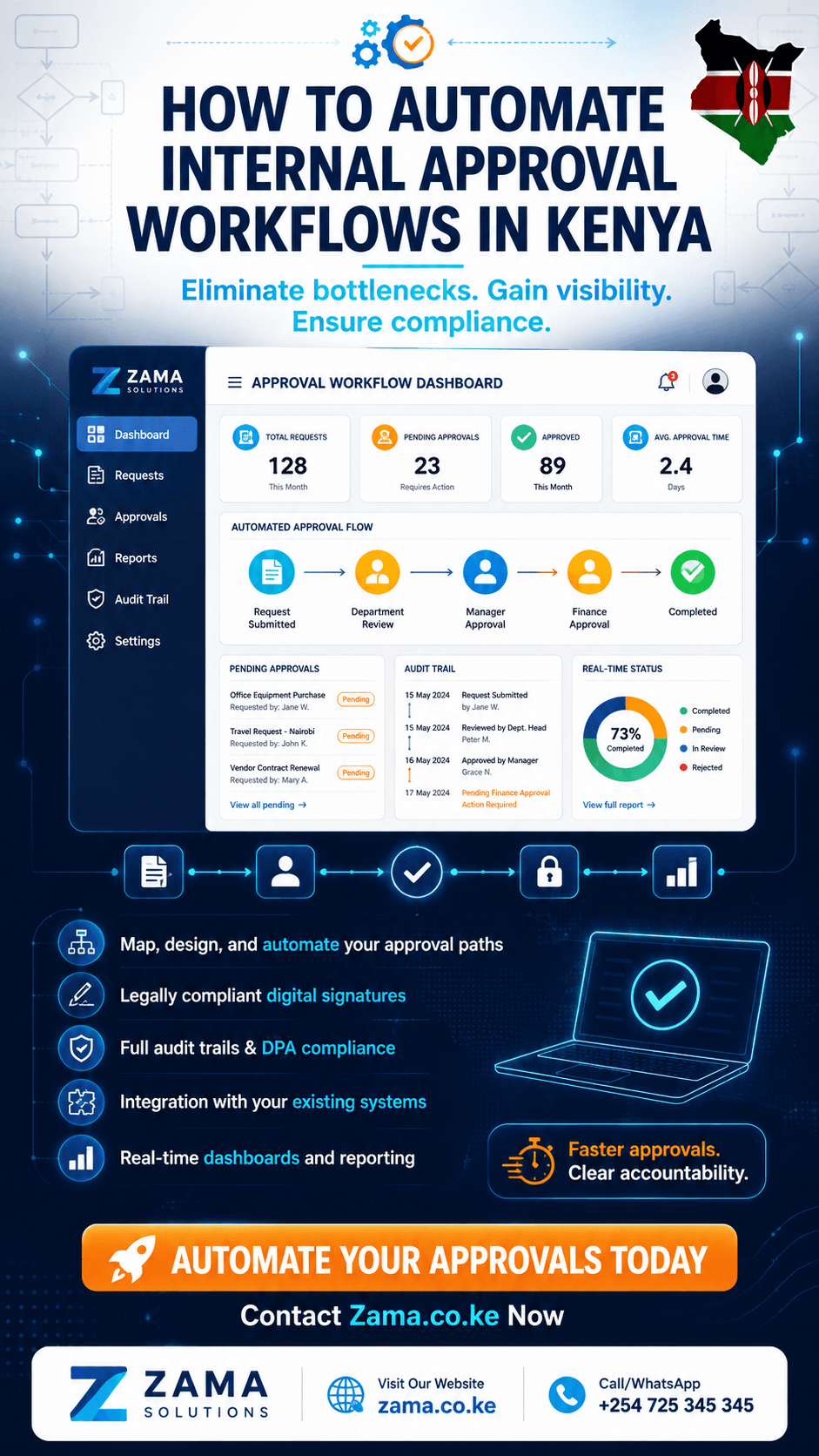
How to automate internal approval workflows in Kenya is a question that every operations manager, finance director, and business owner must answer in 2026. With organizations across Kenya losing valuable time to manual sign-offs, email chains, and paper-based approvals, the need for automation has become urgent. At zama.co.ke, we’ve helped numerous businesses and public sector organizations across Kenya implement automated approval systems that reduce processing time from days to hours and provide complete audit visibility. This comprehensive guide explores how to automate internal approval workflows in Kenya, from understanding the core components to implementing solutions that deliver measurable results.
The Cost of Manual Approvals in Kenyan Organizations
Before diving into how to automate internal approval workflows in Kenya, it’s essential to understand the current challenges. Manual approvals cost Kenyan organizations thousands of hours annually and create significant operational friction. Kenya’s premier public-health research organization, KEMRI, had automated many workflows in Dynamics ERP but lacked a native, legally binding digital-signature capability. As a result, manual sign-off processes delayed approvals by 3–5 days, scanned/PDF signatures carried non-compliance risk under Kenyan e-signature laws, and there was no centralized, tamper-proof audit trail for critical documents .
Similarly, I&M Bank faced significant challenges with manual procurement approvals. Before automation, the bank relied on hard copies and manual processes, making it extremely time-consuming to find approvers and confirm budgets. Order processing for partial deliveries could take anywhere from 2 to 6 weeks to confirm, retrieve documents, communicate with suppliers, and complete the order .
The National Treasury’s Public Financial Management Reforms Secretariat experienced fragmentation before implementing REFORMiS. Activity requests that now take minutes to approve once took days, and the organization suffered from duplicated effort, inconsistent formats, and the quiet loss of institutional memory every time an officer was transferred . These challenges are common across Kenyan organizations and highlight why how to automate internal approval workflows in Kenya has become a priority.
Understanding Internal Approval Workflow Automation
Internal approval workflow automation is the process of digitizing and streamlining the sequence of steps required to get decisions approved within an organization. This includes automating the routing of requests to the right approvers based on rules, providing real-time visibility into pending approvals, and maintaining complete audit trails .
At its core, how to automate internal approval workflows in Kenya involves understanding the approval paths, documenting the decision rules, selecting the right technology, and implementing systems that eliminate manual bottlenecks. Zama Systems builds enterprise platforms that route tasks, record actions, escalate pending items, and give managers a live view of throughput and unresolved work .
When considering how to automate internal approval workflows in Kenya, the most successful implementations start with business process re-engineering—mapping people, processes, policy, and technology before a single line of code is written .
Essential Components of Automated Approval Workflows
When evaluating how to automate internal approval workflows in Kenya, these components are essential:
1. Workflow Design and Process Mapping
The foundation of any automation project is understanding the current workflow. Before building any system, organizations should:
Map Current Processes: Document every step, decision point, and approver involved in the approval process. REFORMiS started with Business Process Re-engineering mapping people, processes, policy, and technology before a single line of code was written .
Identify Pain Points: Understand where delays occur, where information gets lost, and where bottlenecks are most severe.
Define Approval Rules: Document who needs to approve what, based on what criteria (amount, type, risk level, department). Beveron Smart Legal Counsel, for example, routes contracts automatically to the correct approver based on type, value, and risk level .
User-Centered Design: Turn pain points into system requirements through user-centered design sessions with actual users .
2. Automated Routing and Escalation
Modern approval systems eliminate manual handoffs. A proper implementation of how to automate internal approval workflows in Kenya should:
Route Automatically: Send requests to the right approver based on rules, not manual forwarding. This is a core capability of approval and workflow systems .
Escalate Pending Items: Automatically escalate requests that have been pending too long to higher authorities.
Support Parallel and Sequential Approvals: Handle both types of approval chains based on the business requirement.
Provide Clear Ownership: Every approver knows exactly what is waiting for their action.
3. Digital Signatures and Legal Compliance
For approvals that require legal validity, digital signatures are essential. The Kenya Medical Research Institute (KEMRI) implemented emSigner Gateway, an API-driven middleware that plugged into Microsoft Dynamics to deliver legally compliant, automated digital signatures without changing end-user workflows . The solution provided:
Legally Compliant Signatures: Direct integration with Kenya’s Root CA per the Electronic Certification Regulations .
Full Audit Trails: Timestamped, non-repudiable logs for each signature event .
Bulk Signing: Workflow-triggered approvals across departments .
4. Integration with Existing Systems
Automation should not require replacing all existing systems. When implementing how to automate internal approval workflows in Kenya, integration is critical:
ERP Integration: Connect with existing ERP systems like Microsoft Dynamics, SAP, or Odoo. KEMRI’s emSigner Gateway sat between Dynamics ERP and Kenya’s Root CA .
API-Based Integration: Zero-code impact on existing forms and approvals .
Email and Messaging Integration: Send notifications through email, SMS, or WhatsApp.
Payment Integration: Connect with M-Pesa for financial approvals and reconciliation.
5. Audit Trail and Compliance
Complete visibility is essential for compliance. A robust how to automate internal approval workflows in Kenya solution should:
Track Every Action: Show who did what, when, and why .
Provide Complete Audit Logs: Timestamped, tamper-proof records of every approval step .
Enable Compliance Reporting: Instant generation of compliance reports for regulators .
Support DPA Compliance: Align with Kenya’s Data Protection Act requirements.
6. Dashboards and Reporting
Visibility into the approval process is essential for management. Proper implementation of how to automate internal approval workflows in Kenya should:
Show Real-Time Status: Managers can see pending approvals and bottlenecks at a glance .
Track Performance: Monitor approval times, workload distribution, and trends.
Identify Bottlenecks: Spot where delays occur and take corrective action.
Generate Management Reports: Instant reports on approval throughput and efficiency .
Implementation Methodology
The most successful implementations of how to automate internal approval workflows in Kenya follow a structured methodology:
Phase 1: Discovery and Process Mapping
Before building anything, understand the current state. This involves documenting every approval workflow, identifying pain points, and defining success metrics . Zama Systems starts with a discovery call to define the business problem, users, workflows, reports, and current tools .
Phase 2: Solution Design
Based on the discovery, design the automated workflow. This includes defining approval rules, user roles, integration requirements, and reporting needs. REFORMiS used user-centered design sessions with MDA focal persons to turn pain points into system requirements .
Phase 3: Build and Configure
Build the system using the right technology. This may be custom development or configuring an existing platform. Zama Systems approaches software as part of the operating model, not just a screen design project .
Phase 4: Testing and Validation
Before going live, test the system thoroughly. REFORMiS used an agile delivery approach allowing teams to build, test, refine, and deploy modules in iterative sprints. Users were not passive recipients: they tested outputs in every sprint and validated workflows before rollout .
Phase 5: Training and Rollout
User adoption is critical. Provide hands-on training and ongoing support. REFORMiS conducted more than 40 training sessions, helpdesk support, and visible leadership recognition to turn initial sceptics into champions .
Phase 6: Post-Launch Optimization
After launch, monitor performance and refine based on user feedback. The goal is continuous improvement, not just a one-time deployment.
Real-World Success Stories
KEMRI: Sub-Hour Approvals
KEMRI implemented emSigner Gateway to automate digital signatures within their Dynamics ERP. Results were dramatic: approval times dropped from 3-5 days to under 60 minutes, paper usage fell by 95%, logistics costs were eliminated, and efficiency improved by 60% across procurement, finance, and HR .
REREC: Automated HR Workflows
The Rural Electrification and Renewable Energy Corporation automated core HR processes including onboarding, approvals, and record updates. Tasks that previously took days were completed in minutes, with digital trails ensuring traceability and compliance .
REFORMiS: Government Reform Coordination
Kenya’s National Treasury implemented REFORMiS to coordinate public financial management reforms across more than 39 MDAs. The platform now digitally manages more than 150 workplans and processes over 2,000 activity requests. Reporting that once took weeks is now completed in minutes .
I&M Bank: Faster Procurement
I&M Bank implemented Precoro to automate procurement approvals. Order processing time for partial deliveries dropped from 2-6 weeks to just a few days. The finance team gained instant access to custom reports, providing valuable insights into largest vendors, highest cost centers, and peak purchasing periods .
Nairobi Legal Team: 65% Faster Contract Approvals
A Nairobi-based corporate legal department deployed Beveron Smart Legal Counsel, reducing contract approval time by 65% through automated routing based on contract type, value, and risk level .
The Zama.co.ke Approach
When considering how to automate internal approval workflows in Kenya, zama.co.ke follows a structured approach:
Business-Process Understanding
We design systems around how the organization actually works instead of treating the project as a feature list with no operational structure .
Architecture That Supports Change
A good software foundation makes it easier to add modules, integrations, reports, and new user groups without rebuilding everything later .
Integration-Ready
We can connect payments, messaging, CRMs, legacy tools, and data services so the software becomes part of the wider operating environment .
Reliable Support
Software projects create value over time, so we stay available to maintain, refine, and extend the platform after launch .
Local Expertise
We understand the Kenyan regulatory landscape, compliance requirements, and operational realities .
How to automate internal approval workflows in Kenya is a critical question for any organization seeking to improve efficiency, accountability, and compliance. From KEMRI’s 60% efficiency uplift and sub-hour approvals to REREC’s automated HR workflows and REFORMiS’s transformation of government reform coordination, the benefits are proven and substantial .
At zama.co.ke, we’ve helped organizations across Kenya implement automated approval systems that deliver measurable results. Our approach ensures you get exactly what your organization needs—nothing more, nothing less.
Don’t let the complexity of how to automate internal approval workflows in Kenya hold you back. Whether you’re a small business or a large government agency, we have the expertise to guide you through every step.
Contact zama.co.ke today and let us help you build an automated approval workflow solution that transforms your operations.