
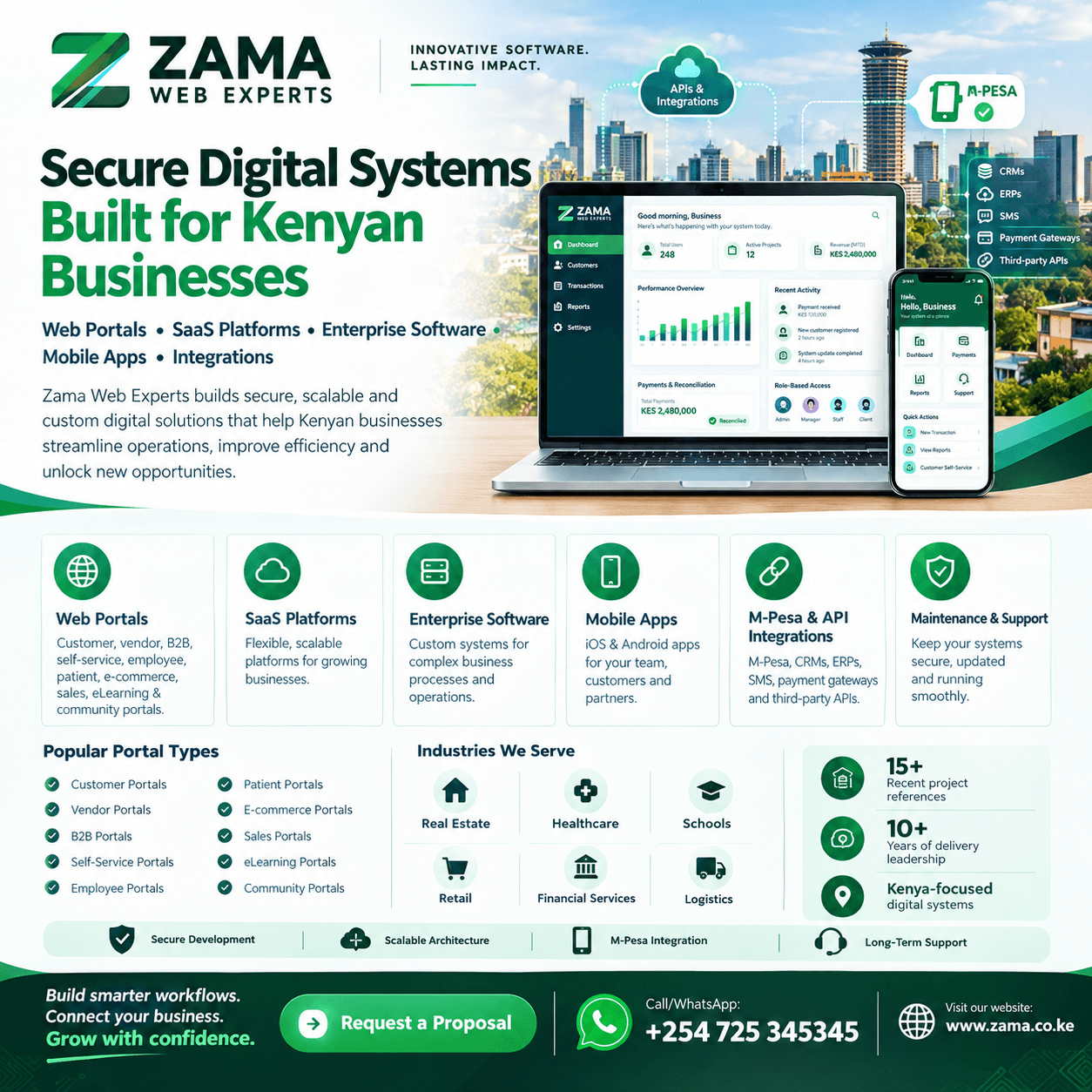
How to build a custom SaaS platform in Kenya is a question that every founder, software entrepreneur, and enterprise innovator must answer in 2026. With Kenya’s cloud and SaaS ecosystem expanding rapidly, mobile money processing over 2 trillion shillings annually, KRA eTIMS compliance mandatory for all VAT-registered businesses, and enterprises across every sector seeking digital solutions tailored to local realities, the opportunity for well-built SaaS platforms has never been greater. At zama.co.ke, we’ve helped numerous organizations across Kenya build custom SaaS platforms that serve real market needs, integrate with local payment rails, and scale reliably. This comprehensive guide explores how to build a custom SaaS platform in Kenya, from validating your idea to launching and scaling your platform.
Understanding What Custom SaaS Platforms Actually Are
Before diving into how to build a custom SaaS platform in Kenya, it’s essential to understand what you are building. A SaaS (Software as a Service) platform is a software product delivered over the internet on a subscription basis. Customers do not install software on their own computers or servers. They access it through a browser or mobile app, pay a recurring fee, and receive continuous updates and support.
A custom SaaS platform is built specifically for a defined market or use case, rather than being a generic tool. It could be a property management platform for Kenyan landlords, a school fee management system for private academies, a logistics dispatch platform for delivery companies, a clinic management system for small hospitals, or a procurement platform for county governments. The key is that it is designed for a specific customer segment with specific problems.
For a Kenyan founder or enterprise, the practical definition of how to build a custom SaaS platform in Kenya is this: the process of validating a market problem, designing a multi-tenant software architecture, integrating with local payment and compliance rails, building and testing the platform, launching it to paying customers, and scaling it sustainably.
Step One: Validate the Problem Before Writing Any Code
When learning how to build a custom SaaS platform in Kenya, the most common and expensive mistake is building first and selling later. Software is expensive to build. Building the wrong software is catastrophic.
Talk to Potential Customers
Before writing a single line of code, speak to at least twenty potential customers. Not to pitch them your idea, but to understand their problems. What are they doing manually today? What frustrates them? What would they pay to solve? How do they currently handle the workflow you intend to digitize?
For a Kenyan SaaS founder, this customer discovery phase is critical. The market realities of Kenyan businesses—limited budgets, mobile-first behavior, M-Pesa dependence, unreliable internet—are different from other markets. Assumptions based on foreign case studies often fail.
Identify a Painful, Repetitive Problem
The best SaaS platforms solve problems that are painful, frequent, and currently handled through manual workarounds. A property manager manually reconciling M-Pesa payments against tenant ledgers every month has a painful, repetitive problem. A school bursar manually tracking fee payments in spreadsheets has a painful, repetitive problem. A clinic manually managing patient records has a painful, repetitive problem.
Your SaaS platform should make a painful, repetitive problem disappear. If the problem is not painful or not repetitive, customers will not pay for a solution.
Confirm Willingness to Pay
Interest is not the same as willingness to pay. Ask potential customers directly: if this solution existed, would you pay for it? How much? What would make it worth the investment? A SaaS platform built for Kenyan businesses must be priced for Kenyan budgets. A solution that costs more than the problem it solves will not sell.
Define Your Minimum Viable Product
Once you have confirmed the problem and willingness to pay, define the Minimum Viable Product. This is the smallest version of your platform that solves the core problem and delivers real value. Everything else can wait. A property management SaaS platform might launch with tenant billing, M-Pesa reconciliation, and basic reporting. Maintenance management, visitor management, and accounting integration can come later.
Step Two: Design a Multi-Tenant Architecture
When learning how to build a custom SaaS platform in Kenya, architecture is where technical decisions have the greatest long-term impact. A SaaS platform must serve many customers—called tenants—from shared infrastructure. This is what makes SaaS economically viable.
Understanding Multi-Tenancy
Multi-tenancy means that multiple customers use the same application instance, with their data isolated from each other. This is different from single-tenancy, where each customer gets their own application instance. Multi-tenancy reduces infrastructure costs, simplifies updates, and enables efficient scaling.
For Kenyan SaaS platforms, multi-tenancy is essential. A property management platform might serve 50 property managers, each with their own tenants, units, and payment records. The platform must ensure that Property Manager A never sees Property Manager B’s data. It must also allow each property manager to configure their own settings, branding, and workflows.
Tenant Data Isolation
Data isolation is the foundation of multi-tenant security. A proper how to build a custom SaaS platform in Kenya architecture implements one of several isolation models:
Shared Database, Shared Schema: All tenants share the same database and tables, with a tenant identifier column distinguishing records. This model is the simplest and most cost-effective, but requires rigorous access controls to prevent cross-tenant data leakage.
Shared Database, Separate Schemas: All tenants share the same database, but each tenant has their own schema. This model provides stronger isolation while still sharing infrastructure.
Separate Databases: Each tenant has their own database. This model provides the strongest isolation but increases infrastructure and maintenance costs.
For most Kenyan SaaS platforms, shared database with shared schema is appropriate, provided that access controls are rigorously implemented.
Role-Based Access Control
Multi-tenancy is not just about isolating tenants from each other. It is also about controlling access within each tenant. A property manager’s staff may include administrators, accountants, caretakers, and security guards. Each role should have access only to what they need.
A proper how to build a custom SaaS platform in Kenya platform implements role-based access control at the tenant level. Tenant administrators can create roles, assign permissions, and manage users. The platform enforces these permissions at every layer—API, application, and database.
Scalability by Design
A SaaS platform must scale as customers are added. This means the architecture must support horizontal scaling—adding more servers as load increases—rather than vertical scaling, which is limited by the capacity of a single server.
For Kenyan SaaS platforms, scalability should be built in from the start. Stateless application servers, load balancing, and database replication are standard patterns. Caching reduces database load. Queue-based processing handles background tasks. The platform should be able to add capacity without downtime.
Step Three: Integrate with Local Payment and Compliance Rails
When learning how to build a custom SaaS platform in Kenya, the most important local consideration is integration with Kenya’s payment and compliance infrastructure. A SaaS platform that cannot accept M-Pesa payments and does not comply with KRA eTIMS requirements cannot serve Kenyan businesses.
M-Pesa Daraja API Integration
M-Pesa is the default payment rail in Kenya. Any SaaS platform serving Kenyan businesses must integrate with Safaricom’s Daraja API. The integration should support:
STK Push (Lipa Na M-Pesa Online): The platform initiates a payment request that appears on the customer’s phone. The customer enters their PIN, and the payment is confirmed. This is the fastest and most convenient payment method for SaaS subscriptions.
C2B (Customer to Business): Customers pay to a PayBill or Till Number. The platform receives payment confirmations and matches them to the correct customer account.
B2C (Business to Customer): The platform sends money to customers—for refunds, marketplace payouts, or disbursements.
B2B (Business to Business): For transactions between business accounts.
Transaction Status Query: The platform checks the status of any transaction, ensuring that payments are confirmed before services are provided.
A proper how to build a custom SaaS platform in Kenya integrates all these capabilities. It handles OAuth token management, callback processing, idempotency for reliable operation, and reconciliation against subscription records.
KRA eTIMS Compliance
Since January 2024, all VAT-registered businesses in Kenya must transmit invoices to KRA through eTIMS. If your SaaS platform charges VAT or generates invoices for customers, it must integrate with eTIMS.
The integration should support:
Online Sales Control Unit (OSCU): For platforms that are always online, transmitting invoices in real time.
Virtual Sales Control Unit (VSCU): For platforms that may not always be online, supporting periodic uploads.
System-to-System Connection: Direct connection between the SaaS platform and the eTIMS platform.
Item Master Data Management: CRUD operations for product and service catalogues.
A proper how to build a custom SaaS platform in Kenya includes eTIMS integration that generates KRA-compliant tax invoices and transmits them in real time.
Data Protection Act Compliance
Kenya’s Data Protection Act of 2019 imposes strict requirements on how organizations handle personal data. A SaaS platform processes personal data on behalf of its customers—tenant information, patient records, student data, employee records. The platform must comply with the Act.
This means implementing consent management, data subject access requests, data retention and deletion, access controls, audit trails, and data breach notification. A proper how to build a custom SaaS platform in Kenya builds compliance into the platform from day one.
Step Four: Choose the Right Technology Stack
When learning how to build a custom SaaS platform in Kenya, the technology stack matters for performance, security, and long-term maintainability. The right stack depends on your team’s expertise, the platform’s requirements, and the deployment environment.
Backend Technologies
For SaaS platforms, popular backend technologies include Node.js, Python (Django or FastAPI), Laravel (PHP), and .NET. Each has strengths. Node.js excels at real-time applications and high-concurrency workloads. Python provides excellent libraries for data processing and machine learning. Laravel offers rapid development and a mature ecosystem. .NET provides enterprise-grade performance and tooling.
The best how to build a custom SaaS platform in Kenya approach is to choose the technology that your team knows best and that fits the platform’s requirements. There is no single correct answer.
Frontend Technologies
Modern SaaS platforms use JavaScript frameworks—React, Vue.js, or Angular—to deliver responsive, interactive user interfaces. These frameworks enable rich dashboards, real-time updates, and mobile-responsive design. For Kenyan SaaS platforms, mobile responsiveness is essential. Most users access the internet via mobile phones. The frontend must work beautifully on small screens, even with limited bandwidth.
Database Technologies
SaaS platforms typically use relational databases—PostgreSQL or MySQL—for transactional data. These databases provide ACID compliance, which is essential for financial transactions. For analytics and reporting, time-series databases or data warehouses may be appropriate.
For multi-tenant platforms, the database design must support tenant isolation, efficient queries, and horizontal scaling. Proper indexing, query optimization, and connection pooling are essential.
Cloud Infrastructure
For Kenyan SaaS platforms, cloud infrastructure offers scalability, reliability, and cost efficiency. Options include AWS, Google Cloud, Azure, and local providers. The choice depends on data residency requirements, cost, and performance.
A proper how to build a custom SaaS platform in Kenya platform is designed for cloud deployment from the start. It uses managed services where appropriate, automates deployment, and implements monitoring and alerting.
DevOps and CI/CD
SaaS platforms require reliable deployment pipelines. Continuous integration and continuous deployment (CI/CD) enable rapid, safe releases. Automated testing ensures that changes do not break existing functionality. Monitoring and alerting detect issues before they affect customers.
For Kenyan SaaS platforms, DevOps maturity directly affects reliability. The best how to build a custom SaaS platform in Kenya teams invest in CI/CD from the start.
Step Five: Build, Test, and Iterate
When learning how to build a custom SaaS platform in Kenya, the build phase is where the architecture and design become working software. This phase requires discipline, focus, and iteration.
Build the Core Features First
Resist the temptation to build every feature before launching. Build the core features that solve the primary problem. For a property management SaaS platform, that might be tenant registration, billing, M-Pesa payment collection, and reconciliation. For a school fee management platform, it might be student registration, fee structure configuration, M-Pesa payment collection, and receipt generation.
Test with Real Users Early
Test the platform with real users as early as possible. Not just internal testing, but testing with actual customers who will use the platform in their daily operations. Real users find issues that internal testing misses. Their feedback shapes the product.
Iterate Based on Feedback
The best SaaS platforms are built iteratively. Launch with core features, gather feedback, and improve continuously. A proper how to build a custom SaaS platform in Kenya process includes rapid iteration cycles—two to four weeks—with each cycle delivering measurable improvements.
Prioritize Reliability
SaaS customers depend on your platform for their daily operations. Downtime costs them money. A property manager who cannot collect rent because your platform is down will not remain a customer. Reliability is not optional—it is a core feature.
Reliability requires monitoring, alerting, redundancy, and rapid incident response. Automated backups protect against data loss. Disaster recovery plans protect against catastrophic failures.
Step Six: Launch and Acquire Customers
When learning how to build a custom SaaS platform in Kenya, the launch phase is where the platform becomes a business. Building the software is only half the work. Acquiring customers, supporting them, and growing revenue is the other half.
Pricing for the Kenyan Market
Pricing a SaaS platform for Kenyan businesses requires understanding local budgets and payment preferences. Monthly subscriptions are common, but annual plans with discounts are increasingly popular. Pricing must be affordable for the target customer segment while covering costs and generating profit.
The best how to build a custom SaaS platform in Kenya platforms offer tiered pricing—a basic plan for small customers, a professional plan for growing customers, and an enterprise plan for large customers. M-Pesa payment integration makes subscription collection seamless.
Customer Acquisition Channels
Kenyan SaaS platforms acquire customers through multiple channels: direct sales, partner networks, referrals, digital marketing, and industry events. Direct sales works well for higher-value customers. Partner networks—accountants, consultants, industry associations—extend reach. Referrals from satisfied customers are the most cost-effective channel.
Onboarding and Support
Customer onboarding is where SaaS platforms win or lose. A customer who struggles to onboard will churn. A customer who experiences a smooth onboarding will remain. Onboarding should be guided, with training, documentation, and support. For Kenyan customers, WhatsApp support is often preferred.
Retention and Expansion
SaaS businesses grow through retention and expansion. Retaining customers is cheaper than acquiring new ones. Expanding revenue from existing customers—through upsells and cross-sells—increases lifetime value.
The best how to build a custom SaaS platform in Kenya platforms track customer health, identify churn risks, and intervene proactively. They identify expansion opportunities and pursue them systematically.
Step Seven: Scale Sustainably
When learning how to build a custom SaaS platform in Kenya, scaling is the final phase—but it never ends. As customer numbers grow, the platform must scale technically, operationally, and financially.
Technical Scaling
Technical scaling means adding capacity as load increases. Stateless application servers, load balancing, database replication, caching, and queue-based processing are standard patterns. The platform should scale horizontally—adding more servers—rather than vertically—upgrading a single server.
Operational Scaling
Operational scaling means adding team capacity as customer numbers grow. Customer support, onboarding, and account management must scale with the customer base. Automation reduces the operational burden. Self-service portals enable customers to help themselves.
Financial Scaling
Financial scaling means growing revenue faster than costs. SaaS platforms have high fixed costs and low marginal costs, so growth improves margins. Pricing, packaging, and expansion revenue all affect financial scaling.
Team Scaling
Team scaling means hiring the right people at the right time. Engineering, product, support, sales, and marketing all need to scale. For Kenyan SaaS platforms, hiring locally and remotely enables access to talent across the country and the region.
Common Mistakes to Avoid When Building a SaaS Platform in Kenya
When learning how to build a custom SaaS platform in Kenya, avoiding common mistakes saves time and money:
Mistake One: Building Before Validating
The most expensive mistake is building software that no one wants. Validate the problem, confirm willingness to pay, and define the MVP before writing code.
Mistake Two: Ignoring Local Integrations
A SaaS platform that cannot accept M-Pesa payments or comply with eTIMS cannot serve Kenyan businesses. Build local integrations from day one.
Mistake Three: Over-Engineering
Building for scale before you have customers is a waste of resources. Build for the customers you have, and scale when the demand exists.
Mistake Four: Under-Investing in Security
Data breaches destroy SaaS businesses. Invest in security from the start—encryption, access controls, audit trails, and regular security assessments.
Mistake Five: Neglecting Customer Support
SaaS is a service business. Customers who cannot get help when they need it will churn. Invest in support from the start.
Mistake Six: Choosing the Wrong Pricing Model
Pricing too low means you cannot sustain the business. Pricing too high means you cannot acquire customers. Research the market, test pricing, and adjust based on data.
The Zama.co.ke Approach to Building a Custom SaaS Platform in Kenya
When considering how to build a custom SaaS platform in Kenya, zama.co.ke follows a structured approach:
Discovery and Validation
We help you validate the market problem, identify your target customers, and confirm willingness to pay. This includes customer interviews, market research, and competitive analysis.
Architecture and Design
We design the multi-tenant architecture, security model, data isolation strategy, and integration framework. The design ensures your platform is scalable, secure, and compliant from day one.
Development and Integration
We build the platform using modern technologies, integrating M-Pesa Daraja API, KRA eTIMS, SMS gateways, and other critical services. We implement role-based access control, audit trails, and data protection compliance.
Testing and Quality Assurance
We test all scenarios: normal operation, error handling, multi-tenant isolation, payment processing, and compliance. We ensure the platform is reliable before launch.
Launch and Support
We support the launch, handle onboarding, and provide ongoing maintenance and enhancement. We remain available as your platform evolves.
Scaling and Growth
We help you scale the platform technically, operationally, and financially as your customer base grows.
The ROI of Building a Custom SaaS Platform in Kenya
When evaluating how to build a custom SaaS platform in Kenya, the ROI is compelling:
Recurring Revenue: SaaS platforms generate recurring revenue, providing predictable cash flow and business stability.
Scalability: SaaS platforms scale efficiently, enabling revenue growth without proportional cost increases.
Market Opportunity: Kenya’s digital economy is expanding rapidly, creating opportunities for SaaS platforms across every sector.
Local Differentiation: Platforms built for Kenyan realities—M-Pesa integration, eTIMS compliance, mobile-first design—differentiate from global competitors.
Customer Lock-In: SaaS platforms become embedded in customer operations, creating switching costs that improve retention.
Implementation Considerations for Kenyan SaaS Founders
When implementing your SaaS platform, consider these factors:
Start with a Clear Value Proposition
Your platform must solve a specific problem for a specific customer segment. A clear value proposition attracts customers and guides product development.
Build for Mobile First
Most Kenyan users access the internet via mobile phones. Your platform must work beautifully on small screens, even with limited bandwidth.
Integrate M-Pesa Early
M-Pesa integration is not optional. Build it into your platform from day one.
Comply with eTIMS
If you charge VAT or generate invoices, eTIMS compliance is mandatory. Build it in.
Protect Customer Data
Data Protection Act compliance is a regulatory requirement and a competitive advantage. Build security and compliance into the platform.
Invest in Support
Customer support is not a cost center—it is a retention driver. Invest in support from the start.
Iterate Continuously
The best SaaS platforms improve continuously based on customer feedback. Build rapid iteration into your development process.
Why Contact Zama.co.ke for Building a Custom SaaS Platform in Kenya
When researching how to build a custom SaaS platform in Kenya, founders and enterprises should contact zama.co.ke because:
Local Expertise: We understand Kenyan market realities, regulatory requirements, and customer expectations.
M-Pesa Expertise: We integrate directly with Safaricom’s Daraja API for STK Push, C2B, B2C, and B2B transactions.
eTIMS Expertise: We build eTIMS integrations that transmit invoices in real time and maintain compliance.
Multi-Tenant Architecture: We design secure, scalable multi-tenant platforms that serve many customers from shared infrastructure.
Transparent Pricing: No hidden fees, clear milestone timelines, and full source-code ownership.
Ongoing Support: We remain available for maintenance, troubleshooting, and platform upgrades as your business grows.
For a custom quote based on your specific requirements, contact zama.co.ke today.
How to build a custom SaaS platform in Kenya is a journey that requires validation, architecture, integration, development, launch, and scaling. From customer discovery and multi-tenant design to M-Pesa integration and eTIMS compliance, every step matters. But the opportunity is substantial. Kenya’s digital economy is expanding, businesses are seeking digital solutions, and the right platform can serve thousands of customers while generating recurring revenue.
At zama.co.ke, we’ve helped founders and enterprises across Kenya build custom SaaS platforms that deliver measurable results. Our approach ensures you get exactly what your business needs—nothing more, nothing less.
Don’t let the complexity of how to build a custom SaaS platform in Kenya hold you back. Whether you’re a solo founder or an enterprise innovation team, we have the expertise to guide you through every step.
Contact zama.co.ke today for a custom quote based on your specific requirements.