
Table of Contents
ToggleHR Software Development Kenya: 15 Powerful Reasons Every Business Needs a Modern HR System in 2026
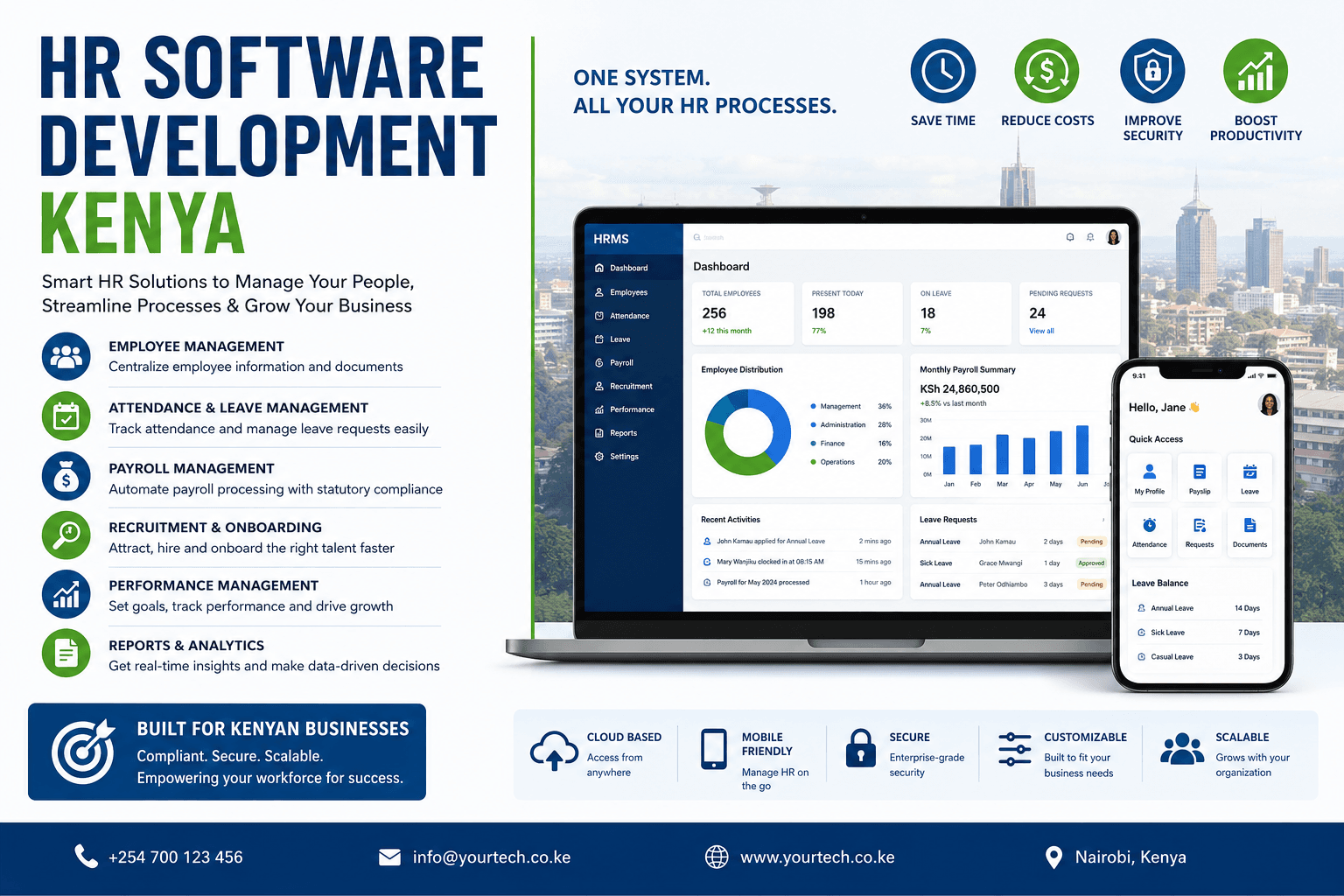
HR Software Development Kenya
Human Resource management has evolved significantly over the past decade. Today, businesses are moving away from spreadsheets, paper files, and disconnected software in favor of intelligent digital HR systems. As organizations continue embracing digital transformation, HR Software Development Kenya has become one of the fastest-growing technology services for businesses seeking to improve workforce management.
Whether you operate a startup, SME, NGO, SACCO, school, manufacturing company, healthcare institution, or large enterprise, investing in HR Software Development Kenya enables your organization to automate repetitive HR tasks, improve employee productivity, and ensure compliance with Kenyan labor regulations.
Instead of purchasing expensive international software that may not fit local business requirements, many organizations are choosing custom-built HR software specifically designed for Kenyan businesses.
This comprehensive guide explores everything you need to know about HR Software Development Kenya, including features, benefits, development process, implementation strategies, emerging trends, and why custom HR systems provide a competitive advantage.
What is HR Software Development?
HR Software Development Kenya refers to the design, development, customization, deployment, and maintenance of digital Human Resource Management Systems (HRMS) that automate HR operations.
A custom HR system centralizes all employee information into one secure platform while automating critical functions such as:
- Employee records
- Recruitment
- Payroll
- Leave management
- Attendance
- Time tracking
- Performance appraisal
- Employee self-service
- Training management
- Benefits administration
- Compliance reporting
Instead of using multiple disconnected systems, businesses can manage all HR processes from one integrated solution.
Why Kenyan Businesses Need HR Software
Many organizations still rely on Excel spreadsheets and manual paperwork. This creates numerous challenges including:
- Payroll errors
- Lost employee records
- Delayed leave approvals
- Poor attendance tracking
- Compliance issues
- Duplicate data entry
- Slow recruitment processes
- Inaccurate reporting
- Data security risks
- Reduced productivity
HR Software Development Kenya addresses these challenges by providing automated workflows that improve efficiency and reduce operational costs.
The Growing Demand for HR Software Development Kenya
Kenya’s digital economy continues expanding rapidly.
Organizations are:
- Hiring remote workers
- Opening multiple branches
- Managing hybrid teams
- Automating payroll
- Digitizing recruitment
- Integrating M-Pesa payments
- Moving to cloud platforms
These trends continue driving demand for HR Software Development Kenya across nearly every industry.
Core Modules of a Modern HR System
A professionally developed HR solution typically includes several integrated modules.
Employee Information Management
Centralized employee profiles include:
- Personal details
- Employment contracts
- Academic certificates
- Tax information
- Emergency contacts
- Next of kin
- Promotion history
- Salary records
- Performance history
- Training records
This eliminates paper files while making employee information easily accessible.
Recruitment Management
Recruitment becomes much easier through automation.
Features include:
- Job postings
- Online applications
- Resume database
- Candidate screening
- Interview scheduling
- Shortlisting
- Applicant tracking
- Offer letters
- Candidate communication
Recruitment managers save significant time while improving hiring quality.
Employee Onboarding
New employee onboarding becomes standardized.
The system automates:
- Employee registration
- Account creation
- Document collection
- Department allocation
- Equipment assignment
- Orientation schedules
- Policy acknowledgements
This improves the employee experience from day one.
Leave Management
Leave management automation allows employees to:
- Apply online
- Track balances
- View leave history
- Receive approval notifications
- Download leave reports
Managers approve requests instantly from desktop or mobile devices.
Attendance Management
Attendance tracking may integrate with:
- Fingerprint scanners
- Facial recognition
- RFID cards
- Mobile GPS
- QR codes
- Biometric devices
Attendance records automatically feed into payroll calculations.
Payroll Management
Payroll remains one of the most critical modules in HR Software Development Kenya.
The payroll engine handles:
- Basic salary
- Allowances
- Deductions
- Overtime
- PAYE
- NSSF
- SHA deductions
- Housing Levy
- NHDF (where applicable)
- Pension
- Loans
- Bonuses
- Commissions
Automation greatly reduces payroll processing time and minimizes costly errors.
Performance Management
Organizations can monitor employee performance through:
- KPIs
- Objectives
- Performance reviews
- Supervisor evaluations
- Self-assessments
- Goal tracking
- Continuous feedback
- Performance reports
Managers gain better visibility into workforce productivity.
Employee Self-Service Portal
Self-service portals empower employees to:
- Download payslips
- Apply for leave
- Update personal information
- View attendance
- Access company documents
- Submit claims
- View payroll history
This reduces HR administrative workload.
Document Management
A secure HR system stores:
- Employment contracts
- IDs
- Certificates
- KRA PIN
- NHIF/SHA records
- NSSF details
- Performance documents
- Warning letters
- Promotion letters
Everything remains securely organized in one location.
Training Management
Training modules help organizations manage:
- Employee training
- Skills development
- Certifications
- Workshops
- Internal learning
- Compliance training
- Training budgets
Organizations improve employee development while tracking learning outcomes.
Benefits of HR Software Development Kenya
Investing in HR Software Development Kenya provides substantial advantages.
Increased Productivity
Automation removes repetitive manual work.
HR teams spend more time on strategic activities rather than paperwork.
Improved Accuracy
Automated calculations minimize human error in payroll, leave balances, attendance, and reporting.
Better Compliance
Kenyan labor regulations continue evolving.
Custom HR software helps organizations remain compliant with statutory deductions, employment records, and reporting requirements.
Enhanced Data Security
Employee information remains protected using:
- Encryption
- Role-based permissions
- Secure authentication
- Audit logs
- Automatic backups
Faster Decision Making
Interactive dashboards provide real-time HR insights including:
- Employee headcount
- Turnover
- Leave utilization
- Payroll costs
- Recruitment performance
- Attendance trends
Managers make informed decisions using accurate data.
Cost Savings
Organizations reduce expenses related to:
- Paper records
- Filing cabinets
- Manual processing
- Payroll outsourcing
- Administrative labor
- Printing costs
Over time, the return on investment can be substantial.
Industries That Benefit from HR Software Development Kenya
Custom HR systems are valuable across many sectors, including:
- Manufacturing
- Healthcare
- Education
- NGOs
- SACCOs
- Banks
- Insurance
- Hospitality
- Logistics
- Retail
- Government agencies
- Construction
- Real estate
- Professional services
- Technology companies
Each industry can tailor modules to its specific operational needs.
Integration Capabilities
Modern HR software can integrate with:
- Payroll systems
- Accounting software
- ERP platforms
- Attendance devices
- Email systems
- SMS gateways
- M-Pesa payment platforms
- Biometric devices
- Recruitment portals
- Learning Management Systems (LMS)
These integrations eliminate duplicate data entry and streamline business processes.
Cloud vs On-Premise HR Software
Businesses considering HR Software Development Kenya often choose between cloud-based and on-premise deployments.
Cloud HR Software
Advantages:
- Access from anywhere
- Lower upfront costs
- Automatic updates
- Scalable infrastructure
- Secure backups
- Ideal for remote teams
On-Premise HR Software
Advantages:
- Full control of data
- Internal hosting
- Custom security policies
- Suitable for organizations with strict compliance requirements
The right choice depends on your organization’s size, budget, and IT strategy.
Future Trends in HR Software Development Kenya
The future of HR technology in Kenya includes:
- Artificial Intelligence (AI) for recruitment
- Predictive workforce analytics
- Employee wellness tracking
- Chatbots for HR support
- Mobile-first HR platforms
- Cloud-native applications
- Digital onboarding
- Automated compliance monitoring
- Skills gap analysis
- Workforce planning dashboards
Organizations that embrace these innovations will gain a competitive advantage in attracting and retaining talent.
Choosing the Right HR Software Development Partner
When selecting a software development company, consider:
- Experience with HR systems
- Understanding of Kenyan labor laws
- Customization capabilities
- Integration expertise
- Security standards
- Ongoing support and maintenance
- Training services
- Client references
- Scalability of the solution
- Transparent pricing
A reliable development partner will ensure the software aligns with your business processes and can grow alongside your organization.
Essential Features of HR Software Development Kenya
When investing in HR Software Development Kenya, businesses should ensure that the system includes features that support both current and future organizational needs. A well-designed HR platform should be scalable, secure, and customizable to fit businesses of all sizes.
1. Employee Database Management
The employee database serves as the foundation of any HR system. It stores all employee-related information in a centralized location, making it easy for HR personnel to retrieve and update records.
Key information stored includes:
- Personal details
- Employment history
- Academic qualifications
- Professional certifications
- Emergency contacts
- Salary history
- Promotion records
- Disciplinary records
- Contract expiry dates
- Tax information
With HR Software Development Kenya, organizations eliminate paper files and improve record accuracy.
Payroll Automation
Payroll processing is one of the most time-consuming HR functions. Custom payroll modules simplify the entire process while ensuring compliance with Kenyan statutory requirements.
The payroll system can automatically calculate:
- Basic salary
- House allowance
- Transport allowance
- Overtime
- Bonuses
- Commissions
- PAYE
- NSSF contributions
- Social Health Authority (SHA) deductions
- Affordable Housing Levy
- Pension deductions
- Loan repayments
- Sacco deductions
Automated payroll reduces processing time from several days to just a few hours.
Leave and Time-Off Management
Manual leave management often leads to confusion, duplicate requests, and inaccurate balances.
With HR Software Development Kenya, employees can:
- Apply for leave online
- View remaining leave days
- Track application status
- Cancel leave requests
- Receive approval notifications
- Download leave history
Managers can approve or reject requests instantly, improving workflow efficiency.
Attendance Management
Employee attendance directly affects payroll and productivity.
Modern HR software supports multiple attendance methods including:
- Biometric fingerprint devices
- Facial recognition
- RFID cards
- QR code scanning
- GPS clock-in
- Mobile applications
- Web check-in
Attendance records automatically synchronize with payroll, eliminating manual calculations.
Recruitment and Applicant Tracking
Hiring the right employees is critical for business success.
An Applicant Tracking System (ATS) within HR Software Development Kenya simplifies recruitment by managing the entire hiring process.
Features include:
- Vacancy creation
- Online job applications
- CV parsing
- Candidate ranking
- Interview scheduling
- Interview evaluation forms
- Offer letter generation
- Candidate communication
- Recruitment reports
HR teams save significant time while improving recruitment quality.
Employee Self-Service Portal
Employee Self-Service (ESS) has become one of the most requested modules in modern HR systems.
Instead of visiting the HR office for every request, employees can access information through a secure online portal.
The ESS portal allows employees to:
- Download payslips
- View tax deductions
- Apply for leave
- View attendance records
- Update personal information
- Submit reimbursement claims
- Access HR policies
- Download employment letters
- Track performance goals
This significantly reduces administrative work for HR departments.
Performance Management System
Performance management helps organizations monitor employee productivity and career growth.
A comprehensive performance module includes:
- Goal setting
- KPI management
- Quarterly reviews
- Annual appraisals
- Continuous feedback
- Manager evaluations
- Employee self-assessment
- Promotion recommendations
- Training recommendations
Managers gain valuable insights into workforce performance through visual dashboards and reports.
Learning and Development Management
Employee development is essential for long-term organizational success.
Training modules help HR departments manage:
- Internal training
- External seminars
- Professional certifications
- Compliance training
- Training budgets
- Skills assessments
- Learning progress
Organizations can monitor employee competencies and identify future training needs.
Asset Management
Many businesses assign laptops, phones, vehicles, uniforms, and equipment to employees.
A built-in asset management module tracks:
- Assigned assets
- Asset condition
- Maintenance schedules
- Asset returns
- Replacement history
- Warranty information
This reduces asset losses while improving accountability.
Employee Exit Management
When employees leave the organization, HR software automates the exit process.
The system manages:
- Resignation notices
- Clearance forms
- Exit interviews
- Asset returns
- Final payroll
- Certificate generation
- Document archiving
Automation ensures a smooth and compliant offboarding process.
HR Reports and Analytics
One of the greatest advantages of HR Software Development Kenya is access to real-time reporting.
Popular reports include:
- Employee headcount
- Department distribution
- Staff turnover
- Leave reports
- Payroll reports
- Attendance reports
- Recruitment reports
- Performance reports
- Training reports
- Gender diversity reports
Business leaders use these insights to make data-driven decisions.
Security Features in HR Software Development Kenya
HR systems store highly sensitive employee information, making security a top priority.
Essential security features include:
Role-Based Access Control
Different users receive different permission levels.
For example:
- HR Manager
- Payroll Officer
- Department Manager
- Employee
- Administrator
Each user only accesses information relevant to their role.
Data Encryption
Sensitive employee information is encrypted both during storage and transmission.
This protects confidential data from unauthorized access.
Two-Factor Authentication
Adding a second verification step significantly enhances account security.
Employees can verify login using:
- SMS codes
- Email verification
- Authentication apps
Audit Logs
Every system activity is recorded, including:
- User logins
- Record updates
- Payroll processing
- Report downloads
- Leave approvals
Audit trails improve accountability and simplify compliance audits.
Automatic Backups
Regular backups protect organizations against:
- Hardware failure
- Cyberattacks
- Accidental deletion
- System crashes
Cloud-based backups ensure quick disaster recovery.
Mobile HR Applications
Today’s workforce expects mobile access.
Modern HR Software Development Kenya often includes Android and iOS applications that allow employees to:
- Clock in remotely
- Apply for leave
- View payslips
- Approve requests
- Access announcements
- Receive notifications
- Update profiles
Mobile accessibility improves employee engagement and operational efficiency.
Benefits of Cloud-Based HR Software
Cloud deployment continues to grow in popularity among Kenyan businesses.
Advantages include:
- Lower infrastructure costs
- Automatic software updates
- High availability
- Remote accessibility
- Secure cloud backups
- Easier collaboration
- Faster implementation
- Scalability as businesses grow
Organizations with multiple branches particularly benefit from cloud-based HR systems because data is synchronized in real time across all locations.
Why Choose Custom HR Software Instead of Off-the-Shelf Solutions?
While off-the-shelf HR software may meet basic requirements, many Kenyan organizations prefer custom-built solutions because they can be tailored to local business processes, statutory requirements, approval workflows, and reporting needs.
Custom HR Software Development Kenya provides greater flexibility, seamless integration with existing systems, and the ability to add new features as the organization grows. Businesses also avoid paying for unnecessary modules while ensuring the software aligns perfectly with their operational goals.
In the next section, we will explore the HR software development process, implementation best practices, integration with payroll and ERP systems, common challenges, pricing considerations in Kenya, and emerging AI trends shaping the future of HR technology.
HR Software Development Process in Kenya
Developing a successful HR system requires careful planning, stakeholder involvement, and a clear understanding of the organization’s human resource processes. A professional HR Software Development Kenya project follows a structured methodology that minimizes risks and ensures the final product meets business objectives.
1. Requirements Gathering
The first phase involves understanding the organization’s HR processes and identifying areas that need automation.
This stage includes:
- HR workflow analysis
- Business process mapping
- Departmental consultations
- Compliance requirements
- Reporting needs
- Existing software evaluation
- User expectations
- Future scalability requirements
A detailed requirements document becomes the blueprint for the entire project.
2. System Design
Once requirements are collected, software architects create the system design.
This includes:
- Database architecture
- User interface (UI) design
- User experience (UX) planning
- Security architecture
- Module structure
- API design
- Mobile compatibility
- Cloud infrastructure planning
A good design ensures the HR software remains easy to use while supporting future expansion.
3. Software Development
This is where developers build the actual HR system.
Development includes creating modules such as:
- Employee management
- Recruitment
- Payroll
- Leave management
- Attendance
- Performance management
- Training management
- Employee self-service
- Reports and analytics
- Administration
Modern HR Software Development Kenya projects often use agile development methodologies, allowing clients to review progress throughout the project.
4. Testing
Before deployment, the software undergoes comprehensive testing.
Testing includes:
- Functional testing
- User acceptance testing
- Security testing
- Performance testing
- Compatibility testing
- Mobile testing
- Integration testing
Thorough testing ensures the software performs reliably under real-world conditions.
5. Deployment
After successful testing, the HR system is deployed.
Deployment options include:
- Cloud hosting
- On-premise servers
- Hybrid deployment
During deployment, organizations also migrate existing employee records into the new system.
6. User Training
Even the best HR software requires proper training.
Training sessions typically cover:
- Employee registration
- Payroll processing
- Leave approvals
- Recruitment workflows
- Performance management
- Report generation
- Security settings
- Mobile application usage
Well-trained users maximize the value of the software.
7. Ongoing Support and Maintenance
The relationship with the software vendor does not end after deployment.
Continuous support includes:
- Bug fixes
- Security updates
- Feature enhancements
- Performance optimization
- Backup monitoring
- User support
- Regulatory updates
Long-term maintenance ensures the system remains secure and compliant with changing business and legal requirements.
Integration with Other Business Systems
One of the biggest advantages of HR Software Development Kenya is the ability to integrate HR software with other enterprise systems, creating a seamless flow of information across the organization.
Payroll and Accounting Integration
Payroll data can automatically synchronize with accounting systems.
Benefits include:
- Reduced manual entries
- Faster financial reporting
- Improved payroll reconciliation
- Accurate expense tracking
ERP Integration
Organizations using Enterprise Resource Planning (ERP) systems can integrate HR software to manage:
- Employee costs
- Department budgets
- Project assignments
- Procurement approvals
- Asset allocation
This provides a unified view of business operations.
Biometric Device Integration
Attendance systems can connect directly with:
- Fingerprint scanners
- Facial recognition devices
- RFID readers
- Time clocks
Attendance records automatically update employee profiles and payroll calculations.
SMS and Email Integration
Automated notifications improve communication.
Employees receive alerts for:
- Leave approvals
- Payslip availability
- Interview invitations
- Training schedules
- Company announcements
- Contract renewals
This keeps everyone informed without manual follow-ups.
M-Pesa Integration
For organizations making employee reimbursements, advances, or other payments, integration with M-Pesa offers faster and more convenient transactions. Employees can receive approved payments directly to their mobile wallets, while finance teams benefit from improved tracking and reconciliation.
Common Challenges Solved by HR Software Development Kenya
Many organizations face recurring HR challenges that hinder productivity and employee satisfaction. A well-designed HR system addresses these issues effectively.
Manual Record Keeping
Paper files and spreadsheets are prone to loss, duplication, and errors. Centralized digital records improve accessibility, security, and accuracy.
Payroll Errors
Incorrect salary calculations, statutory deductions, or overtime payments can damage employee trust. Automated payroll minimizes these errors and ensures timely processing.
Delayed Leave Approvals
Manual approval chains often lead to unnecessary delays. Digital workflows allow managers to review and approve requests quickly from any location.
Compliance Risks
Keeping up with labor laws and statutory changes can be difficult. Custom HR software helps organizations maintain accurate records and generate compliance reports when needed.
Poor Workforce Visibility
Without real-time data, management struggles to make informed decisions. Dashboards and analytics provide insights into attendance, recruitment, turnover, and workforce performance.
Cost Factors for HR Software Development Kenya
The cost of HR Software Development Kenya depends on several factors rather than a single fixed price.
Some of the main cost drivers include:
- Number of modules required
- Level of customization
- Number of employees
- Mobile application development
- Third-party integrations
- Cloud hosting requirements
- Security features
- Reporting complexity
- User training
- Ongoing maintenance and support
Although custom software may require a higher initial investment than generic solutions, it often delivers greater long-term value by aligning with your organization’s unique processes and reducing operational inefficiencies.
Future Trends in HR Software Development Kenya
The HR technology landscape continues to evolve. Businesses that invest in modern solutions today will be better positioned to adapt to future workforce demands.
Emerging trends include:
- Artificial Intelligence (AI): AI-assisted CV screening, interview scheduling, and employee support chatbots.
- Predictive Analytics: Forecasting employee turnover, workforce planning, and identifying training needs.
- Remote Work Management: Enhanced tools for managing distributed and hybrid teams.
- Employee Wellness Features: Monitoring wellness initiatives, engagement surveys, and work-life balance programs.
- Advanced Mobile Experiences: Mobile-first HR platforms with approvals, notifications, and self-service features.
- Data-Driven Decision Making: Interactive dashboards and real-time analytics that support strategic HR planning.
As organizations continue embracing digital transformation, these innovations will shape the next generation of HR Software Development Kenya solutions.
Frequently Asked Questions (FAQs)
1. What is HR Software Development Kenya?
It is the process of designing and developing customized Human Resource Management Systems that automate HR tasks such as payroll, attendance, recruitment, leave management, performance tracking, and employee records for organizations operating in Kenya.
2. Is custom HR software suitable for small businesses?
Yes. Small and medium-sized businesses can start with essential modules and expand the system as their workforce grows.
3. Can HR software integrate with payroll?
Yes. Modern HR systems can integrate payroll processing, allowing salary calculations, statutory deductions, and payslip generation to be managed within a single platform.
4. Is cloud-based HR software secure?
Cloud-based HR systems can be highly secure when they implement encryption, role-based access control, regular backups, and strong authentication measures.
5. How long does HR software development take?
Development timelines vary depending on the scope of the project. A basic solution may take a few weeks, while a fully customized enterprise HR system can take several months.
Conclusion
As businesses continue to digitize their operations, HR Software Development Kenya has become an essential investment rather than a luxury. A well-designed HR system streamlines recruitment, payroll, leave management, attendance tracking, performance evaluation, and employee self-service while improving compliance and reducing administrative costs.
As Kenyan businesses continue to modernize their operations, HR Software Development Kenya is becoming a strategic investment that delivers measurable improvements in efficiency, compliance, and employee experience. By automating repetitive HR tasks, integrating key business processes, and providing real-time workforce insights, organizations can focus more on strategic growth rather than administrative burdens.
Whether you are building a new HR platform or replacing an outdated system, choosing the right development partner and investing in a scalable, secure, and customizable solution will help your organization remain competitive in 2026 and beyond. A thoughtfully designed HR system is more than just software—it is a foundation for smarter workforce management and long-term business success.
Whether you are a startup looking to organize employee records or a large enterprise seeking a fully integrated HR ecosystem, custom HR Software Development Kenya provides the flexibility to meet your unique operational needs. By adopting a scalable, secure, and locally tailored HR solution, Kenyan organizations can enhance productivity, improve employee satisfaction, and position themselves for sustainable growth in an increasingly competitive market.
Investing in HR Software Development Kenya today is an investment in a more efficient, compliant, and future-ready workforce.