
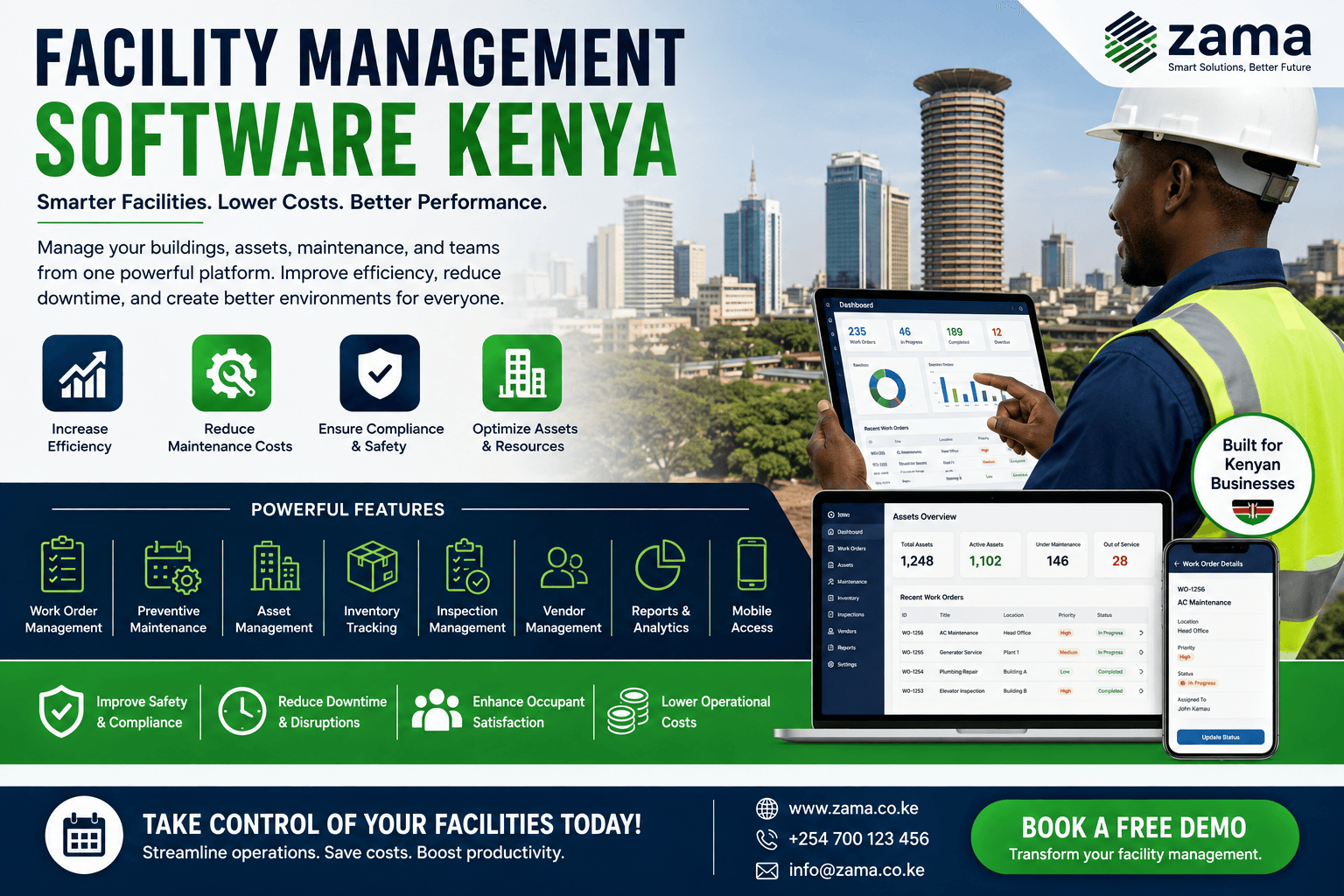
Integrate facility management with M-Pesa payments in Kenya is a question that every property manager, facility director, and real estate operator must answer in 2026. With M-Pesa processing over 2 trillion shillings in annual transactions, more than 30 million active users, and tenants across Nairobi, Mombasa, Kisumu, and beyond expecting to pay rent, service charges, and utility bills from their phones, the ability to connect facility management software with Kenya’s dominant mobile money platform has become essential for operational efficiency. At zama.co.ke, we’ve helped numerous organizations across Kenya integrate facility management systems with M-Pesa payments, eliminating manual reconciliation and accelerating cash flow. This comprehensive guide explores integrate facility management with M-Pesa payments in Kenya, from understanding what integration delivers to selecting the right approach for your portfolio.
What Integrating Facility Management with M-Pesa Payments Actually Delivers
Before diving into integrate facility management with M-Pesa payments in Kenya, it’s essential to understand what this integration actually does. Integrating facility management with M-Pesa payments means connecting your facility management software—the platform that tracks assets, manages work orders, handles tenant requests, and records maintenance costs—directly to Safaricom’s mobile money platform through the Daraja API. This connection enables automated payment collection, real-time payment confirmation, and seamless reconciliation against tenant accounts, vendor invoices, and service charges.
A proper integrate facility management with M-Pesa payments in Kenya solution does far more than simply accept M-Pesa payments. It initiates payment requests through STK Push, receives payment confirmations in real time, matches payments to the correct tenant or vendor account automatically, updates the facility management system’s financial records, and triggers downstream workflows—like marking a service charge as paid or releasing a vendor payment for completed maintenance work.
For a Kenyan facility manager, the practical definition of integrate facility management with M-Pesa payments in Kenya is this: the system that tells you exactly who has paid, exactly how much they paid, exactly when they paid, and exactly what the payment was for—all in real time, with automatic reconciliation that eliminates manual matching of M-Pesa statements against tenant ledgers and vendor invoices.
Why Kenyan Facility Managers Need M-Pesa Integration
When evaluating integrate facility management with M-Pesa payments in Kenya, consider the compelling reasons for adoption:
The M-Pesa Reality in Kenyan Property
M-Pesa is not just a payment option in Kenya—it is the primary payment method for millions of tenants, contractors, and service providers. Tenants expect to pay rent via M-Pesa. Contractors expect to receive payment via M-Pesa. Service providers—cleaners, security firms, landscapers—expect M-Pesa disbursements. Without M-Pesa integration, facility management software is disconnected from how Kenyan property operations actually handle money.
A modern integrate facility management with M-Pesa payments in Kenya solution connects facility workflows to M-Pesa payment rails. When a tenant submits a maintenance request through the tenant portal, they can pay any associated charges via M-Pesa instantly. When a contractor completes a work order, payment can be initiated via M-Pesa as soon as the work is approved. When service charges are due, tenants receive M-Pesa payment prompts directly on their phones.
The Cost of Manual Reconciliation
Manual reconciliation of M-Pesa payments is a significant burden for Kenyan facility managers. Rent payments arrive with transaction codes that must be manually matched to tenant accounts. Service charge payments arrive without clear references. Vendor payments require manual confirmation before the facility management system is updated. This manual effort consumes hours every week and introduces errors.
A proper integrate facility management with M-Pesa payments in Kenya solution automates this reconciliation. Every M-Pesa payment is automatically matched to the correct tenant account, the correct invoice, or the correct vendor. The facility management system updates in real time. Finance teams no longer spend hours matching M-Pesa statements against spreadsheets.
Tenant Experience and Retention
Modern tenants expect digital payment experiences. They want to pay rent from their phones, receive instant confirmation, view their payment history, and see their account balance in real time. Facility managers who provide these capabilities retain tenants longer and attract better tenants.
A comprehensive integrate facility management with M-Pesa payments in Kenya solution delivers this experience. Tenants receive M-Pesa payment prompts, pay instantly with their PIN, and see their account updated in the tenant portal. No more queueing at the property office. No more waiting for receipts.
Cash Flow Acceleration
M-Pesa integration accelerates cash flow. Rent payments are received immediately rather than waiting for cheques to clear or bank transfers to process. Service charge payments are collected at the point of request rather than invoiced and chased. Vendor payments are processed instantly upon work approval rather than waiting for payment runs.
For a Kenyan facility manager, the practical impact of integrate facility management with M-Pesa payments in Kenya is faster cash collection, lower outstanding receivables, and improved working capital.
Operational Efficiency
M-Pesa integration eliminates manual steps throughout the payment lifecycle. Tenants do not need to visit the office to pay. Staff do not need to manually record payments. Finance teams do not need to manually reconcile statements. Contractors do not need to submit invoices and wait for payment runs. Everything is automated.
Essential Features of Integrated Facility Management and M-Pesa Payments
When evaluating integrate facility management with M-Pesa payments in Kenya, focus on these core features:
1. M-Pesa STK Push for Payment Collection
STK Push is the fastest and most convenient way to collect payments from tenants and clients. The facility management system initiates a payment request that appears on the payer’s phone as a prompt. The payer enters their M-Pesa PIN, and the payment is confirmed instantly.
A proper integrate facility management with M-Pesa payments in Kenya solution should support STK Push for rent collection, service charge payments, utility bill payments, and any other tenant-facing charges. The payment is automatically matched to the correct tenant account and invoice.
2. M-Pesa PayBill and Till Number Integration
For tenants who prefer to pay via PayBill or Till Number, the facility management system should support these payment methods. When tenants pay to the designated PayBill or Till, the facility management system receives the payment notification, matches it to the correct tenant account using the account reference, and updates the tenant ledger automatically.
3. B2C Payments to Vendors and Contractors
Facility management involves paying vendors and contractors for maintenance work, cleaning services, security, landscaping, and other services. The system should support B2C payments that disburse funds directly to contractor M-Pesa accounts.
When a work order is completed and approved, the facility management system can initiate a B2C payment to the contractor’s M-Pesa number. The payment is confirmed in real time, and the work order is marked as paid.
4. Automated Payment Reconciliation
Automated reconciliation is the most valuable feature of M-Pesa integration. Every payment received is automatically matched to the correct tenant account, invoice, or vendor. Exceptions—payments that cannot be matched—are flagged for manual review.
A comprehensive integrate facility management with M-Pesa payments in Kenya solution should reconcile STK Push payments, PayBill payments, Till Number payments, and B2C disbursements automatically. Finance teams should be able to see, at any time, exactly how much has been collected, how much is outstanding, and what exceptions require attention.
5. Real-Time Payment Confirmation
Real-time payment confirmation means that as soon as a tenant pays via M-Pesa, the facility management system knows. The tenant ledger is updated. A receipt is generated. The tenant receives confirmation via SMS or the tenant portal.
This real-time visibility eliminates the uncertainty that plagues manual payment processes. Facility managers know exactly what has been paid and what is outstanding at any moment.
6. Payment-Triggered Workflows
M-Pesa integration enables payment-triggered workflows. When a service charge payment is received, the facility management system can automatically trigger a work order or schedule a service. When a maintenance payment is received, the system can release the work order to a contractor. When a vendor payment is made, the system can update the purchase order.
A quality integrate facility management with M-Pesa payments in Kenya solution should support configurable workflows that connect payment events to operational actions.
7. Tenant Portal with Payment History
Tenants should be able to view their payment history, account balance, and outstanding charges through a tenant portal. The portal should show every payment made via M-Pesa, with transaction codes, dates, amounts, and what the payment was for.
A proper integrate facility management with M-Pesa payments in Kenya solution provides this visibility. Tenants can see their payment history, download receipts, and understand their account status without contacting the property office.
8. Vendor Portal with Payment Status
Vendors and contractors should be able to see the status of their payments. When a work order is approved, the vendor should know when payment will be initiated. When payment is made, the vendor should receive confirmation.
A comprehensive integrate facility management with M-Pesa payments in Kenya solution provides this visibility through a vendor portal. Vendors can track their work orders, view approved payments, and see payment confirmations.
9. Financial Reporting and Reconciliation Reports
Facility managers and finance teams need comprehensive reporting. The system should generate reports showing M-Pesa collections by tenant, by property, by payment type, and by period. It should show outstanding balances, aging reports, and reconciliation statements that match M-Pesa transactions against facility management records.
10. Audit Trails and Compliance
Every M-Pesa payment is logged with a unique transaction code, timestamp, and payer details. This creates a complete audit trail for compliance and dispute resolution. A proper integrate facility management with M-Pesa payments in Kenya solution should maintain these records and make them accessible for audit and investigation.
11. KRA eTIMS Integration
For organizations that charge VAT on rent or services, the facility management system should support KRA eTIMS compliance. Every payment should generate a compliant tax invoice that is transmitted to KRA automatically.
12. Multi-Property and Multi-Tenant Support
Nairobi property managers often oversee multiple buildings with different tenant requirements, payment terms, and service charges. A proper solution should support multi-property and multi-tenant scenarios, with separate payment configurations for each property and each tenant.
What Makes M-Pesa Integration for Facility Management in Kenya Different
integrate facility management with M-Pesa payments in Kenya has unique characteristics that global solutions often lack:
Built for Kenyan Payment Realities
Global facility management software is designed for credit cards, bank transfers, and direct debits. Kenyan property operations run on M-Pesa. A proper integration is built around M-Pesa as the primary payment channel, with STK Push, PayBill, Till Number, and B2C as core capabilities.
Support for Partial Payments and Credits
Kenyan tenants often make partial payments, overpay, or have credits on their accounts. A proper integration must handle these scenarios. When a payment does not exactly match an invoice, the system must apply it proportionally, update the outstanding balance, and track any credit.
Support for Multiple Payment References
Tenants pay via M-Pesa with various references—unit numbers, invoice numbers, tenant names, or no reference at all. A proper integration must match payments to the correct tenant account even when references are inconsistent or missing. This requires intelligent matching logic.
Offline and Low-Bandwidth Capability
Kenyan property offices face power fluctuations and internet outages. A proper integration should continue functioning during connectivity issues, queuing payment confirmations and reconciling when connection returns.
Multi-Currency Support
Some Kenyan properties—particularly those serving international tenants or operating in special economic zones—may need to accept payments in foreign currencies alongside M-Pesa. A proper integration should support multi-currency operations.
Local Support and Training
The best providers in Kenya offer local support, training, and implementation services. Property managers need a partner who can respond quickly when issues arise and who understands the Kenyan regulatory environment.
Key Factors That Determine Integration Cost in Kenya
When analysing integrate facility management with M-Pesa payments in Kenya, several factors directly influence pricing:
1. Number of Properties and Units
The number of properties under management and the number of units or tenants affects integration complexity and cost. Each property may have different payment terms, different service charges, and different M-Pesa configurations.
2. Number of Payment Types
The number of payment types—rent, service charge, utility bills, parking fees, event fees, vendor payments—affects development complexity. Each payment type may have different workflows and reconciliation requirements.
3. Existing Facility Management System
If you already have a facility management system, the integration must work with your existing platform. If you are implementing both facility management and M-Pesa integration simultaneously, the development effort may be different.
4. Customization Requirements
Off-the-shelf integrations may not meet your specific requirements. Customization—custom workflows, custom reports, custom reconciliation rules—adds to development cost.
5. Volume of Transactions
The volume of M-Pesa transactions affects infrastructure and API call requirements. High-volume operations require more robust infrastructure and may incur higher API usage costs.
6. Number of Users
The number of staff who need access to the integrated system—finance teams, property managers, administrators—affects licensing and training costs.
7. Reporting and Compliance Requirements
Complex reporting requirements—consolidated reports across multiple properties, aging analysis, KRA compliance reports—add to development cost.
8. Training and Change Management
Training staff on the new system is essential. Training costs add to the overall investment.
9. Ongoing Support and Maintenance
Ongoing support and maintenance—including M-Pesa API updates, reconciliation rule adjustments, and technical support—add to the total cost of ownership.
Key Use Cases for M-Pesa Integration in Facility Management
Rent Collection
Rent collection is the most common use case. Tenants receive M-Pesa payment prompts on their phones, pay instantly with their PIN, and their account is updated in real time. Property managers see exactly who has paid and who is outstanding, without manual reconciliation.
Service Charge Collection
Service charges cover shared facilities—security, cleaning, landscaping, utilities, and common area maintenance. M-Pesa integration enables automatic collection of service charges, with payments matched to the correct unit and period.
Utility Billing
For properties with sub-metered utilities, M-Pesa integration enables automated utility billing and collection. Tenants receive their utility bill via the tenant portal, pay via M-Pesa, and their account is updated automatically.
Parking Fees
For commercial properties with paid parking, M-Pesa integration enables automated parking fee collection. Tenants and visitors pay via M-Pesa, and the parking system is updated in real time.
Vendor and Contractor Payments
Facility management involves multiple vendors and contractors. M-Pesa B2C payments enable efficient disbursement to contractors upon work completion, with automatic reconciliation against work orders and purchase orders.
Security Deposits and Refunds
M-Pesa integration enables efficient collection of security deposits and processing of refunds when tenants leave. Deposits are collected via M-Pesa and refunds are disbursed via M-Pesa, with complete audit trails.
Event and Facility Booking
For properties with bookable facilities—meeting rooms, event spaces, sports facilities—M-Pesa integration enables online booking and payment. Tenants book facilities through the portal, pay via M-Pesa, and receive instant confirmation.
The Zama.co.ke Approach to M-Pesa Integration for Facility Management
When considering integrate facility management with M-Pesa payments in Kenya, zama.co.ke follows a structured approach:
Requirements Discovery
We map your facility management operations and payment requirements: properties, units, tenants, payment types, reconciliation needs, and reporting obligations. This includes understanding your current challenges and defining success metrics.
Integration Design
We design the M-Pesa integration architecture—STK Push, PayBill, Till Number, B2C—based on your specific payment requirements. We ensure the integration supports real-time payment confirmation, automated reconciliation, and complete audit trails.
System Development and Configuration
We develop the integration, configure payment workflows, build reconciliation rules, and set up tenant and vendor portals. The system is configured to support your specific payment types and reconciliation requirements.
Testing and Validation
We test all payment scenarios: STK Push, PayBill, Till Number, B2C, partial payments, overpayments, and exception handling. We ensure the integration works correctly when connectivity is lost or M-Pesa services are unavailable.
Data Migration
We migrate existing tenant records, payment histories, and outstanding balances into the new system. We validate data accuracy before migration and ensure that historical records are preserved.
Training and Support
We provide role-specific training for property managers, finance teams, and administrators. We remain available for ongoing support, maintenance, and integration updates.
Post-Launch Optimization
After go-live, we monitor performance, gather user feedback, and refine the integration to improve payment collection efficiency and reconciliation accuracy.
The ROI of M-Pesa Integration for Facility Management in Kenya
When evaluating integrate facility management with M-Pesa payments in Kenya, the ROI is compelling:
Accelerated Cash Collection: M-Pesa payments are received immediately, improving cash flow and reducing outstanding receivables.
Reduced Manual Reconciliation: Automated reconciliation eliminates hours of manual work every week. Finance teams focus on analysis rather than data entry.
Reduced Errors: Automated matching eliminates the errors that plague manual reconciliation. Payments are always matched to the correct tenant and invoice.
Improved Tenant Satisfaction: Tenants pay from their phones, receive instant confirmation, and see their account updated in real time. This improves satisfaction and retention.
Lower Administrative Costs: Staff no longer spend time chasing payments, recording receipts, or reconciling statements. Administrative costs decrease.
Better Financial Visibility: Real-time payment data provides visibility into cash flow, outstanding receivables, and collection performance.
Compliance Protection: Automated audit trails and KRA eTIMS integration reduce compliance risk.
Scalability: M-Pesa integration scales with your portfolio, handling more properties, more tenants, and more transactions without proportional increases in administrative staff.
Implementation Considerations for Kenyan Property Managers
When implementing M-Pesa integration for facility management, consider these factors:
Assess Your Current Payment Processes
Before selecting a solution, map your current payment processes. How do tenants pay rent? How are payments recorded? How are they reconciled? What are the pain points? This assessment forms the foundation for integration design.
Choose the Right Solution
The best solution for your portfolio depends on your property types, tenant base, payment volumes, and reporting requirements. A small residential estate may need basic rent collection; a large commercial portfolio may need complex reconciliation across multiple payment types.
Plan for Data Migration
Migrating tenant records, payment histories, and outstanding balances requires careful validation. Ensure tenant details, payment records, and account balances are accurate before migration.
Train Your Team
Property managers, finance teams, and administrators need training on the new system. Role-specific training using real scenarios produces higher adoption and better data quality.
Test Thoroughly
Test all payment scenarios: STK Push, PayBill, Till Number, B2C, partial payments, overpayments, and exception handling. Ensure the integration works correctly when connectivity is lost or M-Pesa services are unavailable.
Ensure Compliance
Configure the system for KRA eTIMS compliance from day one. Ensure every payment generates a compliant tax invoice and audit trail.
Consider a Phased Rollout
For large portfolios, consider a phased rollout. Start with one property, prove the integration works, refine based on feedback, then expand.
The Cost of Delaying M-Pesa Integration
While facility managers evaluate integrate facility management with M-Pesa payments in Kenya, the cost of inaction compounds daily. Every month of manual reconciliation represents wasted staff time and missed errors. Every month of delayed payments represents cash flow pressure. Every month of poor tenant payment experience represents retention risk.
Meanwhile, facility managers who have integrated M-Pesa payments are achieving faster collection, lower administrative costs, and higher tenant satisfaction. The competitive gap widens with every passing month.
Why Contact Zama.co.ke for M-Pesa Integration for Facility Management in Kenya
When researching integrate facility management with M-Pesa payments in Kenya, organizations should contact zama.co.ke because:
M-Pesa Expertise: We integrate directly with Safaricom’s Daraja API for STK Push, PayBill, Till Number, and B2C transactions.
Facility Management Expertise: We understand the specific requirements of property and facility management—tenant billing, service charges, vendor payments, and multi-property operations.
Custom Development: We build integrations tailored to your specific payment types, reconciliation rules, and reporting requirements, not generic solutions.
Integration Capabilities: We connect facility management systems to M-Pesa, KRA eTIMS, accounting software, and other enterprise systems.
Transparent Pricing: No hidden fees, clear milestone timelines, and full source-code ownership.
Ongoing Support: We remain available for maintenance, troubleshooting, and integration updates as your portfolio evolves.
For a custom quote based on your portfolio’s specific requirements, contact zama.co.ke today.
Integrate facility management with M-Pesa payments in Kenya is essential for any property manager seeking to automate rent collection, accelerate cash flow, and improve tenant satisfaction. From STK Push and PayBill to B2C vendor payments and automated reconciliation, the right integration transforms how facility operations handle money.
At zama.co.ke, we’ve helped property managers and facility teams across Kenya integrate facility management with M-Pesa payments, delivering measurable results. Our approach ensures you get exactly what your portfolio needs—nothing more, nothing less.
Don’t let the complexity of integrating facility management with M-Pesa payments in Kenya hold you back. Whether you’re managing a single building or a multi-site portfolio, we have the expertise to guide you through every step.
Contact zama.co.ke today for a custom quote based on your portfolio’s specific requirements.