
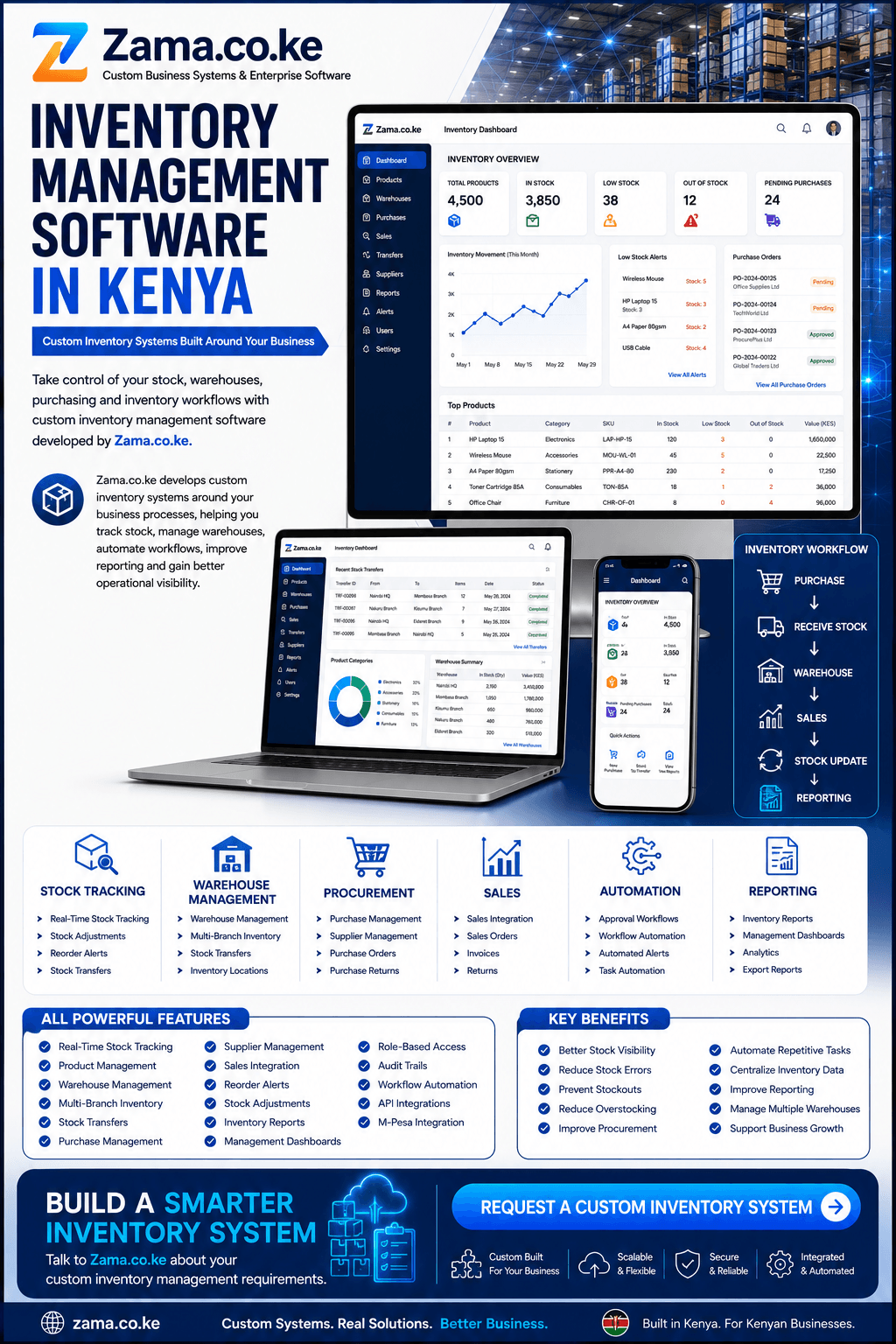
inventory management software in Kenya is becoming an essential digital solution for businesses that want to improve stock control, streamline purchasing, manage warehouses, monitor product movement, and gain better visibility into daily operations. As businesses grow, managing inventory manually can become increasingly difficult. Spreadsheets, paper records, disconnected files, and repetitive data entry can make it challenging to know exactly how much stock is available, where products are located, which items need replenishment, and how inventory is affecting business performance. Zama.co.ke develops custom business systems and enterprise software designed around the specific workflows of modern businesses, helping organizations create centralized, automated, and scalable inventory operations.
Inventory is one of the most important assets for many businesses. Whether an organization sells consumer products, distributes goods, operates several branches, manages a warehouse, manufactures products, or supplies other businesses, accurate inventory information is critical.
When inventory records are inaccurate, the consequences can affect purchasing, sales, finance, customer service, warehouse operations, and management decisions.
A business may purchase products that are already available in sufficient quantities. Employees may spend hours searching through different records to determine stock availability. Customers may be promised products that are actually out of stock. Management may struggle to understand which products are moving quickly and which products are sitting in storage.
A properly designed digital inventory system can bring these activities into one connected environment.
Zama.co.ke focuses on custom software development, meaning inventory functionality can be designed according to the organization’s actual processes, users, reporting requirements, integrations, and long-term goals.
For organizations looking for inventory management software in Kenya, the focus should be on creating a system that provides accurate information, supports employees, reduces repetitive work, and gives management better operational visibility.
What Is Inventory Management Software?
Inventory management software is a digital platform designed to help businesses manage products, stock quantities, purchasing, sales, suppliers, warehouses, stock movements, adjustments, and inventory reporting.
A comprehensive inventory platform can bring multiple activities together.
For example, an organization can manage:
- Product records
- Stock quantities
- Warehouses
- Branches
- Suppliers
- Purchase orders
- Goods received
- Stock transfers
- Sales
- Returns
- Stock adjustments
- Reorder levels
- Inventory reports
- User permissions
- Audit trails
- Notifications
- Dashboards
Instead of relying on several disconnected records, employees can work with a centralized database.
A business looking for inventory management software in Kenya can use a custom development approach to define exactly how products are created, how stock is received, how inventory is transferred, how purchases are approved, and how management receives reports.
Zama.co.ke can develop these processes as part of a wider business application.
The objective is not simply to digitize an existing spreadsheet. The objective is to create a system that improves the entire inventory workflow.
Why Businesses Need Better Inventory Management
Inventory management affects almost every part of a product-based business.
When stock information is accurate, employees can make decisions based on current data. When stock information is inaccurate, employees may make decisions based on assumptions.
Imagine a business with several warehouses.
One warehouse may have 500 units of a particular product. Another may have 50 units. A third location may have no stock.
Without centralized information, employees may not immediately know that the product is available elsewhere.
A digital system can show the business its inventory position across different locations.
For businesses considering inventory management software in Kenya, centralized inventory information can be one of the most important benefits.
Zama.co.ke can develop systems that provide dashboards and reports showing relevant inventory information in a structured format.
Centralizing Inventory Data
One of the biggest challenges of manual inventory management is fragmented information.
Product information might be stored in one spreadsheet.
Purchasing information might be stored somewhere else.
Warehouse employees may maintain their own records.
Sales teams may use another system.
Management may receive periodic reports.
This makes it difficult to establish one reliable picture of inventory.
Custom software can centralize these records.
A product profile could include:
- Product name
- Product code
- SKU
- Category
- Supplier
- Purchase price
- Selling price
- Quantity
- Warehouse
- Reorder level
- Product status
- Stock movement history
This information can be accessed by authorized users according to their responsibilities.
A company exploring inventory management software in Kenya can therefore consider a system where product, stock, purchasing, and reporting information exists within one structured environment.
Zama.co.ke can design the database and interface around the organization’s operational requirements.
Product Management
Effective inventory management begins with organized product information.
Businesses may have hundreds, thousands, or even more products.
Each product may have different attributes.
For example, a business might need to record:
- Product name
- Product category
- Product code
- Unit of measurement
- Brand
- Supplier
- Cost
- Selling price
- Tax information
- Minimum stock level
- Maximum stock level
- Warehouse location
A custom product management module allows the business to define the information it actually needs.
This can reduce inconsistent product records and make searching easier.
For an organization considering inventory management software in Kenya, the ability to customize product information can be particularly useful because different businesses have different inventory structures.
Zama.co.ke can build product management functionality as part of a broader enterprise application.
Real-Time Stock Tracking
Knowing how much stock is available is fundamental to effective inventory management.
A digital platform can update quantities as transactions occur.
For example:
Opening Stock: 1,000 units
Stock Received: +300 units
Sales: -200 units
Stock Transfer: -100 units
Current Stock: 1,000 units
The exact calculation depends on the business rules, but the principle is simple: inventory information should reflect actual transactions.
Businesses considering inventory management software in Kenya can use real-time or near-real-time stock updates to reduce dependence on manual calculations.
Zama.co.ke can develop transaction-based inventory systems that record stock movements and maintain appropriate histories.
Warehouse Management
Warehouse management becomes increasingly complex as a business grows.
A business may have:
- Main warehouse
- Regional warehouse
- Branch warehouses
- Distribution centers
- Retail locations
- Temporary storage areas
Each location may have different stock levels.
A custom inventory system can provide location-based inventory records.
For example:
| Location | Product A | Product B | Product C |
|---|---|---|---|
| Nairobi | 500 | 250 | 100 |
| Mombasa | 250 | 150 | 75 |
| Kisumu | 150 | 100 | 50 |
Management can then see how inventory is distributed.
Organizations searching for inventory management software in Kenya can consider multi-location inventory functionality when planning their software requirements.
Zama.co.ke can develop warehouse modules according to the number of locations, users, products, and workflows involved.
Multi-Branch Inventory Management
Businesses with multiple branches need visibility across locations.
A branch may have sufficient stock of one product but insufficient stock of another.
Without centralized information, management may rely on phone calls or manual reports to understand branch inventory.
A centralized inventory platform can provide branch-level visibility.
Management can see:
- Current stock
- Low-stock products
- Out-of-stock products
- Incoming stock
- Stock transfers
- Sales activity
- Purchase requirements
A business interested in inventory management software in Kenya can consider multi-branch functionality when defining its requirements.
Zama.co.ke can develop branch-based permissions and dashboards so that users see information relevant to their responsibilities.
Stock Transfers Between Locations
Stock transfers are common in businesses with multiple warehouses or branches.
For example:
Warehouse A → Warehouse B
The system can record:
- Transfer request
- Source location
- Destination location
- Products
- Quantities
- Transfer date
- Responsible employee
- Approval status
- Completion status
This creates a traceable inventory movement.
Instead of manually changing quantities in two different records, a properly designed workflow can record the movement as one transaction.
Businesses considering inventory management software in Kenya can therefore include stock transfer workflows in their software requirements.
Zama.co.ke can develop automated stock transfer functionality based on the organization’s operational procedures.
Purchase Management
Inventory and purchasing are closely connected.
When products begin to run low, procurement teams need to know what should be purchased, how much should be purchased, and when the purchase should happen.
A digital workflow can connect inventory levels with purchasing.
A typical process could be:
Low Stock Detected
↓
Purchase Request
↓
Approval
↓
Purchase Order
↓
Goods Received
↓
Inventory Updated
This creates a more structured purchasing process.
Organizations evaluating inventory management software in Kenya can consider whether their inventory platform should include procurement functionality.
Zama.co.ke can develop procurement and approval workflows that connect directly to inventory activities.
Supplier Management
Supplier information is another important part of inventory operations.
A supplier management module can store information such as:
- Supplier name
- Contact details
- Products supplied
- Purchase history
- Pricing
- Purchase orders
- Delivery records
- Payment information
- Supplier status
Connecting suppliers to product records can make procurement more efficient.
For example, when a particular product needs replenishment, authorized employees can quickly identify the relevant supplier.
Businesses researching inventory management software in Kenya can include supplier management among their required features.
Zama.co.ke can integrate supplier information into custom inventory and procurement workflows.
Reorder Level Management
A business needs to know when stock is approaching a level that requires replenishment.
Reorder levels can be defined for individual products.
For example:
Product A
Current stock: 80
Reorder level: 100
The system can identify the product as requiring attention.
Another product may have:
Current stock: 500
Reorder level: 100
This product may not require immediate purchasing.
Automated rules can help employees prioritize replenishment.
For companies exploring inventory management software in Kenya, reorder level functionality can be an important requirement to discuss during system planning.
Zama.co.ke can build configurable stock thresholds and alerts.
Low-Stock Alerts
Employees should not have to manually check every product every day.
Automated notifications can alert responsible users when inventory reaches a predefined threshold.
Notifications may appear through:
- Dashboard alerts
- SMS
- System notifications
The exact notification method can depend on the business requirements.
A custom system can also route alerts to different users depending on product category, warehouse, or branch.
For organizations considering inventory management software in Kenya, automated alerts can be incorporated into a broader inventory workflow.
Zama.co.ke can develop notification-based business automation designed around specific operational rules.
Preventing Stockouts
Stockouts can create serious operational challenges.
If a customer wants a product that is unavailable, the business may lose a sale.
Stockouts can also interrupt production or distribution.
Inventory systems can help reduce the risk by providing:
- Reorder thresholds
- Low-stock alerts
- Purchase reports
- Stock forecasts
- Product movement reports
- Warehouse visibility
A system does not eliminate every stockout, but it can give employees better information for planning.
For businesses seeking inventory management software in Kenya, stockout prevention should be considered when designing the inventory workflow.
Zama.co.ke can create dashboards that highlight products requiring attention.
Preventing Overstocking
Too much inventory can also create problems.
Excess stock can tie up working capital and occupy valuable warehouse space.
Some products may become obsolete, expire, or lose demand.
Inventory reports can help identify slow-moving products.
Management can monitor:
- Product turnover
- Stock age
- Sales volume
- Current quantities
- Purchase history
- Stock value
This information can support better purchasing decisions.
Businesses researching inventory management software in Kenya can therefore consider inventory analytics as part of the system.
Zama.co.ke can develop reporting functionality that helps management understand inventory patterns.
Inventory and Sales Integration
Inventory should ideally connect with sales processes.
When an order is completed, the corresponding stock should be accounted for.
A connected workflow might look like:
Customer Order
↓
Order Confirmation
↓
Stock Availability Check
↓
Stock Allocation
↓
Dispatch
↓
Inventory Update
This reduces duplicate data entry.
For businesses that need inventory management software in Kenya, connecting inventory with sales can make stock availability easier for sales teams to understand.
Zama.co.ke can develop sales and inventory modules that communicate with each other based on the required business rules.
Inventory and Finance
Inventory has a financial impact.
Purchasing stock requires expenditure.
Selling stock generates revenue.
Inventory can also represent a significant business asset.
Connecting inventory and financial processes can provide management with broader operational visibility.
For example, management may want to understand:
- Purchase expenditure
- Stock value
- Sales value
- Product margins
- Supplier obligations
- Inventory adjustments
Zama.co.ke can develop business systems that integrate inventory-related information with financial workflows.
This can create a more connected digital environment for the organization.
Inventory Reporting
Reports transform raw inventory information into useful business intelligence.
A custom inventory platform can provide reports such as:
Current Stock Report
Shows available quantities by product and location.
Low Stock Report
Shows products approaching or below reorder levels.
Stock Movement Report
Shows products entering and leaving inventory.
Purchase Report
Shows purchasing activity.
Supplier Report
Shows supplier-related transactions.
Stock Adjustment Report
Shows changes made to inventory records.
Warehouse Report
Shows inventory by location.
Product Performance Report
Shows product movement and sales activity.
These reports can be available to authorized users through dashboards.
Inventory Dashboards for Management
Senior management may not need to view every transaction.
Instead, management may need a summary of the most important information.
A dashboard can display:
Total Products
Total Stock
Low-Stock Items
Out-of-Stock Items
Pending Purchases
Stock Value
Warehouse Activity
Recent Stock Movements
Charts can also show inventory trends.
Zama.co.ke develops custom dashboards that can present operational information in an easy-to-understand format.
This can help managers spend less time searching for information and more time making decisions.
Stock Adjustments
Inventory records sometimes require adjustments.
Examples include:
- Damaged products
- Missing products
- Expired products
- Returns
- Counting discrepancies
- Data corrections
A controlled adjustment process can prevent unauthorized changes.
For example:
Adjustment Requested
↓
Reason Entered
↓
Manager Reviews
↓
Approval
↓
Stock Updated
↓
Audit Record Created
Zama.co.ke can develop approval workflows for inventory adjustments.
Inventory Audit Trails
Audit trails provide visibility into who performed specific actions.
An audit record might include:
User: Warehouse Manager
Action: Stock Adjustment
Product: Product A
Previous Quantity: 300
New Quantity: 285
Reason: Damaged stock
Date: 20 August 2026
This can help management investigate discrepancies and maintain accountability.
A custom inventory system can provide detailed transaction histories according to business requirements.
User Roles and Permissions
Not every employee should have access to every inventory function.
For example:
Warehouse Employees
May receive and issue products.
Procurement Employees
May create purchase requests and orders.
Sales Employees
May view product availability.
Managers
May approve transactions and access reports.
Administrators
May configure users and system settings.
Role-based permissions help organizations control access to business information.
Zama.co.ke can develop customized access controls based on employee responsibilities.
Barcode and Product Identification
Barcode scanning can make inventory activities faster.
Products can be scanned during:
- Receiving
- Picking
- Dispatch
- Stock counts
- Transfers
This can reduce manual entry.
Depending on the business requirements, barcode functionality can be incorporated into the system.
The objective is to make warehouse processes faster while maintaining accurate records.
Stock Counting and Reconciliation
Physical stock counts are still important even when a digital inventory platform is available.
Businesses may conduct:
- Daily counts
- Weekly counts
- Monthly counts
- Annual counts
- Cycle counts
The system can allow employees to record physical quantities and compare them with system quantities.
For example:
System Quantity: 500
Physical Quantity: 490
Variance: -10
The difference can then be investigated and, where appropriate, adjusted.
Inventory Returns
Products may be returned by customers or to suppliers.
A digital return workflow can record:
- Product
- Quantity
- Return reason
- Customer or supplier
- Date
- Condition
- Approval
- Inventory action
The system can then determine whether the returned product should return to available stock, be quarantined, or be marked as damaged.
Zama.co.ke can develop return workflows according to the organization’s requirements.
Inventory Management for Retail Businesses
Retail businesses often have large numbers of products and frequent transactions.
A custom inventory system can help retail businesses manage:
- Product catalogs
- Stock quantities
- Branches
- Purchases
- Sales
- Suppliers
- Returns
- Reordering
- Reports
When connected to sales, inventory information can be updated as transactions occur.
This creates a more integrated retail operation.
Inventory Management for Wholesale Businesses
Wholesale organizations often manage high volumes of products.
They may require functionality for:
- Bulk purchasing
- Customer orders
- Wholesale pricing
- Warehouses
- Delivery
- Stock allocation
- Supplier management
- Invoicing
A custom system can bring these processes together.
Zama.co.ke can develop wholesale inventory functionality around the organization’s workflows.
Inventory Management for Distribution
Distribution businesses may have products moving through multiple stages.
A typical process could be:
Supplier
↓
Warehouse
↓
Distribution
↓
Branch
↓
Customer
Inventory software can record these movements and provide visibility at each stage.
This can help management understand where products are located and how quickly they are moving.
Inventory Management for Manufacturing
Manufacturing businesses have different inventory requirements.
They may need to track:
- Raw materials
- Components
- Work in progress
- Finished goods
- Production consumption
- Production batches
- Finished-product stock
A manufacturing workflow can connect materials with production processes.
For example:
Raw Materials → Production → Finished Goods → Warehouse → Sales
Zama.co.ke can develop custom manufacturing and inventory workflows according to the organization’s requirements.
Automating Inventory Workflows
Automation is one of the biggest opportunities provided by digital inventory systems.
Instead of requiring employees to perform repetitive tasks manually, the system can trigger actions based on predefined rules.
For example:
Stock below threshold
→ Create notification
→ Notify procurement
→ Generate purchase request
→ Route for approval
→ Record purchase
→ Receive goods
→ Update stock
This can significantly streamline operations.
Zama.co.ke specializes in business automation and custom enterprise applications, making workflow automation an important component of its software development approach.
Inventory Management and Procurement Automation
Procurement teams often spend significant time checking stock requirements and creating purchase documentation.
Automation can help streamline this.
The system can identify products requiring replenishment and initiate the relevant process.
Depending on business rules, automated workflows can include:
- Reorder detection
- Purchase requests
- Approvals
- Purchase orders
- Supplier records
- Goods received
- Inventory updates
This creates a continuous relationship between stock levels and procurement.
Inventory Management and Business Growth
As businesses grow, inventory complexity usually increases.
A business may start with:
1 warehouse + 5 employees + 300 products
Later it may have:
5 warehouses + 100 employees + 10,000 products
The system should be capable of supporting this growth.
Scalability should therefore be considered during development.
Zama.co.ke can design software architecture with future users, products, branches, warehouses, modules, and integrations in mind.
Cloud-Based Inventory Systems
Cloud technology can make business information accessible from different locations.
Authorized users can access dashboards and reports without being physically present in the warehouse.
This can support:
- Remote management
- Multi-branch operations
- Centralized information
- Online reporting
- Centralized backups
- Scalable infrastructure
Zama.co.ke can develop cloud-ready applications according to the project’s technical and business requirements.
Mobile Inventory Management
Modern businesses may need employees to access inventory information from mobile devices.
A responsive interface can allow users to:
- Check stock
- View products
- Record transactions
- Approve requests
- Review alerts
- Access dashboards
This can be particularly useful for managers and employees working away from their desks.
Zama.co.ke develops responsive web-based business applications that can support different devices.
Inventory Data Security
Inventory information can be commercially sensitive.
It can reveal:
- Product costs
- Supplier details
- Stock values
- Sales activity
- Purchasing activity
- Business performance
A well-designed system should therefore include appropriate security controls.
These can include:
- Authentication
- Authorization
- Role-based permissions
- Audit logs
- Secure APIs
- Data backups
- Controlled administrative access
Security requirements should be considered during the architecture and development stages.
Zama.co.ke can incorporate security requirements into custom business applications.
API Integrations
Businesses may already have digital systems that need to exchange information with their inventory platform.
APIs can enable systems to communicate.
Possible integrations can include:
- Sales platforms
- Finance systems
- Payment services
- CRM systems
- SMS services
- Email services
- E-commerce platforms
- Reporting systems
Zama.co.ke can develop API integrations based on the technical requirements of the project.
M-Pesa Integration
For Kenyan businesses, mobile payment workflows can be important.
Where required, inventory and sales systems can be connected to payment processes.
A possible workflow could be:
Customer Order
↓
Payment Request
↓
Payment Confirmation
↓
Order Processing
↓
Inventory Update
The exact integration depends on the organization’s requirements and the payment infrastructure being used.
Zama.co.ke can develop payment-related integrations as part of a broader business application.
Inventory Analytics
Inventory data can be analyzed to identify trends.
Management may want to know:
- Which products move fastest?
- Which products move slowly?
- Which products frequently run out?
- Which products are overstocked?
- Which warehouses hold the most stock?
- How frequently are stock adjustments made?
- Which suppliers are associated with particular products?
Analytics can turn inventory records into actionable information.
Zama.co.ke can develop dashboards and reporting modules that present these insights.
Benefits of Custom Inventory Software
A custom inventory platform can provide several benefits.
Better Visibility
Management can see inventory information through centralized dashboards.
Improved Accuracy
Automated calculations and structured transactions can reduce manual errors.
Faster Operations
Employees can find information quickly.
Better Purchasing
Reorder levels and inventory reports can support purchasing decisions.
Improved Accountability
Audit trails can record user actions.
Better Reporting
Management can access reports based on current information.
Greater Scalability
The platform can be designed to support business growth.
Workflow Automation
Repetitive processes can be automated.
How Zama.co.ke Approaches Inventory Software Development
Developing an effective inventory system begins with understanding the business.
Zama.co.ke can follow a structured process.
Step 1: Business Discovery
The development process begins by understanding:
- Business operations
- Products
- Users
- Warehouses
- Branches
- Purchasing
- Sales
- Reporting
- Existing challenges
Step 2: Requirements Definition
The required features are documented.
Step 3: System Architecture
The technical structure is planned.
Step 4: UI/UX Design
The system interface is designed around user workflows.
Step 5: Development
The required modules and integrations are built.
Step 6: Testing
The system is tested for functionality, usability, security, and performance.
Step 7: Deployment
The completed system is deployed.
Step 8: Training
Users are introduced to the relevant workflows.
Step 9: Support and Improvements
The system can be maintained and expanded as business requirements evolve.
What Makes a Good Inventory Management System?
A good inventory system should be easy to use, accurate, secure, scalable, and aligned with the business.
Important considerations include:
Usability
Employees should be able to complete common tasks without unnecessary complexity.
Accuracy
Transactions should update inventory correctly.
Visibility
Management should have access to useful reports and dashboards.
Security
Users should only access information appropriate to their roles.
Scalability
The platform should accommodate business growth.
Integration
The system should be capable of connecting with relevant business processes.
Automation
Repetitive tasks should be candidates for automation.
Zama.co.ke can incorporate these principles into custom software development projects.
Why Choose Zama.co.ke for Inventory Software Development?
Zama.co.ke focuses on custom business systems and enterprise software.
The company can develop solutions around business processes rather than expecting organizations to completely redesign their operations around rigid software.
Its development capabilities can include:
- Inventory management systems
- ERP development
- Business automation
- Custom web applications
- Enterprise software
- Dashboards
- Reporting systems
- Procurement workflows
- CRM systems
- Employee portals
- API integrations
- Payment integrations
This makes Zama.co.ke suitable for businesses looking to create connected digital operations.
Inventory Management and Operational Visibility
One of the most important benefits of digitizing inventory is improved operational visibility.
Management can move from questions such as:
“How much stock do we have?”
to a dashboard showing current inventory information.
They can also move from:
“Which products need to be purchased?”
to a report showing products below their reorder levels.
Instead of:
“Where did this stock go?”
management can review stock movement records.
This creates a more informed operating environment.
Inventory Management and Employee Productivity
Manual inventory management consumes employee time.
Employees may spend hours:
- Updating spreadsheets
- Searching for records
- Calculating stock balances
- Preparing reports
- Checking purchase requirements
- Reconciling stock
Automation can reduce these repetitive activities.
Employees can then spend more time on activities that require human judgment and customer interaction.
Zama.co.ke develops automation-focused business systems designed to reduce unnecessary manual processes.
Inventory Management and Customer Experience
Accurate inventory information can also support customer service.
Sales employees can determine whether products are available.
They can provide more accurate information about expected availability.
Customers can receive better communication.
Orders can be processed more efficiently.
This demonstrates why inventory is not simply a warehouse function. It can influence the entire customer journey.
Planning Your Inventory System With Zama.co.ke
Before starting development, businesses should document their requirements.
Consider the following questions:
- How many products do you manage?
- How many warehouses do you have?
- Do you operate multiple branches?
- How are products purchased?
- How are goods received?
- How are products sold?
- How are stock transfers handled?
- How are returns processed?
- How are stock adjustments approved?
- Which reports does management need?
- Which employees need access?
- Which integrations are required?
- Which workflows should be automated?
- What future growth should the system support?
The answers can help define the software architecture.
Zama.co.ke can use these requirements to develop a solution tailored to the organization.
The Future of Inventory Management in Kenya
Businesses in Kenya are increasingly adopting digital approaches to everyday operations.
Inventory management is an area where technology can provide significant operational benefits.
As businesses expand, they need more accurate information, faster workflows, better reporting, and greater control.
Modern inventory systems can combine:
- Automation
- Dashboards
- Mobile access
- Cloud infrastructure
- APIs
- Reporting
- Notifications
- User permissions
- Business intelligence
Zama.co.ke can help organizations develop these capabilities as part of custom software solutions.
The future of inventory management is therefore not simply about counting products.
It is about creating a connected digital operation where inventory information supports purchasing, sales, finance, customer service, warehouse management, and management decision-making.
Build Your Custom Inventory System With Zama.co.ke
Every business has different inventory requirements.
A distributor may need multi-warehouse functionality.
A retailer may need sales integration.
A manufacturer may need raw-material tracking.
A wholesaler may need bulk inventory management.
A growing enterprise may need an integrated ERP environment.
A multi-branch organization may need centralized reporting.
Because requirements vary, the right approach is to begin with the organization’s processes.
Zama.co.ke can help transform those processes into a structured software solution.
The goal is to create an inventory platform that helps employees work more efficiently while giving management greater visibility into business operations.