
Table of Contents
Toggle*/Inventory Software Development: The Smart Solution for Modern Businesses
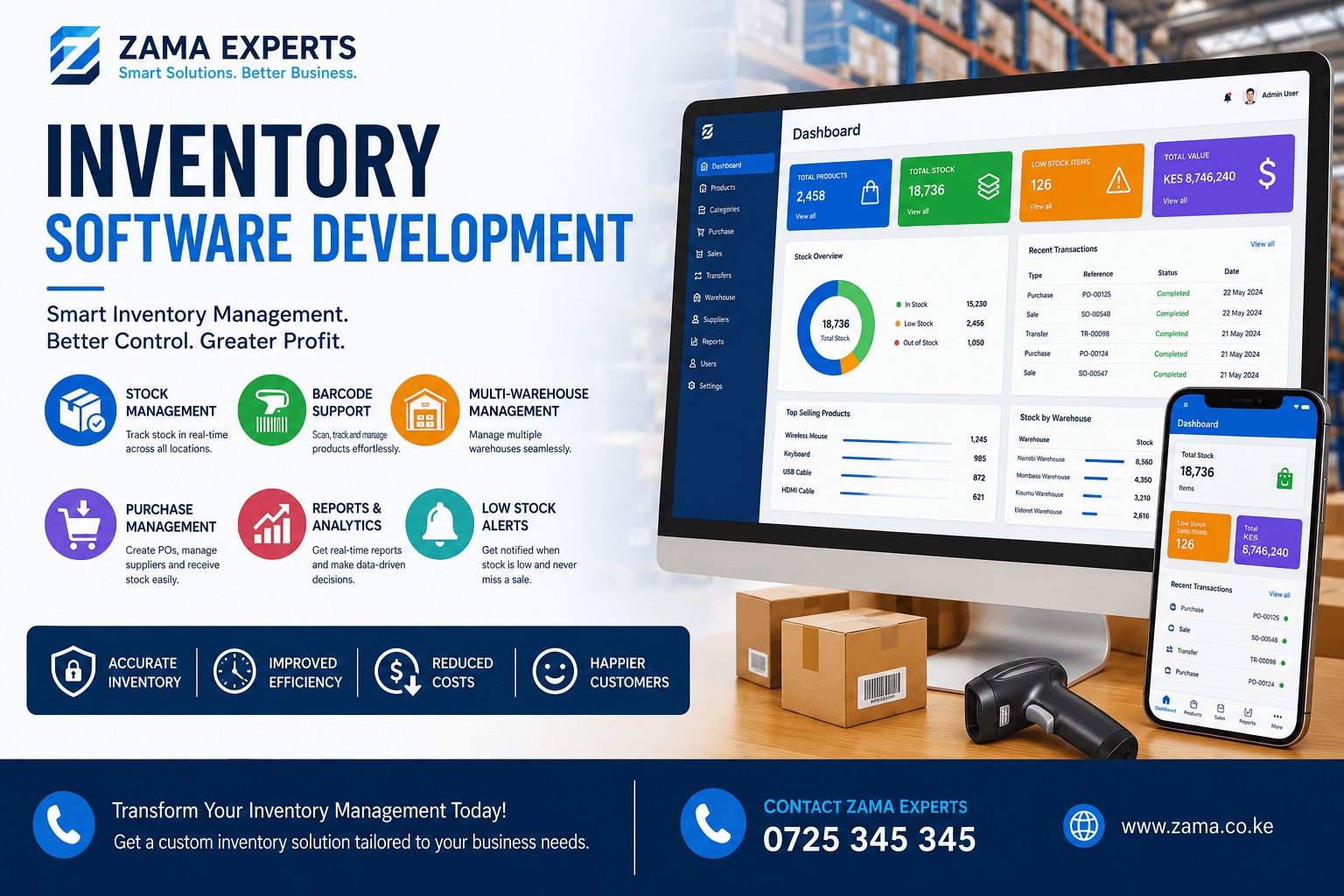 –
–
In today’s competitive business environment, managing inventory efficiently is no longer optional. Whether you operate a retail shop, warehouse, manufacturing company, pharmacy, supermarket, hardware store, or distribution business, having an efficient inventory management system directly impacts profitability.
Inventory Software Development enables businesses to automate stock tracking, reduce losses, improve order accuracy, and gain real-time visibility into inventory movement.
Businesses that continue relying on spreadsheets or manual stock records often experience:
- Stock shortages
- Overstocking
- Lost sales
- Human errors
- Poor forecasting
- Delayed deliveries
- Inventory theft
- Financial losses
Modern businesses require intelligent inventory systems that automate every stage of inventory management.
This comprehensive guide explains everything about Inventory Software Development, why businesses need it, its benefits, features, implementation process, industry applications, and why partnering with experienced developers like Zama Experts gives your business a competitive advantage.
What is Inventory Software Development?
Inventory Software Development is the process of designing, developing, customizing, and implementing software that helps businesses monitor, organize, control, and optimize inventory.
Instead of manually recording stock transactions, inventory software automates:
- Stock receiving
- Product tracking
- Warehouse management
- Purchase orders
- Sales
- Returns
- Transfers
- Supplier management
- Reporting
- Forecasting
The software creates a centralized inventory database accessible from anywhere.
Why Inventory Software Development Matters
Inventory is one of the biggest investments in any business.
Poor inventory management results in:
- Dead stock
- Excess inventory
- Missed customer orders
- Cash flow problems
- Production delays
- Customer dissatisfaction
Custom inventory software eliminates these challenges.
Benefits include:
- Real-time inventory visibility
- Faster operations
- Better customer service
- Improved forecasting
- Accurate reporting
- Reduced operational costs
Industries That Need Inventory Software
Almost every industry benefits from Inventory Software Development, including:
Retail Stores
Track products across multiple branches.
Supermarkets
Monitor thousands of SKUs efficiently.
Manufacturing Companies
Manage raw materials, work-in-progress, and finished goods.
Pharmacies
Track expiry dates and batch numbers.
Hospitals
Monitor medical supplies and equipment.
Hardware Stores
Control inventory movement and prevent losses.
Automotive Parts Dealers
Track spare parts inventory.
E-commerce Businesses
Synchronize online and physical inventory.
Wholesale Businesses
Manage bulk inventory efficiently.
Food Distribution Companies
Track perishable goods.
Key Features of Inventory Software Development
A professionally developed inventory solution includes numerous features.
1. Stock Management
Monitor:
- Available stock
- Reserved stock
- Damaged stock
- Returned items
- Incoming inventory
2. Barcode Integration
Barcode technology allows businesses to:
- Scan products
- Receive stock faster
- Sell products quickly
- Reduce errors
3. QR Code Support
Modern systems also support QR codes for faster identification.
4. Multi-Warehouse Management
Businesses with several warehouses can:
- Track inventory separately
- Transfer stock
- Compare warehouse performance
5. Supplier Management
Store supplier information including:
- Contacts
- Pricing
- Purchase history
- Delivery schedules
6. Purchase Order Management
Generate purchase orders automatically based on stock levels.
7. Sales Integration
Inventory updates automatically after every sale.
No manual stock deduction.
8. Low Stock Alerts
Receive notifications when products reach reorder levels.
9. Inventory Forecasting
Predict future demand using historical sales data.
10. Batch Tracking
Useful for:
- Pharmaceuticals
- Food manufacturers
- Chemical companies
11. Expiry Date Management
Avoid losses by tracking products nearing expiry.
12. Warehouse Mapping
Locate products instantly.
Improve picking speed.
13. Mobile Accessibility
Managers can access inventory using smartphones.
14. User Roles
Control permissions for:
- Storekeepers
- Managers
- Sales staff
- Administrators
15. Real-Time Reports
Generate reports instantly.
Examples include:
- Stock valuation
- Fast-moving items
- Slow-moving products
- Sales trends
- Purchase reports
- Supplier performance
Benefits of Inventory Software Development
Improved Accuracy
Automation minimizes manual errors.
Better Customer Satisfaction
Products remain available when customers need them.
Reduced Stock Losses
Track every inventory movement.
Faster Decision Making
Real-time dashboards support informed decisions.
Lower Operating Costs
Reduce waste and optimize purchasing.
Improved Cash Flow
Avoid tying up capital in excess inventory.
Better Compliance
Maintain accurate records for audits and tax reporting.
Inventory Software Development Process
Developing an inventory solution involves several key stages.
Requirement Analysis
Developers gather information about:
- Business processes
- Existing systems
- Pain points
- Future goals
System Design
The software architecture is planned, including:
- Database design
- User interface
- Security
- Integrations
Development
Programmers build:
- Inventory modules
- Purchase management
- Sales integration
- Reports
- Dashboards
Testing
The software undergoes:
- Functional testing
- Security testing
- Performance testing
- User acceptance testing
Deployment
Install the software and migrate existing inventory data.
Training
Employees learn how to use every module.
Support and Maintenance
Continuous updates ensure optimal performance.
Essential Modules in Inventory Software
A complete inventory solution usually includes:
- Product Management
- Category Management
- Warehouse Management
- Stock Adjustment
- Purchase Orders
- Sales Orders
- Supplier Management
- Customer Management
- Barcode Management
- Reports
- User Management
- Audit Logs
- Dashboard
Integration Capabilities
Modern inventory software integrates with:
- Accounting software
- ERP systems
- CRM software
- POS systems
- E-commerce platforms
- Payment gateways
- Mobile applications
- SMS gateways
- Email systems
Integration eliminates duplicate data entry and creates a seamless workflow.
Cloud vs On-Premise Inventory Software
Cloud-Based Inventory Software
Advantages:
- Accessible anywhere
- Lower upfront costs
- Automatic backups
- Easy scalability
- Automatic updates
On-Premise Inventory Software
Advantages:
- Greater control over data
- Works without internet
- Custom security policies
- Suitable for highly regulated industries
Inventory Software Development for Small Businesses
Small businesses often assume inventory software is expensive.
However, affordable custom solutions help them:
- Reduce stock losses
- Improve customer service
- Increase profitability
- Scale operations efficiently
Even a single retail outlet benefits significantly from automation.
Inventory Software Development for Large Enterprises
Large organizations require advanced capabilities such as:
- Multi-location inventory
- Role-based approvals
- API integrations
- Advanced analytics
- AI forecasting
- Automated procurement
- Enterprise security
Technologies Used in Inventory Software Development
Professional developers may use:
Frontend:
- React
- Angular
- Vue.js
Backend:
- Laravel
- ASP.NET
- Node.js
- Django
Database:
- PostgreSQL
- MySQL
- SQL Server
Cloud Platforms:
- AWS
- Microsoft Azure
- Google Cloud
Mobile:
- Flutter
- React Native
Security Features
Inventory data is valuable.
Professional software includes:
- SSL encryption
- User authentication
- Two-factor authentication
- Activity logs
- Data backups
- Disaster recovery
- Permission management
- Audit trails
Common Challenges Solved by Inventory Software Development
Businesses often struggle with:
Duplicate stock entries
Automation eliminates duplication.
Missing inventory
Every movement is recorded.
Slow stock taking
Barcode scanning speeds inventory counts.
Overstocking
Demand forecasting prevents excessive purchasing.
Stock shortages
Automatic reorder alerts ensure timely replenishment.
Case Study 1: Supermarket Chain
A supermarket chain with five branches struggled with inventory discrepancies and delayed replenishment.
Challenges
- Frequent stockouts
- Manual reconciliation
- Slow reporting
- High shrinkage
Solution
A custom inventory system with:
- Barcode scanning
- Multi-branch synchronization
- Automated purchase orders
- Real-time dashboards
Results
- 40% reduction in stock discrepancies
- 35% faster stock replenishment
- 25% increase in operational efficiency
- Improved customer satisfaction
Case Study 2: Manufacturing Company
A manufacturer relied on spreadsheets to manage raw materials.
Challenges
- Production delays
- Inaccurate material counts
- Excess purchasing
Solution
A custom inventory platform integrated with production planning.
Results
- 50% reduction in production delays
- 30% lower inventory holding costs
- Accurate material planning
- Improved production scheduling
Case Study 3: Pharmacy Network
A pharmacy chain needed to track medicine batches and expiry dates.
Solution
Developed features included:
- Batch management
- Expiry alerts
- Barcode scanning
- Automated replenishment
Results
- Significant reduction in expired stock
- Faster dispensing
- Better regulatory compliance
- Improved inventory accuracy
Customer Testimonials
Retail Business Owner
“Since implementing our custom inventory system, stock accuracy has improved dramatically. We rarely experience stock shortages, and our staff work much faster.”
Warehouse Manager
“The barcode functionality transformed our warehouse operations. Stock counting that once took days now takes only a few hours.”
Manufacturing Director
“Real-time inventory visibility has helped us reduce production downtime and improve planning. The return on investment exceeded our expectations.”
Pharmacy Manager
“The expiry tracking module has virtually eliminated losses from expired medicines. Compliance reporting is now effortless.”
Why Choose Custom Inventory Software Instead of Off-the-Shelf Solutions?
While ready-made inventory software can work for some businesses, custom Inventory Software Development offers distinct advantages:
- Tailored to your workflows
- Scalable as your business grows
- Integrates with your existing systems
- Supports unique approval processes
- Provides ownership of your data and features
- Reduces reliance on unnecessary modules
Custom solutions are designed around your operations rather than forcing your business to adapt to generic software.
Future Trends in Inventory Software Development
Technology continues to transform inventory management. Emerging trends include:
Artificial Intelligence (AI)
AI can forecast demand, recommend reorder quantities, and identify unusual stock movements.
Internet of Things (IoT)
Connected sensors automatically monitor inventory levels and warehouse conditions.
RFID Technology
RFID tags allow faster, contactless inventory tracking across warehouses.
Predictive Analytics
Businesses can anticipate seasonal demand and optimize purchasing decisions.
Mobile Inventory Management
Staff can receive stock, perform counts, and approve transfers directly from mobile devices.
Business Intelligence Dashboards
Interactive dashboards provide executives with actionable insights into stock turnover, profitability, and operational performance.
Choosing the Right Inventory Software Development Partner
Selecting an experienced software development company is critical to project success. Look for a partner that offers:
- Proven experience in custom software development
- Industry-specific expertise
- Scalable architecture
- Strong security practices
- Ongoing technical support
- User training and documentation
- Integration capabilities with ERP, POS, CRM, and accounting systems
A reliable development partner will work closely with your team to understand your processes and deliver software that meets your current and future business needs.
Advanced Inventory Optimization Strategies
Implementing Inventory Software Development is only the beginning. To maximize return on investment, businesses should adopt advanced inventory optimization strategies. A modern inventory management system can analyze historical sales, seasonal trends, supplier performance, and customer buying patterns to recommend the right stock levels.
ABC Inventory Analysis
ABC analysis categorizes inventory based on value and importance:
- Category A: High-value products with lower sales volume that require close monitoring.
- Category B: Moderately valuable products with average demand.
- Category C: Low-value items with high sales volume that can be managed with simpler controls.
By integrating ABC analysis into Inventory Software Development, businesses can prioritize purchasing decisions and allocate warehouse space more efficiently.
Demand Forecasting with Inventory Software
Accurate forecasting is essential for reducing excess inventory and preventing stock shortages. Modern inventory systems use historical sales data, market trends, and seasonal fluctuations to estimate future demand.
Benefits include:
- Better purchasing decisions
- Reduced warehouse storage costs
- Improved cash flow
- Increased customer satisfaction
- Enhanced production planning
Businesses using intelligent forecasting experience fewer emergency purchases and can negotiate better prices with suppliers.
Warehouse Automation
Warehouse automation is transforming inventory management by reducing manual processes and increasing efficiency.
Inventory software supports warehouse automation through:
- Barcode scanning
- QR code scanning
- RFID technology
- Automated picking lists
- Digital warehouse mapping
- Automated stock transfers
Warehouse employees can locate products within seconds, reducing order fulfillment times and improving accuracy.
Multi-Location Inventory Management
Many businesses operate across multiple branches or warehouses. Without centralized software, tracking inventory across locations becomes difficult.
Custom Inventory Software Development enables businesses to:
- View stock across all branches
- Transfer inventory between locations
- Monitor branch performance
- Prevent duplicate purchasing
- Balance stock availability
Managers receive real-time updates regardless of where inventory is stored.
Inventory Cost Management
Inventory represents a significant investment, making cost control essential.
Custom inventory software helps reduce:
Holding Costs
Avoid excess stock that occupies warehouse space and ties up capital.
Ordering Costs
Automate purchase orders and reduce administrative work.
Shortage Costs
Receive alerts before products run out of stock.
Waste
Track expiry dates and slow-moving inventory to minimize losses.
Inventory Auditing Made Easy
Traditional inventory audits can be time-consuming and disruptive.
Modern inventory systems simplify audits by:
- Recording every transaction automatically
- Maintaining complete audit trails
- Tracking user activities
- Supporting cycle counts
- Comparing physical stock with system records
Auditors can quickly identify discrepancies and generate compliance reports.
Role-Based Access Control
Not every employee should have access to all inventory functions.
Professional Inventory Software Development includes role-based permissions such as:
Storekeeper
- Receive stock
- Issue products
- Perform stock counts
Sales Personnel
- View available inventory
- Process customer orders
Warehouse Manager
- Approve transfers
- Manage warehouses
- Generate reports
Administrator
- Full system access
- User management
- System configuration
This improves security and accountability.
Inventory Software and Business Intelligence
Inventory software is no longer just a stock management tool—it is a business intelligence platform.
Interactive dashboards display:
- Revenue trends
- Best-selling products
- Slow-moving inventory
- Supplier performance
- Inventory turnover
- Gross profit
- Purchase history
- Branch comparisons
Executives can make informed decisions using real-time analytics rather than relying on outdated reports.
Integration with Accounting Systems
One of the greatest benefits of custom Inventory Software Development is seamless integration with accounting software.
Benefits include:
- Automatic journal entries
- Accurate cost of goods sold calculations
- Inventory valuation
- Real-time financial reporting
- Reduced manual bookkeeping
Finance teams spend less time reconciling inventory records and more time analyzing business performance.
E-commerce Inventory Synchronization
Online businesses must ensure that inventory levels remain accurate across all sales channels.
Custom inventory software can synchronize stock with:
- Company websites
- Online marketplaces
- Mobile shopping applications
- Point-of-sale systems
When a customer purchases an item online, inventory updates instantly across every connected platform, preventing overselling.
Mobile Inventory Applications
Business owners and warehouse staff increasingly rely on smartphones and tablets.
Mobile inventory applications enable users to:
- Receive stock
- Scan barcodes
- Approve purchase orders
- View inventory reports
- Monitor warehouse operations
- Check product availability
- Record stock adjustments
This mobility improves operational efficiency and decision-making.
Environmental Benefits of Digital Inventory Systems
Inventory digitization also contributes to sustainability.
Benefits include:
- Reduced paper usage
- Lower printing costs
- Digital approvals
- Electronic purchase orders
- Reduced waste through better inventory planning
- Improved energy efficiency through optimized warehouse operations
Companies embracing digital inventory systems often support broader environmental and corporate sustainability goals.
Measuring the Success of Inventory Software
After implementing an inventory solution, businesses should monitor key performance indicators (KPIs), including:
- Inventory turnover ratio
- Order fulfillment rate
- Stock accuracy percentage
- Average inventory value
- Warehouse utilization
- Order processing time
- Supplier lead time
- Stockout frequency
- Overstock percentage
- Customer satisfaction scores
Tracking these KPIs helps organizations continuously improve their inventory management processes.
Common Mistakes to Avoid During Inventory Software Implementation
Successful implementation requires careful planning. Common mistakes include:
- Inadequate staff training
- Poor data migration
- Lack of user involvement
- Ignoring future scalability
- Choosing software without customization options
- Failing to integrate with existing systems
- Skipping system testing
- Not establishing inventory management policies
Avoiding these mistakes ensures a smoother deployment and better long-term results.
Return on Investment (ROI) of Inventory Software Development
Businesses often recover the cost of Inventory Software Development within a short period through:
- Reduced inventory losses
- Lower operational expenses
- Improved employee productivity
- Faster order fulfillment
- Better purchasing decisions
- Increased sales from improved stock availability
- Reduced manual labor
- Enhanced customer retention
A well-designed inventory system becomes a long-term asset that continues delivering value as the business grows.
Additional Customer Testimonials
Electronics Distributor
“Our inventory accuracy improved from 82% to over 99% after implementing the custom solution. The real-time reporting has transformed how we make purchasing decisions.”
Hardware Store Owner
“Managing thousands of products was becoming impossible with spreadsheets. The new inventory system automated our stock management and significantly reduced losses.”
Food Distribution Company
“Expiry tracking and automated stock rotation have drastically reduced waste. We now have complete confidence in our inventory data and can serve our customers much faster.”
Why Choose Zama Experts for Inventory Software Development?
At Zama Experts, we specialize in building custom inventory management systems that help businesses improve efficiency, reduce costs, and gain complete visibility over their stock.
Our services include:
- Custom Inventory Software Development
- Warehouse Management Systems
- Barcode and QR Code Integration
- Multi-Branch Inventory Solutions
- Mobile Inventory Applications
- ERP and Accounting System Integration
- Inventory Analytics and Reporting
- Cloud and On-Premise Deployments
- Software Maintenance and Support
- User Training and System Upgrades
Our experienced development team delivers secure, scalable, and user-friendly solutions tailored to businesses of all sizes.
Frequently Asked Questions (FAQs)
How long does Inventory Software Development take?
The timeline depends on the project’s complexity. Basic systems may take 6–10 weeks, while enterprise solutions can require several months.
Can inventory software integrate with my accounting system?
Yes. Custom inventory software can integrate with popular accounting, ERP, POS, and e-commerce platforms.
Is cloud-based inventory software secure?
Yes. With encryption, secure authentication, backups, and access controls, cloud solutions can provide a high level of security.
Can the system support multiple branches?
Absolutely. Multi-branch inventory management is one of the most common features requested in custom inventory software.
Does the software support barcode scanners?
Yes. Most custom inventory systems can integrate with barcode scanners, QR code readers, and even RFID devices.
Can I access the system on my phone?
Yes. Mobile-responsive web applications or dedicated Android and iOS apps can be developed to provide access from anywhere.
Conclusion
Inventory Software Development is a strategic investment for businesses that want to improve stock accuracy, reduce operational costs, and enhance customer satisfaction. Whether you manage a retail store, warehouse, manufacturing plant, pharmacy, or distribution business, a custom inventory solution gives you the tools to automate operations, make informed decisions, and scale with confidence.
By replacing manual processes with intelligent automation, businesses gain real-time visibility into inventory, streamline purchasing and sales, minimize losses, and improve profitability. As technologies such as AI, IoT, and predictive analytics continue to evolve, investing in modern inventory software positions your organization for long-term success.
Contact Zama Experts Today
Ready to transform the way you manage your inventory?
Zama Experts develops secure, scalable, and fully customized inventory management solutions tailored to your business needs.
Our Services Include:
- Custom Inventory Software Development
- Warehouse Management Systems
- Barcode & QR Code Solutions
- ERP & Accounting Integrations
- Mobile Inventory Applications
- Multi-Branch Inventory Management
- Cloud-Based Inventory Systems
- Inventory Reporting & Analytics
- System Maintenance & Technical Support
Contact Zama Experts today to discuss your project and discover how a custom inventory management system can improve efficiency, reduce costs, and accelerate business growth.
Phone: 0725 345 345