
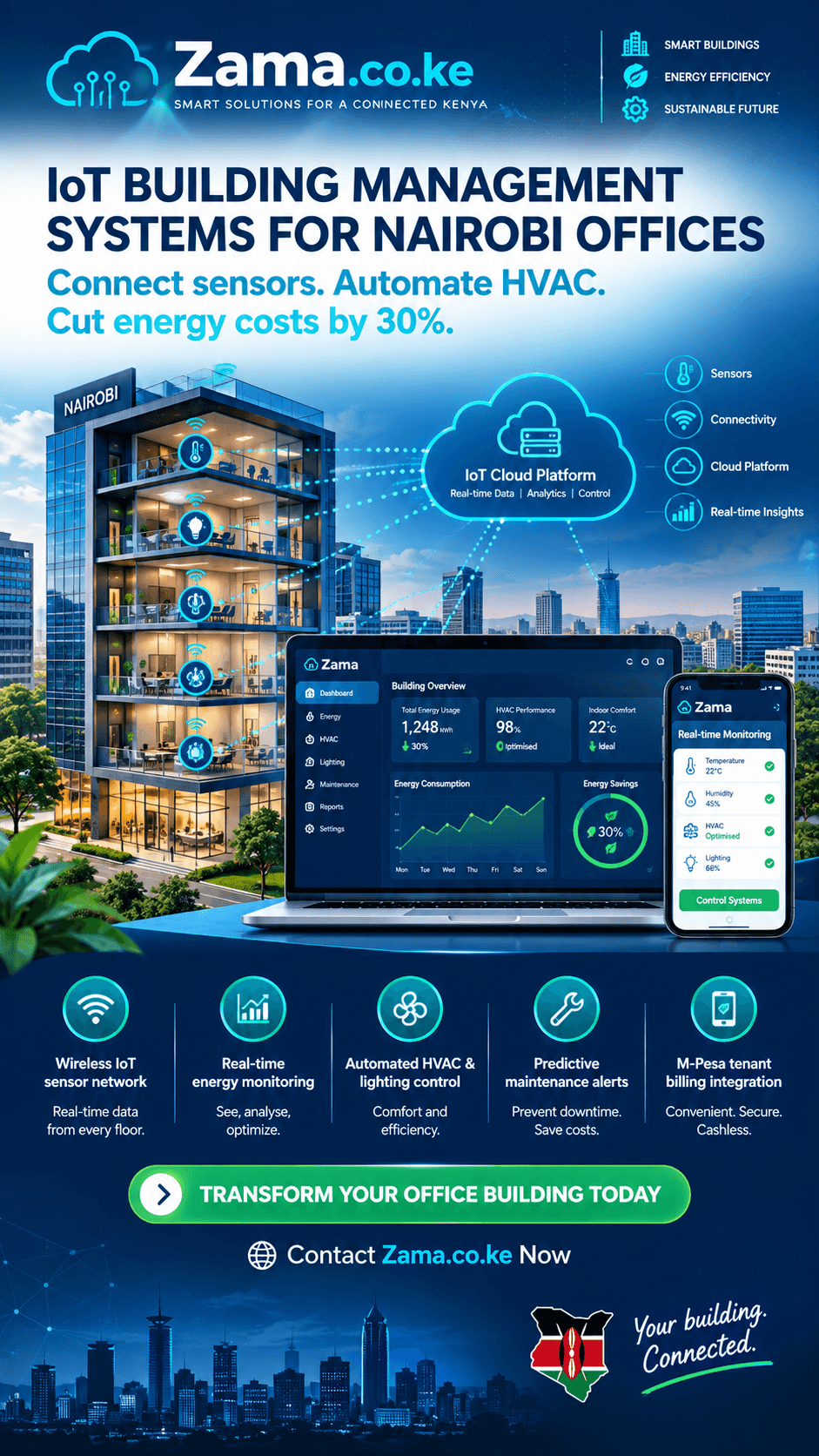
IoT building management systems for Nairobi offices is a question that every property manager, facility director, and building owner in Kenya’s capital must answer in 2026. With Nairobi’s commercial office sector expanding through developments like The Purple Tower, Britam Tower, and the growing cluster of Grade A office spaces in Westlands, Upper Hill, and Kilimani, the complexity of managing building operations has outgrown manual methods. At zama.co.ke, we’ve helped numerous organizations across Nairobi implement IoT-driven building management systems that connect sensors, automate HVAC and lighting, and provide real-time visibility into every system and every shilling of energy consumed. This comprehensive guide explores IoT building management systems for Nairobi offices, from understanding how IoT transforms building operations to selecting the right approach for your office facility.
What IoT Building Management Systems Actually Do
Before diving into IoT building management systems for Nairobi offices, it’s essential to understand what this technology actually does. An IoT building management system combines traditional Building Management System (BMS) capabilities with Internet of Things sensors, cloud connectivity, and data analytics. It replaces wired, closed-loop control systems with wireless sensors, edge computing devices, and cloud platforms that continuously monitor temperature, humidity, air quality, occupancy, energy consumption, and equipment performance.
A proper IoT building management systems for Nairobi offices does far more than control HVAC from a central terminal. It collects data from hundreds of sensors distributed throughout the building, transmits that data to cloud platforms for analysis, applies machine learning algorithms to optimize energy consumption and occupant comfort, and provides building managers with actionable insights through intuitive dashboards. The Kenya Building Automation System Market is anticipated to grow at a CAGR of 8.5% during the forecast period 2025-2031, driven by advancements in wireless technologies and IoT integration that are making building automation more accessible and cost-effective.
For a Nairobi office building, the practical definition of IoT building management systems for Nairobi offices is this: the connected system that tells you exactly how much energy every floor is consuming, exactly which zones are too hot or too cold, exactly when equipment needs maintenance, and exactly how to optimize operations—all from a cloud dashboard accessible on any device, with sensors that can be deployed without disrupting tenants or demolishing walls.
Why Nairobi Offices Need IoT Building Management Systems
When evaluating IoT building management systems for Nairobi offices, consider the compelling reasons for adoption:
Energy Cost Pressures
Energy costs in Kenya continue to rise. For commercial office buildings, HVAC and lighting represent the largest energy consumers—often accounting for 60 to 70 percent of total electricity consumption. Without real-time visibility into energy usage, building owners cannot identify inefficiencies, optimize consumption, or implement effective energy-saving strategies.
A modern IoT building management systems for Nairobi offices provides the visibility and control needed to reduce energy consumption. Smart lighting systems adjust based on natural light levels and occupancy, reducing electricity use by up to 40 percent. In Nairobi, several office buildings have installed automated lighting and HVAC controls, cutting their monthly energy bills by 30 percent on average. By monitoring HVAC performance, lighting usage, and equipment efficiency in real time, facility managers can identify waste, adjust setpoints, schedule equipment operation, and deliver measurable savings.
The Growth of Smart Buildings in Nairobi
Nairobi’s commercial real estate sector is rapidly adopting smart building technologies. The Kenya Intelligent Building Automation Technologies market is experiencing steady growth due to increasing urbanization, infrastructure development, and a focus on energy efficiency. Key factors driving market growth include the adoption of smart building solutions, rising demand for integrated security systems, and government initiatives promoting sustainable development.
Modern office developments are being built with integrated building management systems that control HVAC, lighting, security, and access from a single platform. For these buildings, IoT building management systems for Nairobi offices is not an add-on—it’s a core requirement. Tenants increasingly expect smart building features. They want to control office temperatures from their phones, receive alerts about building events, access energy consumption data for their premises, and integrate building access with their own security systems.
Wireless Technology Makes IoT Accessible for Retrofits
One of the most significant developments enabling IoT adoption in Nairobi offices is the shift toward wireless and IoT-enabled solutions. These technologies offer flexibility, scalability, and ease of installation, making them particularly attractive for retrofitting projects. Unlike wired BMS systems that require extensive cabling and construction disruption, wireless IoT sensors can be deployed in occupied buildings without disrupting tenants.
Smart infrastructure reduces wiring and installation costs by using wireless sensors and centralized control systems. For Nairobi office buildings that were constructed before smart building standards emerged, wireless IoT sensors provide a practical path to modernization without the expense and disruption of rewiring.
Government Regulations and Sustainability Goals
The Kenyan government has implemented policies to regulate the building management system market, including energy efficiency standards for commercial buildings, incentives for installing energy management systems, and public awareness campaigns promoting smart building technologies. Building owners and managers are increasingly prioritizing sustainability, and an IoT BMS helps achieve sustainability goals by reducing energy consumption, lowering carbon emissions, and demonstrating environmental responsibility.
Multi-Tenant Complexity
Nairobi office buildings often house multiple tenants, each with their own employees, operating hours, and comfort preferences. Managing these diverse requirements manually is impossible. A custom IoT building management systems for Nairobi offices can support tenant-specific dashboards, allowing each tenant to monitor their own energy consumption, control their own zones, and receive alerts relevant to their premises.
Essential Features of IoT Building Management Systems for Nairobi Offices
When evaluating IoT building management systems for Nairobi offices, focus on these core features:
1. Wireless IoT Sensor Network
The foundation of an IoT BMS is the sensor network. A proper system should deploy wireless sensors throughout the building to monitor temperature, humidity, air quality (CO2 and CO), occupancy, light levels, and energy consumption. These sensors communicate through protocols like Zigbee, Z-Wave, Wi-Fi, or LoRaWAN, transmitting data to gateways that forward it to the cloud platform.
The Kenya Building Automation System Market report notes that wireless technology—including Zigbee, Enocean, Z-Wave, Wi-Fi, Bluetooth, Thread, Infrared, and Modbus—is making BAS more accessible and cost-effective. Wireless sensors can be deployed in occupied buildings without disrupting tenants, and they can be repositioned as space usage changes.
2. HVAC Control and Optimization
HVAC is the largest energy consumer in most Nairobi office buildings. The IoT BMS should provide comprehensive HVAC control: temperature setpoints by zone, scheduling based on occupancy patterns, integration with weather forecasts, and automated optimization that adjusts settings based on real-time conditions. Modern systems use machine learning algorithms to predict occupancy patterns and adjust HVAC operations accordingly, reducing energy waste while maintaining occupant comfort.
3. Lighting Automation and Daylight Harvesting
IoT lighting systems integrate with occupancy sensors and daylight sensors to adjust illumination automatically. When natural light is sufficient, artificial lighting dims or turns off. When spaces are unoccupied, lighting turns off entirely. Smart lighting systems adjust based on natural light levels and occupancy, reducing electricity use by up to 40 percent.
4. Energy Monitoring and Analytics
A key advantage of IoT BMS is granular energy monitoring. The system should track energy consumption by floor, by zone, by system (HVAC, lighting, plug loads), and by tenant. Cloud analytics identify trends, anomalies, and opportunities for savings. Real-time dashboards show current consumption and compare it against baselines and targets.
5. Environmental Monitoring and Occupant Comfort
IoT sensors monitor air quality, temperature, humidity, and CO2 levels. When conditions fall outside configured ranges, the system alerts facility managers and can automatically adjust HVAC operations. This is particularly important in Nairobi offices where outdoor air quality varies and where occupant comfort directly affects productivity.
6. Predictive Maintenance
IoT BMS collects operational data from equipment—runtime hours, energy consumption, temperature profiles, vibration signatures—and uses machine learning to predict when maintenance will be needed. This shifts maintenance from reactive to predictive, reducing unexpected breakdowns and extending equipment life.
7. Access Control and Security Integration
The IoT BMS should integrate with access control systems, providing visibility into who is in the building, which doors are locked or unlocked, and what access events have occurred. Integration with CCTV allows video verification of access events.
8. Cloud-Based Management Dashboard
The IoT BMS should be accessible through a cloud-based dashboard that works on any device—desktop, tablet, or smartphone. Role-based access ensures facility managers, engineers, tenants, and executives each see the information relevant to their role. The dashboard should provide real-time monitoring, historical reporting, and alerting.
9. M-Pesa Tenant Billing Integration
For multi-tenant buildings, the IoT BMS should support tenant billing for energy consumption, service charges, and parking. Integration with M-Pesa enables automated payment collection through STK Push, with automatic reconciliation.
10. Offline Capability and Resilience
Nairobi buildings face power fluctuations and internet outages. A proper IoT BMS should continue monitoring and controlling critical systems during connectivity issues, storing data locally and syncing when connection returns.
IoT Protocols for Nairobi Office Buildings
When planning IoT building management systems for Nairobi offices, the choice of communication protocols matters:
BACnet
BACnet (Building Automation and Control Network) is the leading protocol for HVAC, lighting, and building automation systems. It is designed specifically for building automation and is supported by major equipment vendors. BACnet allows devices from different manufacturers to communicate on the same network.
Modbus
Modbus is an industrial communication protocol widely used for power meters, generators, and industrial equipment. Many Nairobi office buildings have Modbus-compatible equipment that can be integrated into the IoT BMS.
KNX
KNX is a standardized protocol for lighting, blinds, HVAC, and security. It is particularly strong for lighting automation and is widely deployed in commercial buildings.
Zigbee, Z-Wave, and LoRaWAN
Wireless protocols—Zigbee, Z-Wave, LoRaWAN—are increasingly used for IoT sensors. They offer flexibility, scalability, and ease of installation, making them particularly attractive for retrofitting projects. These protocols enable battery-powered sensors that can be deployed without wiring.
The ROI of IoT Building Management Systems for Nairobi Offices
When evaluating IoT building management systems for Nairobi offices, the ROI is compelling:
Energy Savings: Real-time monitoring and automated optimization reduce energy consumption by 20 to 40 percent, delivering significant annual savings. In Nairobi, office buildings have cut monthly energy bills by 30 percent on average after installing automated lighting and HVAC controls.
Reduced Installation Costs: Wireless sensors eliminate the need for extensive cabling, reducing installation costs and enabling retrofits without disrupting tenants. Smart infrastructure reduces wiring and installation costs by using wireless sensors and centralized control systems.
Extended Equipment Life: Predictive maintenance based on real-time data extends equipment life and reduces emergency repair costs.
Improved Occupant Comfort: Environmental monitoring and automated adjustments maintain optimal conditions, improving occupant satisfaction and productivity.
Tenant Retention: Smart building features—real-time data access, automated controls, responsive maintenance—improve tenant satisfaction and retention.
Operational Efficiency: Facility managers can monitor and control all systems from a single dashboard, reducing time spent on manual checks and reporting.
Compliance Protection: Data Protection Act compliance and KRA eTIMS integration built into the system reduce legal and financial risk.
Implementation Considerations for Nairobi Offices
When implementing IoT building management systems for Nairobi offices, consider these factors:
Start with a Pilot Zone
Deploy IoT sensors in one floor or zone first, prove the technology works, gather data, and refine before expanding building-wide. This approach catches issues early and builds confidence among staff and tenants.
Assess Your Building Systems
Before development begins, document your building systems: equipment types, protocols, data points, and integration requirements. This assessment forms the foundation for system design.
Choose the Right Development Partner
Select a development partner with IoT integration experience, local support capabilities, and a proven track record. The best IoT building management systems for Nairobi offices providers understand building systems as well as IoT technologies.
Plan for Power and Connectivity
Nairobi’s power and internet infrastructure can be unpredictable. Ensure your system includes UPS backup for critical components and offline capability for monitoring and control.
Train Your Team
Facility managers, engineers, and administrators need training on the new system. Role-specific training ensures everyone understands their responsibilities and capabilities.
Ensure Data Security
IoT systems process sensitive data. Implement encryption, access controls, audit trails, and regular security assessments.
The Zama.co.ke Approach to IoT Building Management Systems for Nairobi Offices
When considering IoT building management systems for Nairobi offices, zama.co.ke follows a structured approach:
Building Assessment
We evaluate your building’s systems, equipment, and integration requirements. This includes identifying protocols, mapping data points, and understanding your operational workflows.
IoT Architecture Design
We design the IoT architecture—sensor placement, communication protocols, gateway configuration, cloud platform selection—tailored to your building’s specific characteristics.
Development and Integration
We develop the BMS web portal, integrate with building systems, and configure dashboards, alerts, and reports. We test all scenarios before deployment.
Deployment and Training
We deploy sensors and gateways, configure user accounts, and provide role-specific training for facility managers, engineers, and administrators.
Post-Launch Support
We remain available for maintenance, troubleshooting, and system upgrades as your building evolves.
The Cost of Delaying IoT BMS Implementation
While office building owners evaluate IoT building management systems for Nairobi offices, the cost of inaction compounds daily. Every month of manual building operations represents wasted energy, unnecessary maintenance costs, and missed opportunities to improve tenant satisfaction. For a Nairobi office building spending KES 2 million monthly on electricity, a 30 percent reduction represents KES 600,000 in monthly savings—KES 7.2 million annually that could be invested in building improvements or returned to owners.
Meanwhile, buildings that have implemented IoT BMS are reducing costs, improving tenant satisfaction, and positioning themselves as premium office destinations. The competitive gap widens with every passing month.
IoT building management systems for Nairobi offices are essential for any modern office building seeking to reduce energy consumption, improve operational efficiency, enhance tenant satisfaction, and ensure compliance. From wireless sensor networks and predictive maintenance to M-Pesa tenant billing and cloud-based dashboards, the right system transforms how office buildings operate.
At zama.co.ke, we’ve helped property owners and facility managers across Nairobi implement IoT building management systems that deliver measurable results. Our approach ensures you get exactly what your building needs—nothing more, nothing less.
Don’t let the complexity of IoT building management systems for Nairobi offices hold you back. Whether you’re managing a single office building or a multi-site portfolio, we have the expertise to guide you through every step.
Contact zama.co.ke today and let us help you build an IoT building management system that transforms your office operations.