
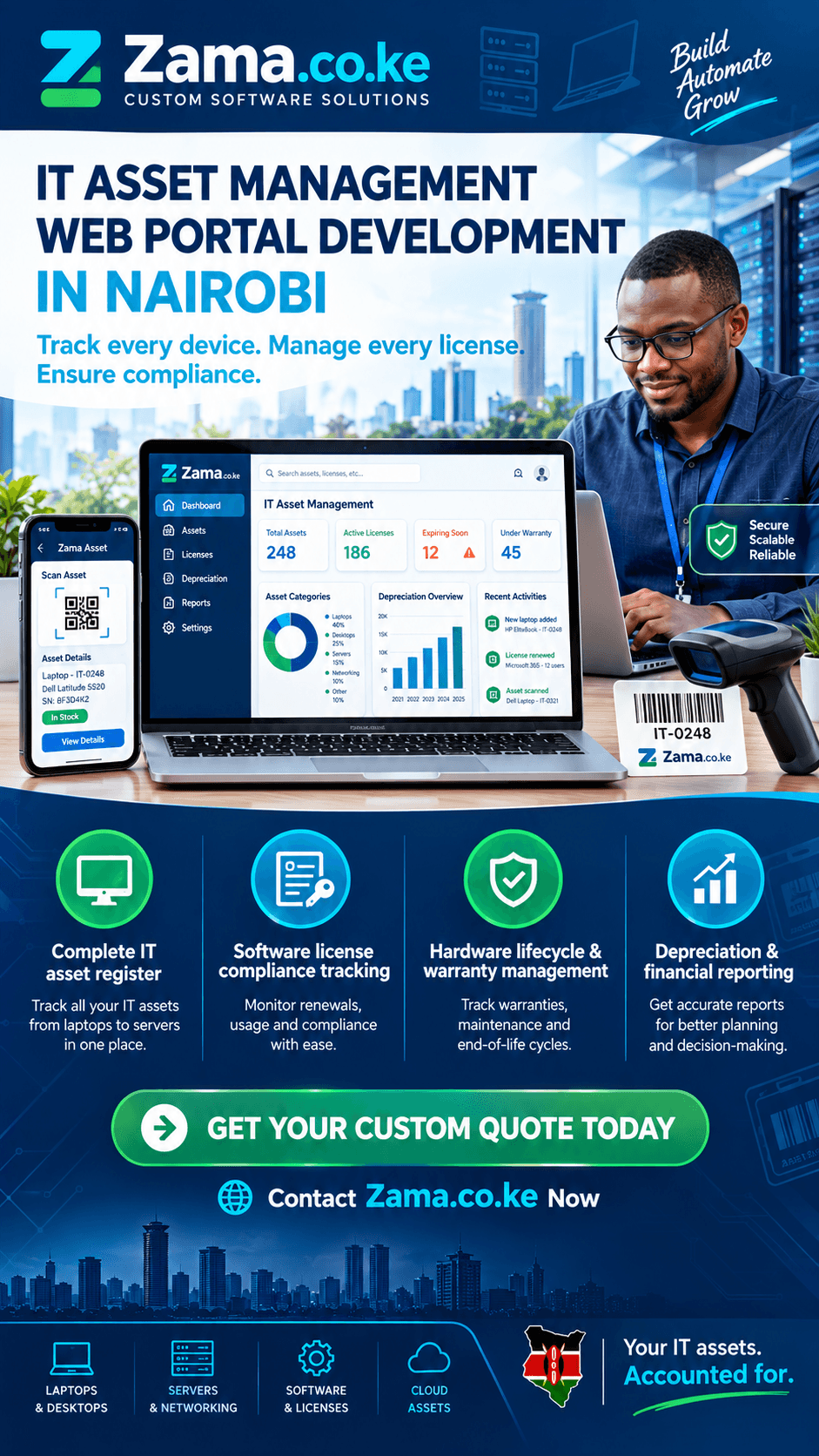
IT asset management web portal development in Nairobi is a question that every IT director, operations manager, and finance leader must answer in 2026. With Kenyan organizations increasingly dependent on technology—laptops, servers, network equipment, software licenses, cloud subscriptions, and mobile devices—the ability to track, manage, and optimize IT assets has become critical for cost control, compliance, and operational continuity. At zama.co.ke, we’ve helped numerous organizations across Nairobi develop custom IT asset management web portals that provide complete visibility into every device, every license, and every subscription. This comprehensive guide explores IT asset management web portal development in Nairobi, from understanding what these portals do to selecting the right development partner for your organization.
What IT Asset Management Web Portal Development Actually Delivers
Before diving into IT asset management web portal development in Nairobi, it’s essential to understand what this technology actually does. An IT asset management web portal is a browser-based platform that tracks, manages, and monitors an organization’s technology assets throughout their lifecycle—from procurement and deployment through maintenance, upgrades, and disposal. It provides a single source of truth for every laptop, desktop, server, network device, software license, cloud subscription, and mobile device in the organization.
A proper IT asset management web portal development in Nairobi does far more than maintain a list of devices. It tracks asset assignments to employees, monitors warranty and support contracts, manages software license compliance, tracks hardware specifications and configurations, records maintenance and repair history, automates depreciation calculations, and provides real-time dashboards for IT and finance teams.
For a Nairobi organization, the practical definition of IT asset management web portal development in Nairobi is this: the web-based platform that tells you exactly what IT assets you own, exactly who has them, exactly how much they cost, exactly when they need replacement, and exactly how they are depreciated—all in real time, from any device, with workflows tailored to your organization’s IT operations.
Why Nairobi Organizations Need Custom IT Asset Management Portals
When evaluating IT asset management web portal development in Nairobi, consider the compelling reasons for adoption:
The Cost of Poor IT Asset Visibility
Most Nairobi organizations manage IT assets through spreadsheets, email trails, and institutional memory. This approach works when the organization has 20 laptops and 5 servers. It fails catastrophically when the organization has 500 laptops, 50 servers, 200 software licenses, and dozens of cloud subscriptions spread across multiple departments and locations.
Without a proper IT asset management portal, organizations face:
Lost Devices: Laptops assigned to departed employees that are never recovered
License Waste: Software licenses paid for but never used, or used without proper licensing
Warranty Gaps: Devices going out of warranty without replacement planning
Audit Failures: Inability to demonstrate software license compliance during audits
Budget Blindness: No visibility into total IT asset costs or depreciation schedules
Security Risks: Unmanaged devices accessing corporate networks without proper controls
A custom IT asset management web portal development in Nairobi addresses these challenges systematically. It provides real-time visibility into every asset, automates lifecycle management, and ensures that IT and finance teams work from the same accurate data.
Software License Compliance
Software vendors—Microsoft, Oracle, Adobe, Autodesk, and others—conduct license audits and impose penalties for non-compliance. Kenyan organizations using unlicensed software face legal risks, financial penalties, and reputational damage. A proper IT asset management portal tracks software installations, license entitlements, and usage, ensuring that the organization is always compliant.
The portal should track perpetual licenses, subscription licenses, and cloud service subscriptions. It should alert IT teams when licenses are approaching renewal, when installations exceed entitlements, and when unused licenses can be reclaimed.
Hardware Lifecycle Management
IT hardware has a defined lifecycle—typically three to five years for laptops and desktops, five to seven years for servers, and varying periods for network equipment. Without proper tracking, organizations either replace equipment too early (wasting money) or too late (risking failures and productivity loss).
A comprehensive IT asset management web portal development in Nairobi tracks the age, condition, and performance of every device. It alerts IT teams when devices are approaching end of life, when warranties are expiring, and when replacement planning should begin.
Audit Readiness and Compliance
Statutory audits, tax audits, and internal audits all require evidence of IT asset ownership, valuation, and depreciation. A weak or outdated asset register creates problems during audits, delays financial reporting, and makes it difficult to support tax claims. A proper IT asset management portal ensures the organization is always audit-ready.
Remote and Hybrid Work Challenges
The shift to remote and hybrid work has distributed IT assets across home offices, co-working spaces, and client sites. Without proper tracking, organizations lose visibility into where devices are, who is using them, and whether they are secure. A custom IT asset management web portal development in Nairobi provides the visibility needed to manage distributed IT assets.
Essential Features of an IT Asset Management Web Portal
When evaluating IT asset management web portal development in Nairobi, focus on these core features:
1. Complete Asset Register
The foundation of any IT asset management portal is a comprehensive register that captures every asset. A professional register should include asset ID, asset type (laptop, desktop, server, network device, mobile device), manufacturer, model, serial number, purchase date, purchase cost, supplier, warranty expiry, assigned user, department, location, and current status.
A proper IT asset management web portal development in Nairobi maintains this register digitally, with role-based access for IT staff, finance teams, and department managers. The register should support bulk import, barcode scanning, and API integration with procurement systems.
2. Asset Assignment and Tracking
Every IT asset should be assigned to a specific user, department, or location. A comprehensive IT asset management web portal development in Nairobi tracks assignments, records transfer history, and maintains a complete chain of custody. When an employee leaves, the portal shows exactly which assets they have and facilitates recovery.
3. Software License Management
Software license management is a critical component of IT asset management. A proper IT asset management web portal development in Nairobi tracks software installations, license entitlements, and usage. It should support:
License Inventory: Complete list of all software licenses, including type, quantity, and expiry.
Installation Tracking: Which devices have which software installed.
Compliance Monitoring: Alerts when installations exceed entitlements.
Renewal Management: Alerts for upcoming license renewals.
Cost Tracking: Total software spend by vendor, department, or application.
4. Hardware Lifecycle Management
Hardware has a defined lifecycle. A quality IT asset management web portal development in Nairobi tracks:
Purchase Date: When the asset was acquired.
Warranty Status: When the warranty expires.
Age: How long the asset has been in service.
Condition: Current condition and performance.
Replacement Planning: When the asset should be replaced.
5. Depreciation and Financial Tracking
IT assets are financial assets. A comprehensive IT asset management web portal development in Nairobi calculates depreciation, tracks net book value, and generates reports for financial statements. It should support different depreciation methods (straight-line, reducing balance) and integrate with accounting software.
6. Maintenance and Repair History
IT assets require maintenance and repair. A proper IT asset management web portal development in Nairobi tracks:
Service History: Every repair, upgrade, or maintenance event.
Service Costs: How much has been spent on each asset.
Service Providers: Who performed the service.
Warranty Claims: Which repairs were covered by warranty.
7. Barcode and QR Code Tracking
Physical asset tagging is essential for efficient IT asset management. A quality IT asset management web portal development in Nairobi supports barcode and QR code generation, printing, and scanning. IT staff can scan assets during audits, assignments, and returns, ensuring accuracy and speed.
8. Reporting and Analytics
Management needs comprehensive reporting. A proper IT asset management web portal development in Nairobi should generate:
Asset Register Reports: Complete list of all assets with details.
Assignment Reports: Who has which assets.
Depreciation Reports: Asset values over time.
License Compliance Reports: Software license status.
Warranty Reports: Assets with expiring warranties.
Replacement Planning Reports: Assets due for replacement.
Cost Analysis Reports: IT spend by category, department, or vendor.
9. Integration with IT Systems
An IT asset management portal should integrate with other IT systems:
Active Directory: For user and device synchronization.
MDM (Mobile Device Management): For device enrollment and policy enforcement.
Helpdesk Systems: For linking service tickets to assets.
Procurement Systems: For asset acquisition workflow.
Accounting Systems: For depreciation and financial reporting.
10. Offline Capability
Kenyan organizations face power fluctuations and internet outages. A proper IT asset management web portal development in Nairobi should continue functioning during connectivity issues, storing data locally and syncing when connection returns.
What Makes IT Asset Management Web Portal Development in Nairobi Different
IT asset management web portal development in Nairobi has unique characteristics that global solutions often lack:
M-Pesa Integration
For organizations that collect payments for IT services or asset disposals, M-Pesa integration is essential. The portal should support M-Pesa STK Push for service payments and automated reconciliation.
Multi-Currency Support
Kenyan organizations procure IT assets from international vendors. The portal should track costs in multiple currencies, including foreign exchange rates and import duties.
KRA eTIMS Compliance
For organizations that charge for IT services, the portal should support KRA eTIMS compliance, generating tax invoices and transmitting them to KRA automatically.
Data Protection Act Compliance
IT asset management portals process employee data and device data. The portal must comply with the Data Protection Act, ensuring data is encrypted, access is controlled, and audit trails are maintained.
Cloud and On-Premise Flexibility
Kenyan organizations have varying preferences for cloud and on-premise deployment. A custom portal can support both models, depending on data sovereignty requirements and existing infrastructure.
Integration with Local Systems
The portal should integrate with local systems—IFMIS for public entities, local accounting software, and local HR platforms.
Common IT Asset Management Use Cases in Nairobi
Corporate IT Departments
Corporate IT departments use asset management portals to track laptops, desktops, servers, network equipment, and mobile devices. They manage assignments, track warranties, monitor software licenses, and plan replacements.
Educational Institutions
Schools and universities use asset management portals to track computer labs, student devices, network infrastructure, and software licenses. They manage assignments to students and staff, track device conditions, and plan upgrades.
Healthcare Facilities
Hospitals use asset management portals to track medical IT equipment, workstations, servers, and network infrastructure. They ensure compliance with health sector regulations and manage maintenance schedules.
Government Agencies
Government agencies use asset management portals to track IT assets across departments, ensure compliance with IFMIS requirements, and demonstrate accountability for public resources.
Financial Institutions
Banks and financial institutions use asset management portals to track IT assets across branches, ensure compliance with regulatory requirements, and manage software licenses for banking applications.
The Zama.co.ke Approach to IT Asset Management Web Portal Development in Nairobi
When considering IT asset management web portal development in Nairobi, zama.co.ke follows a structured approach:
IT Asset Assessment
We evaluate your organization’s IT asset base: categories, quantities, locations, assignments, software licenses, and compliance requirements. This includes understanding your current asset management challenges and defining success metrics.
Portal Design
We design the IT asset management portal architecture—user interfaces, data models, workflows, integrations, and reporting. The design supports your specific asset categories, organizational structure, and reporting requirements.
Development and Integration
We develop the portal, build integrations with existing systems (Active Directory, MDM, helpdesk, accounting), and configure workflows, alerts, and reports. The portal is configured to support your specific asset management processes.
Data Migration
We migrate existing asset data from spreadsheets, legacy systems, or other sources. We validate data accuracy before migration and ensure that historical records are preserved.
Barcode and QR Code Deployment
We support physical asset tagging—generating barcodes and QR codes, printing labels, and configuring scanning workflows. This ensures that every asset is physically identified and trackable.
Training and Support
We provide role-specific training for IT staff, finance teams, and department managers. We remain available for ongoing support, maintenance, and system upgrades.
The ROI of IT Asset Management Web Portal Development in Nairobi
When evaluating IT asset management web portal development in Nairobi, the ROI is compelling:
Reduced License Waste: Tracking software licenses ensures that organizations pay only for what they use and reclaim unused licenses.
Improved Asset Utilization: Visibility into asset assignments ensures that devices are not sitting idle while other employees wait for equipment.
Lower Replacement Costs: Lifecycle tracking enables planned replacements, avoiding emergency purchases at premium prices.
Audit Readiness: Complete asset documentation ensures smooth audits and reduces audit queries.
Enhanced Security: Tracking all devices ensures that unmanaged devices do not access corporate networks.
Data-Driven Decisions: Real-time dashboards and reports provide management with actionable insights for IT budgeting and planning.
Compliance Support: Data Protection Act and KRA eTIMS compliance built into the portal reduces legal and regulatory risk.
Implementation Considerations for Nairobi Organizations
When implementing an IT asset management web portal, consider these factors:
Assess Your Current Asset Base
Before selecting a system, document your current IT assets. What devices do you have? Who has them? What software is installed? What licenses do you hold? What are the warranty terms? This assessment forms the foundation for portal design and data migration.
Choose the Right Solution
The best IT asset management portal for your organization depends on your asset volume, complexity, compliance requirements, and integration needs. A small organization may need basic asset tracking; a large enterprise may need full lifecycle management with MDM integration and automated discovery.
Plan for Data Migration
Migrating existing asset data requires careful validation. Ensure asset descriptions, serial numbers, purchase dates, costs, and assignments are accurate before migration.
Train IT and Finance Teams
IT staff need training on asset tracking, assignment management, and reporting. Finance teams need training on depreciation reports and financial integration. Role-specific training produces higher adoption.
Test Thoroughly
Test all scenarios: asset registration, assignment, transfer, return, disposal, software license tracking, warranty alerts, and report generation.
Integrate with Existing Systems
Where possible, integrate the portal with Active Directory, MDM, helpdesk, and accounting systems. This creates a unified IT management ecosystem.
Consider a Phased Rollout
For large organizations, consider a phased rollout. Start with one department or asset category, prove the system works, refine based on feedback, then expand.
The Cost of Delaying IT Asset Management Portal Development
While organizations evaluate IT asset management web portal development in Nairobi, the cost of inaction compounds daily. Every month of spreadsheet-based asset management represents lost devices that are never recovered, software licenses that are paid for but not used, audits that are delayed by incomplete records, and IT budgets that cannot be accurately planned.
Meanwhile, organizations that have implemented IT asset management portals are achieving complete asset visibility, optimized license costs, and audit-ready records. The competitive gap widens with every passing month.
Why Contact Zama.co.ke for IT Asset Management Web Portal Development in Nairobi
When researching IT asset management web portal development in Nairobi, organizations should contact zama.co.ke because:
Local Expertise: We understand Kenyan regulatory requirements, including KRA eTIMS and Data Protection Act compliance.
Custom Development: We build portals tailored to your specific asset categories, workflows, and reporting requirements, not generic solutions.
Integration Capabilities: We connect asset management to Active Directory, MDM, helpdesk, accounting, and procurement systems.
Hardware and Software: We supply, install, and configure barcode scanners, label printers, and network equipment alongside the portal software.
Transparent Pricing: No hidden fees, clear milestone timelines, and full source-code ownership.
Ongoing Support: We remain available for maintenance, troubleshooting, and system upgrades as your asset base evolves.
For a custom quote based on your organization’s specific requirements, contact zama.co.ke today.
IT asset management web portal development in Nairobi is essential for any organization seeking to track IT assets accurately, optimize license costs, ensure audit readiness, and protect technology investments. From complete asset registers and software license management to hardware lifecycle tracking and financial depreciation, the right portal transforms how organizations manage their IT estate.
At zama.co.ke, we’ve helped organizations across Nairobi develop IT asset management portals that deliver measurable results. Our approach ensures you get exactly what your organization needs—nothing more, nothing less.
Don’t let the complexity of IT asset management web portal development in Nairobi hold you back. Whether you’re managing a small business or a large enterprise, we have the expertise to guide you through every step.
Contact zama.co.ke today for a custom quote based on your organization’s specific requirements.