
Learning Management System Kenya: The Complete Guide to Modern Digital Learning in 2026
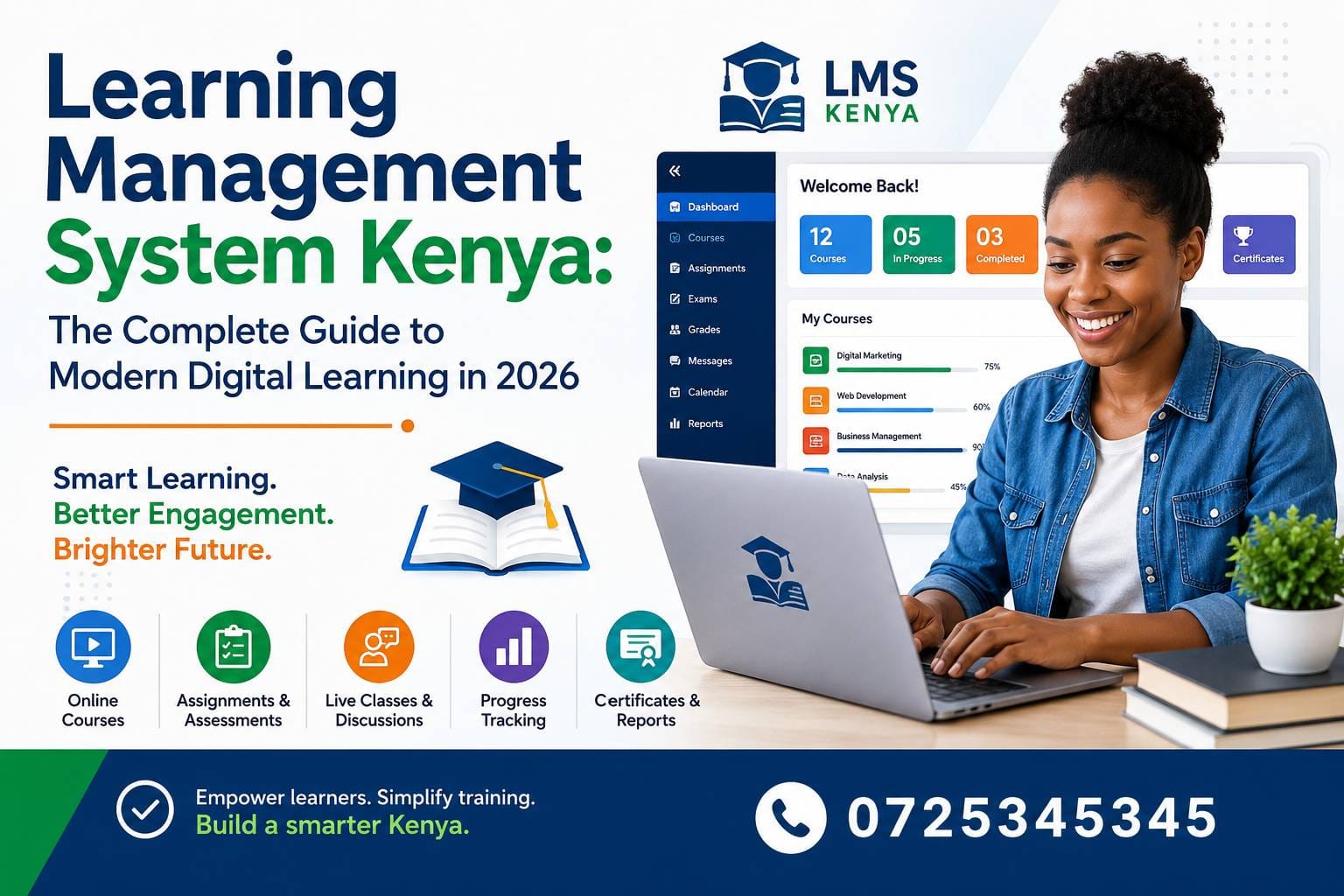
Learning Management System Kenya
The demand for a Learning Management System Kenya has increased dramatically as schools, universities, businesses, NGOs, and government institutions embrace digital transformation. Learning is no longer limited to physical classrooms. Today, students and employees expect flexible, accessible, and interactive learning experiences that can be accessed from anywhere.
A modern Learning Management System Kenya enables organizations to create, manage, deliver, and monitor educational content online. Whether you operate a private school, a university, a corporate training center, or a professional certification institution, implementing an LMS improves learning efficiency while reducing administrative workload.
Kenya’s growing internet penetration, smartphone adoption, and digital literacy have created the perfect environment for online education. Institutions are now investing in cloud-based learning platforms that allow learners to attend classes remotely, complete assignments online, participate in discussions, and monitor their academic progress in real time.
If your institution wants to stay competitive in today’s digital economy, investing in a reliable Learning Management System Kenya is one of the smartest decisions you can make.
What is a Learning Management System?
A Learning Management System (LMS) is software designed to help institutions create, organize, deliver, and manage educational or training programs online.
Instead of relying solely on traditional classrooms, printed notes, and manual record keeping, an LMS centralizes every aspect of learning into one digital platform.
An LMS allows instructors to:
- Upload course materials
- Create video lessons
- Assign quizzes
- Mark assignments
- Conduct examinations
- Track learner progress
- Generate reports
- Communicate with students
Learners can access the platform using computers, tablets, or smartphones, making education available anytime and anywhere.
A well-designed Learning Management System Kenya transforms the learning experience by making education more engaging, measurable, and efficient.
Why Kenya Needs Learning Management Systems
Education in Kenya has experienced rapid changes over the last decade. Digital technologies are reshaping how institutions teach and how students learn.
Several factors have accelerated LMS adoption across Kenya.
Growth of Online Education
Many universities and colleges now offer blended learning programs where students attend some classes physically and others online.
An LMS provides the infrastructure needed to deliver these courses effectively.
Remote Learning
Students living in different counties can access learning materials without traveling long distances.
This increases access to quality education.
Corporate Training
Businesses increasingly train employees through online courses instead of organizing expensive seminars.
A Learning Management System Kenya makes employee development easier and more affordable.
Professional Certification
Professional organizations offering CPD programs use LMS platforms to manage certification courses.
Participants can learn at their own pace while institutions track progress automatically.
Cost Reduction
Digital learning reduces printing costs, travel expenses, venue bookings, and administrative work.
How a Learning Management System Works
A Learning Management System combines multiple educational tools into one centralized platform.
The typical workflow includes:
Course Creation
Administrators create courses and organize learning materials.
These may include:
- Videos
- PDFs
- PowerPoint presentations
- Audio lessons
- Interactive activities
- Assignments
Student Registration
Students can register manually or automatically.
The system assigns learners to the appropriate courses.
Learning
Students log into the platform and access their lessons.
They can:
- Watch videos
- Download notes
- Complete quizzes
- Participate in discussions
- Submit assignments
Assessment
Teachers create quizzes and examinations.
Many assessments are automatically graded.
Others allow instructors to provide detailed feedback.
Reporting
Administrators can monitor:
- Student attendance
- Course completion
- Assessment performance
- Login activity
- Learning progress
Reports help improve educational outcomes.
Features of the Best Learning Management System Kenya
Choosing the right LMS requires understanding the features that matter most.
Course Management
Administrators should easily create, organize, edit, and publish courses.
Courses should support:
- Modules
- Chapters
- Lessons
- Learning paths
Video Learning
Modern learners prefer video content.
An excellent LMS supports:
- Video streaming
- Recorded lectures
- Live sessions
- Embedded multimedia
Online Assessments
Teachers should create:
- Multiple-choice quizzes
- Essays
- Fill-in-the-blank tests
- Practical assessments
- Timed examinations
Automatic grading saves significant time.
Assignment Submission
Students should upload assignments directly through the platform.
Teachers can review, grade, and provide feedback online.
Student Dashboard
Each learner should have a personalized dashboard showing:
- Current courses
- Progress
- Upcoming assignments
- Certificates
- Notifications
Instructor Dashboard
Teachers need tools for:
- Course management
- Student monitoring
- Attendance
- Performance analysis
- Communication
Discussion Forums
Interactive discussions improve engagement.
Students can ask questions and collaborate with classmates.
Mobile Learning
Many Kenyans access the internet using smartphones.
A responsive Learning Management System Kenya should work perfectly on:
- Android phones
- iPhones
- Tablets
- Laptops
Certificates
Automatic certificate generation motivates learners.
Certificates can include:
- Student name
- Course title
- Completion date
- QR verification
- Institution branding
Notifications
Students receive alerts about:
- New lessons
- Assignment deadlines
- Exams
- Announcements
- Certificates
Notifications can be sent via:
- SMS
- Push notifications
Benefits of Learning Management System Kenya
Organizations implementing an LMS enjoy numerous advantages.
Flexible Learning
Students learn at their convenience.
Learning becomes available:
- Morning
- Afternoon
- Evening
- Weekends
This flexibility increases participation.
Improved Student Engagement
Interactive content keeps learners interested.
Examples include:
- Videos
- Quizzes
- Games
- Simulations
- Discussion boards
Engaged learners perform better academically.
Better Performance Tracking
Administrators monitor learner progress using real-time analytics.
Reports reveal:
- Completion rates
- Attendance
- Assessment scores
- Participation levels
These insights support better decision-making.
Reduced Administrative Work
Manual tasks become automated.
Examples include:
- Attendance
- Marking quizzes
- Certificate generation
- Student enrollment
- Report creation
Staff can focus on teaching instead of paperwork.
Lower Costs
Institutions save money on:
- Printing
- Travel
- Venue hire
- Paper records
- Physical storage
Digital learning offers long-term cost savings.
Increased Accessibility
Students in remote counties can access the same quality education as those in urban areas.
This supports educational equality across Kenya.
Faster Communication
Teachers communicate with students instantly through:
- Announcements
- Chat
- Discussion forums
- Notifications
Communication becomes more efficient.
Who Needs a Learning Management System Kenya?
An LMS is suitable for many organizations.
Schools
Primary and secondary schools use LMS platforms to:
- Upload notes
- Manage homework
- Conduct online tests
- Communicate with parents
- Monitor student performance
Universities
Universities manage:
- Degree programs
- Research supervision
- Online lectures
- Assignments
- Examinations
Thousands of students can access learning materials simultaneously.
Colleges
Technical institutions use LMS platforms for:
- Practical training
- Course delivery
- Skills assessments
- Certification
Businesses
Companies use LMS software for:
- Employee onboarding
- Compliance training
- Product training
- Leadership development
- Performance improvement
NGOs
Non-governmental organizations train:
- Staff
- Volunteers
- Community groups
- Partners
Online learning significantly reduces training costs.
Government Institutions
Government agencies use LMS platforms for:
- Staff development
- Policy training
- Public education
- Professional development
Professional Training Institutes
Organizations offering professional certifications benefit from:
- Online registration
- Learning modules
- Assessments
- Certification
- Progress tracking
Their training becomes more scalable and efficient.
Learning Management System Modules Every Institution Needs
A modern Learning Management System Kenya should be more than just a platform for uploading notes. It should provide comprehensive modules that simplify administration, enhance learning, and improve communication.
Student Information Management
Managing student records manually is time-consuming and prone to errors. A comprehensive LMS centralizes all student information in one secure database.
The system stores:
- Student profiles
- Admission details
- Contact information
- Academic history
- Course enrollments
- Attendance records
- Assessment results
- Certificates
With a robust Learning Management System Kenya, administrators can retrieve student records instantly, saving valuable time.
Course Management Module
Course management is at the heart of every LMS. This module allows instructors to create and organize learning content efficiently.
Key capabilities include:
- Creating multiple courses
- Organizing lessons into modules
- Scheduling learning activities
- Uploading learning materials
- Updating content without disrupting learners
- Assigning instructors to courses
This flexibility ensures learners always access the latest educational resources.
Assignment Management
Assignments encourage learners to apply knowledge and demonstrate understanding. An effective LMS streamlines the entire assignment process.
Students can:
- Download assignment instructions
- Upload completed work
- Meet submission deadlines
- View instructor feedback
- Track grades
Teachers benefit by grading assignments online, providing comments, and maintaining organized academic records.
Examination Module
Online examinations have become increasingly popular in Kenya. A reliable Learning Management System Kenya enables institutions to conduct secure digital exams.
Common features include:
- Timed examinations
- Randomized questions
- Multiple question formats
- Automated grading
- Manual grading options
- Result publishing
- Performance analytics
These capabilities reduce examination administration costs while improving accuracy.
Attendance Tracking
Attendance remains an important indicator of learner engagement.
An LMS can automatically record attendance through:
- Student logins
- Live class participation
- Session completion
- QR code check-ins
- Virtual classroom attendance
Administrators can quickly identify learners who require additional support.
Learning Analytics
Data-driven education improves learning outcomes.
Learning analytics provide insights into:
- Student engagement
- Course completion rates
- Assignment submission trends
- Quiz performance
- Learning difficulties
- Instructor effectiveness
These reports help institutions continuously improve teaching quality.
Integration Capabilities of a Learning Management System Kenya
An LMS becomes even more powerful when integrated with other business and educational systems.
M-Pesa Integration
For Kenyan institutions, M-Pesa integration simplifies fee collection.
Students can:
- Pay tuition fees
- Register for courses
- Purchase certification programs
- Receive payment confirmations instantly
Administrators automatically reconcile payments without manual verification.
Zoom Integration
Live virtual classes have become an essential part of modern education.
Integrating Zoom allows institutions to:
- Schedule online classes
- Launch meetings directly from the LMS
- Record sessions
- Track attendance
- Share recordings automatically
Students enjoy seamless learning without switching between multiple applications.
Google Workspace Integration
Google services enhance collaboration within educational institutions.
Integration supports:
- Google Drive
- Google Meet
- Google Calendar
- Gmail
- Google Docs
This enables instructors and students to collaborate efficiently.
Microsoft 365 Integration
Many organizations already use Microsoft products.
An LMS can integrate with:
- Microsoft Teams
- Outlook
- OneDrive
- Word
- Excel
- PowerPoint
Users access familiar productivity tools while learning online.
ERP Integration
Large institutions often operate Enterprise Resource Planning (ERP) systems.
Connecting an LMS with ERP software enables synchronization of:
- Student records
- Financial data
- Human resources
- Procurement
- Academic departments
This eliminates duplicate data entry.
HR System Integration
Corporate organizations benefit by linking employee records with training programs.
This allows managers to monitor:
- Mandatory training
- Certification renewals
- Compliance courses
- Employee development
- Skills improvement
Training becomes an integral part of workforce management.
Industries Benefiting from Learning Management System Kenya
The flexibility of an LMS makes it valuable across multiple industries.
Universities
Universities use LMS platforms to support thousands of learners across different faculties.
Applications include:
- Distance learning
- Blended learning
- Research supervision
- Assignment submission
- Online examinations
- Student collaboration
Academic institutions improve educational quality while serving more students.
Primary Schools
Primary schools use LMS platforms to support classroom learning.
Teachers can:
- Share homework
- Upload educational videos
- Conduct quizzes
- Communicate with parents
- Track learner progress
Parents remain actively involved in their children’s education.
Secondary Schools
Secondary schools use digital learning platforms to prepare learners for national examinations.
Students access:
- Revision materials
- Practice exams
- Video tutorials
- Interactive quizzes
- Performance reports
This supports continuous academic improvement.
Colleges
Technical and vocational institutions benefit from online practical learning resources.
Students access:
- Demonstration videos
- Practical assessments
- Digital manuals
- Certification programs
Blended learning improves flexibility while maintaining educational standards.
Corporate Organizations
Businesses increasingly invest in employee learning.
Training areas include:
- Customer service
- Sales techniques
- Leadership
- Compliance
- Health and safety
- Product knowledge
- Cybersecurity awareness
A Learning Management System Kenya enables continuous employee development without disrupting daily operations.
Financial Institutions
Banks and SACCOs require regular compliance training.
An LMS ensures employees complete mandatory courses while maintaining detailed audit records.
Training topics include:
- Risk management
- Fraud prevention
- Data protection
- Customer service
- Regulatory compliance
Healthcare Organizations
Hospitals and clinics rely on continuous professional development.
Healthcare workers access training on:
- Patient safety
- Medical procedures
- Infection prevention
- Equipment usage
- Regulatory requirements
Digital learning improves knowledge while minimizing disruptions to healthcare services.
NGOs and Development Organizations
Many NGOs operate across multiple counties.
An LMS enables organizations to train:
- Field officers
- Volunteers
- Community health workers
- Project managers
- Beneficiaries
Training reaches remote communities efficiently and cost-effectively.
Artificial Intelligence in Learning Management System Kenya
Artificial Intelligence (AI) is transforming digital education by making learning more personalized, efficient, and engaging.
Personalized Learning Paths
AI analyzes learner performance and recommends relevant lessons based on strengths and weaknesses.
Instead of every learner following the same path, the system adapts content to individual needs.
Intelligent Assessments
AI can automatically evaluate many types of assessments and provide immediate feedback.
Learners receive explanations that help them understand mistakes and improve faster.
Predictive Analytics
AI identifies students who may be struggling before they fall behind.
Institutions can intervene early with:
- Additional tutoring
- Personalized assignments
- Academic counseling
- Targeted support
AI Chatbots
AI-powered assistants answer common questions 24/7.
Students can quickly get help with:
- Course navigation
- Assignment deadlines
- Login issues
- Learning resources
- Frequently asked questions
This improves learner satisfaction while reducing administrative workload.
Automated Content Recommendations
Based on learner interests and progress, AI suggests:
- Additional readings
- Practice quizzes
- Video lessons
- Case studies
- Reference materials
Learning becomes more engaging and individualized.
Security Features Every Learning Management System Kenya Should Have
Educational institutions manage sensitive information that must be protected.
Essential security features include:
- Secure user authentication
- Role-based access control
- Data encryption
- Automatic backups
- Audit logs
- Password protection
- Two-factor authentication
- Secure cloud hosting
- Compliance with data protection regulations
Strong security builds trust among students, parents, employees, and administrators.
Best Practices for Implementing a Learning Management System Kenya
Successful implementation requires careful planning.
Define Clear Objectives
Determine whether your goal is to improve online learning, employee training, certification, or blended education.
Clear objectives guide system configuration and user adoption.
Train Users
Provide training for administrators, instructors, and learners to ensure they can use the platform effectively.
Organize High-Quality Content
Develop engaging learning materials that combine text, videos, quizzes, and interactive activities.
Well-structured content improves learner engagement and knowledge retention.
Encourage Continuous Feedback
Collect feedback from users regularly and use it to improve courses and platform usability.
Monitor Performance
Use built-in analytics to measure learner engagement, course completion, and overall training effectiveness.
Continuous monitoring helps institutions maximize the value of their Learning Management System Kenya.
Future Trends Shaping Learning Management System Kenya
Technology continues to evolve, and educational institutions must keep pace to remain competitive. The future of Learning Management System Kenya lies in intelligent automation, personalized learning, cloud computing, and immersive digital experiences. Schools, universities, businesses, and training organizations that adopt these innovations will be better positioned to deliver engaging and effective learning.
Cloud-Based Learning Platforms
Cloud technology is becoming the preferred deployment model for educational institutions in Kenya. Unlike traditional on-premise software, cloud-based LMS platforms offer greater flexibility and lower maintenance costs.
Benefits include:
- Access from anywhere with an internet connection
- Automatic software updates
- Reduced infrastructure costs
- Improved data security
- Easy scalability as student numbers grow
- Faster deployment
Cloud-based systems are particularly suitable for institutions with multiple campuses or learners in different regions.
Mobile Learning
Smartphones have become the primary internet access device for many Kenyans. As a result, mobile-first learning is no longer optional—it is essential.
A modern Learning Management System Kenya should provide:
- Responsive mobile design
- Android and iOS compatibility
- Offline access to selected learning materials
- Push notifications for announcements and deadlines
- Mobile-friendly quizzes and assignments
This allows learners to study whenever and wherever it is convenient.
Gamification
Gamification introduces game-like elements into learning to increase motivation and participation.
Examples include:
- Achievement badges
- Leaderboards
- Learning points
- Course completion rewards
- Progress bars
- Learning challenges
These features make learning more interactive and encourage learners to complete courses.
Microlearning
Instead of lengthy lectures, many institutions are adopting microlearning.
This approach delivers information in short, focused lessons that are easier to understand and remember.
Microlearning works well for:
- Employee training
- Compliance courses
- Product knowledge
- Professional development
- Revision materials
Short lessons improve completion rates and knowledge retention.
Virtual Classrooms
Virtual classrooms are becoming a standard feature of every advanced Learning Management System Kenya.
They support:
- Live video lessons
- Screen sharing
- Interactive whiteboards
- Breakout discussions
- Session recordings
- Live chat
- Polls and quizzes
These tools recreate many aspects of a physical classroom while offering greater flexibility.
Common Challenges When Implementing a Learning Management System Kenya
Although LMS adoption brings many benefits, institutions may face several challenges during implementation.
Resistance to Change
Some teachers, employees, or students may be hesitant to adopt new technology.
Solution
Provide practical training, demonstrate the platform’s benefits, and offer continuous technical support during the transition.
Limited Internet Connectivity
Some learners may experience unreliable internet access, particularly in remote areas.
Solution
Provide downloadable materials, optimize multimedia content, and enable offline learning where possible.
Poor Content Quality
Even the best LMS cannot compensate for outdated or poorly structured learning materials.
Solution
Develop engaging, accurate, and regularly updated content that combines text, images, videos, quizzes, and practical activities.
Inadequate User Training
Without proper onboarding, users may struggle to navigate the system effectively.
Solution
Offer user guides, tutorial videos, webinars, and helpdesk support to build confidence.
Data Security Concerns
Educational institutions manage sensitive student and employee information.
Solution
Implement secure authentication, encrypted data storage, regular backups, and role-based permissions.
How to Choose the Best Learning Management System Kenya
Selecting the right LMS requires careful evaluation of your institution’s goals and technical requirements.
Consider the following factors:
Ease of Use
Choose software with an intuitive interface that learners and instructors can navigate without extensive training.
Scalability
Ensure the platform can accommodate future growth, whether you expect hundreds or thousands of users.
Customization
The LMS should allow customization of:
- Branding
- User roles
- Course categories
- Reports
- Certificates
- Notifications
A customized platform reflects your institution’s identity and operational needs.
Integration Capabilities
Look for an LMS that integrates with tools you already use, such as:
- Payment gateways
- Video conferencing platforms
- Email systems
- HR software
- Student Information Systems
- Accounting software
Integration reduces manual work and improves efficiency.
Security
Data protection should be a top priority.
Choose a platform that offers:
- Secure login
- Data encryption
- User access controls
- Backup and recovery
- Audit logs
- Compliance with Kenya’s data protection requirements
Technical Support
Reliable technical support minimizes downtime and ensures issues are resolved quickly.
Look for providers offering:
- Email support
- Phone support
- Live chat
- System maintenance
- User training
- Regular updates
Frequently Asked Questions
What is a Learning Management System?
A Learning Management System is software that enables institutions to create, manage, deliver, and monitor educational or training programs online.
Who can use a Learning Management System Kenya?
Schools, colleges, universities, businesses, NGOs, government agencies, healthcare providers, professional training institutions, and corporate organizations can all benefit from an LMS.
Can learners access the LMS using smartphones?
Yes. Most modern LMS platforms are mobile-responsive and allow learners to access courses using smartphones, tablets, laptops, and desktop computers.
Can an LMS support online examinations?
Yes. Advanced systems support timed exams, automated grading, random question banks, secure assessments, and detailed performance reports.
Is an LMS suitable for employee training?
Absolutely. Organizations use LMS platforms for onboarding, compliance training, professional development, leadership programs, and product training.
Can the LMS generate certificates?
Yes. Many platforms automatically generate branded certificates once learners successfully complete a course.
Does an LMS improve learning outcomes?
When implemented effectively, an LMS enhances engagement, provides flexible access to learning resources, tracks progress, and enables data-driven improvements in teaching and training.
Conclusion
As digital education continues to expand, investing in a Learning Management System Kenya is becoming a strategic necessity rather than an optional upgrade. Whether you manage a school, university, college, corporate training department, NGO, or government institution, the right LMS can streamline administration, improve learner engagement, and support measurable educational outcomes.
A well-designed Learning Management System Kenya centralizes course delivery, assessments, communication, reporting, and certification in one secure platform. It reduces administrative workload, supports flexible learning, and helps institutions reach learners regardless of their location. With features such as mobile accessibility, AI-powered personalization, analytics, and integrations with business tools, a Learning Management System Kenya equips organizations to meet the demands of modern education and workforce development.
When selecting a Learning Management System Kenya, prioritize ease of use, scalability, security, customization, and reliable technical support. By choosing a solution that aligns with your goals, your institution can improve productivity, enhance learning experiences, and remain competitive in an increasingly digital world.
The future of education in Kenya is digital, connected, and learner-focused. Implementing a dependable Learning Management System Kenya today will help your organization deliver high-quality learning experiences, improve operational efficiency, and prepare learners with the knowledge and skills they need to succeed tomorrow.