
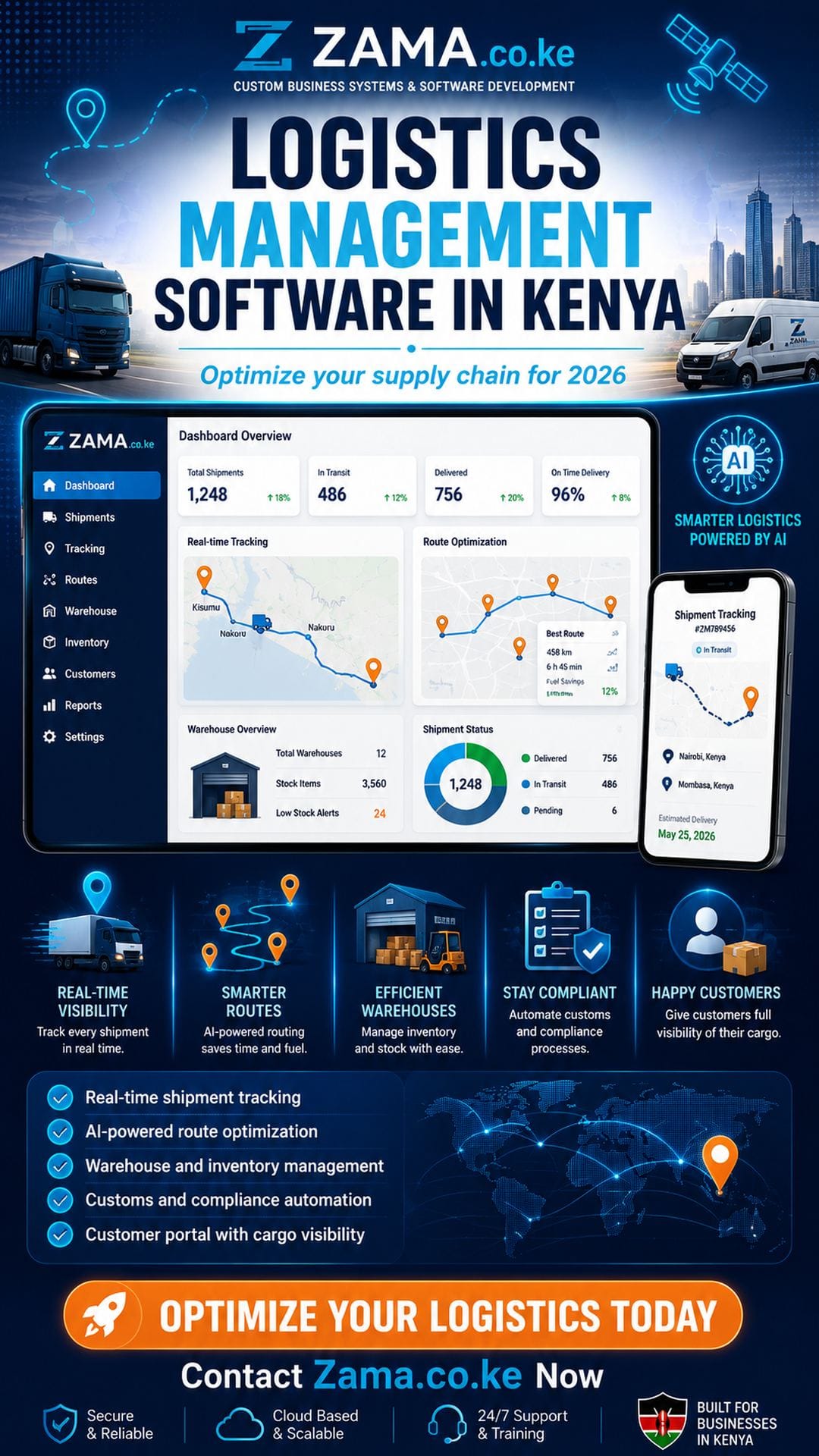
Logistics management software in Kenya is a question that every supply chain manager, logistics director, and business owner must answer in 2026. With the Kenyan logistics market experiencing unprecedented growth driven by a booming e-commerce sector expanding at 15-20% annually , the need for digital solutions has become urgent. At zama.co.ke, we’ve helped numerous logistics businesses across Kenya build custom management solutions that address their unique operational challenges. This comprehensive guide explores logistics management software in Kenya, from understanding core requirements to selecting the right solution for your supply chain.
The State of Logistics in Kenya Today
Before diving into logistics management software in Kenya, it’s essential to understand the current landscape. Kenya is considered one of the most dynamic logistics markets in Africa, with e-commerce projected to grow from $2.3 billion in 2023 to $3.8 billion by 2028 . This growth has created significant pressure on logistics providers to modernize their operations.
However, most warehouses and logistics providers in East Africa still organize fulfillment with manual processes and lists, leading to errors, delivery delays, and limited transparency for clients . Existing software solutions often fail to meet the region’s needs, as they are either too rigid or too expensive, particularly for small and medium-sized businesses .
This gap has made logistics management software in Kenya a critical investment for businesses seeking to remain competitive.
Challenges Facing Logistics Operations
Understanding the unique challenges faced by logistics providers helps when evaluating logistics management software in Kenya:
Fragmented Operations: Using different tools and workflows across departments makes it challenging to maintain a single, real-time overview of information across the organization . Procurement, warehousing, and sales teams often work in silos, with disconnected systems creating information gaps.
Manual Workload: Reporting and performance tracking require substantial manual consolidation, particularly regarding job costing, shipment tracking, receivables, and overall profitability analysis .
Infrastructure Gaps: Port congestion at major hubs, unreliable power, and poorly maintained road networks make real-time tracking difficult. When a shipment leaves the port, it can disappear from view for hours or days .
Fragmented Data Ecosystems: A purchase order placed in one system does not automatically update inventory in another. Manual spreadsheets fill the gap, introducing errors and delays .
Cross-Border Regulatory Friction: Moving goods across African borders involves manual customs processes that create data breaks in the supply chain .
Essential Features of Logistics Management Software
When evaluating logistics management software in Kenya, focus on these core features:
1. Real-Time Visibility and Tracking
Every logistics operation needs visibility. A proper logistics management software in Kenya should:
Track Inventory Across Locations: End-to-end tracking of inventory levels across multiple sites and warehouse locations . Whether operating a central hub in Nairobi with regional stores across East Africa, the system should provide a live picture of stock.
Monitor Shipments in Real Time: GPS monitoring of deliveries and daily progress reports keep stakeholders informed .
Provide Real-Time Status Updates: Users gain access to comprehensive digital tools covering cargo tracking, gate booking, billing, payments, and real-time status updates .
2. AI-Powered Route Optimization
Modern logistics management software in Kenya leverages artificial intelligence to optimize delivery efficiency:
Load and Route Optimization: Select the best available vehicle for each order and decide whether to load products using first-in-first-out (FIFO) or last-in-first-out (LIFO) methods .
Real-Time Route Updates: The system constantly updates its map layer to reflect changes—flooding, police stops, construction, or a presidential convoy .
Blacklist Problem Routes: Flag routes where deliveries repeatedly fail due to flooding, police stops, construction, or other issues .
3. Automated Dispatch and Manifest Creation
Manual dispatch processes waste time and create errors. Good logistics management software in Kenya should:
Automate Manifest Creation: Generate manifests automatically based on optimized load plans .
Streamline Dispatch Planning: Optimize vehicle use based on regional demand and truck capacity .
Replace Intuition with Data: Replace manual, intuition-based dispatching with data-driven decisions .
4. Warehouse Management
A comprehensive logistics management software in Kenya should include warehouse management capabilities:
Multi-Client Management: Support for managing multiple clients efficiently .
Modular Structure: Adapt to specific local requirements through modular design .
Real-Time Inventory Updates: Stock levels update automatically with every transaction, enabling better putaway and picking decisions .
5. Integrated Financial Management
Financial visibility is critical for logistics operations. A proper logistics management software in Kenya should:
Job Costing: Detailed job costing by file, project, and location .
Landed Cost Computation: Calculate customs duties, shipping fees, and clearing charges directly into final inventory valuation .
Multi-Currency Support: Handle transactions in multiple currencies for international operations .
6. Customs and Compliance Management
Operating in Kenya requires compliance with local regulations. Logistics management software in Kenya should:
Support VAT and Tax Compliance: Built-in capability for Kenyan VAT and withholding tax obligations .
Support IFRS: Compliance with International Financial Reporting Standards .
Customs Integration: Handle customs duties, shipping fees, and clearing charges .
7. Customer Portal
Transparency improves customer satisfaction. A proper logistics management software in Kenya should:
Cargo Tracking: Customers can track shipments in real-time .
Downloadable Reports: Customers can access shipment statistics and reports .
Gate Booking: Users can book gates and manage cargo movement .
8. Integration Capabilities
Modern logistics operations require system integration. Good logistics management software in Kenya should:
ERP Integration: Integrate directly with ERP systems, pulling in live order data like SKUs, product types, prices, and customer details .
POS Integration: Connect with point-of-sale systems .
OMS Integration: Link with order management systems .
What Makes Kenyan Logistics Software Different
Logistics management software in Kenya has unique characteristics that global solutions often lack:
Cloud-First Design
The Kenyan logistics sector needs solutions that can be deployed quickly without heavy investments, long project phases, or time-consuming training . Cloud-based solutions close this gap with immediately deployable platforms .
Scalable for SMEs
Most warehouses in East Africa are small to medium-sized. Solutions must be affordable and scalable. One provider notes that “small and medium-sized warehouse providers can get started immediately—without high investments, time-consuming efforts, or lengthy training” .
Local Infrastructure Awareness
Solutions must account for infrastructure gaps, unreliable power, and the realities of Kenyan road networks . This means supporting offline capabilities and optimizing for low-bandwidth environments.
Mobile-First Design
Field staff need to access data on mobile devices without requiring laptops or extensive training.
Multi-Client Management
Logistics providers often manage multiple clients simultaneously. Systems must support efficient multi-client management .
Real-World Examples of Logistics Digitalization
KEMSA’s i-LMIS
The Kenya Medical Supplies Authority (KEMSA) transformed medical commodities management with its Integrated Logistics Management Information System (i-LMIS), developed with UNFPA support . The system includes:
Commodity Early Warning and Alert System: Prevents stockouts by notifying stakeholders when supplies run low .
AI-Powered Demand Forecasting: Uses artificial intelligence to calculate facility-specific needs, minimizing wastage and overstocking .
Electronic Proof of Delivery: Provides real-time notifications once supplies are received at health facilities .
Real-Time Tracking: KEMSA and stakeholders can track commodities in real-time .
WEMALO’s Cloud-WMS
WEMALO introduced the first cloud-based Warehouse Management System designed for efficient multi-client management in Kenya . The solution:
Serves SMEs: Designed for small and medium-sized warehouse providers .
Modular Structure: Adapts precisely to local requirements .
No Heavy Investment: Provides immediate deployment without heavy upfront costs .
Leta’s AI-Powered Platform
Leta is an AI-powered platform that optimizes delivery routes, tracks shipments in real time, streamlines payments, and provides businesses with shipping insights . Key features include:
Load and Route Optimization: Reduces the number of vehicles needed for distribution .
Live Order Integration: Pulls live order data from ERP, POS, and OMS systems .
Vehicle Selection: Selects the best available vehicle for each order .
Automated Dispatch: Automates manifest creation and dispatch planning .
Real-Time Mapping: Constantly updates its map layer to reflect road changes .
Port of Mombasa Digital Transformation
DP World launched the Port Community System (PCS) platform in Kenya, marking a significant milestone in the country’s journey towards more efficient and transparent trade . The system:
Digital Tools: Covers cargo tracking, gate booking, billing, payments, and real-time status updates .
Enhanced Visibility: Enables all port users to benefit from enhanced cargo visibility .
Improved Efficiency: Expected to cut cargo clearance times by up to 30% .
Transfreight Logistics
Transfreight Logistics Limited, a freight forwarding company operating across Eastern and Central Africa, implemented Odoo to centralize its operations . Results included:
30% Reduction in Manual Work: Significant reduction in manual consolidation .
Centralized Operations: Single, real-time overview of information across the organization .
Custom Freight Module: End-to-end freight operations including bond computation, demurrage management, container logging, and customer portal .
The Zama.co.ke Approach
When considering logistics management software in Kenya, zama.co.ke follows a structured process:
Operational Discovery
We define your logistics workflows: order sources, dispatch rules, route constraints, vehicle types, payment methods, and the reports leadership needs.
System Design
Modules, data structure, permissions, user journeys, and reporting layers are planned so the platform supports your unique operational model.
Build and Integrate
Core modules, dashboards, automation logic, and external connections are developed in stages with review checkpoints against agreed requirements.
Validation and Rollout Readiness
We test critical workflows, user roles, integrations, calculations, and reporting behavior so the system can be adopted with confidence.
Post-Launch Support
After go-live, we support stabilization, user feedback, ongoing maintenance, and the next round of improvements informed by real usage.
Why Logistics Businesses Choose Custom Solutions
When evaluating logistics management software in Kenya, businesses often choose custom solutions because:
Business-Process Understanding
We design systems around how your organization actually works instead of treating the project as a feature list.
Architecture That Supports Change
A good software foundation makes it easier to add modules, integrations, reports, and new user groups without rebuilding everything later.
Integration-Ready
We can connect payments, messaging, CRMs, legacy tools, and data services so the software becomes part of the wider operating environment.
Reliable Support
Software projects create value over time, so we stay available to maintain, refine, and extend the platform after launch.
Local Expertise
We understand the Kenyan logistics landscape, including traffic patterns, road conditions, and payment preferences.
The Cost of Not Automating
While businesses evaluate logistics management software in Kenya, the cost of not automating is often higher:
Manual Dispatch Costs: Dispatchers spend hours manually assigning deliveries instead of focusing on growth.
Fuel Waste: Poor routing increases fuel consumption significantly. One company with 70 trucks saves about $30,000 monthly using optimized routing .
Failed Deliveries: Without real-time tracking, customers are not home when drivers arrive, causing re-delivery costs.
Lost Revenue: Inefficient operations mean you cannot handle high-volume periods.
Customer Loss: Late deliveries and poor communication lead to customer churn.
Logistics management software in Kenya is essential for any supply chain business operating in 2026. From AI-powered route optimization and real-time tracking to warehouse management and customs compliance, the right software transforms how logistics businesses operate.
At zama.co.ke, we’ve helped logistics businesses across Kenya build custom management solutions that streamline operations and improve performance. Our approach ensures you get exactly what your logistics business needs—nothing more, nothing less.
Don’t let the complexity of logistics management software in Kenya hold you back. Whether you’re a small courier service or a large freight forwarding company, we have the expertise to guide you through every step.
Contact zama.co.ke today and let us help you build a logistics management system that transforms your operations.