
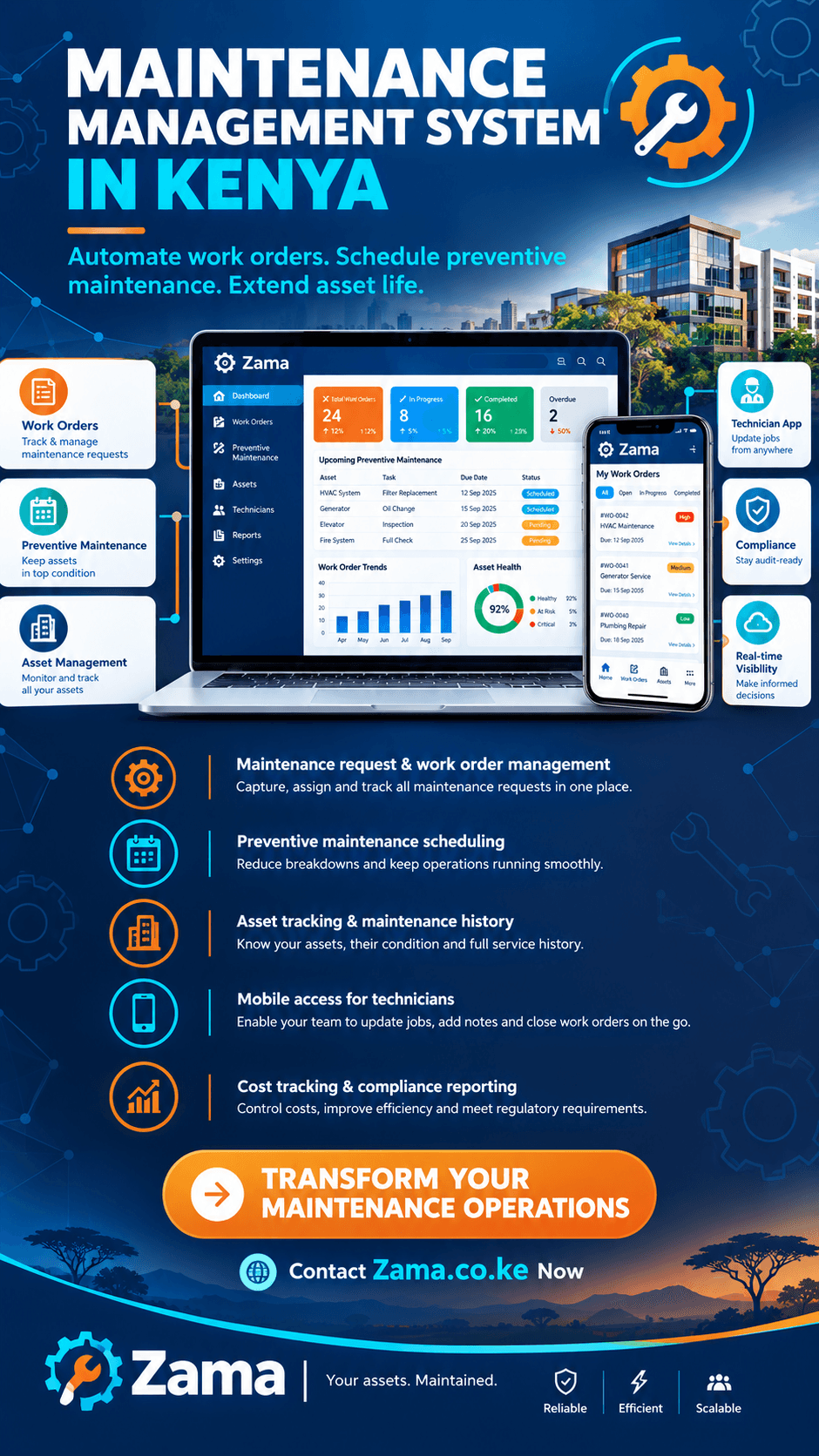
Maintenance management system in Kenya is a question that every facility manager, operations director, and property owner must answer in 2026. With the Kenya Facility Management Software Market expanding and organizations across manufacturing, real estate, healthcare, and energy recognizing that reactive maintenance is no longer sustainable, the shift to digital maintenance management has become essential for operational resilience. At zama.co.ke, we’ve helped numerous organizations across Kenya implement maintenance management systems that eliminate paperwork, automate work orders, and provide real-time visibility into every asset and every repair. This comprehensive guide explores maintenance management system in Kenya, from understanding core features to selecting the right solution for your organization.
What a Maintenance Management System Actually Does
Before diving into maintenance management system in Kenya, it’s essential to understand what this technology actually does. A maintenance management system—sometimes called a Computerized Maintenance Management System (CMMS) or Enterprise Asset Management (EAM) system—is a digital platform that helps organizations plan, track, and execute maintenance activities across their assets and facilities. It replaces spreadsheets, paper logbooks, WhatsApp messages, and phone calls with a centralized system that captures every maintenance request, work order, and repair history.
A proper maintenance management system in Kenya maintains a complete asset register, automates work order generation and assignment, schedules preventive maintenance, tracks technician performance, manages spare parts inventory, records maintenance costs, and generates comprehensive reports. It connects physical assets to their maintenance histories, documentation, and compliance records, creating traceability from acquisition through disposal.
For a Kenyan organization, the practical definition of maintenance management system in Kenya is this: the system that tells you exactly what needs maintenance, exactly who is responsible, exactly when it should be done, exactly how much it costs, and exactly what has been done historically—all in real time, from a single dashboard accessible on any device.
Why Kenyan Organizations Need Maintenance Management Systems
When evaluating maintenance management system in Kenya, consider the compelling reasons for adoption:
The Cost of Reactive Maintenance
Manual and reactive maintenance is expensive. Without a proper system, maintenance requests get lost, repairs are delayed, contractors overcharge, and equipment fails unexpectedly. Property managers spend thousands of shillings every month on repairs without knowing which building costs the most, which equipment fails repeatedly, which contractors overcharge, or where preventive maintenance could reduce expenses.
A modern maintenance management system in Kenya addresses these losses through automation. Benefits include faster response times, better planning, higher tenant satisfaction, reduced maintenance costs, increased staff accountability, better record keeping, and improved decision making. For manufacturing plants, the cost of unplanned downtime can be catastrophic. A single production stoppage can cost millions in lost output and emergency repairs.
Government Push for Preventive Maintenance
The Kenyan government is actively promoting preventive, data-driven maintenance across critical infrastructure. The Ministry of Roads and Transport recently launched the Bridge Management System (BMS) Manuals, establishing a national framework for the inspection, maintenance and management of bridge infrastructure across Kenya. The initiative shifts bridge management from reactive repairs to preventive, data-driven and life-cycle-based maintenance.
The Cabinet Secretary noted that bridges are critical national assets whose failure can disrupt transport services, compromise public safety and result in significant economic losses. This government-led shift toward preventive maintenance is driving demand for maintenance management system in Kenya across both public and private sectors.
Asset Reliability and Operational Continuity
For industries like energy, manufacturing, and healthcare, asset reliability is non-negotiable. Lake Turkana Wind Power (LTWP) operates one of Africa’s largest wind farms, with 365 turbines spread across 40,000 acres, supplying about 11% of Kenya’s electricity demand. Managing such a large-scale operation came with complexities including over 1,500 critical assets to manage, operational inefficiencies due to lack of automation, and manual inventory management affecting maintenance readiness.
LTWP selected eFACiLiTY Enterprise Asset Management Software to optimize asset performance, streamline maintenance, and enhance operational efficiency. The implementation delivered automated work order management, real-time inventory tracking of spare parts, centralized asset tracking, and improved audit and compliance readiness. This demonstrates the transformative power of maintenance management system in Kenya for critical infrastructure operators.
The Shift from Reactive to Predictive
Kenyan organizations are increasingly moving from reactive maintenance—waiting for equipment to fail—to preventive and predictive maintenance. A study on commercial banks in Kenya found that 73.8% applied preventive maintenance, with proactive maintenance gaining ground over purely reactive approaches. Machine learning has significantly enhanced predictive maintenance in Kenya’s manufacturing sector, with algorithms analyzing large datasets from equipment sensors to predict equipment failures before they occur.
The Kusoya SOLID platform, for example, transforms facility operations with predictive maintenance, real-time analytics, and mobile-first design built specifically for African markets. This represents the future of maintenance management system in Kenya—where data and analytics prevent failures before they happen.
Essential Features of a Maintenance Management System in Kenya
When evaluating maintenance management system in Kenya, focus on these core features:
1. Maintenance Request Management
The foundation of any maintenance system is capturing and organizing requests. A proper maintenance management system in Kenya should provide a maintenance request portal where tenants, staff, or users can submit requests easily. Requests should be automatically categorized by type (water leaks, broken doors, faulty street lights, blocked drainage, plumbing issues, electrical faults, security concerns) and routed to the appropriate personnel.
For property managers, this means no more lost requests through phone calls, SMS, emails, or office visits. Every request is logged, timestamped, and tracked from submission to completion.
2. Work Order Management
Once a request is received, the system should automatically create a work order. A comprehensive maintenance management system in Kenya should include job description, priority level, technician assigned, due date, status updates, and completion notes. Work orders should be assignable to in-house staff or external contractors, with tracking of timelines, costs, and job completion status.
3. Preventive Maintenance Scheduling
Preventive maintenance is where maintenance management systems deliver the greatest ROI. A proper system should support automated reminders for recurring tasks like inspections, pest control, HVAC servicing, and equipment calibration. Preventive maintenance helps identify and fix problems before they escalate into costly repairs, extending the life of appliances and building systems.
For organizations with complex assets like hospitals or manufacturers, preventive maintenance scheduling is essential. At Moi Teaching and Referral Hospital (MTRH), the largest public hospital in Western Kenya with over 1,000 beds, a Computerized Maintenance Management System was developed to streamline equipment repair, preventive maintenance, calibration, and inventory management across thousands of pieces of medical equipment.
4. Asset Management and History
A maintenance management system in Kenya should maintain a complete asset register with unique identification numbers, descriptions, locations, and maintenance histories. Every asset should be linked to its work orders, repairs, parts used, and costs. This creates traceability that supports planning, budgeting, and compliance.
For organizations like KenGen, which provides operational consultancy covering asset performance optimization, maintenance strategy design, reliability engineering, and lifecycle management, asset management is central to operational excellence.
5. Technician Assignment and Mobile Access
Modern maintenance teams need mobile access. A proper maintenance management system in Kenya should allow technicians to receive work orders on mobile devices, update status in the field, capture photos, and access asset histories while on site. The eFACiLiTY Smart Facility App makes it simple for users to submit helpdesk requests while enabling technicians to efficiently handle work orders, report requirements, verify asset information on the go, and access asset histories.
6. Spare Parts and Inventory Management
Maintenance requires parts. A comprehensive maintenance management system in Kenya should track spare parts inventory, provide real-time visibility into stock levels, and ensure the right parts are available when needed. For LTWP, managing more than 3,000 inventory items manually without real-time visibility often resulted in stock shortages or excess materials, impacting maintenance schedules. The eFACiLiTY system provided real-time tracking of spare parts and consumables, allowing proactive management of inventory levels.
7. Cost Tracking and Reporting
Understanding maintenance costs is essential for budgeting and decision-making. A quality maintenance management system in Kenya should track labour, materials, and expenses against each work order and asset. Reports should show maintenance costs by building, equipment, or contractor. For property managers, this reveals which building costs the most, which equipment fails repeatedly, which contractors overcharge, and where preventive maintenance could reduce expenses.
8. Compliance and Audit Readiness
For organizations in regulated industries, maintenance records are compliance records. Audit and compliance challenges from manual tracking make audit readiness time-consuming and error-prone. A proper maintenance management system in Kenya should provide automated compliance tracking, instant report generation, and audit-ready records. The Bridge Management System launched by the Ministry of Roads enables road agencies to systematically collect inspection data, prioritize maintenance interventions, and allocate resources more efficiently.
What Makes a Kenyan Maintenance Management System Different
A maintenance management system in Kenya has unique characteristics that global solutions often lack:
Built for African Operating Realities
The best maintenance systems for Kenya are built with the realities of African industries in mind. SaharaDesk is an Africa-built enterprise maintenance management platform designed to help organizations maximize the value of their equipment and critical assets, developed with the realities of African industries in mind. It digitizes and streamlines maintenance operations, enabling organizations to execute maintenance strategies more efficiently, reduce unplanned downtime, improve asset reliability, optimize maintenance costs, and extend equipment lifespan.
M-Pesa and Local Payment Integration
For property management and facility maintenance, M-Pesa integration is essential. Maintenance management systems in Kenya should support M-Pesa and bank payment references matched to the correct tenant, partial payments, credits, and deposits, with role-based access for owners, accountants, agents, and caretakers.
Multi-Tenant and Multi-Property Support
Kenyan property managers often oversee buildings with different tenant requirements, maintenance priorities, and contractor networks. A proper maintenance management system in Kenya should centralize maintenance requests, track assets, automate work orders, improve communication, and provide real-time reporting across multiple buildings.
Offline and Low-Bandwidth Capability
Internet in Kenya is not always reliable, especially outside major cities. Good maintenance management software should work with minimal data usage and function offline when needed, syncing when connection returns.
Local Support and Training
The best maintenance management system in Kenya providers offer local support, training, and implementation services. Kusoya, for example, brings together five specialized subsidiaries delivering comprehensive facility management solutions across Kenya, Tanzania, and Uganda, with a 99.9% uptime guarantee.
Maintenance Management System Use Cases in Kenya
Property Management and Real Estate
Property managers across Kenya use maintenance management systems to coordinate multi-tenant maintenance operations. The PMS platform helps landlords, real estate firms, and property managers stay ahead of repairs, track tasks, communicate with tenants, and manage vendors. EstateAdmin provides a comprehensive maintenance tracking system designed specifically for Kenyan estates, apartments, gated communities, landlords, and property management companies.
Manufacturing
MoKo Home + Living, a leading Kenyan furniture manufacturer with 450 employees, transformed its maintenance operations by adopting Click Maint CMMS. Facing inefficiencies from manual systems and a restrictive legacy platform, MoKo needed a cost-effective, mobile-friendly solution to streamline preventive maintenance, improve compliance, and reduce costs. Before adopting a CMMS, MoKo’s maintenance team relied on spreadsheets and manual logs to manage work orders and track asset history for production machines, vehicles, and facility equipment.
After implementing Click Maint, the company achieved better workflow organization, a higher rate of on-time task completion, and measurable cost savings across maintenance operations. The QR-based work order requests simplified communication, making it easier for staff across departments to report issues in real time.
Energy and Utilities
Lake Turkana Wind Power implemented eFACiLiTY Enterprise Asset Management Software to manage over 1,500 critical assets across 40,000 acres. The system provided automated work order management, real-time inventory tracking, centralized asset tracking, and improved audit and compliance readiness. KenGen provides specialized advisory services to improve operations, maintenance, efficiency, and long-term performance of renewable power plants, including asset performance optimization, maintenance strategy design, reliability engineering, and lifecycle management.
Healthcare
Moi Teaching and Referral Hospital (MTRH), the largest public hospital in Kenya with over 1,000 beds, developed a Computerized Maintenance Management System to streamline equipment repair, preventive maintenance, calibration, and inventory management across thousands of pieces of medical equipment. The BME Department at MTRH has over 35 Biomedical Equipment Technicians and Engineers managing the installation, operation, calibration, maintenance, repair, and disposal of medical equipment throughout the hospital.
Water and Infrastructure
Strathmore University Business School led an Asset Management Training Workshop in Siaya County as part of the EcoRural Project, enhancing ecological sustainability and resilience in rural water systems. Participants explored life cycle costing, reliability-centered maintenance, and data tools for building asset inventories in rural settings. The training demonstrated the importance of shifting from reactive repairs to planned, predictive maintenance based on asset priority.
The ROI of a Maintenance Management System in Kenya
When evaluating a maintenance management system in Kenya, the ROI is compelling:
Reduced Downtime: Preventive maintenance and predictive analytics prevent equipment failures before they occur. LTWP’s work order management reduced downtime directly by enabling timely task completion.
Lower Maintenance Costs: Understanding where and how maintenance costs are incurred helps identify inefficiencies and optimize spending.
Extended Asset Life: Regular preventive maintenance extends the life of appliances, equipment, and building systems.
Improved Tenant Satisfaction: Faster response times and better communication improve tenant retention and satisfaction.
Audit Readiness: Automated compliance tracking and instant report generation ensure audit readiness at all times.
Staff Accountability: Every work order has an assigned owner, a due date, and a completion record.
Data-Driven Decisions: Maintenance analytics reveal trends, recurring issues, and opportunities for improvement.
Implementation Considerations for Kenyan Organizations
When implementing a maintenance management system in Kenya, consider these factors:
Assess Your Maintenance Needs
Evaluate your asset base, maintenance volume, team structure, and reporting requirements. A small property management company has different needs from a manufacturing plant with hundreds of machines.
Choose the Right Solution
The best maintenance management system for your organization depends on your industry, asset complexity, and budget. For property managers, systems like PMS and EstateAdmin offer property-specific features. For manufacturers, CMMS platforms like Click Maint or SaharaDesk provide production-focused maintenance. For energy and infrastructure, EAM solutions like eFACiLiTY handle complex operational assets.
Plan for Data Migration
Migrating asset registers, maintenance histories, and vendor records requires careful validation. Ensure asset descriptions, locations, and maintenance histories are accurate before migration.
Train Your Team
Maintenance technicians, supervisors, and managers need training on the new system. Role-specific training using real scenarios produces higher adoption and better data quality.
Start with a Pilot
Many Kenyan property managers achieve better results by introducing the system in one building or with one maintenance team before expanding across the portfolio.
Ensure Integration
Plan for integration with existing systems including accounting software, procurement systems, and access control. This creates a unified operational platform.
The Zama.co.ke Approach
When considering a maintenance management system in Kenya, zama.co.ke follows a structured approach:
Maintenance Assessment
We evaluate your organization’s maintenance operations: asset types, request volume, team structure, contractor management, compliance requirements, and reporting needs.
System Design
We design a maintenance management solution tailored to your specific needs—whether it’s property maintenance, manufacturing equipment, fleet maintenance, or facility operations.
Implementation and Configuration
We handle system configuration, asset register setup, workflow automation, mobile app deployment, and integration with existing systems.
Training and Support
We provide role-specific training for technicians, supervisors, and managers, including work order management, preventive maintenance scheduling, and reporting.
Post-Implementation Support
We remain available for maintenance, troubleshooting, and system upgrades as your asset base evolves.
Maintenance management system in Kenya is essential for any organization seeking to eliminate paperwork, automate work orders, reduce downtime, and extend asset life. From Lake Turkana Wind Power’s enterprise asset management and MoKo Home + Living’s CMMS transformation to the government’s Bridge Management System and MTRH’s computerized maintenance system, the benefits are proven and substantial.
At zama.co.ke, we’ve helped organizations across Kenya implement maintenance management systems that deliver measurable results. Our approach ensures you get exactly what your organization needs—nothing more, nothing less.
Don’t let the complexity of maintenance management system in Kenya hold you back. Whether you’re managing properties, manufacturing plants, healthcare facilities, or energy infrastructure, we have the expertise to guide you through every step.
Contact zama.co.ke today and let us help you build a maintenance management system that transforms your operations.